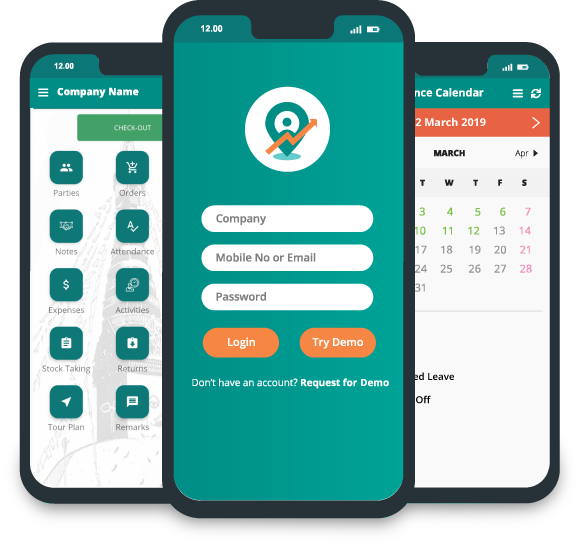

Sales Automation Software That Integrates with ERP Systems
Today, field sales teams work in a rapid environment where speed, accuracy, and real-time information have a direct impact on revenue. Still, many companies run on disconnected systems. Sales reps place orders on one platform, while finance, inventory, and operations teams use a separate ERP system. This gap often leads to slow order processing, inaccurate inventory updates, duplicate data entry, and slower customer service.
Such inefficiencies are even more difficult as businesses grow with larger distributor networks, retail outlets, and product catalogs. Sales teams need real-time access to customer information, product availability, pricing, and order status without the constant back and forth with the back office. Meanwhile, management requires accurate, real-time information for the purpose of making sound business decisions.
This is where sales automation software that integrates with ERP systems becomes a valuable business solution. By connecting field sales operations with your ERP, businesses can automate data flow between departments, reduce manual work, and ensure everyone works with the same up-to-date information. From capturing orders in the field to inventory updates, invoicing, and reporting, ERP integration creates a seamless workflow that improves both operational efficiency and customer satisfaction.
In this blog, we will discuss what ERP-integrated sales automation software is, why growing businesses need this, what the major benefits of this are, what features to look for, and how the Delta Sales App facilitates field sales automation for organizations by integrating with their existing ERP systems.
What is Sales Automation Software with ERP Integration?
Sales automation software with ERP integration is a solution that connects your field sales operations directly with your enterprise resource planning (ERP) system, allowing both platforms to exchange data automatically in real time. Instead of working as separate systems, they function as one connected ecosystem where information flows seamlessly between field sales, inventory, finance, distribution, and management.
In a typical environment, sales reps are usually taking orders with spreadsheets, paper forms, or a point solution. The back office team then manually inputs these orders into the ERP. The process is not only time-consuming but also increases the chances of duplicate entries, pricing errors, inventory mismatches, and delays in order fulfillment.
When using integrated sales automation software, all sales activities that happen in the field are automatically synchronized with the ERP system. So, when a sales rep takes an order, changes a customer detail, records a payment, or checks the status of stock, the ERP has instant access to that information. The sales team has instant access to any updates made in the ERP, such as revised pricing, new products, inventory levels, or customer credit limits.
This real-time synchronization enables field sales representatives to make informed decisions during customer visits while ensuring that finance, warehouse, and operations teams always have accurate and up-to-date information.
Sales automation software integrated with an ERP system typically synchronizes business data such as
- Customer master data
- Product catalogs
- Inventory availability
- Sales orders
- Pricing and discount structures
- Credit limits
- Outstanding payments
- Invoices
- Delivery status
- Distributor and retailer information
The result is a connected sales process where field teams can work more efficiently, back-office operations become more streamlined, and management gains complete visibility into sales activities without relying on manual data transfers. This integration not only improves operational efficiency but also helps businesses deliver faster service, reduce errors, and provide a better customer experience.
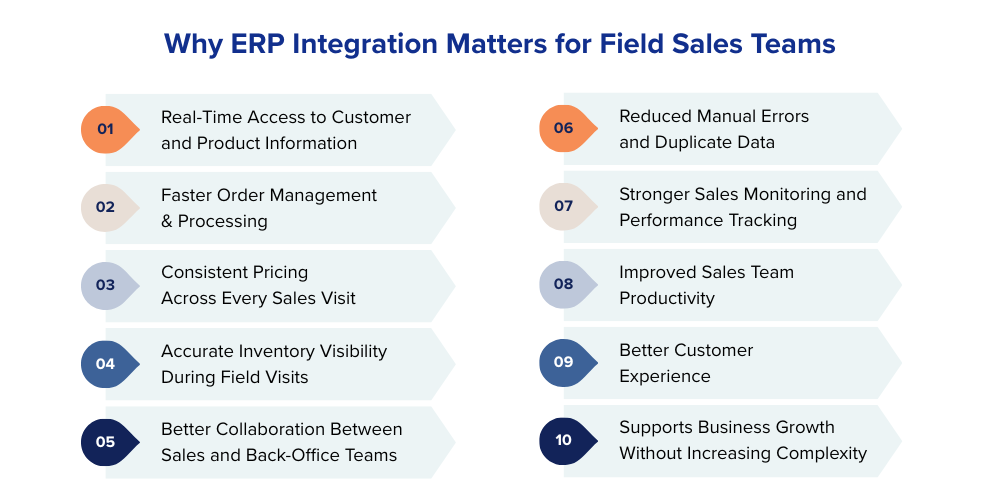
Why ERP Integration Matters for Field Sales Teams
Field sales teams are doing a lot more than taking orders. They visit retailers and distributors, manage customer relationships, track product availability, perform sales activities, collect payments, and ensure timely service to each customer. And for these things to be done well, they need easy access to accurate business data. But when sales automation software and ERP systems are working in silos, sales reps are often working off outdated information while office teams waste valuable time manually updating records in multiple systems.
Here are the key reasons why ERP integration is essential for modern field sales teams.
-
Real-Time Access to Customer and Product Information
Before each customer visit, sales reps need correct information. With ERP integration, they get access to up-to-date customer profiles, product catalogs, pricing, discounts, outstanding payments, and credit limits straight from their sales automation software. Along with features such as customer management and retailer management, this helps sales reps make better recommendations, confidently answer customer queries, and close deals more efficiently without depending on the back-office team.
-
Faster Order Management & Processing
One of the biggest advantages of ERP integration is the ability to automate the entire order management process. Instead of recording orders manually and waiting for office staff to enter them into the ERP, every order captured by the field sales representative is synchronized automatically. This reduces processing time, speeds up approvals, enables faster dispatch, and ensures customers receive their products sooner. Businesses can handle a larger volume of orders while maintaining accuracy and improving operational efficiency.
-
Consistent Pricing Across Every Sales Visit
Managing different pricing structures for distributors, wholesalers, and retailers can become complicated when information isn't synchronized. ERP integration ensures that the latest product prices, promotional offers, and approved discount structures are automatically reflected within the sales automation software. This helps sales representatives generate accurate quotations and orders while reducing pricing errors. Customers receive consistent pricing regardless of which sales representative visits them.
-
Accurate Inventory Visibility During Field Visits
It's frustrating for customers and creates unnecessary operational headaches when you're selling products that aren't in stock. ERP integration gives field sales reps real-time inventory information so they can confirm the availability of stock before confirming an order. Combined with inventory management software capabilities, sales teams can suggest the products that are available, decrease disputes regarding stock and enhance order accuracy. It helps businesses to not oversell and keeps the trust of customers.
-
Better Collaboration Between Sales and Back-Office Teams
Sales, warehouse, finance, and operations teams often depend on the same business information. Without integration, communication gaps can delay order fulfillment, invoicing, and customer service. ERP integration ensures that every department works from a single source of truth. As soon as a sales representative places an order, the warehouse can prepare dispatch, finance can process invoicing, and managers can monitor progress in real time. This creates a more coordinated and efficient workflow across the organization.
-
Reduced Manual Errors and Duplicate Data
Manual data entry increases the likelihood of duplicate customer records, incorrect order quantities, pricing mistakes, and reporting inconsistencies. ERP integration automates data synchronization, significantly reducing these errors. Accurate business data also improves reporting, forecasting, and customer service while minimizing the time spent correcting mistakes.
-
Stronger Sales Monitoring and Performance Tracking
To enhance the performance of their teams, sales managers need to see what’s happening in the field. ERP integration and features like GPS tracking, live location tracking, sales reporting, and real-time dashboards provide full visibility into sales operations. Rather than waiting for manual reports, managers can use real-time data to monitor customer visits, the value of orders, sales targets, team productivity, and overall business performance. This allows for faster decision-making and better sales planning.
-
Improved Sales Team Productivity
Sales reps are most productive when in front of the customer, not in front of forms. ERP integration eliminates repetitive tasks such as manually updating customer records, re-entering the orders, or confirming product information with the office. Along with features like beat planning, route planning, task management, and attendance management, sales teams can better plan their day, visit more outlets, and focus on activities that directly drive revenue growth.
-
Better Customer Experience
Customers expect quick responses, accurate information, and timely deliveries. ERP integration helps sales representatives provide reliable product availability, correct pricing, accurate order confirmations, and up-to-date payment information during every customer interaction. By reducing delays and improving service quality, businesses can strengthen customer relationships, increase repeat purchases, and build long-term loyalty.
-
Supports Business Growth Without Increasing Complexity
As businesses expand into new territories, add more distributors, or manage thousands of retail outlets, manual processes become increasingly difficult to control. ERP-integrated sales automation software allows organizations to scale their operations without sacrificing efficiency or accuracy. Whether your business is managing hundreds or thousands of daily orders, ERP integration ensures that your sales processes remain streamlined, connected, and ready to support sustainable growth.
Key Benefits of Sales Automation Software That Integrates with ERP Systems
It is not enough to connect two business applications when integrating sales automation software with an ERP system. It offers a unified workflow where sales, inventory, finance, warehouse, and management teams work together on the same real-time information. It removes manual processes, increases operational efficiency, and allows businesses to service customers more quickly and accurately. For companies that have large field sales forces and broad distribution networks, ERP integration can provide a strategic advantage by improving productivity, reducing costs, and enabling long-term growth.
Below are the key benefits of using sales automation software that integrates with ERP systems.
-
Real-Time Inventory Visibility
One of the biggest challenges for field sales teams is selling products without the knowledge of the latest inventory status. By integrating the ERP, sales reps can see stock levels in real-time, right inside the sales automation software, so they can confirm that a product is available before confirming an order. This stops overselling, reduces disputes on stocks, and increases customer confidence. Paired with inventory management, sales teams can recommend what is in stock, offer alternatives when something is out of stock, and set accurate delivery expectations for the customer.
-
Faster Order Processing
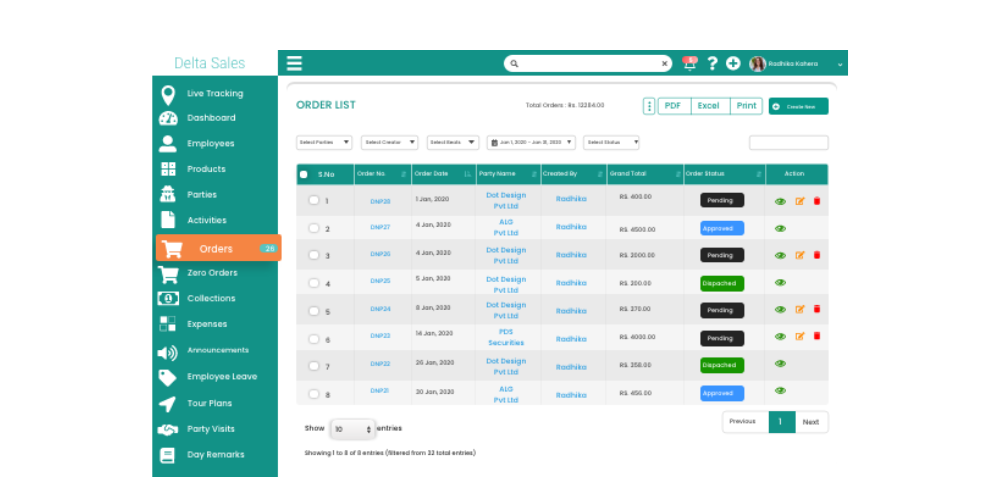
Manual order processing typically involves several departments and is fraught with needless delays. With ERP integration, all orders created by a field sales rep automatically sync with the ERP system, eliminating the duplicate data entry. It speeds up the entire order management process, enabling warehouse teams to begin picking and dispatching goods sooner and finance teams to prepare invoices without waiting for manual updates. The faster the processing, the faster the delivery and the happier the customer.
-
Accurate Customer Information
Field sales representatives make better decisions when they have access to complete and up-to-date customer information. ERP integration ensures that customer profiles, contact details, purchase history, outstanding payments, credit limits, and assigned pricing remain synchronized across both systems. Together with Customer Management and Retailer Management, this enables sales teams to personalize customer interactions, recommend relevant products, and resolve issues more efficiently during every visit.
-
Consistent Product Pricing
Managing different pricing structures across distributors, wholesalers, retailers, and regions can become complicated without centralized data. ERP integration automatically synchronizes product prices, promotional offers, tax information, and approved discount structures with the sales automation software. This ensures sales representatives always use the latest pricing while creating quotations or orders, reducing billing disputes and maintaining consistency across every customer interaction.
-
Better Inventory Planning
With ERP integration, businesses can get accurate, real-time inventory data based on actual sales activity. When field sales reps input orders, inventory records are automatically updated, giving managers better visibility into stock movement and demand trends. These insights assist businesses to optimize purchasing decisions, reduce excess inventory, avoid stock shortages, and improve overall inventory planning across multiple warehouses and distribution locations.
-
Improved Financial Accuracy
Getting the right sales data is the first step to accurate financial data. The approved orders are automatically uploaded to the ERP system, enabling businesses to reduce the time and effort required to accomplish tasks such as invoicing, tax calculations, payment tracking and financial reporting. Finance teams spend less time fixing manual errors and more time focusing on strategic activities. Sales reps can also view customer payment status and outstanding balances, helping improve collections while maintaining healthy customer relationships.
-
Higher Productivity for Field Sales Representatives
Sales reps generate maximum value when they’re in the field engaging with customers, not spending time on admin. ERP integration eliminates repetitive tasks like manual order entry, updating customer information, or checking on pricing with the office. When integrated with beat planning, route planning, attendance management, and task management, sales teams are able to prepare their schedules in a more efficient manner, visit more outlets in a day, and focus on activities that lead to an increase in sales.
-
Better Decision-Making with Unified Data
When sales and ERP systems operate as one, management gains access to accurate, real-time business insights from a single source. Combined with sales reports and analytics and real-time dashboards, decision-makers can monitor sales performance, inventory movement, distributor productivity, customer buying patterns, and revenue trends without waiting for manual reports. These insights enable businesses to identify opportunities, respond quickly to market changes, and make informed decisions that support sustainable growth.
Common Business Challenges Solved by ERP Integration
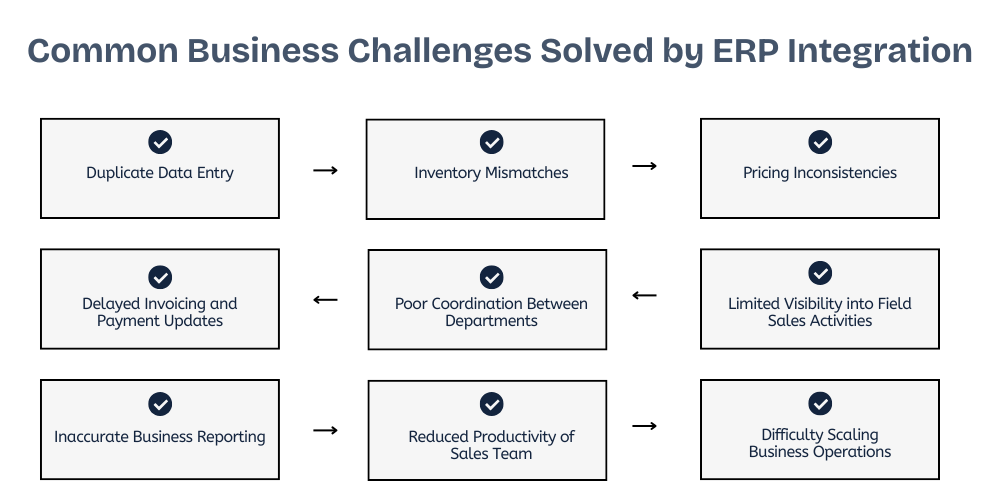
As businesses expand their field sales operations, managing information across multiple systems becomes increasingly difficult. Sales teams, warehouse staff, finance departments, and management often rely on different software platforms, making it challenging to maintain accurate and consistent data. This disconnect can lead to operational delays, poor customer experiences, and inefficient workflows that ultimately affect revenue and business growth. Below are some of the most common business challenges that ERP integration helps solve.
-
Manual Order Processing
Many businesses still rely on sales representatives to collect orders in the field, which are then manually entered into the ERP by the back-office team. This process consumes valuable time and often delays order fulfillment. ERP integration automates the order management process by synchronizing orders directly with the ERP, reducing processing time and enabling warehouse teams to begin dispatching products much faster.
-
Duplicate Data Entry
Entering the same customer, order, or product information into multiple systems increases the risk of duplicate records and inconsistent data. ERP integration eliminates repetitive data entry by automatically synchronizing information between the sales automation software and the ERP system. This saves time, improves accuracy, and reduces administrative workload for both field and office teams.
-
Inventory Mismatches
Without real-time visibility into inventory, reps could unknowingly oversell products that are unavailable or allocated to other customers. ERP integration gives real-time updates to inventory via the sales automation software so that sales teams always have up-to-date stock information. Incorporating inventory management allows companies to reduce stock discrepancies, improve order accuracy, and maintain customer confidence.
-
Pricing Inconsistencies
Outdated price lists and manual handling of discounts often lead to incorrect quotations and billing disputes. ERP integration helps the sales automation software automatically display the current product prices, promotional offers, tax information, and accepted discount structures. This enables sales reps to create accurate orders with pricing applied consistently to all customers.
-
Delayed Invoicing and Payment Updates
When sales orders are not synchronized with the ERP immediately, invoice generation and payment processing are often delayed. ERP integration automatically transfers approved orders into the ERP, enabling finance teams to generate invoices faster and update payment records in real time. Sales representatives can also view outstanding balances during customer visits, helping improve payment collection and cash flow.
-
Poor Coordination Between Departments
Sales, finance, warehouse, and operations teams often struggle when they work with different sets of information. ERP integration creates a single source of truth by synchronizing data across departments. This improves collaboration, reduces communication gaps, and ensures every team can respond quickly using the same real-time information.
-
Limited Visibility into Field Sales Activities
Without integrated systems, managers often rely on manual reports to understand what is happening in the field. This limits their ability to make timely decisions. ERP integration, combined with features such as GPS-based employee location tracking, attendance management, sales reporting, and real-time dashboards, provides complete visibility into field activities, customer visits, sales performance, and order status, allowing managers to monitor operations as they happen.
-
Inaccurate Business Reporting
The credibility of a business report rests entirely on the data that backs it up. When information is spread across multiple systems, reports are often inconsistent and figures are not up to date. Adding an ERP centralizes business data into a single synchronized system which means you can report more accurately on things like sales performance, inventory movement, customer trends, and revenue. This enables management to make more confident data-driven decisions.
-
Reduced Productivity of Sales Team
Field sales representatives should spend their time building customer relationships and generating revenue, not following up on order status or correcting data entry errors. ERP integration automates many administrative tasks, allowing sales teams to focus on customer visits, beat planning, task management, and business development. This leads to higher productivity and better utilization of field resources.
-
Difficulty Scaling Business Operations
As companies add more sales representatives, distributors, territories, and retail outlets, manual processes become increasingly difficult to manage. ERP-integrated sales automation software provides the automation and centralized data needed to support business growth without increasing operational complexity. Whether managing hundreds or thousands of daily transactions, businesses can scale efficiently while maintaining accuracy, speed, and control.
How DeltaSalesApp Integrates with ERP Systems
Delta Sales App is designed to integrate with ERP systems, enabling businesses to connect their field sales operations with core business processes. As sales representatives capture orders, update customer information, record payments, or complete outlet visits, the relevant data is synchronized with the ERP system. Likewise, updates made within the ERP, such as product information, pricing, inventory availability, and customer credit limits, are reflected in the Delta Sales App, ensuring field teams always work with the latest information.
Here are some of the key ways DeltaSalesApp integrates with ERP systems to improve business performance.
-
Automatic Sales Order Synchronization
Delta Sales App makes order management easy. Automatically synchronize sales orders with your ERP. Once the sales rep makes an order in the mobile app, the data is automatically transferred to the ERP, without manual data entry. It speeds up order processing, reduces admin work, reduces errors, and allows warehouse teams to start order fulfillment a lot faster.”
-
Real-Time Inventory Availability
Delta Sales App’s ERP integration allows field sales reps to have real-time inventory information when they are with a customer. The sales team can check stock availability before confirming orders, suggest alternative products where necessary, and avoid overselling. This helps keep customers confident, improves order accuracy, and enables better inventory management.
-
Synchronized Customer Information
Delta Sales App keeps customer information aligned with the ERP system by synchronizing details such as contact information, retailer profiles, distributor records, credit limits, outstanding payments, and purchase history. Combined with Customer Management and Retailer Management, this enables sales representatives to deliver more personalized service and make informed recommendations during every visit.

-
Centralized Product Catalog and Pricing
Managing thousands of products and multiple pricing structures becomes much easier when information is synchronized automatically. Delta Sales App reflects the latest product catalog, approved pricing, promotional offers, and discount policies from the ERP system. This ensures every sales representative creates accurate quotations and orders while maintaining pricing consistency across all sales channels.
-
Faster Invoicing and Payment Tracking
Once orders are synchronized with the ERP, finance teams can generate invoices more quickly and update payment records without manual intervention. Sales representatives can also view customer payment status and outstanding balances directly within DeltaSalesApp, enabling better follow-ups and supporting faster payment collections.
-
Improved Field Sales Productivity
Delta Sales App offers ERP integration with powerful field sales features like beat planning, route planning, GPS tracking, attendance management, task management & expense management. By reducing administrative tasks and providing instant access to business information, sales representatives can spend more time on the road, covering more outlets and hitting sales targets.
-
Real-Time Reporting and Business Insights
By integrating with your ERP, the Delta Sales App delivers accurate and up-to-date business information through sales reporting, analytics, and real-time dashboards. Managers can monitor field sales team performance, track field activities, analyze order trends, and measure team productivity without waiting for manual reports. This enables faster decision-making and better planning across the organization.
-
Scalable Integration for Growing Businesses
Whether your business manages a few hundred customers or thousands of distributors and retail outlets, Delta Sales App is built to scale alongside your operations. ERP integration ensures that increasing transaction volumes, expanding sales teams, and growing distribution networks can be managed efficiently without disrupting daily workflows. This provides businesses with the flexibility to grow while maintaining operational accuracy and control.
-
A Connected Sales Ecosystem
When Delta Sales App is integrated with your ERP system, every department benefits from synchronized data and streamlined processes. Sales teams can focus on selling, warehouse teams can fulfill orders faster, finance teams can process invoices efficiently, and management gains complete visibility into business performance. Instead of operating in silos, your entire organization works as one connected ecosystem, resulting in greater efficiency, improved customer service, and sustainable business growth.
Conclusion
Managing field sales becomes more difficult in a growing company with disjointed systems. Manual order processing, delayed inventory updates, inconsistent pricing, and duplicate data entry not only reduce productivity but also impact customer satisfaction. By integrating sales automation software with an ERP system, these inefficiencies are eliminated through the creation of a seamless flow of information between field sales, inventory, finance, warehouse, and management.
By synchronizing data in real-time, organizations can automate order processing, improve the accuracy of inventory, speed up invoicing, and provide field sales reps with the information they need to sell more effectively. The result is a faster, more connected sales process that improves operational efficiency, helps you make better decisions, and delivers a superior customer experience.
Ready to see how ERP-integrated sales automation software can transform your field sales operations?
Book a free demo of Delta Sales App today and discover how seamless ERP integration can help your business automate workflows, improve sales team productivity, enhance operational visibility, and drive sustainable business growth