
Why Successful FMCG Owners Are Investing in Sales Force Automation Tool
The FMCG industry has become far more competitive than it was a few years ago. Companies are no longer competing only on product quality or pricing. Today, success depends heavily on execution speed, retail visibility, distributor coordination, and field sales efficiency.
As markets expand and distribution channels become more fragmented, manual sales management methods are struggling to keep up. FMCG owners are realizing that spreadsheets, phone calls, WhatsApp updates, and delayed reporting systems create operational blind spots that directly impact revenue.
Modern FMCG businesses require faster decision-making, accurate field visibility, and better sales team accountability. This shift is pushing companies toward smarter digital systems that can automate field operations and improve execution quality at every level.
That is why more companies are now adopting sales force automation software to modernize their sales operations and strengthen market control.
The Growing Complexity of FMCG Distribution Networks
FMCG distribution networks have evolved significantly over the last decade. Businesses now manage multiple distributors, thousands of retailers, and large field sales teams operating across various territories.
At the same time, customer expectations have increased. Retailers expect faster deliveries, accurate stock availability, better communication, and regular sales visits. Managing all of this manually becomes extremely difficult as the business grows.
Sales managers must monitor field movement, order collection, retailer engagement, product availability, and market performance simultaneously. Without technology, maintaining operational consistency becomes nearly impossible.
This growing complexity is one of the main reasons FMCG owners are investing in digital systems that improve coordination and visibility.
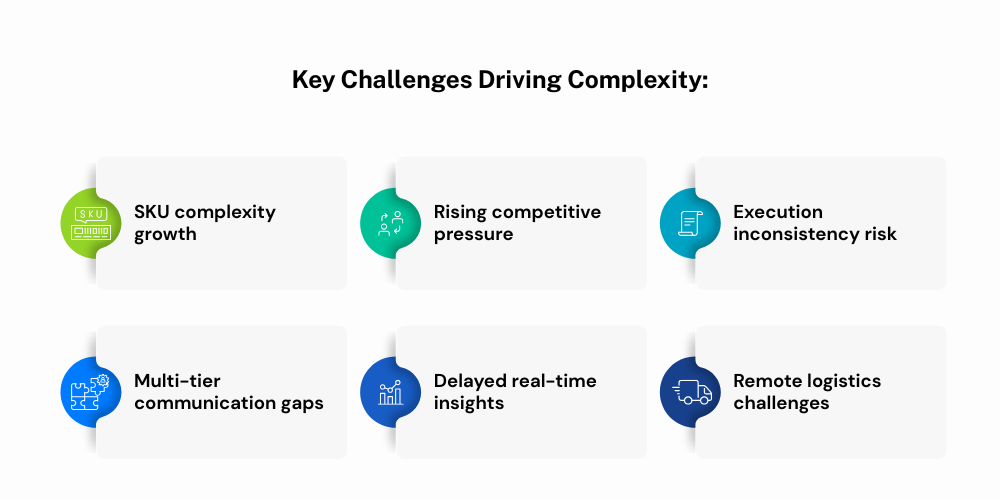
Key Challenges Driving Complexity:
- Increasing SKU variety makes tracking stock movement across distributors and retailers more difficult
- Expanding multi-tier distribution structures create communication gaps between company, distributor, and field teams
- Rising competition forces brands to respond faster to market changes and demand fluctuations
- Lack of real-time data leads to delayed corrective actions in sales and supply chain
- Higher dependency on field teams increases chances of inconsistency in execution quality
- Geographic expansion into remote areas adds logistical and operational coordination challenges
Common Challenges FMCG Owners Face Without Automation
FMCG businesses operate in highly dynamic and competitive environments where execution speed and field visibility are critical. However, many companies still rely on manual processes that limit control and slow down decision-making. These gaps create inefficiencies across the entire sales operation.
Below are the most common challenges FMCG owners face without automation:
Lack of Real-Time Visibility
Many FMCG companies still depend on end-of-day reports or verbal updates from sales representatives. This delays managerial decision-making and creates visibility gaps. Managers often struggle to identify which retailers were visited, what orders were collected, which outlets faced stock shortages, and which products were underperforming. Without live tracking, sales execution becomes difficult to monitor effectively.
Delayed Sales Reporting
Traditional reporting systems consume a large amount of time. Field representatives frequently submit reports manually, leading to delays and inaccuracies. Late reporting prevents businesses from reacting quickly to market conditions. Competitors with faster data access often gain an advantage. This is why companies are increasingly investing in field sales management software to streamline reporting processes.
Poor Retail Execution
Retail execution directly affects brand visibility and product movement. However, many FMCG businesses cannot properly track shelf placement, promotional display execution, product availability, and retail branding compliance. As a result, valuable retail opportunities are lost, and inconsistent execution weakens overall market presence and brand impact.
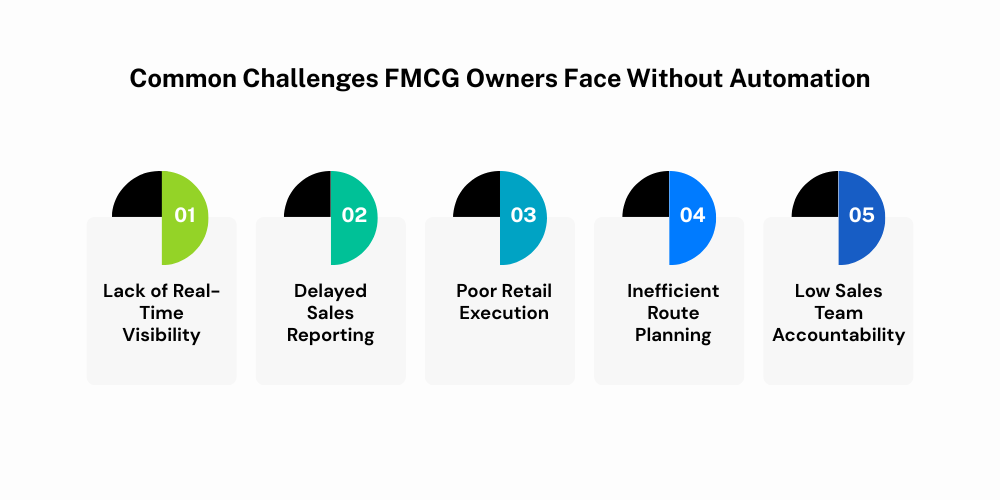
Inefficient Route Planning
Field representatives often travel inefficiently due to poor territory planning. This increases fuel expenses, reduces outlet coverage, and lowers productivity. Without optimized planning, sales teams spend more time traveling than selling. Optimized routing is now becoming essential for large FMCG operations to ensure better efficiency and improved field performance.
Low Sales Team Accountability
Without digital monitoring systems, it becomes difficult to verify field activities. Managers may not know whether visits actually occurred or whether tasks were completed properly. This lack of accountability can negatively affect operational performance and sales consistency, reducing overall control over FMCG field sales execution and results.
What Is a Sales Force Automation Tool?
A Sales Force Automation tool is a digital solution designed to simplify, automate, and optimize end-to-end FMCG field sales operations. It replaces manual reporting, disconnected communication, and delayed updates with a structured, real-time system that improves control and efficiency.
Below is a breakdown of its core functions:
Sales Visits
Tracking sales visits ensures every field activity is logged with accuracy, helping managers monitor daily retailer engagement effectively through structured digital reporting.
Order Collection
Digital order collection enables real-time order booking, reducing errors, improving speed, and ensuring faster fulfillment across distribution channels and retail networks.
Attendance Tracking
Attendance management helps FMCG companies verify field staff presence using GPS-based check-ins, improving discipline, accountability, and operational transparency across teams.
Retail Audits
Retail audits allow brands to monitor shelf visibility, promotional compliance, and product availability directly from retail outlets for better execution control.
Distributor Coordination
Distributor coordination improves communication between sales teams and distributors, ensuring faster order processing, smoother supply flow, and better stock management.
Expense Tracking
Expense tracking helps companies monitor field expenses like travel and allowances, reducing leakages and improving financial control across sales operations.
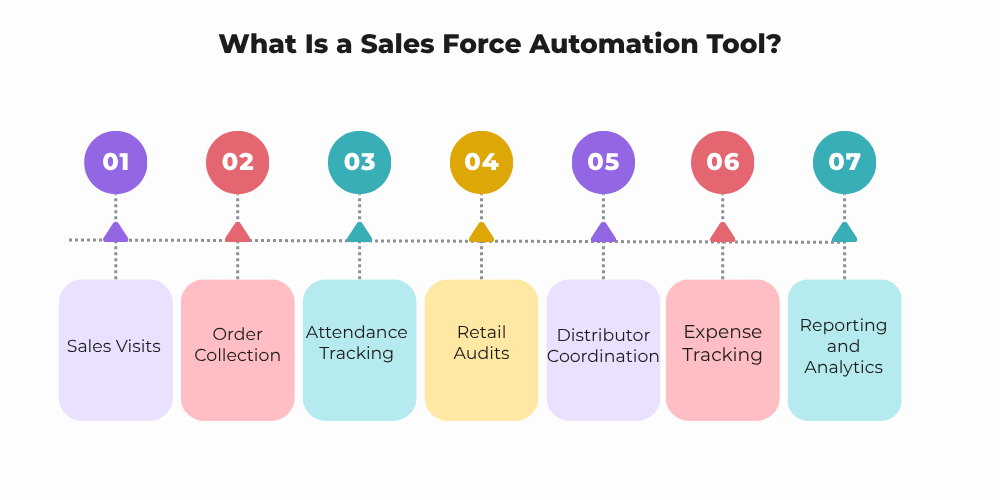
Reporting and Analytics
Reporting and analytics provide real-time dashboards and insights, enabling data-driven decisions and improved sales performance monitoring across territories.
Modern systems provide real-time visibility into field operations, enabling managers to make faster and more accurate decisions.
Many FMCG businesses now rely on mobile sales automation platforms like Delta Sales App to improve field productivity and streamline communication between teams.
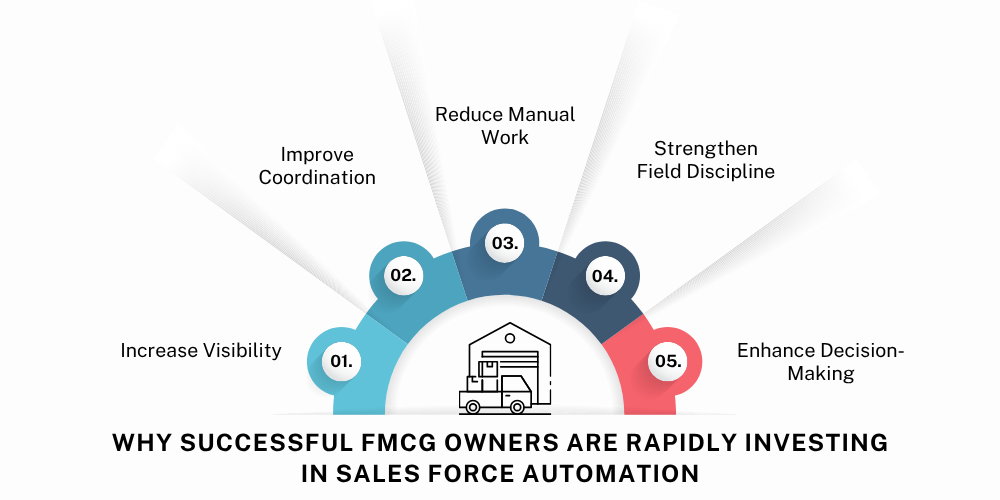
Why Successful FMCG Owners Are Rapidly Investing in Sales Force Automation
Successful FMCG owners understand that operational speed, accuracy, and real-time visibility directly influence market performance and long-term competitiveness. In today’s fast-moving retail environment, even small delays in decision-making can lead to lost sales opportunities and weakened distributor relationships.
Companies that respond faster to stock shortages, retailer issues, and evolving sales trends consistently outperform competitors. Automation enables businesses to build a structured, data-driven sales ecosystem that improves control across every field activity.
Automation allows businesses to:
Increase Visibility
Improves sales visibility across FMCG operations by providing real-time insights into field activities, retailer coverage, and product movement across territories.
Improve Coordination
Strengthens FMCG sales coordination system by connecting field teams, distributors, and managers through a unified digital platform for smoother communication.
Reduce Manual Work
Eliminates repetitive administrative tasks through automated reports and analytics, allowing sales teams to focus more on selling and retailer engagement.
Strengthen Field Discipline
Enhances field sales discipline in FMCG teams by tracking visits, attendance, and task completion, ensuring consistent execution across all territories.
Enhance Decision-Making
Supports data-driven FMCG decision making by providing real-time analytics and dashboards that help managers act quickly and accurately.
More importantly, automation transforms reactive sales management into proactive operational control. Instead of waiting for problems to appear, managers can identify issues early and take immediate corrective action.
Top Benefits of Sales Force Automation (SFA) for FMCG Brands
Sales Force Automation delivers measurable operational improvements across the FMCG ecosystem by streamlining field operations, improving visibility, and strengthening execution consistency. It helps FMCG brands move from manual, error-prone processes to structured, real-time decision-making systems.
Some major benefits include:
-
Faster reporting cycles: Enables real-time FMCG reporting systems that eliminate manual data entry and delays, allowing managers to access accurate field updates instantly and make faster operational decisions across territories.
-
Improved retailer servicing: Enhances retailer management in FMCG operations by ensuring timely visits, consistent communication, and faster order fulfillment, which strengthens retailer relationships and improves long-term business retention.
-
Higher field productivity: Boosts FMCG field sales productivity tools by reducing administrative workload, enabling sales representatives to focus more on customer engagement, retail expansion, and achieving higher daily sales targets.
-
Better route optimization: Supports route planning optimization for FMCG teams by creating efficient travel paths, reducing fuel costs, minimizing travel time, and increasing the number of outlets covered per day.

-
Reduced operational leakages: Minimizes FMCG operational cost leakage control by tracking field expenses, reducing manual errors, preventing fake claims, and ensuring complete transparency in all sales-related financial activities.
-
Increased sales visibility: Improves real-time sales visibility in FMCG by offering live dashboards for orders, visits, and territory performance, enabling managers to monitor operations and identify issues immediately.
-
Improved team accountability: Strengthens FMCG sales team accountability systems by tracking attendance, visit confirmations, and task completion, ensuring disciplined execution and improving overall field performance consistency across teams.
Many businesses also adopt retail execution software to monitor in-store performance more effectively.
How Sales Force Automation Improves Field Sales Productivity
One of the biggest advantages of Sales Force Automation is its direct impact on field sales productivity. In traditional FMCG operations, sales representatives spend a significant amount of time on manual reporting, attendance updates, and administrative tasks instead of actual selling.
With automation, these repetitive tasks are reduced, allowing field teams to focus more on retailer visits, order collection, and market expansion activities. This shift directly improves daily output and overall efficiency.
Managers also benefit from instant access to field data. They no longer need to depend on repeated calls or delayed reports, which improves coordination and decision-making speed.
Key Productivity Improvements:
- Reduces time spent on manual reporting and administrative tasks by eliminating repetitive work and improving field efficiency.
- Increases time available for retailer visits and direct selling by maximizing productive hours in the field.
- Improves communication between field teams and managers through real-time updates and seamless digital coordination.
- Enables faster decision-making using real-time data, helping managers respond quickly to market changes.
- Enhances daily workflow structure and execution discipline by standardizing field sales processes.
- Strengthens focus on revenue-generating activities by shifting effort from admin work to active selling.
- Improves consistency in beat planning and field execution by ensuring structured and optimized territory coverage.
GPS Tracking and Route Optimization for FMCG Teams
GPS tracking and route optimization improve FMCG field efficiency by providing real-time visibility of sales team movement and ensuring structured, data-driven route planning. It helps FMCG brands eliminate unplanned travel, reduce operational costs, and improve outlet coverage through smarter territory execution.
Some major benefits include:
Real-time GPS tracking: Enables live monitoring of field sales representatives, ensuring managers can verify location, track movement, and improve accountability across all field operations.
Accurate visit verification: Confirms retailer visits through location-based check-ins, reducing false reporting and ensuring every scheduled outlet is properly covered.
Efficient route planning: Supports optimized daily routes for FMCG teams by reducing travel time, minimizing backtracking, and improving overall field productivity.
Increased outlet coverage: Helps sales teams visit more retailers per day by eliminating unnecessary travel and improving structured beat planning across territories.
Reduced fuel and travel costs: Minimizes operational expenses by avoiding inefficient routes, unnecessary movement, and repetitive travel across the same areas.
Improved time utilization: Ensures field representatives spend more time selling and engaging retailers instead of managing long and unstructured travel schedules.
Better territory control: Strengthens managerial control over assigned regions by providing clear visibility into field execution and ensuring consistent coverage across markets.
Many FMCG businesses also rely on GPS-based employee location tracking to improve operational efficiency and strengthen sales force discipline.
Better Beat Planning and Territory Management
Better beat planning and territory management are critical for ensuring FMCG sales teams cover maximum outlets efficiently while maintaining consistent market engagement. Without structured planning, field teams often miss key retailers, repeat unnecessary visits, or overlap territories, leading to reduced productivity and poor market coverage.
Automation systems help businesses create more structured and data-driven field operations that improve efficiency, consistency, and overall execution quality.
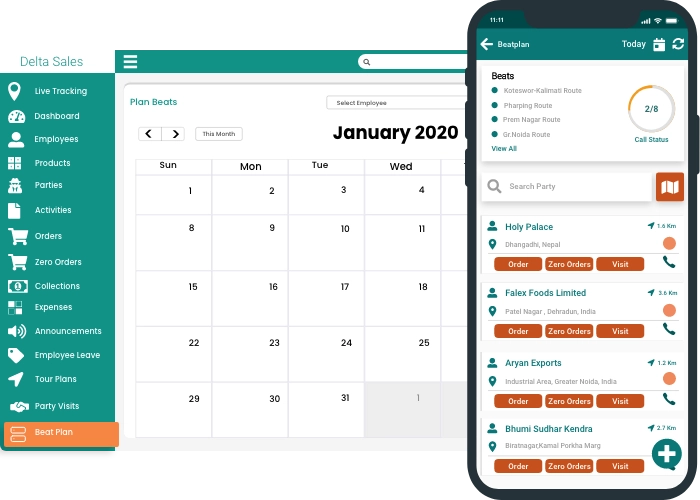
Some major benefits include:
Design optimized routes: Enables systematic beat planning by creating efficient daily travel routes that reduce time wastage and improve outlet coverage.
Assign territories properly: Ensures clear territory allocation among sales representatives, reducing confusion, duplication of efforts, and improving accountability.
Avoid market overlap: Prevents multiple sales representatives from visiting the same outlets unnecessarily, ensuring balanced workload distribution across teams.
Improve visit consistency: Helps maintain regular retailer visits through structured schedules, improving retailer relationships and strengthening brand presence.
Increase field efficiency: Enhances overall productivity by reducing unplanned travel and ensuring sales teams follow optimized daily plans.
Strengthen market coverage: Ensures wider and more consistent retailer reach, improving product availability and boosting sales opportunities across regions.
This structured approach leads to better market penetration and improved retailer servicing, ultimately strengthening FMCG sales performance.
Advanced territory management software solutions further enhance operational planning by providing real-time insights, automated beat scheduling, and better field force coordination.
How Automation Helps Increase Retail Coverage
Retail expansion is critical for FMCG growth, but without structured systems, field teams often miss key outlets or fail to maintain consistent visit cycles. This leads to poor coverage, weak retailer relationships, and lost sales opportunities across territories.
Automation helps FMCG companies improve retail expansion through better visibility, tracking, and execution control.
Some major benefits include:
- Track outlet coverage: Improves FMCG retail visibility by tracking all visited and unvisited outlets in real time, ensuring complete and accurate market coverage across territories.
- Identify unvisited retailers: Helps FMCG field teams detect missed outlets quickly, reducing coverage gaps and ensuring no potential retailer is left unserviced.
- Monitor visit frequency: Strengthens FMCG retailer engagement by tracking how often outlets are visited, ensuring consistent interaction and stronger business relationships.
- Improve route efficiency: Enhances FMCG field route planning by optimizing travel paths, reducing time wastage, and increasing the number of outlets covered per day.
This enables companies to expand retail presence systematically and improve overall execution quality.
Many businesses now integrate retail coverage optimization strategies into their field operations for better scalability and stronger market penetration.
How Sales Force Automation Improves Order Accuracy
Order accuracy is a critical factor in FMCG operations because even small errors in order entry can lead to stock mismatches, delayed deliveries, and poor retailer satisfaction. In manual systems, sales representatives often record orders on paper or rely on verbal communication, which increases the chances of mistakes, duplicate entries, and missing product details.
Automation eliminates these inefficiencies by enabling real-time digital order capture directly from the field. This ensures that every order is accurately recorded, instantly shared, and properly processed across the supply chain.
Some major benefits include:
- Reduces manual entry errors: Improves FMCG order accuracy by eliminating handwritten or verbal order-taking mistakes and ensuring correct product and quantity selection.
- Prevents duplicate orders: Strengthens FMCG order management by automatically syncing data in real time, reducing the risk of repeated or duplicate entries from field teams.
- Improves retailer communication: Enhances FMCG retailer coordination by ensuring that orders placed by sales representatives are instantly visible to all stakeholders.
- Enables real-time order processing: Speeds up FMCG supply chain execution by transmitting orders instantly to distributors and warehouses for faster fulfillment.
This improves coordination between retailers, distributors, and warehouses while reducing delays and operational friction.
Modern FMCG businesses increasingly rely on order management systems for FMCG operations to improve fulfillment accuracy and streamline end-to-end sales execution.
Monitoring Sales Representative Performance in Real Time
Real-time monitoring gives FMCG managers stronger operational control by providing instant visibility into daily field activities and performance metrics. It helps ensure that sales execution is aligned with planned targets and reduces dependency on delayed or manual reporting systems.
Businesses can track:
Daily visits: Improves FMCG field visibility by tracking every retailer visit in real time, ensuring proper coverage across assigned territories.
Orders collected: Enhances FMCG sales performance tracking by recording real-time order data and ensuring accurate reporting from field teams.
Productivity levels: Supports FMCG productivity analysis by measuring individual sales representative output based on visits, orders, and efficiency metrics.
Attendance: Strengthens FMCG attendance monitoring by using digital check-ins to verify field presence and improve workforce discipline.
Task completion: Improves FMCG task execution tracking by ensuring assigned activities are completed on time with full accountability.
This improves accountability while helping managers identify training or performance gaps quickly.
Companies using sales team tracking software often experience stronger field discipline and improved execution consistency.
How FMCG Brands Use Automation to Improve Retail Shelf Visibility
Retail shelf visibility is one of the most critical drivers of FMCG sales performance, as product placement directly influences purchase decisions at the point of sale. However, maintaining consistent shelf execution across thousands of outlets is challenging without structured monitoring systems.
Automation helps FMCG brands standardize in-store execution by enabling real-time tracking of shelf conditions, promotional compliance, and product availability. It ensures that field teams follow defined merchandising guidelines and that execution quality remains consistent across all retail locations.
Automation systems allow field teams to capture store images, conduct audits, and monitor display compliance, creating a transparent and verifiable record of in-store execution activities.
Managers can instantly verify whether promotional materials and product placements meet company standards, reducing dependency on delayed reports or manual inspections.
Many brands also use structured audit workflows to identify gaps in shelf execution and take corrective actions quickly, improving overall retail performance and brand visibility.
Many FMCG brands now invest in retail merchandising software to strengthen in-store execution and ensure consistent shelf presence across competitive retail environments.
The Role of Mobile Apps in Modern FMCG Sales Operations
Mobile applications have fundamentally transformed FMCG field sales management by making operations faster, more transparent, and highly data-driven. They act as the central interface between field representatives, managers, distributors, and retailers, enabling seamless communication and real-time execution.
In traditional systems, field updates often depend on manual reporting or delayed communication, which reduces efficiency and increases the chances of errors. Mobile apps eliminate these challenges by enabling instant data capture and synchronization from the field.
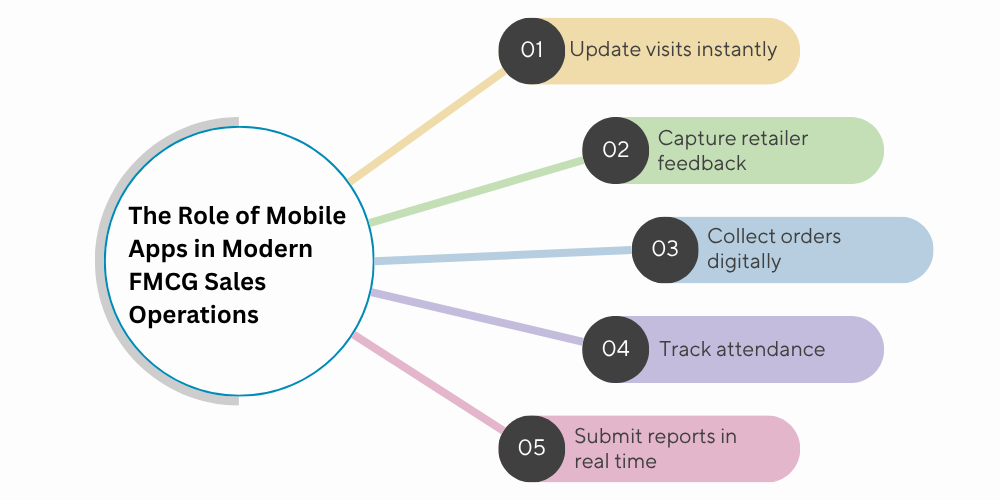
Representatives can now:
- Update visits instantly: Improves FMCG field reporting efficiency by allowing real-time visit logging, reducing delays and improving operational visibility.
- Capture retailer feedback: Enhances FMCG customer insight collection by recording retailer inputs directly from the field for better decision-making.
- Collect orders digitally: Strengthens FMCG order management by enabling accurate digital order capture, reducing errors and improving fulfillment speed.
- Track attendance: Improves FMCG workforce monitoring by using GPS-based check-ins to ensure accurate attendance and field presence tracking.
- Submit reports in real time: Enhances FMCG reporting accuracy by eliminating manual reporting delays and providing instant access to field data.
Mobile accessibility improves communication speed and operational transparency, enabling faster coordination between all stakeholders in the sales ecosystem.
This is why many FMCG businesses are adopting cloud-based sales automation software to achieve scalable, efficient, and future-ready field operations.
Reducing Operational Costs with Sales Automation
Operational inefficiencies are one of the biggest hidden cost drivers in FMCG businesses. When field operations rely on manual reporting, unoptimized routes, and delayed communication, expenses gradually increase without clear visibility. These inefficiencies not only impact profitability but also reduce overall field productivity and execution quality.
Sales automation helps FMCG companies bring structure, accuracy, and efficiency into daily operations, leading to significant cost savings across multiple areas.
Automation helps reduce:
Fuel expenses: Minimizes unnecessary travel and route duplication through optimized planning, reducing overall transportation and fuel consumption.
Administrative workload: Reduces manual paperwork and back-office tasks by automating reporting, attendance, and field data collection processes.
Reporting delays: Eliminates lag in data submission by enabling real-time updates, ensuring faster decision-making and improved operational response.
Manual data entry: Reduces human errors and duplicate entries by digitizing order booking, visit tracking, and field reporting activities.
Field inefficiencies: Improves overall field productivity by ensuring structured beat plans, better coordination, and optimized daily workflows.
Businesses implementing FMCG sales analytics platforms often gain better control over operational spending, improved transparency, and stronger financial discipline across field operations.
How Sales Force Automation Supports Business Scalability
As FMCG businesses expand, operational complexity increases across sales teams, distributors, retailers, and territories. Managing this growth manually often leads to inconsistencies, reduced visibility, and weaker execution control. Scalability becomes difficult when processes are not standardized or data is not available in real time.
Sales force automation helps FMCG companies scale operations in a structured and controlled manner by digitizing workflows, centralizing data, and ensuring uniform execution across all regions. This allows businesses to grow without proportionally increasing managerial burden or operational inefficiencies.
Businesses can scale:
- Teams: Supports FMCG workforce expansion by standardizing field processes, improving coordination, and ensuring consistent performance across large sales teams.
- Territories: Enables structured territory expansion with clear visibility, better beat planning, and reduced overlap between field sales representatives.
- Distributor networks: Strengthens FMCG distribution scalability by improving coordination, order flow, and communication between companies and distributor partners.
- Retail coverage: Expands market reach by tracking outlet coverage, ensuring consistent retailer engagement, and identifying untapped sales opportunities across regions.
Without significantly increasing management complexity, automation ensures that growth remains controlled, measurable, and performance-driven.
Many companies also integrate distributor management software capabilities to strengthen supply chain coordination and improve end-to-end operational efficiency.
Why Automation Is Becoming Essential for FMCG Growth
The FMCG industry is rapidly shifting toward faster, data-driven, and highly competitive operating models. In this environment, traditional manual systems are no longer sufficient to manage complex distribution networks, large field teams, and evolving retailer expectations.
Companies that continue relying on manual processes often struggle to maintain control, efficiency, and consistency across their operations, especially as scale increases.
Common challenges include:
- Delayed decisions: Slower access to field data prevents timely actions, resulting in missed opportunities and reduced responsiveness to market changes.
- Poor visibility: Lack of real-time insights into sales activities, retailer coverage, and stock movement creates blind spots in operational control.
- Weak retailer servicing: Inconsistent communication and delayed order fulfillment negatively impact retailer satisfaction and long-term relationships.
- Inconsistent execution: Variations in field performance across regions lead to uneven market coverage and reduced brand effectiveness.
Automation is no longer viewed as a luxury. It has become a core operational requirement for sustainable FMCG growth, enabling companies to operate with speed, accuracy, and full visibility.
Businesses implementing digital transformation in FMCG strategies are better positioned to compete in modern markets, improve execution quality, and scale efficiently.
Key Features FMCG Owners Should Look for in a Sales Force Automation Tool
Choosing the right SFA platform is critical for FMCG businesses aiming to improve field efficiency, visibility, and execution consistency. The ideal solution should be simple for field teams to use while offering strong control, real-time insights, and scalable functionality for management.
Below are some essential features FMCG businesses should prioritize:
Attendance & GPS Tracking
Attendance monitoring ensures field representatives follow assigned schedules properly and maintain discipline across daily operations. GPS tracking improves route verification, prevents fake visits, and strengthens accountability in field execution. Many businesses rely on employee tracking system capabilities to improve workforce monitoring and operational transparency.
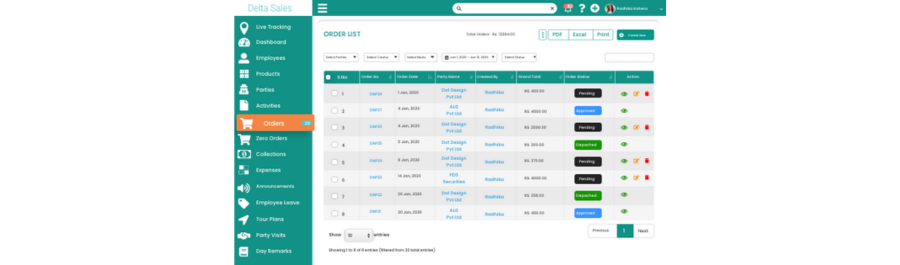
Order Management
Digital order management improves order accuracy, speeds up processing, and reduces manual entry errors. It also enhances coordination between sales teams, distributors, and warehouses, ensuring faster fulfillment and smoother supply chain execution across FMCG networks.
Expense Management
Expense management features help FMCG companies monitor travel costs, field reimbursements, and operational spending more efficiently. It improves financial transparency, reduces leakage, and minimizes dependency on manual claim verification processes.
Retailer Management
Retailer management systems help businesses maintain accurate outlet databases and improve retailer servicing quality. Companies can track purchase history, visit frequency, and communication records, enabling stronger engagement and better sales planning.
Analytics & Dashboards
Advanced dashboards provide actionable insights into sales performance, outlet productivity, and territory performance. Businesses increasingly depend on real-time automated sales reports and analytics for faster strategic decisions and improved operational control across regions.
Offline Working Capability
Many FMCG field teams operate in areas with limited or unstable internet connectivity. Offline functionality ensures uninterrupted field operations, allowing representatives to capture data and sync it later when connectivity is restored. This is especially important for businesses operating in rural and semi-urban markets.
Why Small and Mid-Sized FMCG Companies Are Also Adopting Automation
Earlier, automation was primarily associated with large enterprises that had complex distribution networks and extensive field teams. However, this trend has shifted significantly, and small and mid-sized FMCG companies are now actively investing in digital sales systems to stay competitive in evolving markets.
Affordable technology solutions, cloud-based platforms, and scalable pricing models have made automation accessible even for growing businesses with limited resources.
Smaller companies are using automation to:
Compete more effectively: Improves FMCG market competitiveness by enabling smaller brands to operate with enterprise-level efficiency, better visibility, faster execution, and stronger control across all sales and distribution operations.
Improve operational control: Strengthens FMCG operational management by providing real-time visibility into field activities, orders, retailer engagement, and performance tracking, ensuring better decision-making and execution control.
Expand retail coverage: Supports FMCG distribution expansion by helping teams systematically track outlets, identify untapped markets, and improve retail penetration with structured field execution strategies and consistent coverage.
Increase team productivity: Enhances FMCG field sales productivity by reducing manual reporting tasks, improving workflow efficiency, and enabling sales teams to focus more on selling and retailer engagement activities.
This shift is accelerating digital adoption across the FMCG sector and reshaping how companies of all sizes manage field operations.
Common Mistakes FMCG Companies Make While Choosing Automation Software
Many FMCG businesses invest in automation tools without properly evaluating long-term operational requirements, leading to poor adoption and limited ROI.
Common mistakes include:
Choosing overly complex systems: Reduces FMCG user adoption when software is difficult to operate, poorly designed for field conditions, and increases training burden for sales representatives and managers.
Ignoring field usability: Impacts FMCG execution quality when systems are not designed for real-world field challenges, making daily usage difficult for sales teams operating in dynamic environments.
Lack of integration capability: Creates FMCG data silos by preventing smooth connectivity between sales, distribution, inventory, and reporting systems, leading to fragmented and inefficient operations.
Poor training processes: Weakens FMCG software adoption when field teams are not properly trained, resulting in inconsistent usage, reporting errors, and reduced overall system effectiveness.
Selecting software without offline support: Disrupts FMCG field operations in low-connectivity areas, limiting data capture, reducing productivity, and affecting real-time reporting accuracy and reliability.
Businesses should prioritize scalability, usability, and operational relevance before implementation to ensure long-term success.

How to Successfully Implement a Sales Force Automation System
Successful implementation requires structured planning, clear objectives, and strong organizational alignment across all levels of FMCG operations.
Important steps include:
Define clear business objectives: Establish FMCG implementation goals such as improving visibility, increasing productivity, enhancing retailer coverage, and reducing operational inefficiencies across field sales operations.
Identify operational pain points: Analyze FMCG field challenges like reporting delays, poor visibility, inefficient routing, and inconsistent execution before selecting and deploying automation solutions.
Train field teams properly: Ensures FMCG adoption success by enabling structured onboarding, practical training sessions, and continuous support to improve confidence and system usage efficiency.
Monitor adoption rates: Tracks FMCG system usage to ensure field teams are consistently using the platform correctly, identifying gaps early and improving compliance across operations.
Review performance regularly: Helps FMCG managers evaluate system impact on sales growth, productivity, and execution quality using data-driven insights and continuous performance tracking mechanisms.
Optimize workflows continuously: Improves FMCG operational efficiency by refining processes based on real-time insights, field feedback, and evolving business requirements for better long-term scalability.
Strong leadership support is also essential for successful adoption, ensuring consistent usage and long-term transformation success.
Final Thoughts
FMCG businesses operate in a highly competitive and fast-changing environment where traditional sales methods are no longer enough to manage modern distribution complexity and execution demands.
Sales Force Automation helps improve visibility, strengthen field execution, increase accountability, and support scalable operations through real-time, structured data-driven processes.
Successful FMCG owners understand that growth depends not just on selling more, but on executing faster and smarter than competitors.
As digital transformation accelerates, businesses adopting automation early build stronger operational control and long-term competitive advantage.
To experience how automation can transform your field sales operations, you can book a demo of Delta Sales App and explore how it improves visibility, productivity, and overall sales performance.