
Hidden Challenges in Indian FMCG Market and How Delta Sales App is Solving Them
The Indian FMCG market is one of the largest and fastest-growing consumer markets in the world, valued at over USD 110+ billion and expected to reach nearly USD 220+ billion by 2025–27, driven by rising consumption, urban expansion, and rural demand growth. Despite this strong growth, FMCG businesses continue to face serious operational challenges at the field execution level. Behind every successful FMCG brand lies a complex network of distributors, retailers, sales representatives, warehouses, and field operations working together every single day.
According to industry insights, India’s FMCG sector is expected to grow steadily at 6–9% annually, but companies are increasingly struggling with distribution efficiency, retail execution, and real-time visibility across large sales networks. IBEF FMCG Industry Report
While the market continues to expand, many FMCG companies still rely on manual reporting systems, WhatsApp communication, Excel sheets, and delayed field updates. This creates gaps between what is happening in the market and what management actually sees on paper.
As a result, issues like missed retailer visits, weak distributor coordination, outlet skipping, and delayed order processing often go unnoticed until they start affecting sales performance.
This is where field sales automation becomes critical. Modern FMCG businesses are now shifting toward digital solutions like Delta Sales App to gain real-time visibility, improve execution, and streamline field operations.
In this blog, we will explore the hidden challenges in the Indian FMCG market and how automation is helping businesses solve them effectively.
The Real Problem in FMCG Is Not Sales; It Is Execution
Many FMCG businesses believe low sales are mainly caused by competition or pricing. But in reality, the bigger issue is often poor execution in the market. A company may have strong products and active distributors, but if field operations are inconsistent, sales opportunities slowly disappear. In the FMCG industry, growth depends heavily on how efficiently retailers, distributors, and sales teams are managed every day.
Some of the most common execution problems faced by FMCG businesses include:
-
Inconsistent Retailer Visits
Many retailers are not visited regularly by field sales representatives. Over time, this weakens retailer relationships and reduces product visibility in the market.
-
Poor Field Sales Monitoring
Managers often have limited visibility into what sales reps are actually doing in the field. Without proper tracking, outlet skipping and inaccurate reporting become common problems.
-
Delayed Order Collection
Manual order-taking methods slow down communication between retailers, sales reps, and distributors, leading to delayed deliveries and missed sales opportunities.
-
Weak Beat Plan Execution
Sales teams do not always follow assigned routes properly. This creates uneven market coverage and leaves many potential outlets underserved.
-
Lack of Real-Time Market Insights
Businesses struggle to identify stock-outs, low-performing areas, or retailer complaints quickly because reporting systems are delayed and manual.
-
Low Sales Team Accountability
Without field sales automation, businesses find it difficult to measure productivity, track attendance, or verify market visits accurately.
-
Poor Coordination Between Teams
Sales reps, distributors, and managers often work with disconnected information, creating confusion and operational inefficiencies.
As FMCG operations grow larger, these hidden execution gaps become harder to manage manually. This is why many businesses are now shifting towards field sales automation software and sales force management systems to improve visibility, accountability, and overall market execution.
Hidden Challenges Faced by FMCG Businesses in India
The Indian FMCG sector is growing fast, but many companies have underlying operational inefficiencies that are not visible at the surface level. These challenges often lurk within the daily execution of field, distributor coordination, and sales management processes, slowly beginning to affect overall performance and profitability.
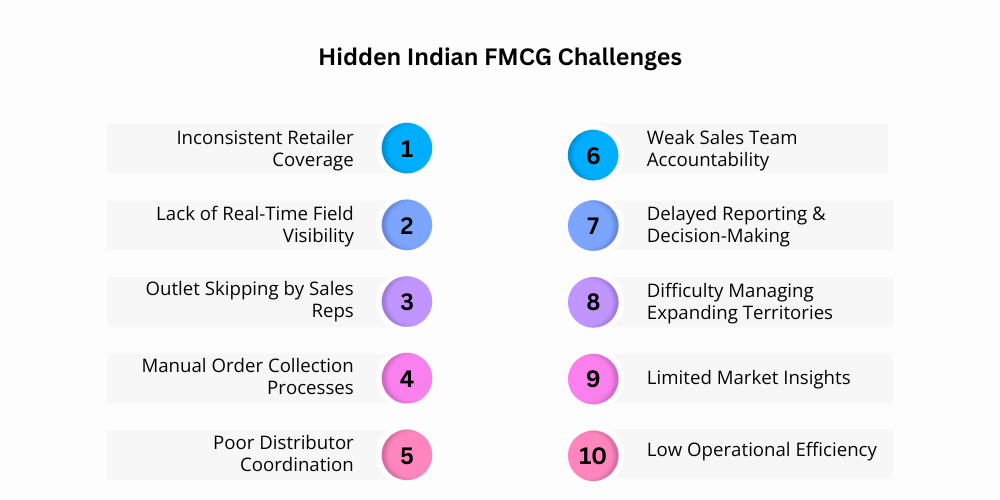
Below are the key hidden challenges facing FMCG businesses in India.
-
Inconsistent Retailer Coverage
In many FMCG companies, retailer coverage is not consistent across all territories. Field sales representatives often prioritize high-volume or easily accessible outlets, while smaller or remote retailers receive irregular visits. Over time, this creates a gap in market penetration and weakens brand presence in important micro-markets. Without a structured beat planning system or proper retail coverage tracking software, managers are unable to ensure that every outlet is being serviced regularly. This inconsistency directly affects retailer relationships, reduces trust, and leads to missed sales opportunities in the long run.
-
Lack of Real-Time Field Visibility
One of the most critical challenges in FMCG operations is the lack of real-time visibility into field activities. Most managers still rely on phone calls, WhatsApp messages, or end-of-day reports to understand what is happening in the field. This delayed reporting makes it difficult to take quick decisions or correct issues on time. Without a proper field sales tracking app or sales force automation software, businesses cannot monitor live sales rep movement, outlet visits, or daily market coverage accurately. As a result, managers often make decisions based on incomplete or outdated information.
-
Outlet Skipping by Sales Representatives
Outlet skipping is a common issue in FMCG field operations where sales representatives do not visit all assigned retailers during their route. This usually happens when reps prioritize easier or high-value outlets and avoid difficult or low-performing ones. In the absence of GPS tracking software for field employees and route monitoring systems, companies are unable to verify actual field movements. This leads to reduced retailer engagement, poor product visibility, and loss of potential sales from skipped outlets. Over time, competitors often take advantage of these gaps and strengthen their presence in those locations.
-
Manual Order Collection Creates Delays
Many FMCG businesses still depend on manual methods such as phone calls, paper notes, or WhatsApp messages for order collection. While this may work in smaller operations, it becomes highly inefficient as the business grows. Manual processes often result in delayed order processing, communication gaps between sales teams and distributors, and errors in order entry. Without a proper mobile order management system or field sales automation app, businesses struggle to maintain accuracy and speed in their order-to-delivery cycle, which ultimately affects customer satisfaction and supply chain efficiency.
-
Weak Sales Team Accountability
Many FMCG businesses struggle to accurately measure the productivity and accountability of their field sales teams. Sales representatives may report completed visits or attendance manually, making it difficult for managers to verify whether the data is accurate. Without proper employee tracking software or sales team monitoring systems, businesses cannot track actual working hours, outlet visits, or route completion effectively. This reduces accountability in the field and makes performance evaluation subjective rather than data-driven.
-
Delayed Reporting and Slow Decision-Making
In traditional FMCG systems, reporting is often delayed because data is collected manually and compiled at the end of the day or week. By the time this information reaches management, many field-level issues such as stock-outs, retailer complaints, or sales drops have already impacted the business. Without a real-time sales reporting system or sales analytics dashboard, companies struggle to react quickly to market changes. This delay in decision-making often results in missed opportunities and reduced competitiveness in fast-moving markets.
-
Poor Distributor Management and Coordination
Another big challenge for FMCG operations when communication is not centralised is distributor management. Distributors, sales teams and managers use different systems, or informal communication channels, often. This results in inventory mismatches, reporting delays and confusion with secondary sales data. Without the right distributor management software or secondary sales tracking system, companies lack visibility on stock movement and distributor performance. This disjointedness affects supply chain efficiency and retards overall business operations.
-
Difficulty Managing Expanding Sales Territories
As FMCG businesses expand into new cities and regions, managing bigger sales teams and retailer networks gets more complex. Manual systems are often not scalable to handle multiple territories efficiently. Planning routes, territory allocation and regular retailer coverage are difficult. Without a scalable sales force management system, you face operational inefficiencies that become more acute with growth, hindering your ability to provide consistent performance across all regions.
-
Poor execution in the retail market
“Retail execution is key to FMCG success, but many companies do not have visibility into how their products are actually displayed and promoted at the retail level. Without the right retail execution tracking tools or merchandising monitoring systems in place, you won’t know for sure if your products are positioned correctly, your promotional materials are present, or your competitors are getting better access to shelf space. Poor retail execution affects customer buying behavior and the visibility of the brand in competitive markets.
-
Low Operational Efficiency Due to Manual Processes
One of the biggest hidden challenges for FMCG businesses is the high dependence on manual processes in their day-to-day operations. But this means sales managers are spending a good chunk of their day gathering updates, reviewing reports, and communicating between teams, rather than working on strategic growth. Manual tasks without field sales automation software hinder operations, reduce productivity, and add to operational costs. Over time this restricts the business’s ability to scale efficiently in competitive FMCG markets.
How Delta Sales App Helps FMCG Businesses Solve These Challenges
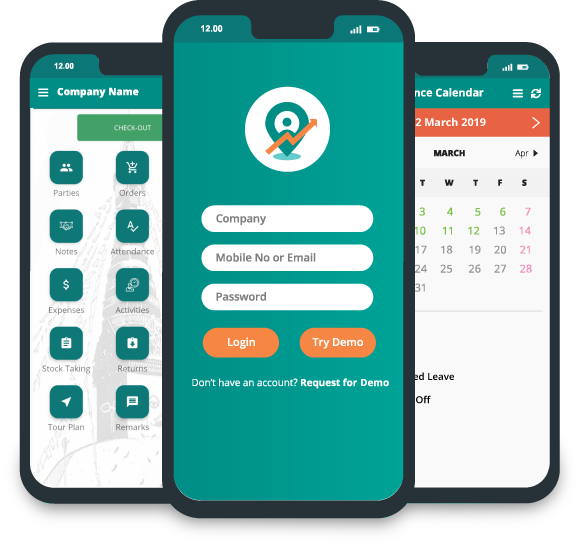
As soon as FMCG companies begin to encounter execution problems in the field, the next challenge is to find a system that can bring visibility, control, and efficiency into daily operations. That’s where field sales automation comes in. Delta Sales App helps FMCG companies to move away from manual processes and run their entire sales operation in a structured, real-time, and data-driven way.
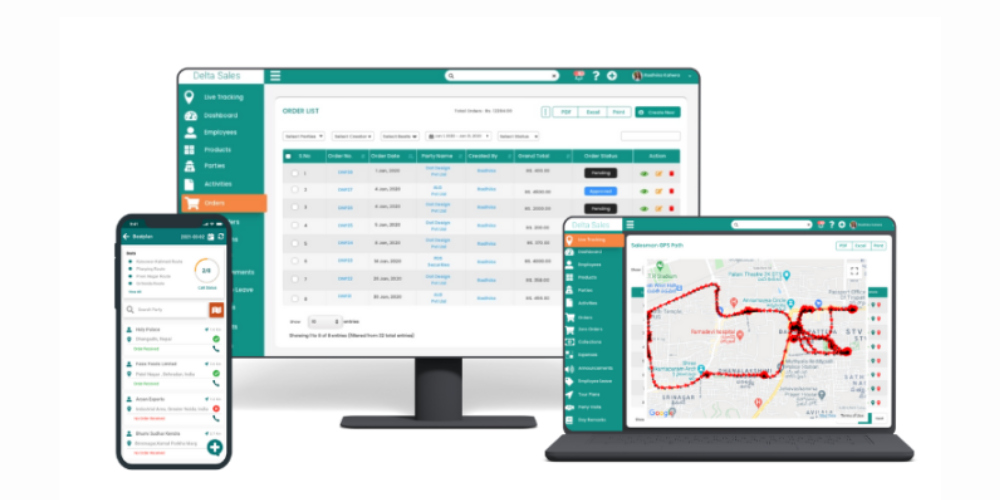
This is how the Delta Sales app directly tackles the hidden challenges faced by FMCG businesses in India.
-
Real-Time Field Sales Tracking for Complete Visibility
One of the biggest advantages of Delta Sales App is real-time field tracking. Instead of depending on end-of-day reports or phone updates, managers can see live field activity as it happens. This includes sales rep movement, outlet visits, attendance, and working hours.
A well-oiled field sales tracking system can offer FMCG businesses full visibility of ground operations. That eliminates guesswork and keeps managers informed of what’s happening in the market, leading to faster and more accurate decisions.
-
Smart Beat Planning and Retail Coverage Control
Delta Sales App’s structured beat planning helps businesses address inconsistent retailer coverage. Sales reps have set routes every day so all retailers are visited in a systematic manner. A good retail coverage management system allows managers to track if all outlets are being visited as planned. This improves discipline in field execution and ensures even small and remote retailers are serviced regularly, strengthening overall market presence and reducing coverage gaps.
-
GPS-Based Outlet Visit Verification
To eliminate outlet skipping, The app uses GPS-based check-ins that verify whether a sales representative has actually visited a retailer location. Every outlet visit is recorded with accurate location data and time stamps. This creates a reliable GPS tracking system for field sales teams, which helps prevent fake reporting and ensures accountability in field operations. It also helps businesses understand actual market coverage instead of relying on manual reporting.
-
Digital Order Management for Faster Sales Cycles
The platform replaces manual order collection methods with a fully digital order management system. Sales representatives can directly take orders from retailers using the mobile app, reducing errors and delays. This mobile order management system ensures faster communication between retailers, sales teams, and distributors. Orders are processed in real time, which improves inventory planning, reduces billing errors, and speeds up the entire order-to-delivery cycle.
-
Distributor Management with Real-Time Data Flow
The platform also improves distributor coordination by providing real-time sales and order data. Distributors no longer depend on delayed reports or manual updates from sales teams. With a strong distributor management system, FMCG businesses can track stock movement, secondary sales, and order flow more accurately. This improves transparency between field teams and distributors and helps reduce inventory mismatches and communication gaps.
-
Sales Team Accountability Through Automated Tracking
The app ensures complete transparency in sales team performance. Every activity, including attendance, visits, and route completion, is automatically recorded in the system. This works as an effective employee tracking and sales force monitoring system, allowing managers to evaluate productivity based on real data rather than manual reports. It improves accountability and encourages better discipline among field sales representatives.
-
Real-Time Reporting and Instant Decision-Making
Instead of waiting for daily or weekly reports, Delta Sales App provides real-time dashboards that show live sales performance, outlet coverage, and field activity. With a powerful sales analytics and reporting system, managers can quickly identify issues like stockouts, low-performing territories, or missed visits. This enables faster decision-making and helps businesses respond to market changes without delay.
-
Scalable Territory and Sales Force Management
The Delta Sales App makes it easier for FMCG businesses to manage multiple territories when expanding into new regions. The system supports a structured allocation of territories, route planning, and monitoring of teams in large sales networks. This sales force management system means growth doesn’t become operational chaos. Rather, it provides a standardized system that can grow with the business and maintain efficiency and control.
-
Improved Retail Execution and Market Visibility
Delta Sales App also helps businesses improve retail execution by tracking in-store activities, promotional execution, and outlet-level performance. Sales teams can capture field data that reflects real market conditions. With a retail execution tracking system, companies can ensure better product placement, monitor competitor activity, and maintain stronger brand visibility at the retail level. This directly improves customer experience and sales performance.
-
Higher Operational Efficiency Through Automation
By automating daily field operations, Delta Sales App significantly reduces manual workload for managers and sales teams. Tasks like reporting, tracking, and coordination are handled automatically through the system. This field sales automation software improves overall operational efficiency, reduces dependency on manual processes, and allows FMCG businesses to focus more on strategy, expansion, and revenue growth instead of routine administrative tasks.
What Users of Delta Sales App Commonly Experience After Automation
After adopting field sales automation, most FMCG businesses experience a noticeable shift in how their field operations are managed. Instead of relying on manual reporting, WhatsApp updates, and fragmented communication, everything becomes structured, transparent, and data-driven through Delta Sales App.
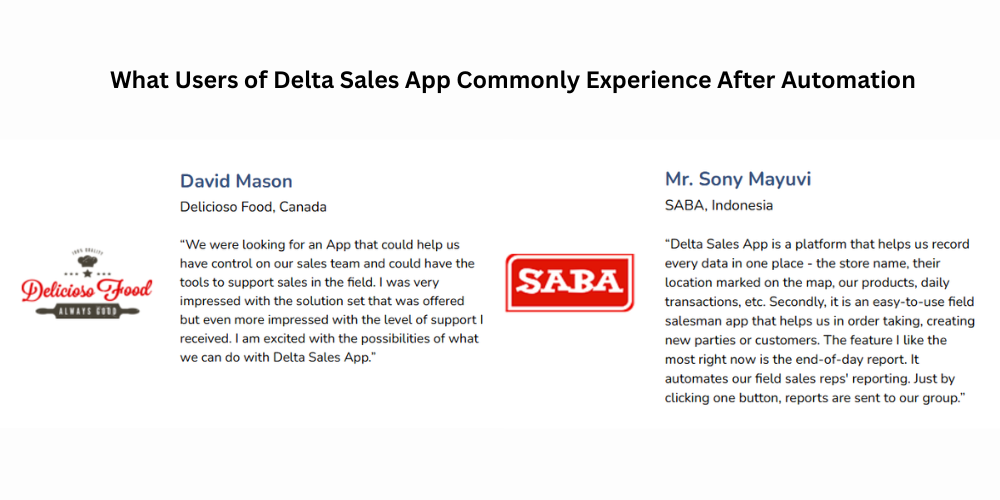
Many users describe the transformation as not just a software change but a complete improvement in control over their sales force, distributor network, and retail execution. This is what our users say:
Here are some common experiences shared by users:
-
Improved Discipline in the Field Team
Business owners often notice that sales reps become more consistent with retailer visits and reporting once activities become trackable. Field operations become more structured and organized.
-
Faster Communication Between Teams
Because orders, attendance, and reports are updated digitally, communication between
-
Sales reps
-
Distributors
-
Managers
-
Back-office teams
becomes much faster and smoother.
-
Better Control Over Daily Operations
Users frequently mention that they finally gain proper visibility into:
-
Retail coverage
-
Sales activities
-
Team productivity
-
Market movement
This helps reduce confusion and improves operational control.
-
Increased Productivity Without Increasing Workforce
Instead of hiring more staff to manage growth, businesses can optimize existing teams more efficiently using automation tools. This improves operational efficiency while controlling costs.
-
More Confidence in Decision-Making
When businesses receive accurate real-time data, they can make faster and smarter decisions. Instead of depending on assumptions, managers can rely on actual field insights.
Why Field Sales Automation Is Becoming Necessary for Indian FMCG Businesses
The Indian FMCG sector is getting faster, more competitive, and execution-driven than ever before. The battle for companies is no longer about sales growth; it is about scaling daily field operations. As territories grow, distributor networks expand and retailer expectations increase, manual systems are no longer sufficient to deal with the complexity of modern FMCG distribution.
That’s why field sales automation is not an upgrade anymore but a necessity for sustainable growth.
-
Increasing Market Complexity Requires Better Control
As FMCG businesses expand into multiple cities and regions, managing field teams manually becomes extremely difficult. Sales reps operate across different territories, distributors handle large volumes, and retailers expect faster service. Without a proper sales force automation system, businesses lose control over daily operations. Field sales automation helps bring structure by centralizing all activities like visits, route planning, orders, and reporting into one system, making operations more manageable and transparent.
-
Manual Reporting Is No Longer Reliable
Many FMCG companies still depend on WhatsApp updates, Excel sheets, and verbal reporting to track field activities. However, these methods are not reliable in a fast-moving market. Data can be delayed, incomplete, or even inaccurate. With a proper field sales tracking app, businesses get real-time updates on retailer visits, sales performance, and team movement. This ensures that decisions are based on actual data rather than assumptions.
-
Faster Decision-Making Is Now Critical
In today’s FMCG world, slow decision making can mean lost sales opportunities. Stock-outs, competitor activity, retailer complaints require immediate attention. Without real-time sales analytics software, businesses tend to respond too late. Field sales automation gives you instant dashboards and live insights so managers can see problems early and take corrective action before it affects revenue.
-
Sales Team Accountability Must Be Data-Driven
As field teams grow, monitoring productivity becomes more challenging. It is no longer possible to track performance manually or rely on self-reported updates. With GPS tracking and employee monitoring systems, FMCG businesses can verify outlet visits, working hours, and route completion accurately. This improves accountability and ensures that sales teams follow structured beat plans consistently.

-
Retail Expectations Are Higher Than Before
Retailers today expect faster service, regular visits, and quick issue resolution. If a sales representative fails to maintain consistency, retailers may shift to competing brands. Field sales automation ensures that retailers are visited on time, orders are taken efficiently, and communication is consistent. This helps strengthen retailer relationships and improves long-term loyalty.
-
Distributor Coordination Needs Real-Time Data Flow
In traditional FMCG systems, distributors often work with delayed or incomplete data from the field. This creates mismatches in stock levels, order delays, and inefficiencies in supply chain management. With a distributor management system integrated with field sales automation, businesses can ensure real-time data flow between sales teams and distributors, improving coordination and reducing operational errors.
-
Scaling Without Automation Leads to Inefficiency
As FMCG companies grow, manual processes do not scale effectively. What works for a small team becomes unmanageable when operations expand. Without automation, businesses face challenges in route planning, territory management, reporting, and sales tracking. Field sales automation provides a scalable structure that supports business growth without increasing operational complexity.
-
Competitive Pressure Demands Faster Execution
The FMCG market is highly competitive, with both national and regional players fighting for shelf space and retailer attention. Companies that execute faster in the field always have an advantage. Automation ensures quicker order processing, better retail coverage, and faster response to market changes, helping businesses stay ahead of competitors.
Conclusion
The Indian FMCG market is undergoing rapid evolution, and the challenge today is not only selling products but also managing execution across a complex field network. Be it retailer coverage, distributor coordination, sales team accountability, or real-time reporting, small operational gaps can lead to big losses if not nipped in the bud. That’s why FMCG companies are increasingly turning to automation and data-driven systems to gain better visibility and control over their daily operations. Platforms like the Delta Sales App help companies speed up field activities, make quicker decisions, and build a more disciplined and efficient sales force. As competition heats up, the businesses that get out ahead in adopting field sales automation will always be ahead in execution, productivity, and market responsiveness.
Book a free demo today and discover how Delta Sales App can simplify your FMCG field sales operations and improve overall business performance.