
Why Sales Performance Varies Across Reps (And How to Standardize High Performance)

In most sales organizations, a familiar pattern emerges, a small percentage of sales reps consistently generate the majority of revenue, while others struggle to meet their targets. This imbalance is not accidental. It typically stems from differences in execution quality, process adherence, visibility into activities, and overall operational discipline.
For companies managing field sales teams, these variations become even more significant due to real-world challenges such as travel inefficiencies, missed customer visits, and inconsistent follow-ups. Without structured systems in place, performance depends heavily on individual effort rather than a repeatable process.
The real challenge for businesses is not just improving the output of underperforming reps, but creating a standardized framework that enables every sales representative to perform at a consistently high level. By focusing on process-driven execution, data visibility, and accountability, organizations can reduce performance gaps and build a more predictable, scalable sales engine.
Why Sales Performance Varies Across Reps
Sales performance differences are rarely driven by effort alone. In most organizations, the gap between top and average performers is shaped by a mix of structural inefficiencies and execution inconsistencies. When these factors are not actively managed, outcomes become unpredictable, making it difficult to forecast revenue, optimize resources, and scale operations effectively.
In field sales environments, this variability is amplified due to limited supervision, dynamic customer conditions, and dependency on individual decision-making. Without standardized systems, even well-planned strategies fail at the execution level. To address this, businesses must first understand the root causes behind performance variation.
- Uneven Territory Potential: Different sales territories offer varying demand levels, competition intensity, and outlet density, significantly impacting sales outcomes regardless of a rep’s effort or capability.
- Inconsistent Daily Activity Levels: Some reps follow structured schedules while others lack consistency, resulting in uneven customer interactions, reduced productivity, and missed revenue opportunities across territories.
- Lack of Standardized Sales Processes: Without clearly defined workflows, reps rely on personal methods, leading to inconsistent execution, variable conversion rates, and difficulty in tracking performance effectively.
- Limited Visibility into Field Operations: Managers often lack real-time tracking of field activities, making it difficult to monitor execution quality, identify gaps early, and provide corrective guidance promptly.
- Variations in Follow-Up Discipline: Inconsistent follow-up practices result in lost sales opportunities, delayed deal closures, and weaker customer relationships due to lack of systematic engagement tracking.
Ground-Level Challenges That Create Performance Gaps
In field sales operations, performance gaps are often rooted in execution-level inefficiencies rather than strategy failures. While plans, targets, and territories may be well-defined, the real issue lies in how consistently these plans are executed on the ground.
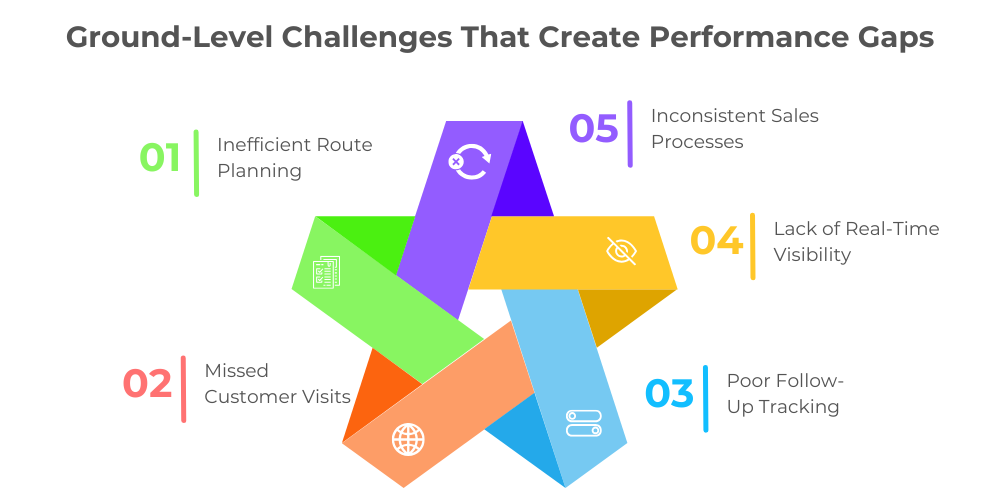
Sales reps operate in dynamic environments with minimal supervision, making it easy for inconsistencies to creep into daily workflows. Over time, these small inefficiencies compound into significant performance differences across the team. To build a predictable sales system, it is critical to identify and address these ground-level challenges.
Inefficient Route Planning
Poor route planning leads to wasted travel time, reduced outlet coverage, and lower productivity, ultimately impacting daily performance and overall revenue generation.
Missed Customer Visits
Without structured tracking systems, reps may skip planned visits or prioritize low-value outlets, resulting in missed opportunities and inconsistent market coverage.
Poor Follow-Up Tracking
Lack of systematic follow-up tracking causes delays in deal closures, missed opportunities, and weak customer engagement, reducing overall sales effectiveness significantly.
Lack of Real-Time Visibility
Managers often rely on end-of-day reports or manual updates, which limits their ability to:
-
Managers rely on delayed reports, limiting their ability to monitor activities, correct deviations, and ensure consistent execution across the entire sales team.
-
Identify issues early:
Without real-time insights, managers fail to detect performance gaps early, allowing small inefficiencies to grow into significant operational and revenue challenges. -
Guide reps proactively:
Delayed visibility prevents managers from offering timely guidance, reducing their ability to improve rep performance and ensure better execution in the field. -
Ensure plan vs execution alignment:
Lack of live tracking makes it difficult to compare planned activities with actual execution, leading to inconsistencies and reduced accountability across teams.
Inconsistent Sales Processes
When sales processes are not standardized, reps follow individual approaches, resulting in inconsistent execution, unpredictable outcomes, and difficulty in scaling operations effectively.
-
Customer experience becomes inconsistent:
Different selling approaches create varied customer experiences, reducing trust, weakening relationships, and impacting long-term customer retention and loyalty significantly. -
Conversion rates fluctuate:
Inconsistent sales methods lead to varying conversion rates, making it difficult to identify best practices and optimize overall sales performance effectively. -
Performance becomes difficult to measure:
Without standardized processes, comparing rep performance becomes unreliable, making it harder to evaluate productivity and implement effective improvement strategies.
The Gap Between Planned vs Actual Sales Execution
Most organizations create structured sales plans that define how field operations should run on a daily basis. These plans typically include beat planning, target allocations, customer segmentation, and visit scheduling to ensure optimal coverage and productivity. On paper, everything appears well-organized and execution-ready.
However, the real challenge lies in execution. In practice, what is planned rarely matches what actually happens in the field. This disconnect creates hidden inefficiencies that gradually impact overall sales performance, revenue consistency, and team productivity.
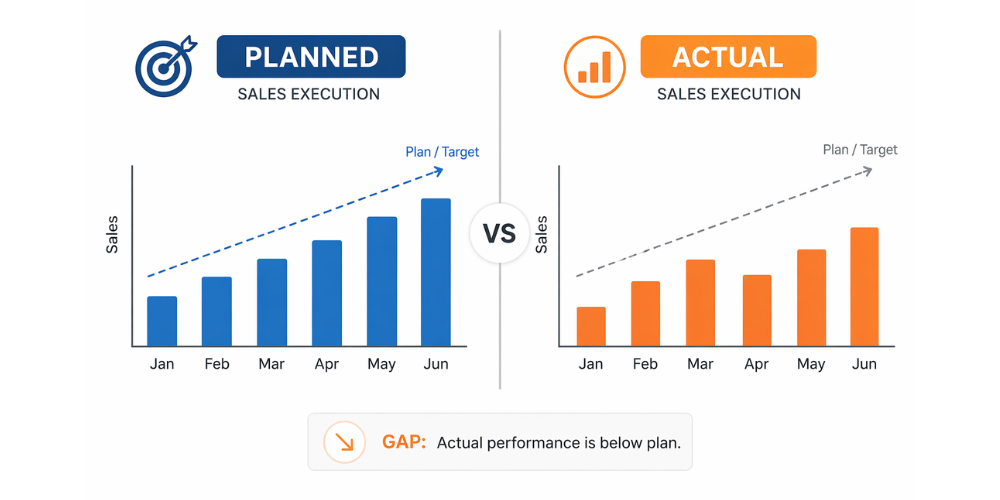
Common Gaps Include:
Planned 30 visits → Actual 18 visits:
Time inefficiencies, poor route planning, and lack of monitoring reduce daily productivity, resulting in significantly lower customer coverage than expected.
Assigned high-value outlets → Low-value outlets visited:
Reps often deviate from priority accounts, focusing on convenience rather than strategic outlets, which directly impacts revenue potential and growth opportunities.
Scheduled follow-ups → Missed or delayed:
Without structured tracking, follow-ups depend on individual discipline, leading to lost leads, weaker conversions, and reduced customer engagement over time.
Without real-time execution tracking, these gaps remain invisible until performance reports are reviewed at a later stage. By then, corrective action becomes reactive instead of preventive, limiting its effectiveness.
Over time, this misalignment between planning and execution leads to inconsistent sales outcomes, difficulty in performance evaluation, and reduced forecasting accuracy across the organization.
What Top-Performing Sales Reps Do Differently
High-performing sales reps do not depend on chance or occasional effort spikes. Their success is driven by consistent systems, disciplined execution, and structured daily habits. Unlike average performers, they reduce uncertainty in their workflow by following repeatable practices that maximize efficiency and output every single day.
Their performance is not accidental, it is the result of intentional behavior, strong discipline, and smart use of available data. These reps focus on controlling what they can influence: time, priorities, customer interactions, and follow-ups.
1. Consistent Daily Planning
Top performers start each day with a clear and structured beat plan that guides all field activities effectively.
-
Which outlets to visit: They prioritize outlets based on potential, ensuring maximum revenue impact from every field visit.
-
What objectives to achieve: Each visit has a defined goal such as order generation, relationship building, or product placement improvement.
-
How to prioritize customers: They segment customers based on value, ensuring high-impact accounts receive the most attention and effort.
2. Strong Follow-Up Discipline
They maintain strict control over follow-ups, ensuring no lead or opportunity is left unattended or forgotten.
Top reps track every interaction systematically, ensuring timely follow-ups that improve conversion rates and strengthen long-term customer relationships consistently.
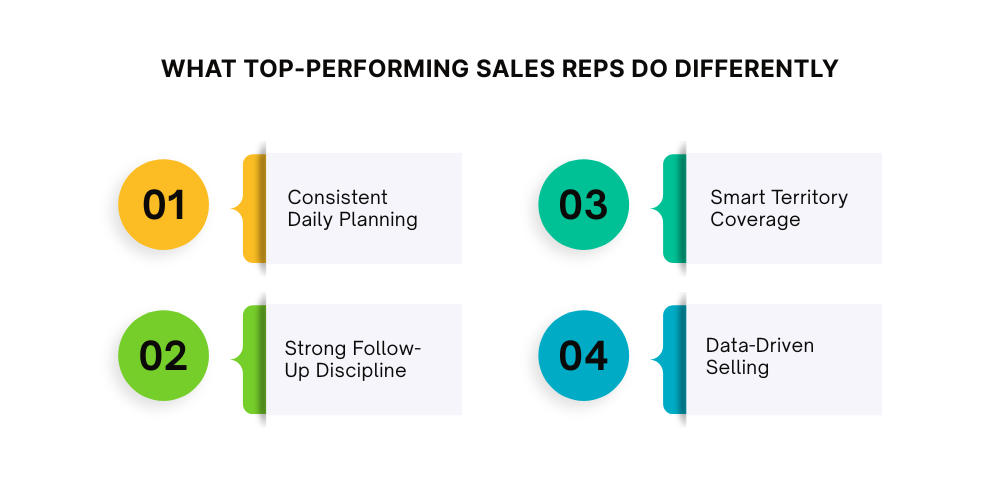
3. Smart Territory Coverage
They strategically plan routes and coverage to maximize efficiency and ensure optimal use of available working hours daily.
-
Focus on high-potential outlets: They prioritize outlets with higher sales potential to maximize revenue from limited time and effort.
-
Optimize travel routes: Efficient routing reduces travel time and increases the number of productive customer visits per day.
-
Maximize daily productivity: Every working hour is optimized to ensure maximum field coverage and higher output per day.
4. Data-Driven Selling
Top performers rely on data insights rather than assumptions, enabling smarter decisions and more effective sales strategies consistently.
They analyze customer behavior patterns, past purchases, and engagement data to identify opportunities and improve sales performance effectively over time.
The Need for Standardizing Sales Performance
If sales performance is heavily dependent on individual capability, the entire growth model becomes fragile and difficult to scale. While top performers may consistently deliver strong results, relying on a few individuals creates imbalance, operational risk, and unpredictable revenue outcomes.
Organizations cannot build long-term success on inconsistent execution patterns. Without standardization, every rep operates differently, which leads to uneven customer experience, fluctuating results, and limited control over field activities.
Standardizing sales performance ensures that success is no longer dependent on “who” is selling, but rather on “how” selling is being done across the organization.
Standardization helps:
Reduce dependency on top performers:
It ensures business continuity by making performance repeatable, even when high-performing reps leave or change roles.
Ensure consistent execution across teams:
Every rep follows the same structured process, reducing variability in customer engagement and field activities.
Improve predictability in revenue:
With standardized workflows and tracking, organizations can forecast sales outcomes more accurately and plan growth effectively.
Simplify onboarding of new reps:
New sales reps can quickly adapt to proven processes, reducing training time and accelerating productivity from day one.
Proven Strategies to Standardize High Sales Performance
Standardizing high sales performance requires more than motivation or target setting. It demands a structured operating system for sales execution, one that ensures every rep follows the same proven framework, every activity is measurable, and every outcome is trackable.
Organizations that successfully standardize performance focus on removing randomness from field execution and replacing it with repeatable, data-driven processes. Below are the most effective strategies to achieve consistent high performance across sales teams.
Define Structured Sales Processes
A clearly defined sales process eliminates ambiguity in execution. From lead handling to order closure, every step should follow a standardized workflow. This ensures that all reps operate within a consistent framework, reducing variation in customer experience and improving overall efficiency.
Standardize Daily Sales Activities
High performance becomes predictable when daily activities are clearly defined and consistently followed. Organizations must outline expected visit counts, customer engagement rules, and productivity benchmarks to ensure every working day is structured and measurable.
Implement Clear KPIs and Benchmarks
Without defined performance indicators, it is impossible to measure consistency. KPIs such as visit-to-order ratio, conversion rate, and daily productivity help identify gaps early and align all reps toward the same performance standards.
Improve Sales Coaching and Training
Standardization is reinforced through continuous coaching. Regular training sessions help align reps with best practices, correct deviations, and ensure that high-performance behaviors are replicated across the entire team.
Use Data for Performance Monitoring
Real-time data visibility is critical for maintaining consistency. When managers can track field activities, visit completion, and order patterns, they can quickly identify inefficiencies and take corrective actions before performance declines.
Enforce Accountability Across Teams
Performance standardization only works when accountability is enforced. Clear ownership of targets, activities, and outcomes ensures that every rep is responsible for their execution quality, not just their results.
How Sales Force Automation Helps Eliminate Performance Variability
Technology plays a decisive role in removing inconsistency from sales execution. In traditional field sales environments, performance variation often arises due to lack of visibility, manual tracking, and dependency on individual discipline. A sales force automation software eliminates these gaps by standardizing processes, improving transparency, and enabling real-time control over field operations.
With the right system in place, organizations can ensure that every sales rep follows the same structured workflow, and managers can monitor execution without delays or assumptions.
Activity Tracking - Sales force automation ensures complete visibility into daily field activities, helping organizations maintain discipline and accountability across teams.
-
Monitor daily visits: Every customer visit is logged in real time, ensuring accurate tracking of field productivity and eliminating reporting inconsistencies.
-
Track attendance and movement: GPS-based tracking allows managers to verify rep location, attendance, and movement patterns throughout the working day.
-
Ensure accountability: Transparent activity logs ensure that reps remain responsible for their time utilization and daily execution outcomes.
Beat Planning and Route Optimization - Structured planning tools help optimize field movement and ensure maximum productivity from every working hour.
-
Predefine routes: Sales teams follow predefined beats, ensuring systematic coverage of assigned territories without random or inefficient travel decisions.
-
Ensure coverage of all outlets: Planned routes guarantee that all priority outlets are visited consistently, reducing missed opportunities and uneven market coverage.
-
Reduce travel inefficiencies: Optimized routing minimizes unnecessary travel time, allowing reps to focus more on customer engagement and order generation.
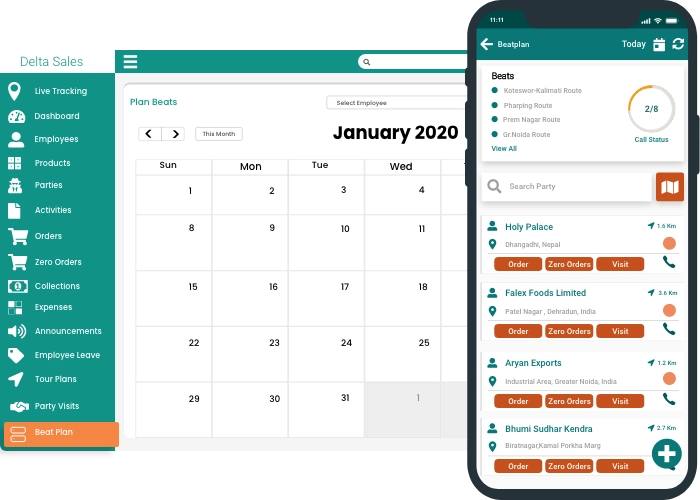
Real-Time Reporting- Instant data capture transforms decision-making from reactive to proactive, improving overall sales control and execution speed with automated reports and analytics.
-
Instant visibility into field activities: Managers can view live updates of rep activities, eliminating dependency on end-of-day manual reporting systems.
-
Faster decision-making: Real-time insights enable quick interventions, helping managers guide reps before performance issues escalate.
-
Reduced reporting delays: Automated data entry removes manual reporting lag, ensuring accurate and timely information flow across the organization.
Customer and Order Management- Centralized systems streamline customer interactions and improve efficiency with sales order management app.
-
Centralized customer data: All customer information is stored in one system, enabling better tracking, segmentation, and relationship management.
-
Seamless order processing: Orders are captured and processed digitally, reducing errors and improving overall speed of execution.
-
Better follow-up tracking: Every interaction and order is recorded, ensuring timely follow-ups and improved conversion rates.
Performance Analytics - Data-driven insights help organizations evaluate performance objectively and make informed decisions for continuous improvement.
-
Compare reps objectively: Performance data allows fair comparison between reps based on actual execution, not assumptions or biased reporting.
-
Identify top vs low performers: Analytics highlight performance patterns, helping organizations identify high performers and those needing support.
-
Take corrective actions quickly: Early detection of performance gaps enables timely coaching, training, and corrective interventions to improve results.
Key Metrics to Track for Consistent Sales Performance
To standardize results, focus on metrics that reflect execution quality:
-
Daily visit count vs target: This metric measures how effectively sales reps execute planned field visits against assigned targets, highlighting discipline, time management, and overall productivity gaps in daily operations.
-
Order conversion rate: This reflects how efficiently a sales rep converts customer interactions into confirmed orders, indicating selling effectiveness, persuasion ability, and quality of field communication.
-
Average order value (AOV): This metric evaluates the revenue generated per transaction, showing how effectively reps upsell, cross-sell, and maximize value from each customer visit.
-
Strike rate (orders per visit): This indicates the success ratio of visits that result in confirmed orders, helping identify productivity differences between high-performing and low-performing sales reps.
-
Repeat order frequency: This measures customer retention strength and loyalty, reflecting how consistently reps maintain relationships and drive repeat purchases over time.
-
Sales per territory: This provides visibility into geographic performance, helping organizations assess territory potential, compare regional productivity, and balance workload distribution across sales teams.
Common Mistakes That Lead to Inconsistent Sales Performance
Even with the right strategy, businesses often make these mistakes:
-
Focusing only on revenue, not execution:
Prioritizing end results over daily activities leads to blind spots in sales performance management. -
Lack of real-time tracking systems:
Without live tracking, managers cannot monitor field activities or intervene before performance issues escalate. -
No standardized sales process:
Absence of defined workflows creates inconsistent execution styles and unpredictable sales outcomes across teams. -
Ignoring field-level visibility:
Without on-ground insights, decision-making becomes reactive, reducing control over actual sales execution and productivity. -
Over-reliance on top performers:
Depending heavily on few reps creates business risk and limits scalability of sales performance. -
Weak accountability structure:
Poor ownership of targets and activities leads to inconsistent discipline and reduced execution effectiveness.

How to Build a Predictable and Scalable Sales System
Building a predictable and scalable sales system requires moving beyond individual effort and focusing on structured processes, data-driven execution, and operational consistency. When sales performance depends on a system rather than personal capability, organizations gain control, visibility, and long-term growth stability.
A scalable sales system ensures that every rep follows the same execution framework, every activity is measurable, and every outcome can be analyzed for continuous improvement.
Standardize processes
Clearly defined sales processes eliminate confusion in execution and ensure every rep follows the same structured workflow from lead to closure.
Track execution in real time
Real-time monitoring provides visibility into field activities, helping managers identify gaps early and ensure alignment between planning and execution.
Use data for decision-making
Data replaces assumptions, enabling organizations to evaluate performance objectively, identify trends, and make faster, more accurate business decisions.
Implement automation tools
Sales automation systems streamline field operations, reduce manual errors, and improve efficiency across activity tracking, orders, and reporting.
Continuously optimize performance
Regular analysis of sales metrics helps refine strategies, improve execution quality, and ensure consistent performance improvement over time.
Final Thoughts
Sales performance variation is one of the most common and expensive challenges in field sales organizations. While it may appear to be a problem of individual capability, in reality it is almost always a system and execution problem. Differences in processes, visibility, discipline, and accountability create uneven outcomes across reps, even when targets, products, and territories are the same.
The key to solving this challenge is not to continuously push individuals harder, but to build a repeatable and standardized sales system. When execution is structured, tracked in real time, and supported by data, performance becomes consistent rather than dependent on personal habits.
Book your demo for Delta Sales App today and take control of your field sales execution.