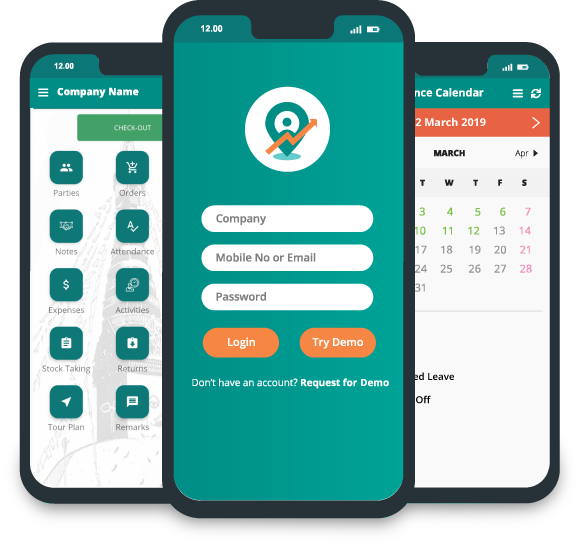

How to Stop Fake Visits and Ghost Check-Ins in Your Sales Team
In fast-moving markets, field teams are expected to deliver consistent execution and measurable results. However, a critical issue often goes unnoticed, fake visits field sales operations. When sales representatives report visits without actually meeting customers, it creates a misleading sense of productivity and performance.
These practices lead to poor visibility, unreliable field activity tracking, and weak execution on the ground. Managers end up relying on inaccurate data, which results in missed sales opportunities, poor customer engagement, and ineffective decision-making. Over time, this disconnect between reported and actual activities directly impacts revenue growth and long-term strategic planning.
Additionally, fake visits reduce accountability within teams, making it difficult to evaluate true performance and identify improvement areas. To stay competitive and maintain operational efficiency, businesses must adopt modern systems that ensure transparency through real-time sales monitoring, automated tracking, and structured reporting processes.
The Reality of Fake Visits Field Sales Teams Don’t Talk About
The truth is, many organizations face fake visits and field sales challenges but rarely address them openly. In environments that rely on manual processes, it becomes easy to manipulate updates without proper verification or accountability.
Sales reps may mark visits as completed to:
- Meet targets
- Reduce travel effort
- Save time
This behavior creates misleading sales execution data, making it difficult for managers to assess actual performance on the ground. As a result, businesses operate on inaccurate insights, which impacts planning and overall efficiency.
Without proper mobile workforce tracking and field sales tracking, the problem continues to grow silently. Over time, this lack of transparency weakens accountability, reduces operational efficiency, and prevents organizations from achieving consistent and reliable sales outcomes.
What Are Ghost Check-Ins and How Do They Work?
Ghost check-ins are a major component of fake visits field sales, where visits are recorded without actual physical presence at the customer location. This creates inaccurate reporting and weakens overall field activity tracking.
This usually happens when:
- Check-ins are done without GPS validation
Sales reps log visits without GPS tracking, allowing false entries without actual location verification. - Updates are shared via unstructured tools
Using apps like WhatsApp leads to unverified updates, impacting sales execution data accuracy. - No geo-location verification exists
Without geo-location verification, businesses cannot confirm whether visits actually happened at assigned locations.
Without systems like visit verification tools and mobile workforce tracking, it becomes impossible to ensure authenticity. This results in unreliable reporting, reduced accountability, and poor decision-making across field sales operations.
Why Sales Reps Fake Visits: Root Causes You Must Understand
Fake reporting is often driven by operational inefficiencies rather than intent alone. In many cases, gaps in systems and processes create opportunities for fake visits to field sales, impacting accuracy and overall performance.
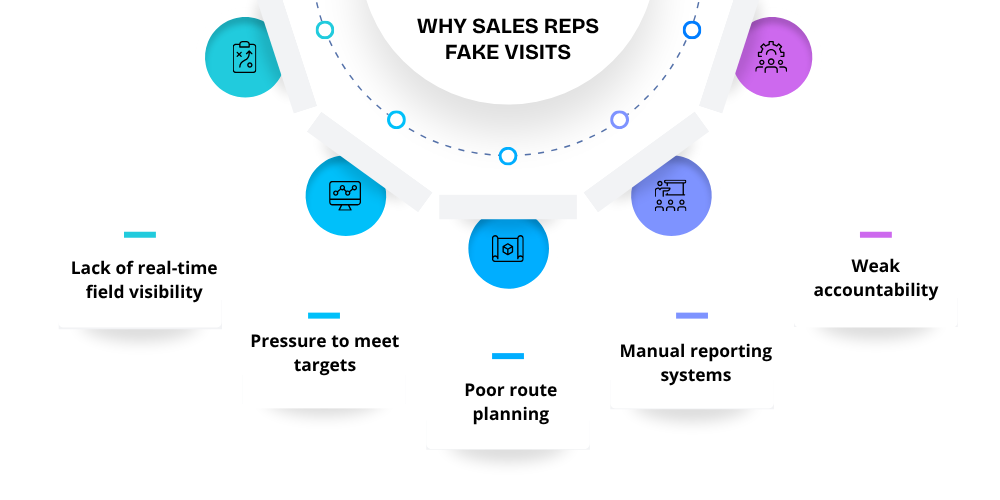
Key reasons include:
- Lack of real-time field visibility
Without real-time field visibility, managers cannot track activities, enabling unverified updates and inaccurate reporting practices. - Pressure to meet targets
High expectations push sales representatives to mark fake visits, prioritizing numbers over genuine customer interactions. - Poor route planning
Inefficient routes reduce productivity, encouraging reps to skip visits and manipulate field activity tracking data. - Manual reporting systems
Manual tools lack validation, making it easy to alter sales execution data without accountability or verification. - Weak accountability
Absence of strict monitoring reduces accountability, allowing inaccurate reporting to continue without consequences.
Without sales automation tools and mobile workforce tracking, these issues create gaps that lead to unreliable reporting, reduced operational efficiency, and poor decision-making.
The Real Cost of Fake Visits: Revenue Leakage & Missed Opportunities
The impact of fake visits field sales goes far beyond inaccurate reporting, it directly affects business revenue, growth, and market performance
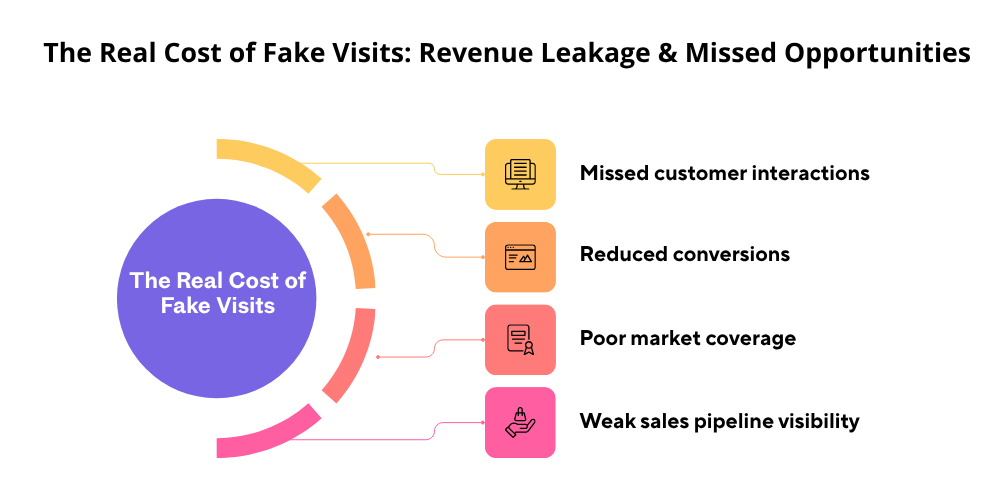
Key losses include:
- Missed customer interactions
When visits are skipped, valuable customer engagement opportunities are lost, weakening relationships and reducing repeat business potential significantly. - Reduced conversions
Fake reporting leads to fewer real interactions, lowering conversion rates and impacting overall sales performance across territories. - Poor market coverage
Unverified visits result in gaps in market coverage, leaving key outlets unattended and reducing brand visibility. - Weak sales pipeline visibility
Inaccurate data disrupts sales pipeline visibility, making forecasting unreliable and affecting strategic planning decisions.
Over time, these inefficiencies create serious challenges, leading to revenue leakage, poor sales execution, and reduced long-term growth potential for the business.
How Fake Visits Distort Sales Data and Decision-Making
When fake visits to field sales data enters the system, it severely distorts sales analytics, leading to inaccurate reporting and flawed strategic decisions across the organization.
Businesses may:
- Overestimate productivity
Inflated visit counts create a false sense of high performance, misleading sales performance tracking and KPI evaluation. - Misallocate resources
Managers assign territories, manpower, and inventory based on incorrect data, reducing operational efficiency and ROI. - Misinterpret market demand
Distorted field inputs lead to wrong assumptions about customer needs, affecting demand forecasting and planning accuracy.
Without accurate performance tracking systems and reliable field activity monitoring, decision-making becomes inconsistent and ineffective. Over time, this weakens execution quality, reduces accountability, and negatively impacts overall business growth.
Early Warning Signs Your Team Is Logging Fake Visits
Businesses must actively monitor performance data to detect potential fake visits field sales issues early. Ignoring these signals can lead to poor execution and inaccurate sales performance tracking.
Common red flags include:
- High visits but low conversions
When reported visits are high but actual sales are low, it indicates ineffective field activity tracking or possible fake reporting. - Identical check-in timings
Repeated or unrealistic timestamps suggest manipulated entries instead of genuine on-ground sales activity. - Missing location-based tracking data
Absence of geo-location verification makes it impossible to confirm whether visits actually occurred. - Mismatch between reports and actual outcomes
Differences between reported data and real sales results indicate unreliable sales execution data.
These warning signs highlight the need for advanced field monitoring solutions, real-time verification, and stronger sales accountability systems to ensure accurate reporting and improved performance.
Why WhatsApp, Excel, and Manual Reporting Fail Completely
Manual tools like WhatsApp, Excel, and spreadsheets fail to support structured field sales reporting and create major operational gaps in sales execution management.
Limitations include:
- No real-time reporting systems
Manual tools do not support real-time sales tracking, causing delays in decision-making and reducing visibility into field operations. - Unstructured data
Information is scattered across chats and sheets, making sales performance analysis difficult and unreliable. - No verification mechanisms
Without GPS-based tracking or visit validation systems, it becomes easy for fake entries and inaccurate reporting to go unnoticed. - Lack of integration
These tools cannot connect with CRM systems, order management tools, or field force automation platforms, leading to disconnected workflows.
Due to these limitations, manual systems fail to ensure accountability, making it easier for fake visits, field sales issues and reporting inconsistencies to persist across teams.
From Blind Spots to Visibility: The Need for Field Sales Verification Systems
To eliminate operational inefficiencies and reduce sales execution errors, businesses must shift from manual reporting to modern digital sales tracking systems.
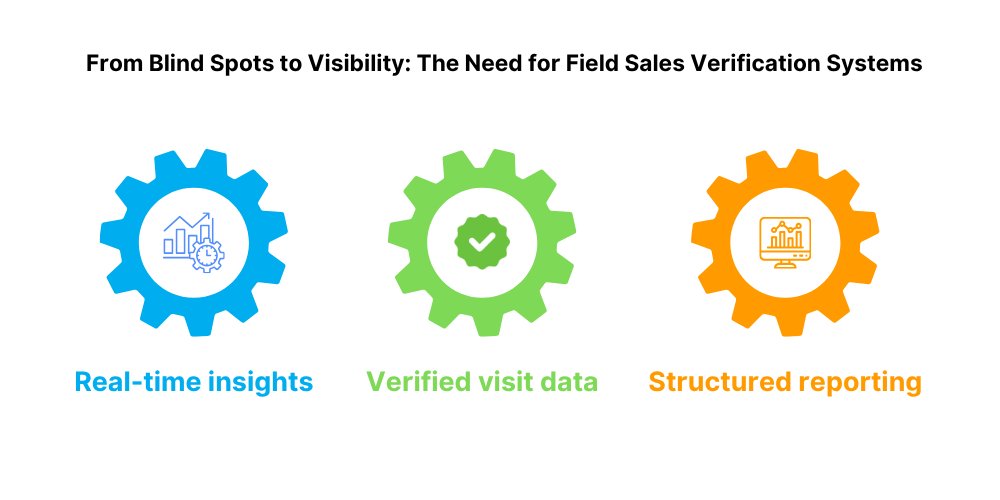
These systems provide:
- Real-time insights
Enable real-time field visibility, allowing managers to monitor activities instantly and make faster, data-driven decisions. - Verified visit data
Ensure every check-in is authenticated through GPS-based tracking and geo-location verification, eliminating false reporting. - Structured reporting
Standardize field sales reporting across teams, improving consistency, accuracy, and overall sales performance tracking.
This transition ensures complete transparency in operations, strengthens field accountability, and significantly improves execution quality across all levels of the sales organization.
Core Technologies That Detect and Prevent Fake Visits
Modern field sales tracking systems use advanced technologies to eliminate fake visits field sales issues and ensure accurate, verified reporting. These tools improve transparency, accountability, and overall sales performance tracking.
GPS-Based Tracking
Enables precise location tracking for sales reps, ensuring they are physically present at customer locations before a visit is marked complete.
Geo-Fencing & Geo-Tagging
Creates virtual boundaries for location-based check-ins, preventing false entries outside defined customer zones and improving visit authenticity.
Time-Stamped Activity Logs
Records every field activity tracking event with accurate timestamps, reducing manipulation and ensuring reliable sales execution data.
Route Intelligence & Movement Tracking
Uses route planning to monitor movement patterns and validate whether visits follow planned routes efficiently.
Live Reporting Dashboards
Provides real-time sales dashboards that allow managers to monitor field performance instantly and take corrective actions when needed.
How Real-Time Field Sales Tracking Builds Accountability
Strong field sales tracking systems ensure every activity is verified, transparent, and aligned with actual on-ground execution. This helps eliminate fake visits and field sales issues and strengthens overall sales performance tracking across teams.
This results in:
- Improved discipline
Real-time monitoring encourages sales representatives to follow planned routes and complete genuine customer visits consistently. - Better team performance monitoring
Managers gain access to accurate field activity tracking, allowing them to evaluate productivity and identify performance gaps effectively. - Increased accountability
With GPS-based tracking and real-time reporting systems, every action is traceable, reducing manipulation and improving responsibility at all levels.
Overall, real-time visibility ensures stronger control, better execution quality, and more reliable sales execution data for strategic decision-making.
A Practical Framework to Eliminate Fake Visits from Your Team
To effectively control fake visits and field sales issues, businesses must adopt a structured, technology-driven approach that strengthens field accountability and improves sales performance tracking.
Step 1: Audit current reporting gaps
Identify inconsistencies in field activity tracking, reporting delays, and areas where manual processes allow inaccurate data entry.
Step 2: Implement field force automation tools
Deploy field force automation systems to centralize reporting, standardize workflows, and improve real-time visibility across teams.
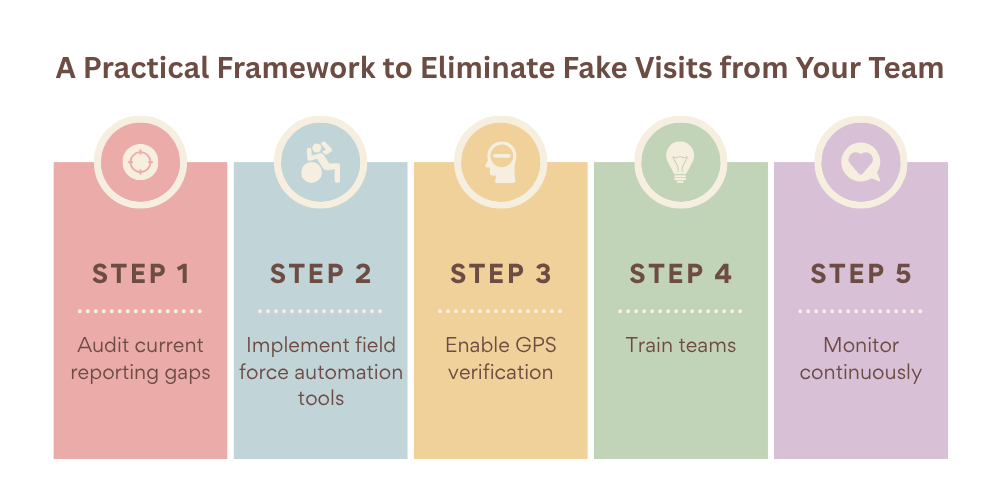
Step 3: Enable GPS verification
Use GPS-based tracking to ensure every sales visit is physically validated, reducing chances of false check-ins.
Step 4: Train teams
Educate sales representatives on proper system usage, ensuring smooth adoption of mobile sales apps and compliance with reporting standards.
Step 5: Monitor continuously
Regularly track sales execution data and monitor performance dashboards to detect anomalies and maintain consistent operational discipline.
Field-Proven Strategies to Ensure 100% Genuine Sales Visits
To reduce fake visits and field sales issues and improve field accountability, organizations must implement structured, verifiable systems that ensure every customer interaction is genuine and traceable.
- Use geo-verified check-ins
Implement GPS-based tracking and geo-location verification to confirm that sales representatives are physically present at customer locations during each visit. - Standardize reporting formats
Adopt consistent field sales reporting templates to eliminate confusion, improve data quality, and ensure uniform sales execution data across all teams. - Monitor daily activities
Track real-time field activity tracking through dashboards to identify deviations, improve visibility, and ensure adherence to planned routes and schedules. - Align incentives with real performance
Link rewards to verified sales performance tracking metrics such as actual visits, conversions, and customer engagement rather than self-reported data.
These strategies collectively strengthen sales transparency, improve execution discipline, and ensure more reliable business outcomes.
How Automation Transforms Sales Discipline and Transparency
Automation eliminates manual loopholes and strengthens sales process transparency by ensuring every field activity is systematically captured and verified. It reduces dependency on manual reporting and improves overall field accountability.
With workflow automation tools, businesses can:
- Reduce manual errors
Automated systems remove human dependency in field sales reporting, minimizing mistakes, duplication, and inaccurate entries. - Improve reporting accuracy
Real-time data capture through mobile sales apps ensures consistent and reliable sales execution data across all teams. - Enhance productivity
By automating repetitive tasks like reporting and follow-ups, sales teams can focus more on selling, improving overall sales performance tracking and efficiency.
Ultimately, automation builds a transparent and disciplined field sales environment, enabling better decision-making and stronger operational control.
Barriers to Adoption: Why Teams Resist Tracking Systems (and Fixes)
While sales tracking software and field force automation tools help eliminate fake visits field sales issues, many organizations face resistance during implementation due to operational and behavioral challenges.
Challenges:
- Resistance to change
Sales teams often prefer familiar manual methods, making it difficult to adopt new mobile sales apps and structured field activity tracking systems. - Lack of training
Without proper onboarding, users struggle to understand real-time reporting systems, leading to low adoption and inconsistent usage. - Privacy concerns
Employees may feel uncomfortable with GPS-based tracking and geo-location verification, fearing excessive monitoring.
Solutions:
- Proper onboarding
Provide structured training to ensure smooth adoption of field sales tracking systems and improve confidence in usage. - Clear communication
Explain the benefits of transparency, improved sales performance tracking, and reduced manual workload. - Easy-to-use sales tracking software
Adopt intuitive tools that simplify workflows, enhance usability, and encourage consistent engagement across teams.
How Delta Sales App Detects and Prevents Fake Visits in Real Time
Delta Sales App is an advanced field sales app built to eliminate fake visits field sales issues by ensuring every field activity is accurately tracked, verified, and recorded in real time. It strengthens sales accountability and improves overall sales performance tracking across teams.

Key capabilities:
- Real-time field activity tracking
Enables continuous monitoring of sales representatives, ensuring every visit and task is updated instantly for complete field visibility. - GPS-based verification
Uses GPS tracking to confirm physical presence at customer locations, preventing false check-ins and improving visit authenticity. - Geo-tagged attendance
Captures location-based attendance data, ensuring structured field activity tracking and eliminating manual manipulation. - Automated reporting
Generates instant sales reports without manual input, improving accuracy and reducing reporting delays. - Performance dashboards
Provides actionable insights through sales performance tracking, helping managers identify gaps and optimize execution.
It ensures accurate data, stronger accountability, and more efficient field execution across all levels of the sales organization.
What’s Next: AI and the Future of Field Visit Verification
The future of field visit verification systems is rapidly evolving with advanced technologies that will further reduce fake visits field sales issues and strengthen sales accountability across organizations.
Future trends include:
- AI-based behavior tracking systems
Artificial intelligence will analyze sales representative behavior patterns, helping detect anomalies in field activity tracking and identifying suspicious visit patterns automatically. - Predictive analytics
Advanced analytics will forecast sales performance trends, helping managers anticipate risks, improve planning, and optimize field sales execution. - Advanced automation
End-to-end field force automation will eliminate manual reporting entirely, ensuring accurate, real-time sales data capture across all activities. - Smart mobile solutions
Next-generation mobile sales apps will offer intelligent insights, seamless tracking, and enhanced real-time reporting systems for better decision-making.
These innovations will create a more transparent, efficient, and data-driven field sales ecosystem, significantly improving performance and operational control.
Final Thoughts:
Eliminating fake visits field sales is critical for achieving accurate reporting, stronger sales accountability, and improved overall performance. When organizations move away from manual processes and adopt modern sales automation solutions, they gain complete visibility and better control over field operations.
This shift not only improves field activity tracking but also ensures more reliable sales performance tracking, helping businesses make faster and more informed decisions.
Book a demo of Delta Sales App today and transform your field sales operations with real-time tracking, automation, and complete transparency.