
Streamline Field Sales with CRM & OMS Integration
In today’s fast-moving sales environment, field teams are under constant pressure to process orders faster, maintain accuracy, and deliver better customer experiences. However, many organizations still rely on disconnected systems where CRM and OMS operate independently, creating delays, errors, and communication gaps.
This is where CRM and OMS integration becomes a game changer. By connecting customer data with order management in real time, businesses can streamline field operations, improve decision-making, and empower sales teams with actionable insights during every customer interaction.
When combined with modern digital tools like a field sales automation app, this integration transforms traditional sales execution into a fully connected, data-driven ecosystem. The result is faster order cycles, improved productivity, and stronger customer relationships across every territory.
What Is CRM & OMS Integration?
CRM (Customer Relationship Management) and OMS (Order Management System) integration is the process of connecting customer management systems with order processing platforms to create a unified, real-time sales ecosystem.
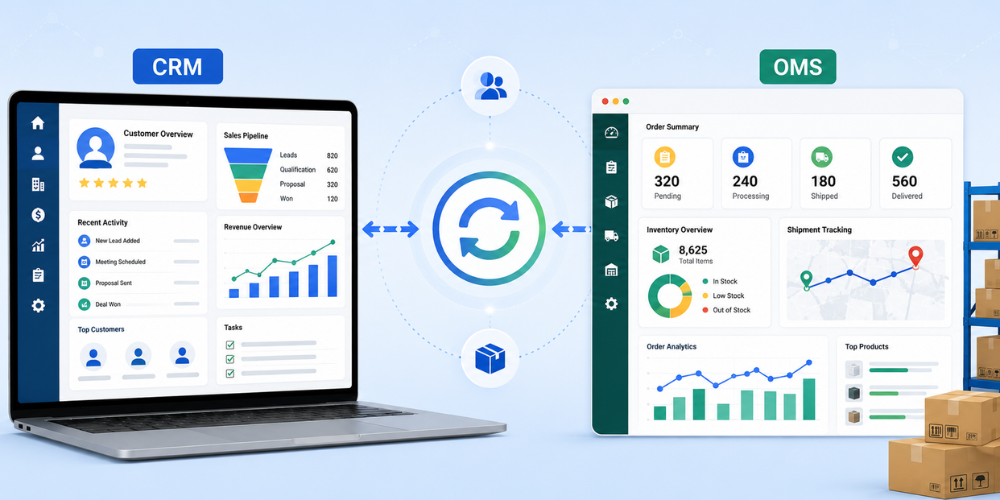
In traditional setups, CRM stores customer data such as purchase history, preferences, and interactions, while OMS handles order processing, inventory tracking, and fulfillment. When integrated, both systems share data seamlessly, enabling field teams to execute sales operations without delays or manual intervention.
This integration is especially critical in industries using a field sales automation app, where real-time execution directly impacts productivity and customer satisfaction.
Why CRM & OMS Integration Matters in Modern Field Sales
Modern field sales teams operate in highly competitive environments where speed and accuracy define success. Without integration, sales reps often switch between multiple tools, leading to inefficiencies.
By adopting a field sales tracking app, organizations can unify CRM and OMS functions into a single mobile-first platform. This ensures that field executives always have updated customer data and order status during visits.
Integration also supports organizations aiming to improve salesforce automation software capabilities by reducing dependency on manual coordination between departments.
Key Points
- Faster Decision-Making in the Field: Reps can instantly access customer history, pricing, and inventory data, allowing them to respond quickly during customer interactions.
- Reduced Operational Dependency: Sales teams no longer need to rely on backend teams for stock checks or order confirmations, improving overall efficiency.
- Improved Sales Productivity: Unified systems reduce app-switching and manual processes, enabling reps to focus more on selling rather than administrative tasks.
Key Challenges in Traditional Field Sales Systems
Traditional field sales systems are often fragmented, leading to operational bottlenecks such as:
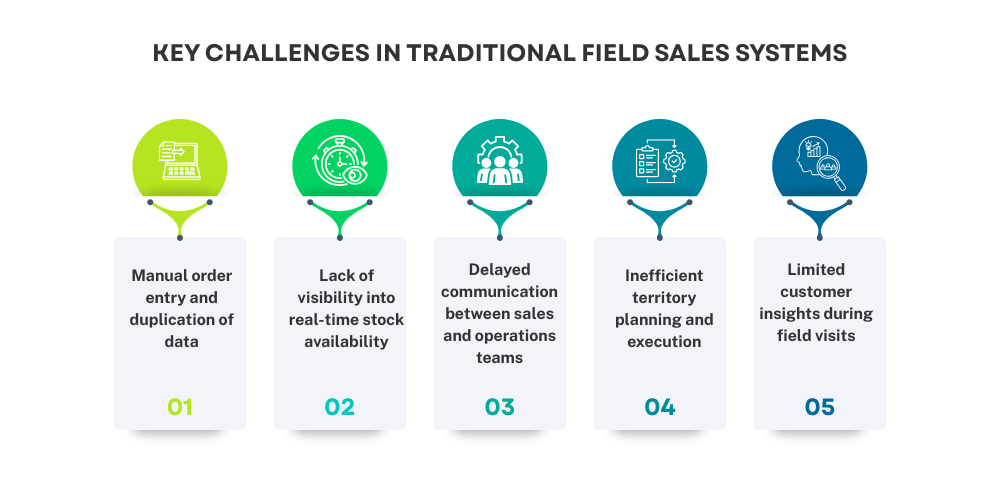
- Manual order entry and duplication of data
Reps manually enter orders causing duplication errors, delayed processing, and inconsistent sales records across multiple disconnected systems. - Lack of visibility into real-time stock availability
Field teams cannot access updated inventory, leading to overpromising, stock issues, and reduced customer trust during visits. - Delayed communication between sales and operations teams
Information flow between departments is slow, causing order delays, fulfillment issues, and inefficient coordination across sales cycles. - Inefficient territory planning and execution
Poor planning tools result in unoptimized routes, missed visits, uneven coverage, and reduced overall field productivity levels. - Limited customer insights during field visits
Sales reps lack detailed customer data, reducing personalization, engagement quality, and conversion potential during interactions.
These challenges directly reduce the effectiveness of a field force management system, making it difficult for businesses to scale efficiently.
Additionally, companies using outdated tools struggle to maintain route compliance tracking, resulting in inconsistent field performance and missed sales opportunities.
Key Benefits of CRM and OMS Integration
Integrating CRM and OMS delivers significant operational and strategic advantages:
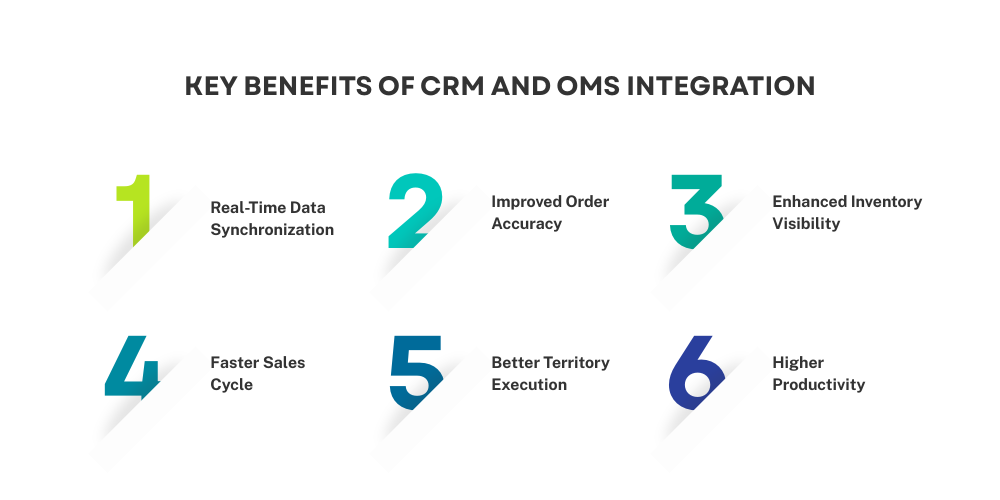
1. Real-Time Data Synchronization
All customer and order data is updated instantly across systems, reducing delays, duplication errors, and improving decision accuracy across teams.
2. Improved Order Accuracy
Integration minimizes manual intervention, ensuring orders are captured correctly, processed faster, and delivered without costly human errors or mismatches.
3. Enhanced Inventory Visibility
Sales reps gain instant access to stock availability, enabling better decision-making, preventing stock-outs, and improving customer satisfaction during visits.
4. Faster Sales Cycle
Automated workflows accelerate order placement, approval, and fulfillment processes, significantly reducing turnaround time from sales to delivery completion.
5. Better Territory Execution
Integration with a geo tracking app for sales reps ensures accurate territory coverage, optimized route planning, and improved visit monitoring efficiency.
6. Higher Productivity
Field teams spend more time selling and less time managing administrative tasks, improving output per rep and overall sales performance efficiency.
Organizations also see stronger adoption of mobile CRM for field sales, which improves on-ground efficiency, real-time reporting, and customer engagement quality.
Impact on Field Sales & Medical Representative Performance
CRM and OMS integration has a direct impact on field productivity, especially for pharma and healthcare sectors.
Medical representatives benefit from improved access to real-time product data, customer history, and order status, which significantly enhances their effectiveness.
Using a medical representative performance tracking app, managers can measure call productivity, order conversion rates, and visit efficiency in real time.
This leads to better decision-making and improved execution of FMCG sales tracking software, especially in large distribution networks.
Overall, organizations experience improved discipline, better customer engagement, and higher conversion rates across territories.
CRM & OMS Integration in Action: Before vs After
Before Integration
- Manual order entry and paper-based tracking create delays, errors, and lack of standardization in field sales execution processes.
- No real-time inventory visibility leads to stock uncertainty, overpromising, and frequent order fulfillment issues during customer visits.
- Delayed communication between departments slows down approvals, delivery coordination, and overall sales cycle efficiency across teams.
- Limited reporting and analytics restrict management visibility into performance trends, territory productivity, and customer behavior insights.
- High dependency on back-office teams increases operational workload and reduces autonomy of field sales representatives significantly.
After Integration
- Instant digital order placement through CRM enables faster capture, processing, and seamless transmission to fulfillment systems.
- Real-time inventory synchronization via OMS ensures accurate stock visibility, reducing errors and improving customer trust instantly.
- Automated workflows and approvals eliminate manual bottlenecks, accelerating execution and improving operational efficiency across departments.
- Live dashboards and analytics provide actionable insights into sales performance, enabling faster and smarter business decisions.
- Seamless coordination across sales and operations improves alignment, reduces friction, and enhances end-to-end customer experience quality.
This transformation is often powered by a sales automation platform, enabling businesses to unify field execution and backend operations into a single system.

How Automation Optimizes Field Sales Workflow
Automation plays a critical role in improving efficiency across field sales operations by reducing manual effort, increasing accuracy, and enabling real-time decision-making.
With integrated systems, businesses can:
- Automatically assign visits using a field sales management app, ensuring optimal territory coverage, balanced workloads, and reduced planning effort for managers and reps.
- Track live rep movement using a GPS tracking app for sales teams, providing real-time visibility into field activity, improving accountability, and ensuring route adherence.
- Trigger alerts for low inventory or delayed orders, helping teams respond proactively, avoid stockouts, and maintain uninterrupted customer service levels.
- Generate automated performance reports, enabling faster analysis of sales KPIs, productivity metrics, and territory-wise performance without manual reporting delays.
- Optimize daily route planning for better coverage, reducing travel time, increasing visit efficiency, and maximizing the number of productive customer interactions per day.
Automation also enhances order management system integration, ensuring seamless flow from order capture to delivery without manual delays or data mismatch issues.
By leveraging a sales tracking mobile app, field teams can execute tasks faster, improve data accuracy, and maintain consistent visibility across all sales activities in real time.
Final Thoughts
CRM and OMS integration is no longer just a technical upgrade, it is a strategic necessity for modern sales organizations.
Businesses that adopt tools like field sales force tracking app and field force automation software gain a significant competitive advantage through improved speed, accuracy, and visibility.
By combining CRM intelligence with OMS execution, companies can eliminate inefficiencies, improve sales rep productivity software performance, and create a fully connected field ecosystem.
Ultimately, organizations that embrace integrated systems and modern tools such as retail execution software and sales order automation apps are better positioned to scale, improve customer experience, and drive sustainable revenue growth.
If you're looking to streamline your field sales operations with real-time CRM & OMS integration, Delta Sales App can help you build a fully connected, automated sales ecosystem.
Book a Demo today and see how Delta Sales App transforms your field sales performance.