
The Complete Guide to FMCG Sales Software: Managing Field Sales, Orders & Distribution Teams in 2026
-1773639224.png)
The FMCG industry operates at incredible speed. Thousands of SKUs move across distributors, wholesalers, and retailers every day. Field representatives visit dozens of outlets daily while managers attempt to monitor performance across territories. Despite this complexity, many FMCG companies still rely on spreadsheets, phone calls, and manual reporting to manage sales operations.
This results in lost orders, delayed reporting, inaccurate inventory visibility, and missed revenue opportunities. Industry estimates suggest that manual sales operations can lead to 5–15 percent revenue leakage due to reporting delays, order errors, and poor retail coverage.
For insight into broader industry trends driving FMCG companies to digitize their sales and distribution processes, explore how digital transformation trends in FMCG operations are shaping efficiency and growth.
This is where FMCG sales software becomes critical. Modern FMCG companies need digital tools that can manage field sales teams, streamline order booking, improve distributor coordination, and provide real-time insights into secondary sales.
This guide explains everything you need to know about FMCG sales software in 2026. It is designed for:
-
FMCG manufacturers
-
distributors and super stockists
-
sales managers and territory managers
-
operations leaders responsible for distribution
If you are evaluating digital tools for your field sales operations, this guide will help you understand the technology, features, and business benefits.
What Is FMCG Sales Software?
FMCG sales software is a specialized digital platform designed to manage the unique sales and distribution requirements of fast-moving consumer goods companies.
Unlike general sales tools, this software is built specifically for high-velocity retail distribution environments where hundreds or thousands of products are sold across large outlet networks.
-1773639224.png)
FMCG companies face operational challenges that differ significantly from typical B2B sales companies. Sales representatives make daily visits to retailers, distributors handle high volumes of secondary sales, and product availability must be tracked across multiple territories.
FMCG sales software integrates all of these processes into a single system.
Who Uses FMCG Sales Software
FMCG sales software is not intended for a specific role or team. Its purpose-built design makes it useful throughout the FMCG ecosystem, from manufacturers to field representatives, distributors, and managers. Here's a breakdown on who uses it and why:
-
FMCG Manufacturers
Manufacturers use the software to monitor product movement between distributors and retailers. It enables them to gain real-time visibility into secondary sales, track SKU performance, and ensure that all outlets in their network are properly serviced. -
Distributors and C&F Agents
Distributors serve as the intermediary between manufacturers and retailers. FMCG sales software enables them to manage large volumes of orders, monitor inventory levels, and accurately report sales to the manufacturer. -
Super Stockists
Super stockists oversee multiple distributors and are responsible for ensuring timely product delivery across regions. The software allows them to monitor distributor performance, forecast demand, and ensure stock availability across multiple territories. -
Field Sales Representatives
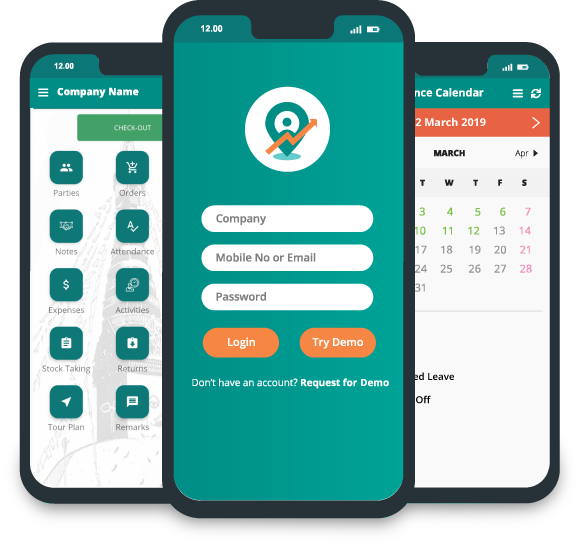
Field reps are the front line of FMCG sales. The mobile app allows them to:
-
Capture orders digitally during retailer visits
-
Access live product catalogues with pricing and schemes
-
Record visit logs and check-in locations.
-
Stay updated on new promotions and product launches
-
Sales Managers and Territory Managers
Managers use FMCG sales software to track team productivity, ensure compliance, and generate actionable reports. They can pinpoint gaps in outlet coverage, assess sales performance by SKU or region, and optimize resource allocation to improve overall efficiency. -
Operations and Supply Chain Teams
Operations teams benefit from visibility into order flow, inventory levels, and distribution bottlenecks, even when they are not directly involved in sales. This enables better planning, faster deliveries, and more effective coordination between sales and supply chain functions.
How FMCG Sales Software Differs from Generic CRM Systems
FMCG sales software is designed specifically for the fast-moving nature of retail distribution, while generic CRM systems are mainly built for managing leads and long sales cycles. Traditional CRM platforms focus on opportunity pipelines and lead tracking, which work well for B2B sales environments. However, FMCG businesses operate on daily order cycles where sales representatives visit retailers, capture orders instantly, and ensure quick stock replenishment. FMCG sales software prioritizes order capture, distributor management, and efficient retail distribution rather than lead management.

Another major difference is how these systems handle products, usage environments, and sales operations. Generic CRM tools often have limited capability for managing large SKU catalogs and are typically used in office-based settings. In contrast, FMCG sales software supports extensive product catalogs, multiple pricing structures, and promotional schemes while being mobile-first for field representatives. Instead of focusing on opportunity pipelines, it emphasizes beat planning, outlet coverage, route tracking, and real-time field team visibility, helping FMCG companies manage on-ground sales operations more effectively.
Because FMCG sales processes are heavily dependent on distribution networks and field activity, businesses require tools that support territory management, retailer databases, order booking, and distributor coordination.
Core Problems FMCG Sales Software Solves
FMCG businesses operate in a fast-paced, complex environment. High SKU counts, thousands of retail outlets, and large field sales teams make manual sales management almost impossible. Purpose-built FMCG sales software is designed to solve these operational challenges, enabling companies to run their sales and distribution networks efficiently.
-
Beat Management
Field sales teams typically follow predefined routes, called beats, to visit retailers. Manually tracking these visits leads to missed outlets, duplicate visits, or inefficient travel routes. FMCG sales software automates beat management by assigning routes to representatives and ensuring every retailer is visited on schedule. -
Order Capture
Traditional methods of taking orders through paper forms or phone calls are slow and error-prone. Mistakes in order capture can lead to delayed shipments, stock-outs, and dissatisfied retailers. With digital order capture, field representatives can instantly record orders during outlet visits using their mobile devices. -
Secondary Sales Visibility
In FMCG distribution, manufacturers rarely sell directly to retailers. Instead, distributors handle the sale of products to retail outlets. Without proper visibility, manufacturers often cannot track how much product actually reaches the market. FMCG sales software provides secondary sales tracking, allowing manufacturers to monitor distributor activity and ensure products are being sold as intended. -
Retail Coverage
Ensuring consistent retail coverage is critical for brand visibility and sales growth. Manual tracking often results in some outlets being neglected, especially in large territories. The software allows managers to monitor outlet visits, track visit frequency, and measure coverage metrics across regions. -
Field Productivity Tracking
Field sales teams are the foundation of FMCG operations, but tracking their productivity manually is difficult. FMCG sales software monitors key metrics like the number of visits, distance traveled, orders captured, and sales value generated per representative. Managers gain insights into high-performing employees, identify areas for improvement, and make informed resource allocation decisions. -
Integration Across Operations
Beyond these core functions, modern FMCG sales software integrates beat management, order capture, and field tracking with distributor data and back-office systems. This creates a seamless flow of information across the sales ecosystem, reducing manual reporting, improving accuracy, and enabling managers to make faster, data-driven decisions.
Why Generic Sales Software Fails FMCG Businesses
Many FMCG companies start with general sales software because it appears to be flexible and cost-effective. On the surface, these tools appear to automate sales processes and enhance reporting. However, they frequently overlook the unique challenges of FMCG distribution workflows. The FMCG industry moves quickly, with complex distribution networks, daily order cycles, and thousands of retail touchpoints. Traditional sales tools, designed for lead-driven B2B sales, are simply unable to keep up with FMCG companies' operational realities.
-
FMCG Sales Environments Are Complex
FMCG companies have very dynamic sales and distribution networks. Field teams work across multiple territories, visiting hundreds or thousands of retailers each day. These teams must manage a large SKU catalog, process orders quickly, and adhere to carefully planned beat routes. Van sales operations, distributor coordination, and retailer-specific reporting all add layers of complexity. Generic sales tools are not designed to meet these needs, making tracking performance, ensuring coverage, and maintaining order accuracy extremely difficult in fast-paced FMCG environments.
-
Generic Sales Software Lacks Distribution Capabilities
Most horizontal sales platforms focus on generic sales processes such as managing leads, opportunities, and long sales cycles. They often lack critical features that FMCG businesses require, including outlet master management, beat route planning, retailer visit scheduling, SKU-level order booking, trade scheme management, and secondary sales tracking through distributors. Without these capabilities, teams are forced to rely on spreadsheets, manual reporting, and phone calls, which increases the likelihood of errors, missed orders, and lost revenue.
-
Scalability Challenges
As FMCG businesses grow, their operational needs expand exponentially. The number of products, retail outlets, distributors, and field representatives can increase rapidly. Generic sales software struggles to scale alongside these growing requirements. Large SKU catalogs, multiple territories, extensive distributor networks, and thousands of daily orders can overwhelm traditional tools, creating inefficiencies and operational bottlenecks. In contrast, purpose-built FMCG sales software is designed to scale with the business, supporting large volumes of data, multiple user roles, and complex distribution models without compromising speed or accuracy.
For a deeper comparison between vertical and horizontal solutions, you can explore this guide to Field Sales Management Software
The FMCG Sales App: Managing Field Reps on Mobile
Field sales representatives are the backbone of FMCG operations, spending most of their day on the road visiting multiple retailers, capturing orders, and ensuring product availability. Managing such a mobile workforce with traditional tools is slow, error-prone, and inefficient. A purpose-built FMCG sales app puts all essential tools in the palm of their hand, enabling reps to digitally access product catalogs, place orders, log visits, track promotional schemes, and sync data with the back office in real time. By empowering field teams with mobile technology, companies can streamline operations, reduce errors, and improve overall sales efficiency.

Why Mobile First Tools Matter
Field sales reps often operate in environments with limited internet connectivity. They travel between multiple outlets and must capture information quickly during visits. A well-designed field force automation app enables reps to:
-
check assigned beat routes
-
view retailer information
-
access product catalogues
-
capture orders digitally
-
log visit outcomes
Mobile apps also reduce paperwork and eliminate the need to manually submit reports.
Core Features of an FMCG Sales App
A typical FMCG sales app includes:
-
Product Catalogue
The product catalog is the foundation of any FMCG sales application. It provides field representatives with a current list of all SKUs, including prices, descriptions, and available trade schemes. This ensures that reps always have accurate information at their disposal, allowing them to confidently showcase products, check stock availability, and respond to retailer inquiries without delay or error. -
Digital Order Booking
Digital order booking allows sales reps to capture retailer orders instantly during visits. Unlike manual paper-based methods, this feature eliminates the risk of errors in order details and accelerates the processing cycle. Orders are automatically validated against inventory and pricing, ensuring that the back office receives accurate data in real time for faster fulfillment. -
Visit Logging
Visit logging allows representatives to document every interaction with a retailer, including the visit time, outcome, and follow-up actions. Managers can track visit frequency, ensure compliance with beat plans, and identify gaps in outlet coverage. This feature encourages accountability and ensures that all retail touchpoints receive consistent attention. -
Retailer Information
Access to detailed retailer information is critical for effective field operations. The app provides sales reps with contact details, purchase history, preferred products, and any special instructions for each outlet. This empowers representatives to personalize their approach, build stronger retailer relationships, and make informed sales decisions on the spot. -
Reporting Tools
Integrated reporting tools allow both field reps and managers to monitor sales performance and productivity. Reps can track daily targets, completed visits, and orders placed, while managers can generate analytics on SKU performance, territory coverage, and representative efficiency. This visibility helps teams make data-driven decisions and optimize sales strategies. -
Real-Time Synchronization
Back-office teams and managers can instantly access all data collected by field representatives, including orders, visits, and retailer updates, thanks to real-time synchronization. This speeds up order processing, minimizes manual reconciliation, and offers current information on distributor activity, inventory levels, and sales performance. -
Offline Mode for Low Connectivity Regions
Many FMCG field operations take place in regions with limited or unstable internet connectivity. Offline mode allows sales representatives to continue capturing orders, logging visits, and accessing retailer data without interruption. Once the device reconnects to the internet, all stored data automatically syncs with the central system, ensuring seamless operations even in remote areas.
Field Sales App for FMCG: Beat Planning, Visits and Coverage
Efficient field operations depend heavily on proper beat planning and outlet coverage.
A field sales app helps sales managers organize territories and ensure that every outlet receives the required attention.
-1773639224.png)
-
Beat Route Planning
Managers can assign each representative an optimal route, or beat, using a field sales app. These routes specify exactly which stores should be visited, how often, and in what order. Businesses can cut down on travel time, avoid missing outlets, and increase overall productivity by automating beat planning. This ensures that field teams are operating effectively and strategically throughout their territories.
-
Territory Assignment
Managers can avoid overlaps between field representatives and balance workloads by assigning territories. Managers can assign territories using the app according to distributor alignment, outlet density, and geography. Better accountability and more targeted coverage of important outlets are made possible by clear territory mapping, which guarantees that each representative is aware of precisely which retailers they are in charge of.
-
GPS Tracking and Geo-Tagged Check-Ins
GPS tracking is used by contemporary field sales apps to give real-time insight into field activity. Managers can keep an eye on travel routes, confirm check-ins at each location, and make sure representatives are visiting the correct retailers. Geotagged check-ins give leadership assurance that the team is carrying out the scheduled beats as intended by adding a layer of accountability and transparency.
-
Outlet Visit Frequency Monitoring
Not every retailer needs the same care. While smaller or lower-priority stores might require fewer interactions, high-performing outlets might require frequent visits. A field sales app automatically monitors the frequency of visits and notifies managers if any outlets are under-serviced or overlooked. This helps optimize sales opportunities across all outlets, guarantees uniform coverage, and improves relationships with retailers.
For organizations managing large sales teams, it is also useful to explore the Guide to Sales Team Tracking Software. This resource explains how companies can monitor field workforce productivity and optimize territory coverage.
FMCG Sales Management Software: Running the Entire Operation
While mobile apps empower field representatives, managers require broader tools to oversee the entire sales operation. This is where field sales management software becomes essential.
These platforms provide centralized dashboards and management controls that allow companies to monitor distribution networks and field performance.
-
Target and Performance Management
Sales managers need to ensure that their teams are aligned with business goals and hitting the right targets. FMCG sales management software allows managers to assign targets at multiple levels, including individual sales representatives, territories, distributors, and product categories. This hierarchical target setting ensures accountability across the network. Real-time performance dashboards track achievements against these targets, allowing managers to identify high performers, detect gaps in sales coverage, and take corrective action immediately. By linking targets directly to daily operations, companies can maintain consistent sales momentum and drive measurable growth.
-
Distributor Management
As a link between producers and retailers, distributors are essential to FMCG supply chains. Accurate reporting, timely deliveries, and appropriate stock allocation all depend on effective distributor management. Businesses can track secondary sales to retailers, keep track of distributor orders, manage credit limits, and maintain stock visibility with the help of FMCG sales management software. Manufacturers can identify underperforming distributors, improve supply planning to minimize stock-outs or excess inventory, and gain a clear understanding of product movement throughout the distribution network with the help of these insights.
-
Manager Dashboards
To make strategic choices for their teams, managers need actionable insights. FMCG sales management software offers robust dashboards that combine information from distributors, retail stores, and field representatives. Reports on representative productivity, outlet coverage data, sales performance by SKU, and comparisons at the territory level are all included in these dashboards. Managers can swiftly spot trends, gauge the success of field operations, and modify tactics to maximize sales coverage and team productivity with this degree of visibility. These dashboards convert unprocessed data into leadership-useful intelligence.
-
Trade Scheme Management
A key component of FMCG sales strategies is trade incentives and promotional programs. Manually handling these frequently results in mistakes and postponed claims. Retailer discounts, volume incentives, promotional campaigns, and seasonal offers are just a few of the schemes that FMCG sales management software enables businesses to develop, implement, and monitor. Automated scheme management lowers administrative overhead, streamlines claim settlement, and guarantees that discounts and incentives are applied correctly during order processing. In addition to increasing accuracy, this enhances relationships with retailers and promotes regular participation in trade promotions.
Key Features to Look for in FMCG Sales Software
Choosing the right FMCG sales software requires evaluating the capabilities that support your business model.
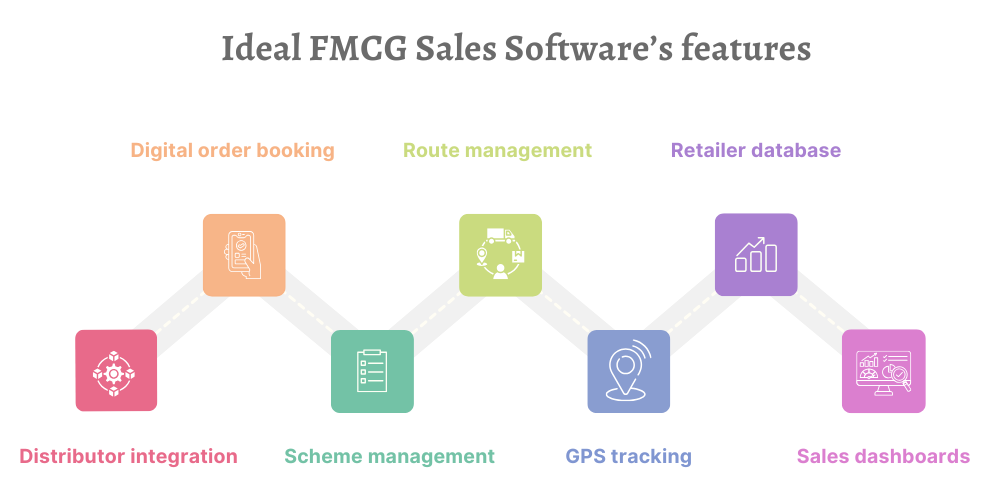
The most effective platforms offer the following features.
-
Digital Order Booking
Digital order booking is a fundamental component of any FMCG sales software. A live SKU catalog with current pricing, stock availability, and relevant trade schemes should enable field representatives to quickly record orders. This ensures accurate data flows from the field to distributors and back-office teams, reduces human error, and expedites order processing. -
Beat Plan and Route Management
Well-thought-out beats and territories are essential for effective sales execution. Managers should be able to monitor visit coverage, assign field representatives optimal routes, and define beats using the software. Businesses can minimize travel time, guarantee reliable retail coverage, and increase each representative's productivity by automating route planning. -
Retailer and Outlet Database
Maintaining accurate and comprehensive outlet information requires a centralized retailer database. Teams can store contact information, past purchases, visitation plans, and unique instructions for every retailer. Field representatives can tailor their approach, build relationships, and promptly address retailer needs with this real-time data. -
Distributor Integration
Order fulfillment, inventory levels, and secondary sales should all be visible through the seamless integration of FMCG sales software with distributor systems. This guarantees that producers can effectively manage distributor performance, optimize stock allocation, and monitor product movement after the initial sale.
-
Scheme and Promotion Management
Retailer programs and trade promotions are essential components of FMCG sales strategies. Managers should be able to set up campaigns, seasonal promotions, volume incentives, and discounts that are automatically applied when an order is booked. This guarantees consistent use of promotional tactics, decreases human error, and expedites the processing of claims. -
Attendance and GPS Tracking
Monitoring field team activity is essential for accountability and productivity. Geotagged check-ins, GPS tracking of visits, and attendance recording should all be possible with the software. These features help maximize workforce efficiency and coverage by giving managers insight into who visited which outlets, when, and how often. -
Sales Reports and Dashboards
Dashboards and sophisticated reporting are essential for making data-driven decisions. Managers should be able to create MIS reports that show trends, gaps, and opportunities by analyzing performance by representative, territory, SKU, or distributor. Detailed dashboards facilitate demand forecasting, success measurement, and strategic initiative planning throughout the sales network.
FMCG Sales Software vs CRM vs ERP: Which Does Your Business Need?
Many businesses often struggle to determine whether they need a CRM, ERP, or FMCG sales software because each system serves a different operational purpose. A CRM (Customer Relationship Management) system is primarily designed to manage leads, customer interactions, and sales pipelines, making it ideal for B2B organizations that focus on nurturing prospects and closing deals over longer sales cycles. On the other hand, an ERP (Enterprise Resource Planning) system focuses on integrating core business processes such as finance, procurement, inventory management, and operations, helping companies manage internal workflows and enterprise-level resource planning.
In contrast, FMCG sales software is specifically built for companies operating in retail-driven distribution environments. It focuses on managing field sales teams, distributor networks, retail order capture, and outlet coverage. Instead of concentrating on lead management or enterprise accounting, FMCG sales software helps businesses streamline on-ground sales activities, improve field team productivity, and ensure efficient product distribution across retail markets. For FMCG companies with large sales teams and extensive retail networks, this type of software plays a critical role in managing daily sales operations effectively.
When to Use a Sales App Alone
A specialized mobile sales app may be enough to digitize field operations for small or startup FMCG teams. Without the intricacy of more complex systems, these apps enable representatives to record visits, take orders, and monitor fundamental performance indicators. A standalone sales app offers a quick, affordable way to improve accuracy and transparency in the field while streamlining daily operations when teams are small, territories are manageable, and distributor networks are constrained.
When Integration With ERP Becomes Necessary
Managing bigger product catalogs, growing distributor networks, and processing more orders call for more than a stand-alone app as FMCG companies expand. Synchronizing accounting, finance, and inventory with field operations requires integration with an ERP system. Accurate stock management, automated billing, and real-time financial tracking are made possible by ERP integration, which guarantees that sales data flows smoothly into the larger business system. This lessens operational bottlenecks and guarantees that efficiency and data accuracy are not compromised when field operations are scaled up.
Common Mistakes FMCG Businesses Make
A common mistake is attempting to manage complex FMCG distribution workflows using generic CRM systems. While CRMs are effective for lead management and B2B sales cycles, they often lack the functionality required for large-scale retail distribution, such as beat planning, distributor tracking, and SKU-level order management. This can result in operational gaps, missed orders, and poor field visibility. Choosing purpose-built FMCG sales management software avoids these pitfalls by providing tailored tools for field operations, distributor coordination, and trade promotion management, ensuring smoother execution and better business outcomes.
How FMCG Sales Software Improves Distribution Efficiency
Purpose-built FMCG sales software transforms the way distribution networks operate by automating key processes, reducing errors, and providing real-time visibility across the entire sales ecosystem. By digitizing field operations, companies can achieve higher operational efficiency, faster order fulfillment, and better retailer engagement.
-
Improved Order Accuracy
Errors like incorrect SKUs, quantities, or pricing are common in manual order capture, whether it is done over the phone or on paper forms. During retailer visits, field representatives can quickly and accurately record orders thanks to digital order booking. In the end, this improves customer satisfaction by lowering errors, avoiding stock discrepancies, and minimizing follow-up corrections. -
Faster Order Processing
Orders are immediately sent to distributors and the back office after they are digitally recorded. This speeds up order processing and shortens the time between order placement and delivery by removing the delays brought on by manual reporting, phone calls, or physical forms. Retailers are kept stocked and satisfied as a result of a more responsive supply chain. -
Stronger Retailer Relationships
FMCG sales software gives representatives comprehensive retailer data, such as past purchases, preferences, and unresolved issues. Equipped with this information, agents can have more tailored discussions, predict retailer requirements, and suggest pertinent merchandise. Long-term loyalty is increased, and retailer relationships are strengthened by regular, informed interactions. -
Real-Time Sales Visibility
Live dashboards that show product movement, sales trends, and outlet coverage give managers instant insight into field operations. Leadership can react swiftly to market shifts, pinpoint high-performing areas, and take care of underserved outlets before problems worsen thanks to real-time visibility. -
Better Inventory Planning
Accurate sales data collected from the field enables manufacturers and distributors to better forecast demand. Companies can optimize inventory allocation, reduce stock-outs, and avoid overstocking by understanding what products are selling where and at what rate. This optimizes working capital utilization and ensures that products are available where they are most needed.

Results FMCG Brands Achieve After Implementation
Companies that adopt FMCG sales software typically see measurable improvements in their sales operations.
Common results include:
-
Higher Outlet Coverage
With digital beat planning and route optimization, sales teams can visit more retailers within the same time frame. Field representatives follow structured beats and territory assignments, ensuring that no outlet is neglected. As a result, brands can expand their reach, maintain a consistent retail presence, and strengthen relationships with key retailers. -
Reduction in Order Errors
Manual order taking often results in errors such as incorrect quantities, wrong SKUs, or missed promotions. By capturing orders digitally through a mobile app, FMCG companies drastically reduce these mistakes. This not only minimizes costly corrections but also improves retailer satisfaction and streamlines the entire order-to-delivery process. -
Improved Sales Visibility
Managers gain real-time insight into field activities, distributor performance, and outlet sales trends through dashboards and reporting tools. This enhanced visibility allows leadership to monitor team productivity, identify under-serviced outlets, and make timely adjustments to strategies. The result is more informed decision-making and better alignment between field operations and business goals. -
Increased Secondary Sales
By coordinating effectively with distributors and tracking secondary sales, FMCG companies can ensure that products reach retailers efficiently and in the right quantities. Improved collaboration between manufacturers and distributors leads to higher retail sales, faster stock replenishment, and reduced stock-outs, directly impacting overall revenue growth. -
Industry Benchmarks
Industry studies suggest that companies implementing field sales automation can achieve measurable results, including a 20–30 percent improvement in sales productivity, a 15–25 percent increase in outlet coverage, and up to 30 percent faster order processing. These operational improvements translate into tangible revenue
How to Choose the Right FMCG Sales Software for Your Business
Selecting the right FMCG sales software is a critical decision that can have a lasting impact on your field operations, distributor management, and overall sales performance. To make an informed choice, it’s essential to carefully evaluate your business needs, operational workflows, and long-term growth plans.
-
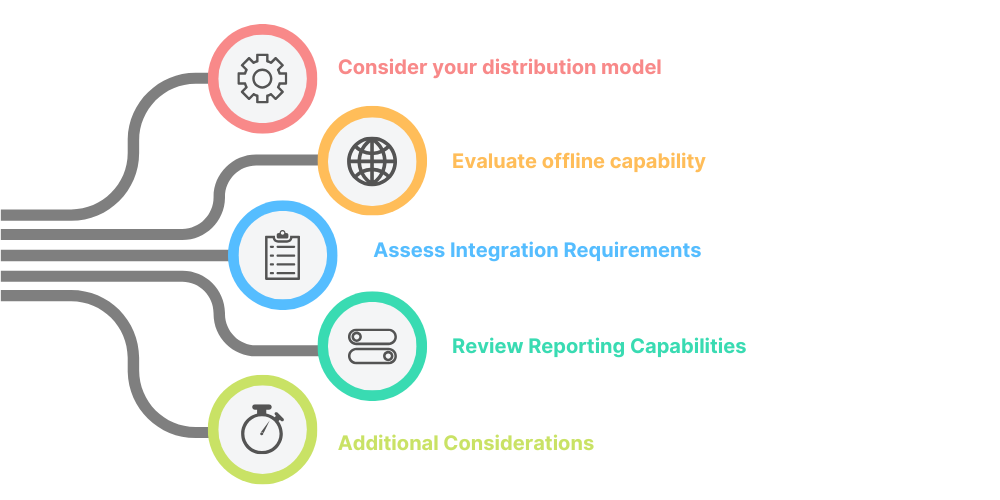
Consider Your Distribution Model
FMCG businesses use a variety of distribution models. Some rely heavily on distributors and secondary sales networks, while others employ van sales teams or direct-to-retail supply. The software you select should support your specific distribution model, allowing for seamless order capture, outlet tracking, and distributor coordination. A solution that does not fit with your operational structure can result in inefficiencies, missed orders, and reduced visibility. -
Evaluate Offline Capability
Field teams often work in areas with limited or unreliable internet connectivity, especially in rural or remote regions. Offline functionality is critical for ensuring that representatives can continue capturing orders, logging visits, and accessing retailer data without disruption. Once connectivity is restored, the app should automatically sync all offline data with the central system, maintaining accuracy and continuity in operations.
-
Assess Integration Requirements
As your company grows, it becomes increasingly important to integrate your sales software with ERP systems, accounting tools, and distributor platforms. Integration ensures that sales, inventory, and financial data flow seamlessly across systems, reducing manual reconciliation, preventing errors, and allowing for real-time visibility into stock and revenue. When evaluating software, ensure that it can be integrated with your current technology stack and scaled as your needs change. -
Review Reporting Capabilities
Robust reporting and analytics are essential for making data-driven decisions. The software should offer dashboards, MIS reports, and customizable analytics that track sales performance, outlet coverage, representative productivity, and distributor activity. These insights allow managers to identify trends, detect gaps, optimize territories, and plan promotions effectively, ultimately improving sales efficiency and ROI. -
Additional Considerations
Other factors to consider include ease of use for field reps, scalability to accommodate larger teams or more SKUs, support and training offered by the vendor, and flexibility to configure the system according to your unique business requirements. A carefully selected FMCG sales software not only streamlines day-to-day operations but also provides the foundation for long-term growth, operational efficiency, and improved collaboration across the distribution network.
Questions to Ask Before Choosing a Vendor
-
Can the software handle large SKU catalogs?
-
Does it support distributor sales tracking?
-
Is the mobile app easy for field reps to use?
-
Does it support offline order capture?
-
Are analytics and dashboards customizable?
Red Flags to Watch Out For
-
software that lacks offline functionality
-
limited reporting capabilities
-
poor scalability for large sales teams
Choosing the right solution can significantly transform your FMCG sales operations.
Conclusion
The FMCG industry depends on speed, efficiency, and strong distribution networks. Managing field representatives, retailers, and distributors manually is no longer sustainable in a competitive market. FMCG sales software enables companies to digitize field operations, improve order accuracy, enhance visibility, and strengthen retailer relationships. From mobile sales apps for field representatives to advanced management dashboards for leadership teams, modern sales platforms provide the tools required to manage complex distribution ecosystems. Organizations that invest in the right technology gain a clear competitive advantage through better data, stronger execution, and improved sales performance. Delta Sales App is designed specifically for FMCG businesses, helping you manage field representatives, optimize distributor networks, capture accurate orders, and gain real-time insights across your operations. With Delta, your team can improve outlet coverage, reduce order errors, accelerate order processing, and strengthen retailer relationships, all from a single, mobile-friendly platform.
If your company is looking to streamline field operations and improve distribution visibility, take the first step toward transforming your FMCG sales operations. Book a free demo of Delta Sales App today and discover how your team can work smarter, serve more retailers, and drive growth across every channel.