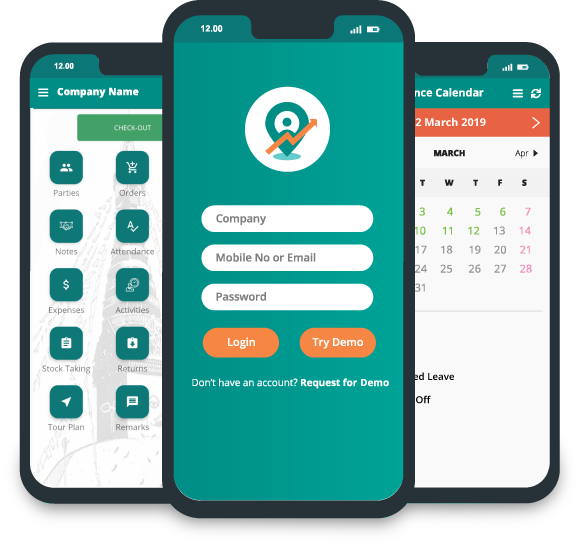

Streamline Your Business with a Distributor Management System
Managing distributors manually becomes increasingly difficult as a business grows. Orders, inventory updates, distributor communication, pricing structures, and performance tracking can quickly become complex and time-consuming. This is where a Distributor Management System (DMS) becomes essential.
A modern Distributor Management System helps businesses gain complete visibility into their distribution network while automating routine processes. By centralizing data and streamlining workflows, organizations can improve efficiency, reduce operational costs, and strengthen relationships with distributors.
What is a Distributor Management System (DMS)?
A Distributor Management System (DMS) is a software solution designed to help manufacturers, wholesalers, and brands manage their distributor network efficiently. It serves as a centralized platform that connects businesses with distributors, enabling seamless coordination of inventory, orders, sales activities, and financial transactions.
Instead of relying on spreadsheets, emails, and manual reporting, businesses can use a DMS to automate critical distribution processes and gain real-time visibility into operations.
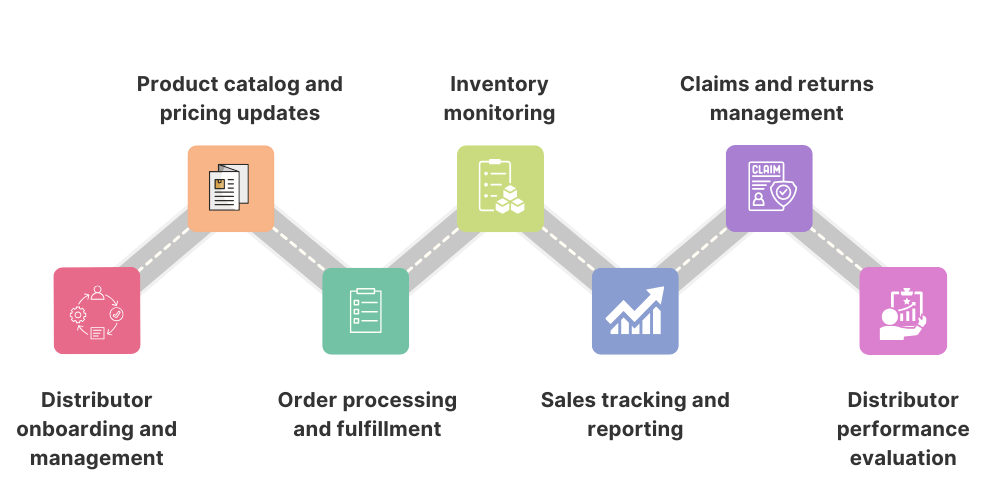
A Distributor Management System typically manages:
- Distributor onboarding and management: Simplifies distributor registration, verification, and profile management while ensuring smooth communication and collaboration across the network.
- Product catalog and pricing updates: Centralizes product information and pricing updates, ensuring distributors always access accurate product details and rates.
- Order processing and fulfillment: Automates order capture, validation, and dispatch workflows to reduce errors and accelerate product delivery timelines.
- Inventory monitoring: Provides real-time stock visibility across warehouses and distributor locations to prevent stockouts and excess inventory situations.
- Sales tracking and reporting: Tracks sales activities and generates actionable reports that help businesses measure performance and identify growth opportunities.
- Claims and returns management: Streamlines return requests and claim approvals while maintaining transparency and reducing resolution time significantly.
- Distributor performance evaluation: Monitors sales achievements, market coverage, and operational efficiency to identify top-performing distributors and improvement areas.
By bringing all distribution activities into a single platform, businesses can improve operational control and make faster, data-driven decisions.
Why Businesses Need a Distributor Management System
A Distributor Management System helps businesses streamline distribution operations, improve visibility, and maintain better control over inventory, orders, and distributor activities. As distribution networks grow, managing multiple partners manually becomes difficult, leading to inefficiencies and missed opportunities.
A Distributor Management System helps businesses:
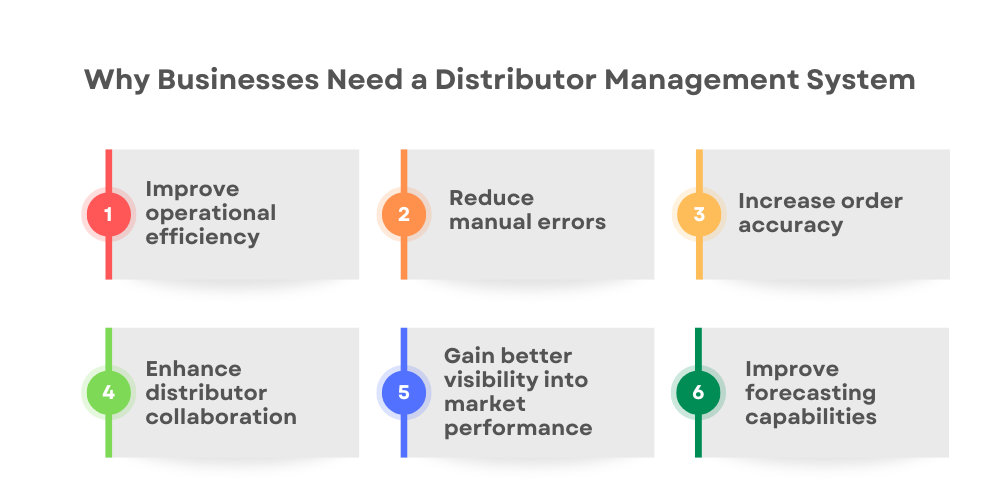
- Improve operational efficiency: Automates repetitive distribution tasks, reducing administrative workload and enabling teams to focus on strategic business growth.
- Reduce manual errors: Minimizes mistakes in order entry, inventory updates, and reporting through automated workflows and centralized data management.
- Increase order accuracy: Ensures orders are processed correctly with real-time validation, reducing fulfillment issues and customer dissatisfaction.
- Enhance distributor collaboration: Provides a unified platform for communication, helping businesses and distributors work together more effectively and transparently.
- Gain better visibility into market performance: Delivers real-time insights into sales trends, distributor activities, and product performance across regions.
- Improve forecasting capabilities: Uses historical sales and inventory data to support demand planning and more accurate business forecasting.
Many organizations integrate their DMS with supply chain management software to create a connected ecosystem that improves coordination between manufacturing, warehousing, and distribution operations.
As businesses expand into new markets, managing distributors becomes increasingly complex. A centralized Distributor Management System ensures consistency, transparency, and control across the entire distribution network while supporting long-term scalability.
Key Features of a Powerful Distributor Management System
The effectiveness of a Distributor Management System depends largely on its features and capabilities. A robust solution should provide comprehensive tools that simplify distributor management, improve operational visibility, and support long-term business growth.
1. Inventory Management
Efficient inventory management is critical for maintaining product availability and meeting customer demand. Real-time inventory visibility allows businesses to monitor stock levels across warehouses and distributor locations, helping prevent stockouts and excess inventory.
Many advanced solutions also include inventory tracking software capabilities that provide detailed insights into stock movement throughout the distribution process, improving inventory accuracy and replenishment planning.
2. Order Management
A powerful DMS automates order processing from creation to fulfillment. Businesses can manage orders more efficiently, reduce manual errors, and accelerate delivery timelines.
With centralized order tracking, stakeholders gain complete visibility into the order lifecycle, enabling faster responses to delays and customer inquiries.
3. Distributor Performance Monitoring
Performance monitoring tools help businesses evaluate distributor productivity, market coverage, sales achievements, and operational efficiency.
Interactive dashboards provide real-time insights that enable managers to identify top-performing distributors, address performance gaps, and make informed decisions to strengthen distribution operations.
4. Sales Analytics and Reporting
Comprehensive reporting and analytics capabilities help businesses understand sales performance, customer demand patterns, and market trends.
Detailed reports allow organizations to identify growth opportunities, measure distributor effectiveness, and optimize strategies based on accurate business intelligence.
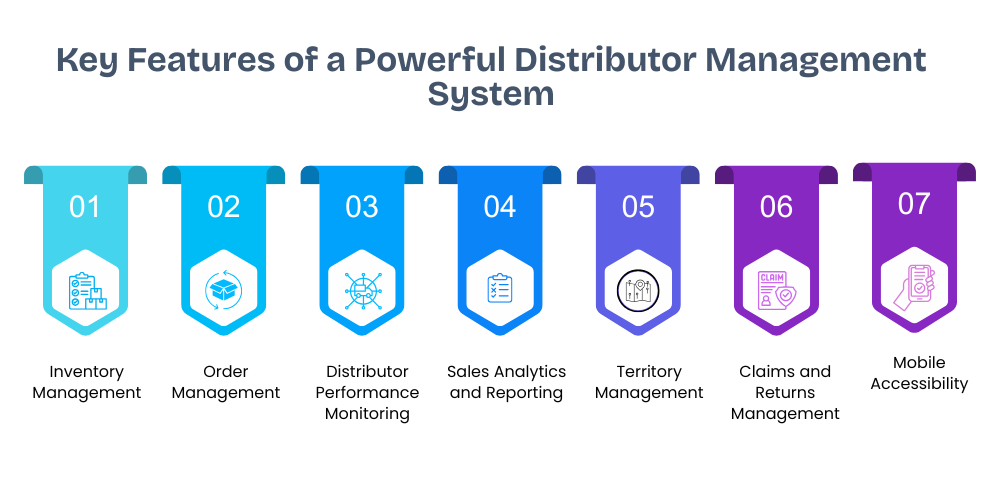
5. Territory Management
Effective distribution channel management enables businesses to organize distributors based on geographic regions, product categories, or customer segments.
This structured approach helps improve market coverage, reduce channel conflicts, and ensure balanced distribution across target territories.
6. Claims and Returns Management
Managing product returns and claims manually can be time-consuming and prone to errors. A Distributor Management System streamlines the process through automated workflows that improve transparency and accountability.
This feature helps businesses resolve issues faster while maintaining strong distributor relationships and customer satisfaction.
7. Mobile Accessibility
Mobile accessibility enables distributors and field teams to access critical business information anytime and from anywhere. Users can place orders, check inventory availability, view reports, and monitor performance directly from mobile devices.
Many organizations also integrate field force management software with their Distributor Management System to improve coordination between distributors and sales representatives operating in the field. This integration enhances communication, increases productivity, and ensures better execution of market strategies.
Benefits of Using a Distributor Management System
Implementing a Distributor Management System delivers measurable benefits across multiple areas of business operations. By automating routine processes and providing real-time visibility into distribution activities, businesses can improve efficiency, reduce costs, and strengthen distributor relationships.
Improved Visibility
A Distributor Management System provides complete visibility into distributor activities, inventory levels, order status, and sales performance through centralized dashboards and reporting tools.
This enhanced transparency enables businesses to monitor operations in real time, identify bottlenecks quickly, and make proactive decisions that improve overall distribution efficiency.
Faster Order Processing
Manual order handling often leads to delays and errors. A DMS automates the entire order lifecycle, from order creation and approval to fulfillment and delivery tracking.
As a result, businesses can process orders faster, reduce turnaround times, and improve customer satisfaction through more reliable service.
Better Inventory Control
Maintaining optimal inventory levels is essential for ensuring product availability while minimizing carrying costs. A Distributor Management System helps businesses monitor stock movement and manage replenishment more effectively.
Many organizations leverage stock management software capabilities within their DMS to improve inventory accuracy, reduce stockouts, and prevent excess inventory accumulation.
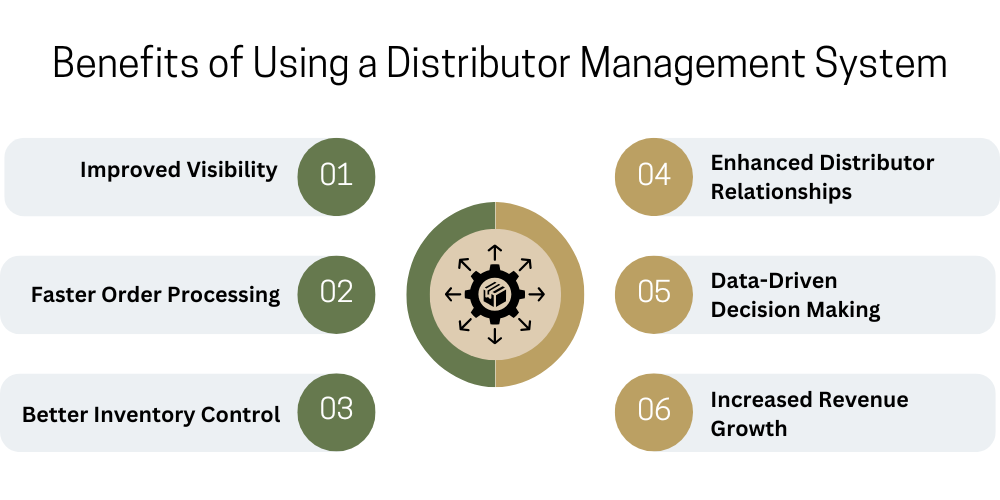
Enhanced Distributor Relationships
Strong distributor relationships are critical for long-term business success. A centralized platform improves communication, increases transparency, and ensures distributors have access to accurate product, pricing, and inventory information.
Streamlined collaboration helps build trust, improve responsiveness, and create stronger partnerships across the distribution network.
Data-Driven Decision Making
Modern Distributor Management Systems provide advanced analytics and reporting features that transform raw business data into actionable insights.
Businesses can identify growth opportunities, monitor sales trends, evaluate distributor performance, and make strategic decisions based on real-time information rather than assumptions.
Increased Revenue Growth
Improved operational efficiency, faster order fulfillment, better inventory management, and stronger distributor engagement often contribute directly to increased revenue and profitability.
By optimizing distribution processes, businesses can expand market reach, improve product availability, and capture more sales opportunities.
Organizations seeking greater market visibility frequently integrate their DMS with a sales force automation system to improve coordination between sales teams and distributors, ensuring consistent execution across all sales channels.
Challenges in Distributor and Distribution Management
Managing distributors effectively is essential for maintaining a smooth and profitable distribution network. However, businesses often face several operational challenges that impact efficiency, visibility, and overall performance. Without the right systems in place, these issues can lead to delayed deliveries, inventory problems, and reduced customer satisfaction.
Lack of Real-Time Data
Many businesses struggle to access accurate and up-to-date information when relying on spreadsheets, emails, or disconnected systems. The absence of real-time visibility makes it difficult to monitor distributor activities, track inventory levels, and respond quickly to changing market conditions.
As a result, decision-makers often operate with outdated information, increasing the risk of costly errors and missed opportunities.
Inventory Discrepancies
Inventory inaccuracies are among the most common challenges in distribution management. Manual stock updates and inconsistent reporting can create mismatches between actual and recorded inventory levels.
These discrepancies may lead to stockouts, overstocking, delayed deliveries, and increased operational costs, ultimately affecting customer experience and business profitability.
Order Processing Delays
Manual order processing workflows often involve multiple approvals, data entry tasks, and communication steps. This increases the likelihood of processing delays and human errors.
Slow order fulfillment can negatively impact distributor relationships and customer satisfaction while reducing overall operational efficiency.
Limited Distributor Visibility
Without centralized reporting and performance tracking tools, businesses may struggle to evaluate distributor effectiveness and market coverage.
Limited visibility makes it difficult to identify high-performing distributors, address performance issues, and implement strategies that improve overall distribution outcomes.
Communication Gaps
Effective communication between manufacturers, distributors, and sales teams is critical for successful distribution management. Poor communication can lead to misunderstandings, delayed responses, inaccurate order information, and service disruptions.
These challenges can weaken distributor relationships and affect customer satisfaction levels over time.
Many organizations experience these operational challenges because they lack a structured dealer management system that centralizes information, standardizes workflows, and improves coordination across the distribution network.
How a Distributor Management System Solves These Challenges
A Distributor Management System addresses these challenges through automation, visibility, and centralized management.
Real-time dashboards provide instant access to inventory levels, sales performance, and order status. Automated workflows reduce manual intervention and improve operational consistency.
Businesses can also leverage order management software functionality to accelerate order processing and improve fulfillment accuracy.
Integrated reporting tools help management identify performance gaps and take corrective action quickly. Meanwhile, centralized communication channels improve collaboration between distributors, sales teams, and company stakeholders.
The result is a more efficient and responsive distribution network capable of supporting business growth.
How to Choose the Right Distributor Management System
Selecting the right Distributor Management System requires careful evaluation of business requirements and long-term goals.
Consider the following factors:
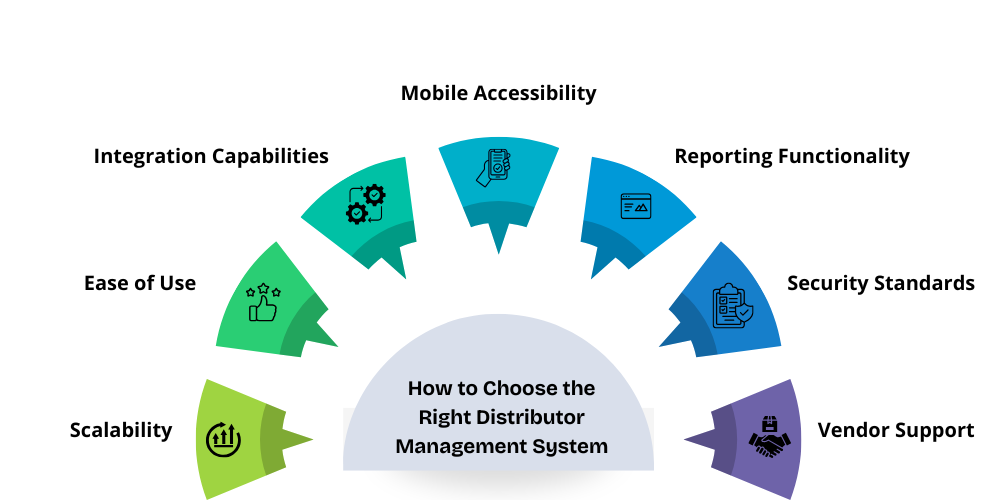
- Scalability: A scalable system accommodates growing distributors, products, and transactions without performance issues, supporting business expansion and future requirements.
- Ease of Use: An intuitive interface helps users quickly adopt the platform, reducing training efforts and improving productivity across teams.
- Integration Capabilities: Seamless integration with existing business software ensures smooth data exchange, eliminates duplication, and improves operational efficiency.
- Mobile Accessibility: Mobile access enables distributors and field teams to manage orders, inventory, and reports from any location.
- Reporting Functionality: Advanced reporting tools provide actionable insights into sales, inventory, and distributor performance for informed decision-making processes.
- Security Standards: Strong security features protect sensitive business information through encryption, access controls, secure backups, and compliance measures.
- Vendor Support: Reliable vendor support ensures successful implementation, timely issue resolution, continuous training, and smooth long-term system performance.
Businesses that rely heavily on route-based distribution may benefit from systems that support sales route optimization to improve field execution and delivery efficiency.
A scalable platform ensures the system continues to support business growth without requiring costly replacements in the future.
Important Factors to Consider Before Implementing a DMS
Successful implementation requires more than simply selecting the right software.
- Data Preparation: Ensure product, distributor, and customer information is clean, accurate, and well-structured before migrating into the new system.
- User Adoption: Train employees and distributors effectively so they understand features clearly and consistently use the system for daily operations.
- Process Alignment: Map existing business workflows carefully and identify automation opportunities to streamline operations and eliminate inefficiencies.
- Integration Requirements: Many businesses connect their DMS with enterprise resource planning software to ensure seamless data flow across departments and functions.
- Performance Metrics: Define clear KPIs such as order cycle reduction, improved inventory accuracy, and sales growth to measure implementation success.
Proper planning significantly improves implementation success and long-term ROI.
Best Practices to Maximize ROI from Your Distributor Management System
To maximize the value of your investment, follow these best practices:
- Automate Routine Processes: Reduce manual effort by automating repetitive tasks such as order entry, reporting, inventory updates, and communication workflows wherever possible.
- Monitor Key Performance Indicators: Track distributor performance, inventory turnover, order fulfillment rates, and operational efficiency to evaluate system effectiveness and improve decision-making.
- Leverage Analytics: Use real-time data insights and reporting tools to improve demand forecasting, optimize planning, and strengthen overall business strategy.
- Conduct Regular Training: Ensure users consistently update their knowledge of system features through ongoing training sessions and best practice workshops.
Many organizations strengthen execution further by integrating retail execution software, trade promotion management, channel partner management, demand forecasting software, and secondary sales tracking capabilities into their distribution strategy.
These technologies help businesses improve market visibility, optimize sales performance, and strengthen distributor relationships.
Why Modern Businesses Choose Delta Sales App for Distributor Management
Modern businesses require more than basic distributor management capabilities. They need a platform that supports scalable growth, improves operational visibility, and enables smarter, data-driven decision-making across the entire distribution network.
Delta Sales App helps businesses streamline distributor operations through real-time reporting, automated order management, inventory tracking, sales monitoring, and distributor performance analysis. It ensures complete transparency between field teams, distributors, and management, reducing delays and improving execution efficiency.
The platform enables organizations to manage their distribution network more effectively while strengthening collaboration between distributors, sales representatives, and management teams. With centralized data and mobile accessibility, businesses can respond faster to market changes and customer demands.

Key Features of Delta Sales App
- Real-time distributor and sales reporting
- Automated order management and processing
- Live inventory tracking across locations
- Secondary sales tracking and visibility
- Distributor performance monitoring dashboards
- Field force tracking with GPS-based insights
- Route planning and sales route optimization
- Retailer and outlet management system
- Credit and outstanding management
- Data-driven sales analytics and reporting
With comprehensive features designed for growing businesses, Delta Sales App helps companies improve operational efficiency, increase sales visibility, and gain stronger control over their entire distribution ecosystem.
Final Thoughts
A Distributor Management System is no longer a luxury but a necessity for businesses looking to improve efficiency, strengthen distributor relationships, and drive sustainable growth.
By automating key processes, improving visibility, and enabling data-driven decision-making, a DMS helps organizations build a more agile and efficient distribution network.
Whether you are a small business expanding your reach or a large enterprise managing multiple distribution channels, investing in the right Distributor Management System can transform the way you operate and position your business for long-term success.
Book a free demo of Delta Sales App to see how you can streamline distributor management, improve visibility, and boost sales performance with a powerful, all-in-one platform.