
6 Things Your Salesman Should Capture on Every Market Visit (And How to Track Them)

Field sales reps visit retailers and dealers every day. Most visits are just to collect orders or follow up on payments When you go to a market the market is really good for more than selling something. Every time a sales representative talks to a customer at the market the sales representative gets to know what the customers want from the market what the market has in stock what other companies that sell things at the market are doing, how the products are shown at the market and what is changing at the market. The information from the market helps the businesses make decisions about the market. A lot of companies do not even get this information from the market on a basis. The sales representatives usually write things down on paper make phone calls, about the market use computer programs or just try to remember what they saw at the market. Important details get lost in reports, and change agents have to make decisions with incomplete or old information.
In today’s competitive FMCG, manufacturing, pharmaceutical, and distribution businesses need more than just sales figures. They need real-time market intelligence that helps them know what’s going on at the retailer level, spot problems before they become expensive, and react fast to changing consumer tastes.
But what exactly should your sales team be capturing on every market visit?
In this blog, we will talk about the 6 important things that every salesperson must record during every market visit and why each of them is important for business growth.
6 Essential Insights Every Salesman Should Capture During Every Market Visit
Every time you visit the market, you can obtain information that goes far beyond sales orders. Businesses can better understand how the market is doing, spot potential issues before they affect sales, and make well-informed decisions based on real-time data when the appropriate insight is obtained at each visit to a retailer or distributor. Managers have more insight into field operations and more consistent reporting are made possible by standardizing the information that sales representatives document on each visit.
The following are the six crucial insights that every salesperson should record:
1. Distributor Health
Product availability, order fill rates, and retailer satisfaction are all impacted by a distributor's success. Salespeople must look into inventory trends, the efficiency of deliveries, late payments, the time required between ordering and obtaining the new batch of the goods, and any operational challenges that may affect the supply chain when checking on the market to determine the overall condition of their distributors. This information is captured periodically and allows companies to address issues before they affect sales and keep a stronger distribution network.
The main observations are the following:
- Inventory turnover
- Delivery performance
- Stock replenishment speed
- Payment issues
- Recurring operational challenges
- Satisfaction of distributors
Using a Distributor Management System allows businesses to monitor distributor performance, stock replenishment rate, and collections and improve supply chain visibility from a single platform.
2. Retail Coverage
Retail coverage involves visiting the priority outlets on a regular basis to ensure that there are no chances of missing out on sales opportunities. The salesmen should make sure that they visit all the assigned retail outlets on time, check for any missing retail outlets, identify new outlets, and make sure that the visits are frequent according to the requirements of the business. It is also important to find out whether or not the competitors are getting more market share than their own company in areas where their product is not available.
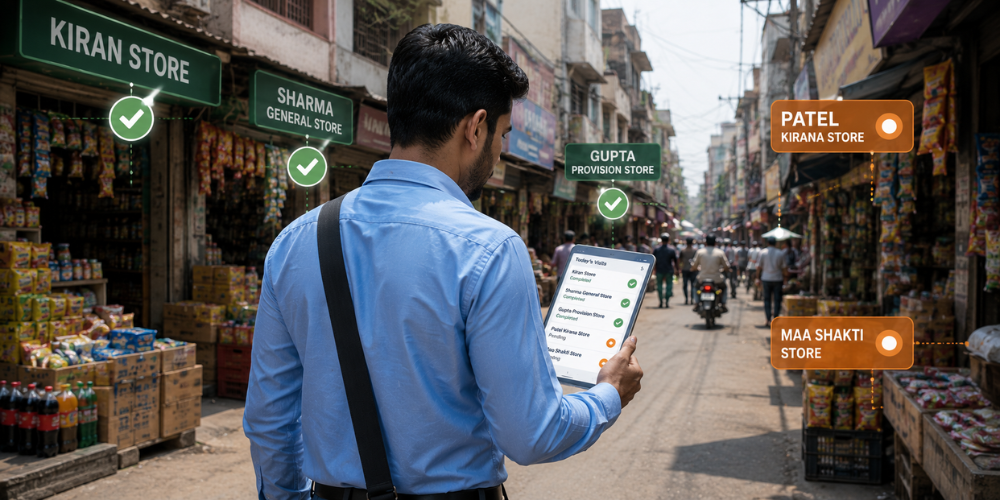
Sales reps should expect questions like:
- Are all priority retailers being visited?
- What stores haven’t been mentioned recently?
- Are we missing outlets competitors are already reaching?
- Are new retail opportunities opening up?
Simply counting visits isn't enough. Businesses need visibility into visit frequency and market It’s not just about counting visits. They want to see how many times they come, how many they have in the market, etc. With Beat Planning and Sales Route Planning, managers can be sure that each retailer will be visited as planned and at the same time minimize unnecessary travel time.
3. Shelf Visibility
Just because you have products available doesn’t mean you’re going to sell them,” she said. “If customers don’t have visibility or accessibility to the products, then how are they going to buy them?” Sales reps should review at each retailer visit: shelf location, product visibility, quality of display, location of promotional material, pricing labels, and shelf share vs. competition. They should also take pictures of product displays to provide visual proof of merchandising execution. Shelf visibility monitoring enables businesses to maintain a consistent brand presence, improve retail execution & increase customer purchase potential.
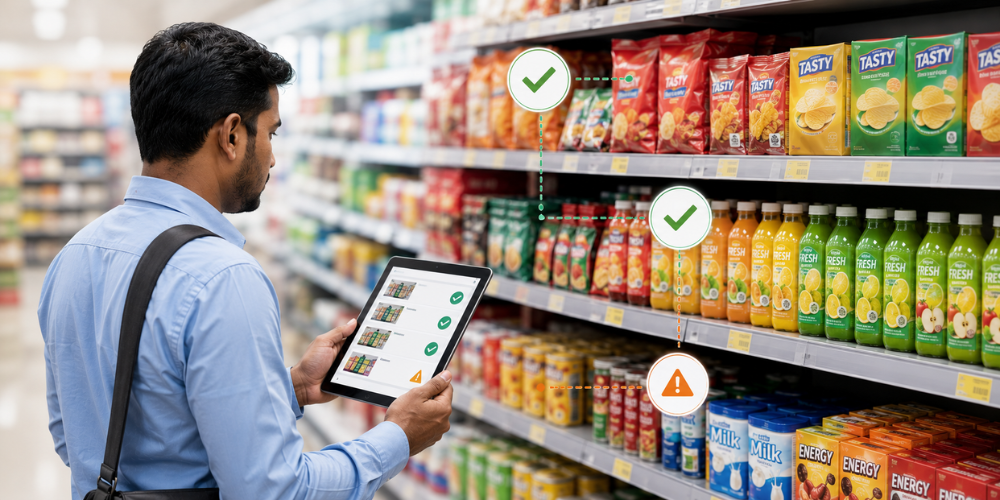
In every visit, salesmen must capture:
- Positioning on shelves
- Visibility of products
- Quality of show
- Promotional material position
- Signage of out-of-stock products
- Shelf share of competitors
4. Competitor activity
It is extremely crucial to understand what your competitors are up to, if you wish to make sound business decisions and keep an edge over your competitors. During visits to the market, the salesmen must jot down the competitor pricing, deals, launch of new products, schemes offered by the competitors to the retailers, shelf positioning, display techniques, and customer preference of the competitors' brands. Any change which can impact the purchasing behavior and decrease demand for their products must be kept in mind. Competitors' insights enable businesses to respond quickly to changes in the market, change their sales strategy, and strengthen their market position.
Salesmen must constantly gather information regarding:
- New product releases
- The next step
- Price movements
- Improved display
- Retailer preferences
- Competitors' sales plans
This allows marketing and sales teams to be more responsive and pivot their strategies before losing market share. Competitor information is captured at the time of the visit on a single, centralized sales force automation platform, not after the fact via verbal updates when back in the office. Managers get real-time market intelligence straight from the field.
5. Stock Availability
Correct inventory in all the stores is extremely important to ensure that there are no losses because of lack of stocks and to satisfy the customers. Sales reps need to write down the items which are out of stock, check the level of stock of already existing items, determine the fast moving and the slow moving items, monitor almost expired stocks and determine replenishment requirements in each visit. They also have to find out the reasons of stockout and immediately inform about inventory issues to the distributor or warehouse staff. Inventory checking regularly allows the companies to enhance demand forecasting and decrease stockout. Sales reps should make the following entries during each visit:
- Items in stock
- Fast moving items
- Slow moving items
- Stockout
- Almost expired items
- Replenishment requirements
6. Retailer Feedback
Retailers talk to customers every day and are one of the most valuable sources of market intelligence. A good sales rep will ask their customers not only what they are buying but also about how and why they have chosen their product(s). Product demand is another matter they will discuss with customers. Pricing is one such matter customers often mention to sales reps. Product quality may also be an area of concern for customers. Promotion effectiveness as well as service issues are two additional areas where feedback comes. Retailers are generally the ones who have the most direct interaction with customers and sales reps. So, sales reps should make sure that their retailers know where to report these issues and how quickly they expect the issues to be fixed. Sales reps should also let their retailers know that they can share with them any ideas for future products or improvements on how they serve the retailers.
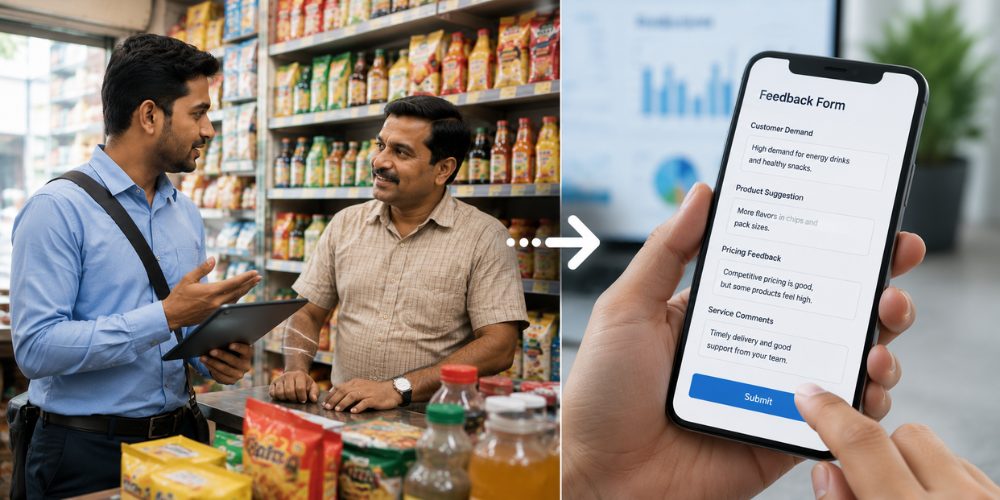
Field reps should collect information such as:
- Customer buying behavior
- Most requested products
- Frequent complaints
- Concerns about product quality
- Pricing feedback
- Tips to make it better:
Rather than sharing through conversations, the business should ensure retailer insights are collected in an organized manner. Leaving the feedback unprocessed and in verbal form is ineffective to the business. Though, by having the feedback within the sales application, it is easier for product teams, marketing teams, and sales managers to look for recurring issues that lead up to effective decision-making. Ultimately, this will result in better product planning as well as stronger relationships with retailers.
Efficient Way to Capture These Six Insights from Market Visits
"It is not enough just to gain meaningful market insights.The key here is to be good at gathering and looking at those sales insights. If salespeople do not use tools, like notebooks or spreadsheets they can miss sales insights or put them off or even forget about the sales insights. Salespeople need to think about how to get these sales insights and write them down so they do not forget the sales insights. This makes it hard for managers to manage field activities, recognize market trends, and handle business issues accordingly. The field sales automation tool will help to overcome such inefficiencies. Salespeople can enter their data directly into the tool, depending on their visits to the market. Managers have full visibility over all the field activities, since every insight is being collected and then instantly reflected in the dashboard, without creating different reports later in the office.
These are the ways for companies to capture these six key insights from market visits:
-
Use Digital Visit Reporting
Every visit to a retailer or distributor should be digitally logged, with the reason for the visit, observations made, actions taken, and follow-up needed. This allows for a consistent reporting process and ensures that no vital information is missed. With field sales reporting software, managers see reports of visits immediately, rather than waiting for end-of-day reports.
-
Capture GPS Verified Visits
-1783941467.png)
It is really important to know if someone went to a place. This is just as important as knowing what they did when they got to that place. The GPS employee location tracking system is a help, to companies. It helps them keep track of when and where each salesperson visits a store. This is because the GPS employee location tracking system uses GPS to verify the visits that the salesperson makes to a store. The companies can then use this information to see what the salesperson did at the store.
-
Upload Photos for Visual Verification
The photographs are a visual record of shelf displays, product placement, promotional material, stock conditions and merchandising activities. Sales reps don’t just have to rely on written descriptions anymore; they can upload images directly from the field using a retail execution app, enabling managers to verify in-store execution remotely.
-
Instantly Record Stock Levels And Orders
When a salesperson is at the store they should update the inventory information. This helps to track stock availability products that're out of stock and what needs to be replenished. By doing it reduces stock-outs and improves planning of inventory. A sales order management app is helpful for businesses. It allows them to accept orders from retailers at the point of sale. This reduces the need for paperwork and speeds up processing of orders.
-
Document Competitor Actions and Retailer Feedback
We need to keep an eye on the prices of our competitors and also watch out for their promotions and new products. This will help our company stay ahead of our competitors. By doing this we can make sure that our company is always one step ahead of our competitors. Retailers have insights that can help us improve.. By tracking competitor actions and retailer feedback. We can make decisions about our own business strategy. Competitor actions and retailer feedback are crucial, to our success. We must keep an eye on competitor prices and promotions. Also retailer feedback is essential for us to make changes and grow. Competitors are always trying to be one step We need to listen to retailers and adjust our approach accordingly.
-
Performance Monitoring with Real-Time Dashboards
The idea of gathering Performance Monitoring data is to change it into useful insights.A single dashboard provides a view of several key areas. These include retailer coverage, distributor performance, and stock availability. It also tracks competitor activities and sales staff productivity. With reporting and analytics companies can identify performance gaps. They can track execution in the field. Make faster decisions based on data.
Best Practices for Sales Representatives During Every Market Visit
It’s not just about going to see retailers and distributors and getting the necessary market intelligence. Systematic planning of each market visit will make sure that you never forget to take into account the necessary information and don’t lose the chance. With these best practices, your business will be able to increase the quality of their market intelligence, take decisions faster and create relationships with retailers and distributors.
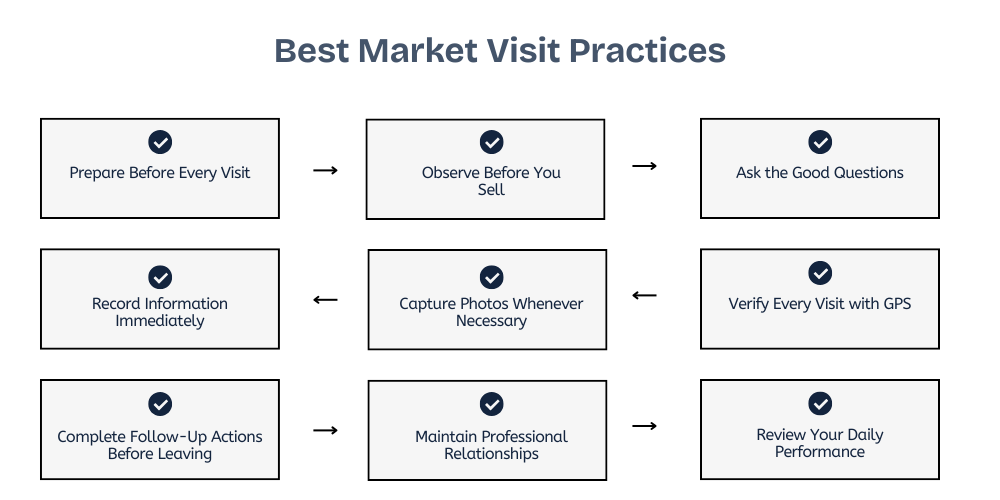
Follow a Planned Visit Schedule
A well-thought-out plan makes sure you see all the important stores regularly and don't miss any key ones. It is an idea for sales representatives to check their assigned route and visit plan every single day. Sales representatives can work efficiently this way. This really helps sales representatives cut down on the time they waste by traveling. There are apps and software for beat planning that can make your daily routes better, help you cover more stores, and finish your visits on time.
Prepare Before Every Visit
Before you meet with a store or a distributor, it’s smart to look over past visit reports, any orders that are still pending, bills that haven't been paid yet, recent complaints, and things you need to follow up on. Knowing the customer’s background helps sales reps have more useful conversations and fix problems quicker.
Observe Before You Sell
Take a time to get a sense of the store. Look at the products. See if they are available. Check how they are placed on the shelves. See what the competitors are doing. Count how many customers are coming in. Find out what promotions are running. The store is a place to learn things. You can learn a lot from looking around. This can help you when you are trying to sell things and manage the store. You can learn a lot from what you see in the store. The store and its products are very important.
Ask Good Questions
Have a real conversation with retailers, not just a conversation about sales orders.” Ask about:
-
Customer demand and buying trends
-
Fast-moving and slow-moving products
-
Competitor offers and promotions
-
Stock shortages or delivery issues
-
Product quality concerns
-
Suggestions for improving service
These discussions provide valuable market intelligence that helps businesses respond to changing customer needs.
Record Information Immediately
Do not rely on your memory. Wait until the end of the day to write notes. Sales representatives should write down their observations after each visit. They should also write down the feedback they get from the retailers. It is an idea to note down the availability of stock and what the competitors are doing. A field sales management app is very useful, for field teams. It allows them to update the information soon as something happens which means the sales representatives can make sure their reports are accurate and complete and the field sales management app helps them do that.
Capture Photos Whenever Necessary
Pictures help establish facts about merchandising activity, product displays, promotional materials, shelf visibility and stock conditions. They help managers to verify the remote field execution and reduce misunder standings. Sales reps in the field can upload store images on the spot, during the visit using a retail execution app.
Verify Your Visit with GPS
Accurate verification of visits means accountability is built-in and the retailer visits that need to take place, do. GPS Employee Tracking automatically records the location and time of visits for businesses, providing managers with greater insight into field operations and removing the need for manual reporting.

Complete Follow-Up Actions Before Leaving
Complete any work necessary before leaving the outlet. They could be ordering stock, taking down feedback from retailers, updating stock levels, collecting payments or organising the next visit. Performing these activities at the time of the visit means less follow-up delays and a happier customer. The sales order management app lets sales reps place orders and keep the sales process moving fast.
Maintain Professional Relationships
Regular communication is important for building relationships with retailers and distributors. Being reliable and responsive helps a lot. Sales reps should really listen to their concerns. They should fix issues fast. They can also offer advice when they can. Retailers who trust you will give you feedback. They will also want to keep working with you for a time. Trust is key to long-term business partnerships, with retailers and distributors. Retailers and distributors want to work with people they trust.
Review Your Daily Performance
Daily review of visits completed, follow-ups pending, outlets missed, and important market insights. Sales reps benefit from regular performance reviews that allow them to see where they need to improve. Managers benefit from having better visibility into field productivity. Field Sales Reporting Software automatically compiles daily activities into actionable reports, speeding up and improving accuracy of performance tracking.
How Delta Sales App Helps Businesses Capture Every Market Visit
“Market insights are only useful if the information is accurate, accessible and actionable. Manual reporting often means delays in updates, incomplete records and little visibility into field operations. Delta Sales App offers a centralized Field Sales Automation App to tackle these challenges. Through the App, sales representatives can record all details of a market visit from their mobile devices. From planning to retailer visits, to creating reports, all activities are tracked digitally, allowing businesses to boost productivity and make data-driven decisions.
-1782992909.png)
-
Plan Every Visit with Precision
The first step to an effective market visit is proper planning. The Delta Sales App helps businesses plan daily schedules, assign territories and optimize travel routes so sales reps can visit the right retailers at the right time. Beat planning software and sales route planning app can be used by businesses to extend retail coverage, reduce travel time and visit all priority outlets on time.
-
Capture Market Data in Real Time
Rather than relying on handwritten notes or end-of-day reporting, sales reps can capture distributor observations, retailer feedback, competitor activity, stock availability and follow-up actions in real time in the field. Because of this real-time reporting, managers have always current market information. This means they can respond quickly to new challenges and opportunities.
-
Verify Every Visit with GPS Tracking
It’s just as important to know what happened on a retailer visit as it is to know that a sales rep visited a retailer. The Delta Sales app also provides GPS employee tracking, which automatically logs the location and time of visits, allowing businesses to verify field activity, build accountability, and get rid of inaccurate or missed visit reports.
-
Real-time Stock Monitoring & Order Collection
In the same visit, the sales representative can verify product availability, record stock levels, identify out-of-stock items, and place retailer orders. The Delta Sales App combines inventory management software with a sales order management app to reduce manual paperwork, improve inventory visibility, and speed up the order-to-delivery process.
-
Record Competitor Insights and Retailer Feedback
“Any time you go to a retailer, you learn something important about customer demand and what your competitors are doing.” With the Delta Sales App, you can easily capture competitor pricing, promotions, retailer suggestions, consumer preferences and market trends all in one place. Businesses can use its Sales Force Automation (SFA) software to turn those field observations into useful insights that allow for better planning and faster decision making.
-
Generate Actionable Reports and Analytics
All data collected during the market visit through the Delta Sales app is converted into detailed reports and dashboards automatically. It also enables managers to track salespeople productivity, retailer coverage, distributor performance and field execution in real time, without waiting for manual updates. With this centralized visibility, organizations are able to recognize trends, measure performance, and make informed decisions based on data in real time.
-
Retail Execution Improvement
All merchandise must be merchandised and displayed properly to support sales. Sales reps can also upload photos of outlets, track shelf space, and log merchandising observations with the Delta Sales App’s retail execution app. This gives managers visual proof of in-store execution and helps to ensure that products are presented to company standards in each retail outlet.
-
Transform Every Market Visit into Business Intelligence
The Delta Sales App is more than just a tool to record field activities. This is how businesses can turn every visit to the market into business intelligence they can act on. It integrates visit planning, GPS tracking, reporting for retailers, inventory tracking, retail execution and analytics in one platform to help organizations improve field productivity, build stronger retailer relationships and make smarter sales decisions. Whether you are managing FMCG pharmaceutical manufacturing or distribution sales teams Delta Sales App helps you make every market visit count towards long term business growth.
Conclusion
Going to the market is a way to find things that will help you make better business decisions. When you are at the market you can see how your products are doing. You can find out how many stores have your products how easy it is to see them on the shelves and what your competitors are doing. You can also see how much stock is available and what the retailers think. All this information gives you an idea of what is happening in the market.
When you get this information regularly you can sell more have relationships with the retailers and keep track of your inventory. You can also make changes quickly when things, in the market change.
However if you try to get all this information by yourself you might end up with reports that're not the same every time you might not get the updates when you need them and you might miss some good opportunities.
This is why when companies use a field sales automation app, like the Delta Sales App, they can create a standard way to log market visits, confirm field activities using GPS, gather market intelligence as it happens, and give managers a clear view of all their field operations from one central dashboard.
Skip the manual reporting. Let the decisions be driven by field data in real time. Schedule a free demo of the Delta Sales app to see how our all-in-one Sales Force Automation (SFA) software can help your team optimize market visits, improve retail execution, and boost field sales performance.