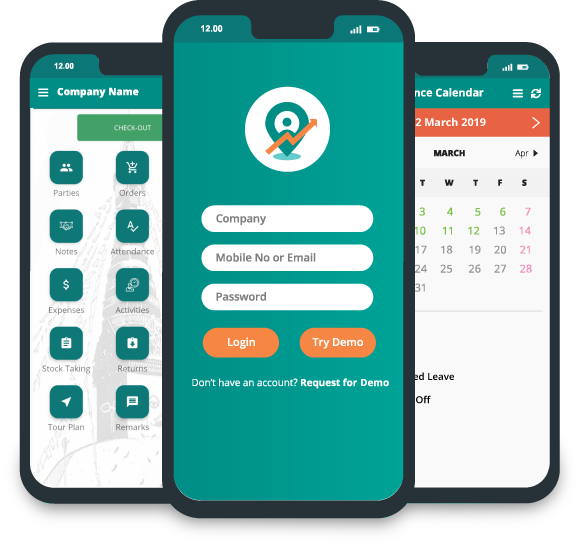

Top 7 Field Sales Challenges Solved with GPS-Based Tracking Apps
-1787290750.png)
A sales rep may be marked as "present," a visit may be reported as "completed," and a daily report may show impressive numbers, but the reality on the ground may be a very different story.
Did the sales rep really call on the retailer? Did they stick to the route? How long did it take to travel from customer to customer? Which regions are well covered and which are neglected?
Field sales managers can have a hard time answering these questions without dependable location data. This is where GPS-based tracking apps for field sales come into play. “Using GPS technology, businesses can get a real-time view on field activity and increase sales team accountability instead of just manual reports, phone calls, spreadsheets, or end-of-day updates.”
GPS tracking can help solve many operational issues that affect field sales productivity, from preventing fraudulent field visits to enhancing territory management.
In this blog, we will go over the top 7 field sales challenges and how to solve them with GPS-based tracking apps. We will also go over the key features and benefits that businesses should look for in a field sales tracking solution.
What Is a GPS-Based Tracking App for Field Sales?
A GPS-based tracking app for field sales is a mobile app that uses location data to help businesses monitor and manage employees who work outside the office. For sales teams, that can mean:
-
Current or recent sales representative locations
-
Customer visit locations
-
Visit duration
-
Travel routes
-
Attendance locations
-
Planned versus completed visits
-
Territory coverage
-
Field activity data
Unlike a traditional attendance system or a manual sales report, this kind of app ties location data directly to what's actually happening in the field. That gives managers a real picture of the market instead of a secondhand summary. For companies running reps across multiple territories, cities, distributors, retailers, or customer locations, that visibility makes day-to-day sales operations a lot easier to manage.
How GPS Tracking Apps Work
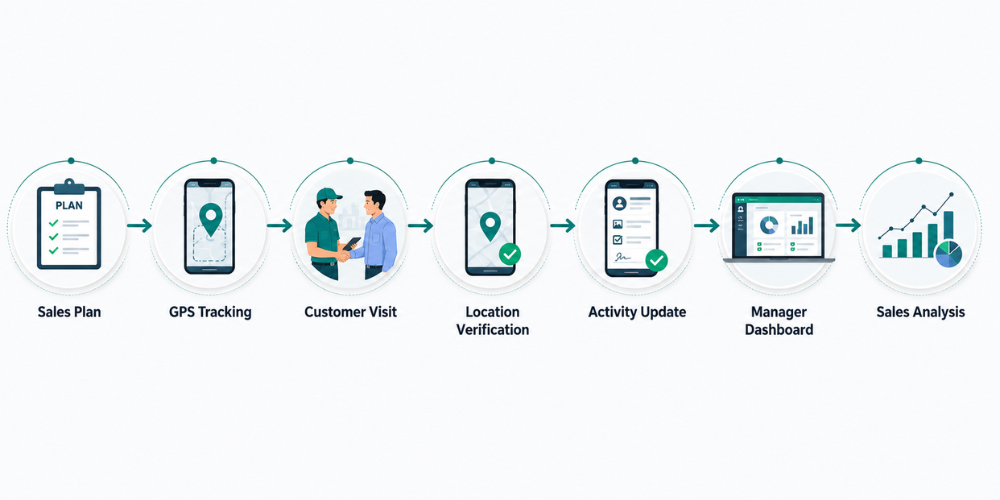
Most GPS tracking apps run on a mix of mobile GPS, location services, geofencing, timestamps, and field activity records. When a rep reaches a retailer, the app captures their location and matches it to the scheduled visit. Depending on the software, the rep might also need to log an order, snap a visit photo, update customer info, or complete some other activity. All of that syncs to a central dashboard where managers can watch field operations as they happen. A typical workflow looks something like this:
Why Field Sales Teams Need One in 2026
Field sales operations are evolving to become more decentralized. In today’s landscape, a single sales team might have representatives engaging with hundreds of customers across various regions. As the team expands, managing these interactions manually can become overwhelming. Sales managers require more than just a basic attendance log; they need a clear view of field sales activities, customer interactions, travel routes, territory coverage, and overall sales effectiveness.
Implementing GPS-based tracking can significantly enhance this visibility, minimizing the reliance on manual updates. For organizations looking to improve their field sales management software, integrating GPS tracking can play a crucial role in streamlining the entire sales automation process.
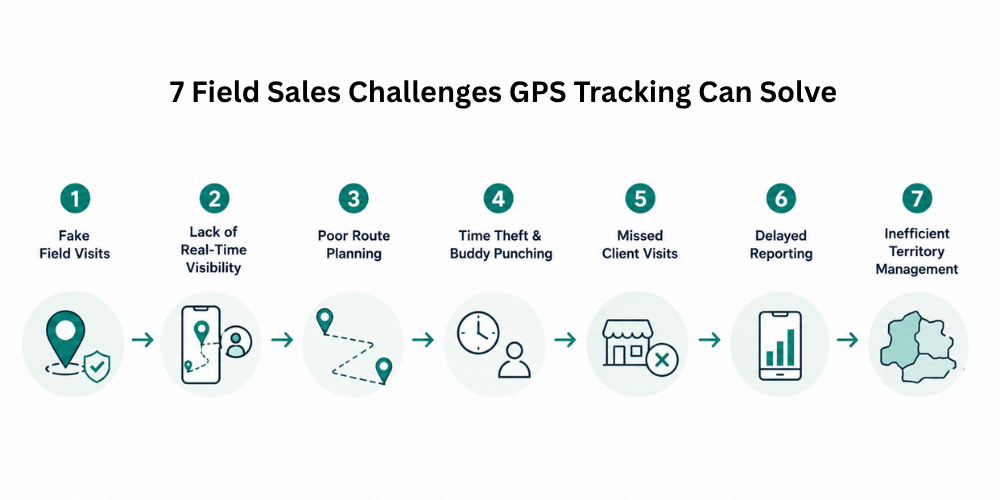
Top 7 Field Sales Challenges Solved by GPS Tracking Apps
GPS tracking is not simply about knowing where a salesperson is. When combined with attendance, visit management, route planning, customer information, and reporting, it can address several everyday challenges faced by field sales teams. Here are seven of the most common ones.
1. Fake or False Field Visits
One of the biggest issues with manual field reporting is that managers might have trouble trying to verify a customer visit actually happened. A representative could report a completed visit without physically visiting the customer location. In a spreadsheet, basic reporting process, or paper-based system, it can be time-consuming to verify the claim. Customer visits can be linked with location data through a sales app with GPS functionality.
The system can record the geographical position of a representative when they check in at a customer site. Companies can set up a geofence around a customer location and then check whether or not the representative was in that area. Visit timestamps and other field activity records can give context. This helps companies move from “The rep says the visit occurred” to “The system has location-based proof of the visit.” That distinction can do much to increase field sales accountability.
2. Lack of Real-Time Visibility Into Sales Reps
A manager can't physically follow every rep around all day. When teams are spread across multiple territories, most managers end up relying on phone calls, WhatsApp messages, or end-of-day reports to piece together what actually happened, and those methods only tell you so much in real time.
A GPS-based sales rep tracking app gives managers a centralized view of field activity within whatever tracking and privacy settings the app allows. That can mean better visibility into:
-
Representative movement
-
Customer visits
-
Visit status
-
Attendance
-
Planned activities
-
Territory coverage
-
Field productivity
The real value is catching problems while the day is still happening instead of finding out about them the next morning. If an important customer hasn't been visited by early afternoon, a manager can spot that gap and do something about it, rather than reading about it in a report after the fact.

3. Poor Route Planning and Wasted Travel Time
Sales representatives often find themselves on the road for a large part of their day, visiting various customers. However, if their travel routes aren't well thought out, it can lead to several issues:
-
Backtracking unnecessarily
-
Increased travel distances
-
Missed customer visits
-
Overlooked customer visit expenses
-
Reduced hours for actual selling
Utilizing GPS tracking can provide valuable insights into how representatives navigate their territories. When this data is paired with route planning software, beat planning, and customer location information, managers can develop more effective field schedules. For instance, rather than assigning visits to five customers spread out over a vast area, a sales manager can group visits by their proximity to one another. This approach creates a more organized sales route, minimizing wasted travel time and maximizing opportunities for selling. This strategy is especially beneficial for FMCG companies, where representatives may need to connect with numerous retailers, distributors, wholesalers, and other outlets daily.
4. Time Theft and Buddy Punching
A traditional attendance system can confirm someone clocked in, but it usually can't tell you where they actually were when they did it. Buddy punching, where one employee marks attendance for another, makes the problem worse. GPS-enabled attendance fixes this by tying the attendance record to an actual location.
A rep might be required to mark attendance only from an approved location, for instance. Geofencing lets a business restrict attendance or certain activities to a defined area, and some platforms pair GPS attendance with a selfie check for an extra layer of verification. Between the two, it gets a lot harder to fake an attendance record and easier for a manager to tell genuine field presence from something that doesn't add up.
5. Missed or Delayed Client Visits
Customer coverage is critical for field sales. A missed visit may mean a delayed order, an overlooked merchandising issue, an unresolved customer complaint, or a competitor gaining an advantage. Yet managers often discover missed visits only after reviewing end-of-day reports. GPS-enabled field sales software can connect planned visits with actual field activity. Managers can compare:
Planned visits → Actual visits → Missed visits → Rescheduled visits
This creates a more structured approach to customer visit management. For businesses using beat plans, GPS tracking can also help managers understand whether representatives are following their assigned customer coverage plans. Instead of relying on memory or manual reports, managers can use actual field activity data to improve future schedules.
6. Delayed Reporting to Sales Managers
Delayed field reporting is another common problem. A sales rep might complete a few customer visits and update everything at the end of the day. This may be efficient, but managers have very little visibility during working hours. Late reporting can impact decision-making. For example, the manager of a large retailer might discover a problem with stock availability only a few hours after the visit. With mobile field sales management apps, reps can update customer visits, orders, activities, and other information right from the field. GPS data can provide some context around those activities. This allows managers access to more up-to-date information rather than waiting for paper reports or manually consolidated spreadsheets. Pulling field activity data into a centralized dashboard also reduces the administrative work for organizations looking to automate daily sales reports.
7. Inefficient Territory Management
Territory management gets harder as an organization grows. A manager needs to know things like:
-
Which reps are covering which territory
-
How often customers are actually being visited
-
Which areas have thin coverage
-
Whether reps are spending too much time driving instead of selling
-
Whether the important accounts are getting enough attention
-
Where new customers should be assigned
Without solid field data, a lot of those decisions end up based on guesswork. GPS tracking gives managers real geographical activity data to work from instead. Combine that with customer records, sales numbers, visit frequency, and rep performance, and a business can actually spot coverage gaps and fix territory assignments instead of guessing at them.
That's what makes territory management software genuinely useful: managers aren't staring at a customer list in isolation anymore. They can weigh customer coverage against what's actually happening in the field.
Key Benefits of Using a GPS Tracking App for Field Sales
The value of GPS tracking goes beyond simply monitoring employee locations. When implemented as part of a broader field sales automation strategy, it can improve accountability, productivity, and decision-making.
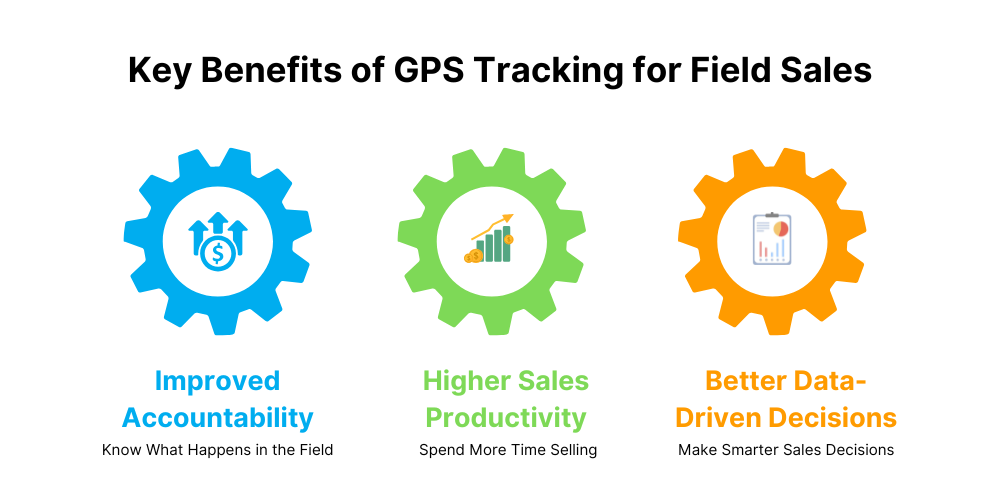
Improved Accountability
GPS-based activity records create greater transparency between planned work and completed work. Managers can better understand:
-
Where field activities took place
-
When visits happened
-
Which customers were visited
-
Whether planned routes were followed
- Which visits were missed
This creates a more accountable field sales environment without requiring managers to constantly call representatives for updates.
Higher Sales Productivity
Time spent on unnecessary travel, report preparation, or fixing attendance discrepancies is time that could be spent selling. GPS tracking can help you plan better routes, cover customers, plan visits, and manage field activities. “By spending less time on administrative work and unnecessary travel, representatives can, potentially, spend more time with customers. This can be particularly useful for FMCG organizations where sales representatives have to manage a large number of outlets on a daily basis.
Better Data-Driven Decisions
One of the key benefits of digital field sales tracking is the wealth of operational data it produces. Rather than depending solely on subjective reports, managers can gain a clearer picture by examining field activities in conjunction with sales performance. For instance:
Location data + Visit data + Order data + Customer data = Enhanced understanding of field sales
These insights empower businesses to pinpoint areas that need improvement, enhance customer engagement, streamline travel routes, and allocate sales resources more efficiently.
How to Choose the Right GPS Tracking App for Your Sales Team
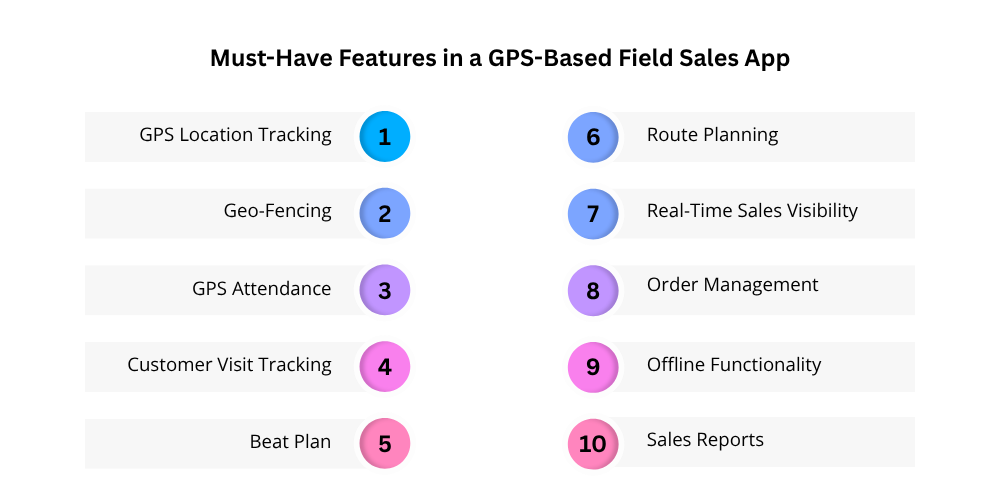
Not all GPS tracking applications cater specifically to field sales needs. While a simple employee location tracker can indicate someone's whereabouts, an effective field sales platform integrates location data with relevant sales activities. When assessing software options, consider factors beyond just GPS tracking. Must-have features to look for in a strong GPS-based field sales solution should ideally include:
-
GPS Location Tracking
GPS-based employee location tracking gives managers insight into the whereabouts and daily activities of sales representatives. This enables them to see where representatives are operating, the regions they are servicing, and if scheduled field tasks are being executed as intended.
-
Geo-Fencing
Creates a virtual perimeter around a customer, retailer, distributor, or office site. The system can validate the presence of a representative in the defined area when they enter it. This geo-fencing is useful to validate customer visits and improve field accountability.
-
GPS-Based Attendance
Links attendance records to where representatives are located. Rather than depending solely on a manual check-in, managers can easily view the locations where attendance was recorded, fostering a more trustworthy approach to tracking field sales attendance.
-
Customer Visit Tracking
Records planned and completed customer visits along with relevant visit details. This helps managers compare scheduled visits with actual visits, identify missed customer visits, and maintain better visibility into daily field activities.
-
Beat Plan Management
Empowers sales managers to thoughtfully plan customer visits by considering territories, customer locations, and established routes. A well-structured beat plan enables representatives to connect with the right customers consistently, minimizing unnecessary travel and enhancing their overall experience.
-
Route Planning
Enhances travel planning by arranging customer visits in a sensible order. Improved route planning minimizes redundant travel and time wasted, enabling representatives to focus more on engaging with customers and driving sales.
-
Real-Time Sales Visibility
Empowers managers with real-time insights into field activities and sales operations, eliminating the need to wait for end-of-day reports. This enables managers to quickly spot missed visits, engage in meaningful follow-ups on key activities, and address field challenges with greater urgency and understanding.
-
Order Management
Empowers sales representatives to effortlessly record customer orders right from the field, whether during or after a visit. By integrating order management with customer interactions and field activity data, businesses can create a seamless sales process that flows smoothly from customer engagement to order fulfillment.
-
Offline Functionality
Field teams frequently find themselves in locations where mobile internet can be spotty. With offline field sales software, representatives can keep track of their activities, customer visits, and orders even when they’re not connected to the internet. Once they regain connectivity, all their data syncs seamlessly, ensuring nothing is lost, and they can focus on building relationships with customers.
-
Sales Reports and Analytics
Transforms field activity and sales data into insightful reports for managers. By examining visits, orders, customer interactions, attendance, and representative engagement, businesses can uncover performance gaps and make smarter, more empathetic sales decisions.
-
Territory Management
Enables businesses to thoughtfully categorize customers and sales representatives by geographical regions. By fostering effective sales territory management, organizations can more compassionately assign accounts, ensure adequate coverage, recognize areas that need attention, and equitably distribute workloads among the field team, ultimately enhancing relationships and service quality.
Why Choose Delta Sales App for Your Field Sales Team
Running a field sales team takes more than just knowing where reps are. Managers need to know whether visits are actually happening, how efficiently territories are being covered, whether attendance is genuine, and how all of that adds up to actual sales performance.
-(1)-1787029208.png)
Delta Sales App brings those pieces together in one platform, giving businesses more visibility and control over their sales teams.
Its GPS tracking lets managers watch field activity, and features like GPS attendance, geo-fencing, customer visit tracking, beat planning, and route planning tie location data to what's actually happening on the ground. So a manager isn't just seeing a dot on a map; they're seeing what the rep is getting done.
The app also handles order management, retailer management, inventory tracking, secondary sales tracking, expense reporting, payment collection, and sales reporting. With all of that in one system, teams can cut way down on paper processes, spreadsheets, and apps that don't talk to each other.
For teams spread across multiple territories, it also gives a clearer view of customer coverage and rep performance. Managers can use the field data to catch missed visits, tighten up routes, review coverage, and make decisions based on what's actually happening rather than a guess.
One feature worth calling out: it works offline. Reps often end up somewhere with no signal, and being able to keep recording activity and sync it once connectivity comes back keeps the data continuous instead of full of holes. At the end of the day, the point of Delta Sales App isn't just tracking reps. It's connecting GPS tracking, attendance, customer visits, order taking, route planning, and sales reporting into one workflow that actually works together.
If you want better field visibility and sales operations that are more structured and data-driven, Delta Sales App is a practical way to pull all of that into one platform.
Conclusion
Managers can’t always be there for field sales teams; they’re on the road, in retail outlets, at distributor locations, and in customer territories. Visibility is one of the biggest challenges in field sales management, therefore. Many day-to-day problems, such as false visits, bad route planning, late reporting & poor territory coverage, are associated with a lack of reliable field activity data. A field sales tracking app with GPS can help solve these challenges by associating location information with attendance, customer visits, routes, sales activities, and reporting. But GPS tracking is most effective when it is part of a total field sales management system, not a stand-alone tracking tool. If you need to improve field visibility, tighten sales team accountability, and manage customer visits more effectively, it might be time to move away from manual field reporting.
Schedule a free demo of Delta Sales App and learn how GPS-enabled field sales automation can help your team improve the management of field activities.