
WhatsApp for field sales teams: useful tool or distraction?
Walk into any FMCG distribution company's office in South Asia, Southeast Asia, or Sub-Saharan Africa and you will find the same thing: a sales manager furiously scrolling through WhatsApp groups, piecing together his team's daily coverage like a detective assembling clues. Somewhere in those 200-odd unread messages is Ravi's order photo from retailer #34, an excuse from Deepak about why he missed three beats, and a blurry image of a stockout that nobody can trace back to an SKU.
This is the unglamorous reality of field sales management for millions of FMCG businesses around the world. WhatsApp, the app built for messaging your aunt and sending memes, has become the de facto field force management tool for companies that move everything from biscuits to beverages to personal care products across thousands of retail outlets.
But is it actually working? Or are we all just too accustomed to the chaos to notice how much it's costing us?
Key Stats at a Glance:
- 68% of field sales reps use WhatsApp as their primary reporting tool
- 2.4 hours - average time per day field reps spend on non-sales communication tasks
- ₹3.2 Lakh - estimated annual revenue lost per rep from poor order tracking and missed visits
WhatsApp is undoubtedly powerful. With more than 3 billion users globally and massive business adoption, it has become one of the most active communication platforms in the world. India alone has hundreds of millions of WhatsApp users, making it one of the most accessible communication channels for retailers, distributors, and sales reps.
At the same time, FMCG businesses are growing more complex. Quick commerce is reshaping buying behavior, retail competition is increasing, and field sales teams are expected to do more in less time.
This blog explores the real role of WhatsApp in FMCG field sales operations, where it helps, where it fails, and how businesses can use it smartly without letting it replace proper sales force automation systems.
The WhatsApp Reality in FMCG Field Sales
To be honest: WhatsApp was never a strategic choice for field sales. It just happened naturally. Field reps already had it on their phones, managers could instantly communicate without enterprise software, and no one needed training. For an FMCG distributor with limited resources managing 15 reps across 400 outlets, it felt like a miracle tool.
And in many ways, it was, for a while. But as teams scaled, product lines expanded, and retailer coverage deepened, the cracks began to show. What started as a convenient shortcut became a structural bottleneck embedded in daily operations.
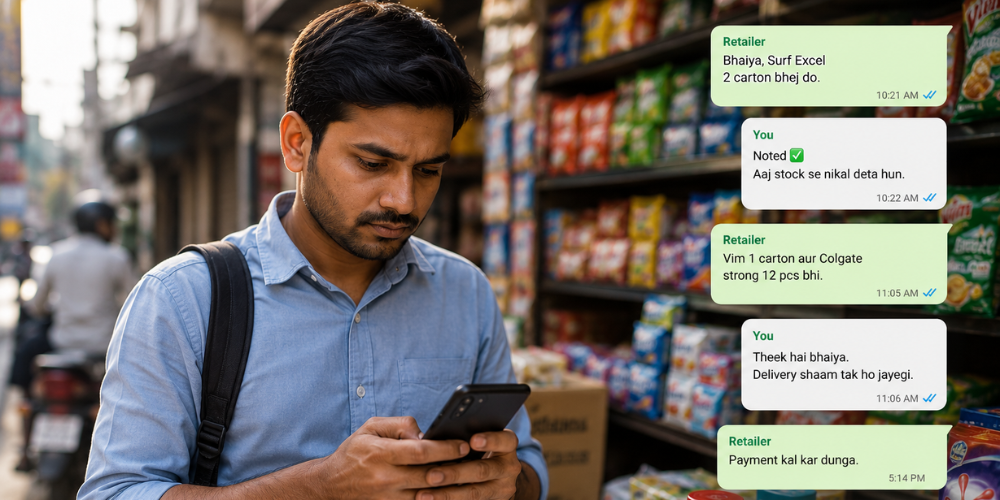
"I have six WhatsApp groups for my sales team, one for each zone. By 10 AM every morning, I have over 300 messages. I cannot tell you who visited which retailer, whether an order was fulfilled, or why coverage dropped last Tuesday. I'm managing chaos, not sales." Regional Sales Manager, FMCG Distributor, Mumbai
This experience is not an outlier. It is the norm across the FMCG industry wherever field sales teams operate without structured field sales management software.
Why Sales Teams Love WhatsApp (And Why That's the Problem)
But before we condemn it, we need to give WhatsApp its due. Field reps and managers have rallied around it for good reasons.
-
No structured order data
WhatsApp can take an order, but only as a photo, text or voice note No standard format. No SKU validation. No automatic system entry. That means every order still has to be manually interpreted and re-entered into another system. This results in delays, higher human error and does not provide a clean, searchable way to track the order history in FMCG operations.
-
Zero GPS visit verification
A rep can say, “I visited the outlet,” and even send a photo, but there’s no way to verify where or when it actually happened. Field activity without GPS based validation is a report based on trust, not evidence based tracking. This means for FMCG managers there is no reliable way to validate actual outlet coverage or field execution.
-
No beat planning or route optimization
Beat plans are crucial in FMCG to ensure all outlets are covered efficiently. WhatsApp cannot allocate routes, monitor daily visits or verify if the planned beat has been followed. As a result, reps often choose their own routes based on convenience, traffic or preference, leading to inconsistent coverage and missed outlets.
-
Cannot generate sales reports
WhatsApp has conversations, not analytics. It can’t calculate secondary sales, track SKU performance, measure rep productivity or create dashboards. Managers must pull data from messages manually, resulting in reporting that is slow, reactive and often stale by the time it’s ready.
-
No attendance or leave tracking
Attendance often amounts to a “Good morning sir” message or location pin. But WhatsApp doesn’t have a structured check-in system, geo-verification and leave workflow. This means workforce tracking is informal and unreliable especially for large field teams where accountability is critical.
-
Messages are lost and irretrievable
Orders, complaints, approvals, important updates get lost in a group chat with hundreds of messages a day. There is no tagging, filtering or retrieval system whatsoever. Later when teams need the information, they end up scrolling forever or asking again, creating repetition and confusion.
The Hidden Costs Nobody Talks About
Here is where the conversation gets uncomfortable for FMCG owners. The costs of running your field sales operations on WhatsApp don't show up as a line item on your P&L. They hide inside revenue leakage, unverified claims, and management time burned on administrative work that should be automated.
- No Real-Time Visibility Into Field Activity
If your rep sends you a photo of a store visit, you don’t know if it was taken at the actual outlet, at what time, or if the rep even spoke to the retailer. Without GPS-based field tracking, you are simply trusting people, and in competitive FMCG markets, trust can come at a steep price.
- Order Data That Lives Nowhere Useful
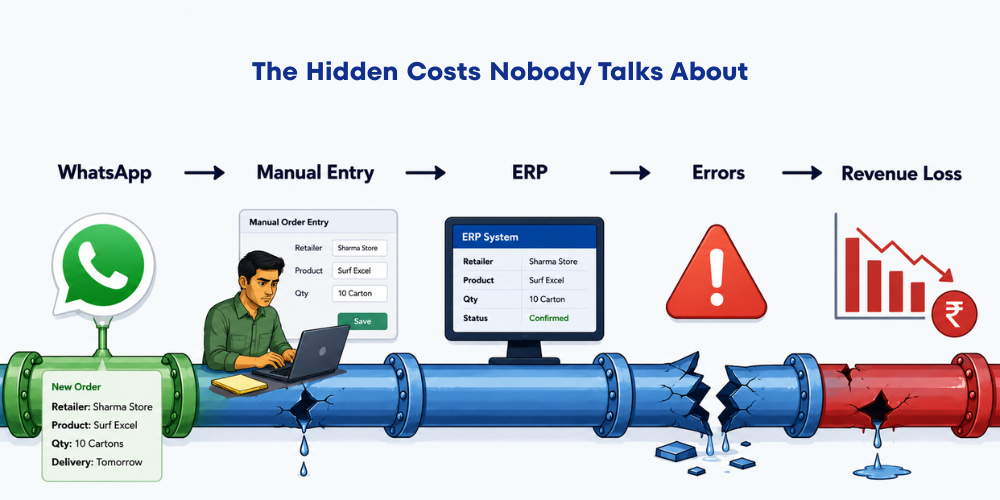
A rep takes a photo of a handwritten order and forwards it to the WhatsApp group. You must now type this order into your ERP or billing system manually. Every link in this chain adds delay, error and labor cost. With a team of 20 reps taking 15 orders each per day, you’re looking at hundreds of manual data entry points every day.
- Beat Plans Exist on Paper Or Not at All
Great FMCG coverage means disciplined beat planning and structured routes that mean every retailer is visited with the right frequency. WhatsApp can't enforce a beat plan. Reps visit who they want, when they want, and the manager has no real-time visibility until the end of the day or week.
- Built-in Engagement:
WhatsApp is designed to be addictive. Constant interruptions with notifications, group activity, and personal messages. A field rep bouncing between the office WhatsApp group, personal conversations, and customer chats is not selling. Research from the University of California, Irvine, shows that it takes an average of 23 minutes to fully refocus after a digital interruption, a devastating statistic for a rep with 20 outlets to cover in a day.
Industry data suggests FMCG distributors using WhatsApp-based reporting miss an average of 12–18% of potential outlet coverage per week due to unverified visits, ad-hoc routing, and poor follow-up on retailer requests. On a ₹50 lakh monthly turnover, that's ₹6–9 lakhs of accessible revenue left on the table every single month.
A Day in the Life: The Field Rep's Perspective
Let’s take a typical day in the life of Suresh, a field sales rep at a mid-sized FMCG distributor covering 22 retailers in an urban territory.
7:45 AM: Suresh wakes up to 47 WhatsApp messages ; 23 in the sales team group, 14 personal, and 10 from the manager's broadcast. He reads the important ones and misses two. His beat plan for the day was shared in the group last week, but he has to scroll up to find it.
9:30 AM: At his third retailer, he takes a photo of the order on a notepad and sends it to the group. The photo is blurry. He sends another one. Both sit unprocessed until the office admin transcribes them at 2 PM.
11:00 AM: His manager messages, asking for a "coverage update." Suresh stops mid-conversation with a retailer to type a status message. The retailer, irritated, cuts the meeting short.
3:30 PM: Suresh skips two retailers because traffic has made them time-inefficient. He doesn't flag this. His manager won't know until the weekly coverage review, if it gets reviewed at all.
5:45 PM: His end-of-day report is a voice note. Useful for context, useless for data.
Suresh isn't a bad rep. He's a capable rep working inside a broken system. The problem is not people; it's process and tooling.
What the Numbers Look Like for FMCG Sales Managers
From the manager's seat, the picture is equally frustrating. Consider what a regional sales manager or FMCG business owner needs to know every single day:
- Which retailers were actually visited vs. planned?
- How many orders were placed and what is the total value?
- Which SKUs are moving fast and which are stuck?
- Are reps hitting their beat plan or self-routing?
- Which reps checked in on time, and who is reporting late?
- Which retailers are overdue for a visit?
None of this is extractable from WhatsApp without enormous manual effort. And the uncomfortable truth is most managers don't even attempt to extract it. They operate on gut feeling, anecdote, and end-of-week summaries that are already outdated.
How Delta's Sales App Bridges the Gap That WhatsApp Could Not
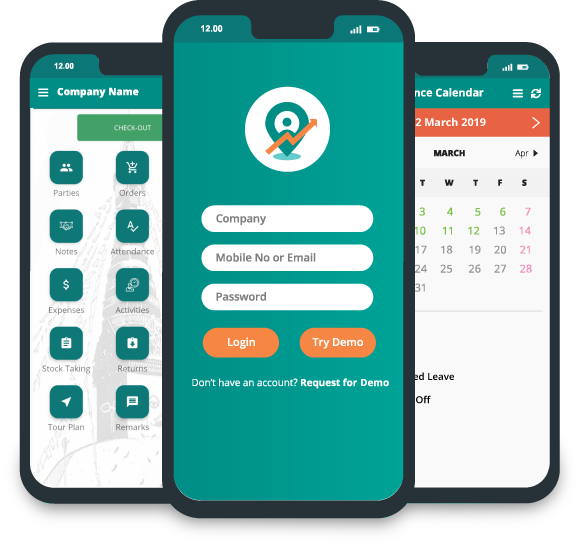
WhatsApp got your team talking. Delta Sales App gets your team performing. The goal here isn't to take away a tool your reps are comfortable with, it's to give them something that actually supports the work WhatsApp was never designed to handle. Think of it as the missing layer between your team's daily hustle and the business results you need to see.
Here's where Delta Sales App steps in and fills the gaps that have been quietly costing you.
- Real-Time GPS Tracking & Live Location
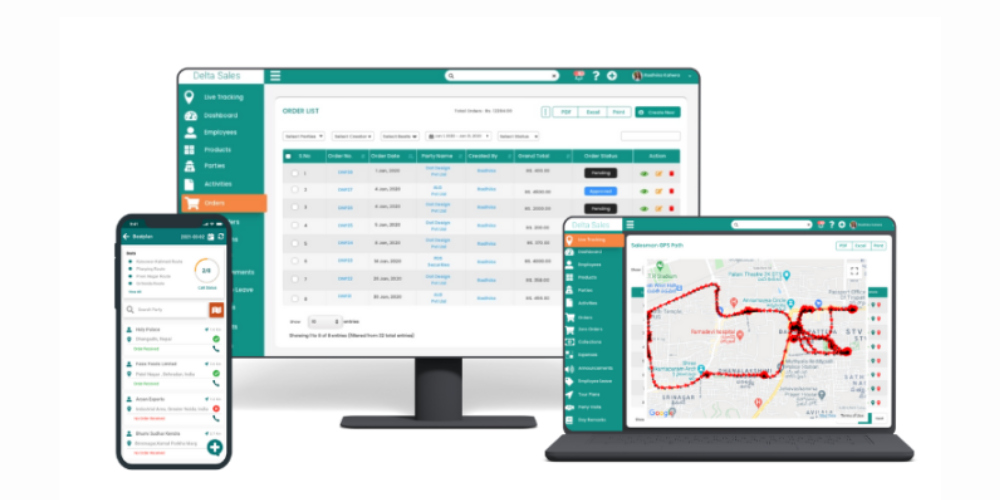
WhatsApp allows a rep to send a location pin, but that’s one point in time, manually sent, and easily spoofed. GPS-based field tracking in Delta Sales App automatically geo-stamps and time-stamps each outlet visit. Managers have a live map view of their whole team without having to ask, chase, or wait for an update. What's the difference between "I went to the outlet" and provable, verifiable coverage? Closed.
- Digital Order Management
WhatsApp got order photos closer to real time, but the order still had to be read, typed up and entered somewhere else by someone else. That’s where the Delta Sales App’s Order Management System comes in. Reps enter orders in a structured digital format: SKU, quantity, and retailer, and it flows right into your system. No transcription. No delay. No lost photos buried in a chat thread.
- Beat Planning & Route Optimization
WhatsApp could send a beat plan as a PDF or message. But it could never enforce it or track it or flag it when it’s being ignored. The beat planning module and route optimization feature in the Delta Sales app shows reps their route for the day and tracks how much of the route they have completed. Most of the FMCG coverage loss happens in that gap between a plan that was shared and a plan that was really executed.
- Attendance & Daily Check-In
A "good morning" message in the group was never real attendance. Delta Sales App replaces that with geo-verified check-ins that are automatic, accurate, and auditable. No more guessing who started late, who was in the field, or who filed a claim for a day they weren't working.
- Sales Performance Dashboard
WhatsApp, when reps remembered to send you updates. The Delta Sales App gives you a live dashboard of order value, coverage rate, SKU performance, rep rankings, and more, that updates live without anyone having to type a single message. The difference between info you had to ask for and info you always have?
- Expense & Claims Management
Reps were already sending expense photos on WhatsApp. The expense reporting system takes that same habit and wraps a proper workflow around it, structured submission, manager approval, payment tracking, and a full audit trail. Same behavior, zero chaos.
Is WhatsApp a Useful Tool or a Distraction?
In FMCG field sales, WhatsApp is often assumed to be a helpful communication tool. But when you look at how field operations actually run at scale, the answer becomes very clear:
Yes: WhatsApp is a distraction when used as a field sales system.
Not because communication is bad, but because WhatsApp slowly replaces structured execution with unstructured conversations. And in FMCG, unstructured work always leads to unmeasured losses.
At first, it looks efficient. Messages are instant, updates are real-time, and everyone feels connected. But underneath that speed, critical sales processes start breaking quietly, without alerts, without reports, and without visibility.
The problem is simple: WhatsApp was built for communication, not control. And FMCG field sales requires both.
Here is what actually happens inside most field teams and why WhatsApp slowly stops being a communication tool and starts becoming an execution problem:
Orders are sent as photos or messages, not structured data
Instead of a proper order system, reps simply send photos of notebooks or type quantities in chat. On the surface, it looks quick and flexible. But in reality, it creates a broken data flow.
Someone in the office still has to read, interpret, and manually enter everything into a system. This leads to delays, transcription errors, missed SKUs, and no proper order history. Over time, businesses lose visibility into what was actually ordered versus what was processed.
Retail visits are “claimed” but not verified
A rep can easily send a message like “Visited outlet” or drop a location pin but there is no proof of actual presence or timing.
Without GPS-based verification, field activity becomes trust-based reporting. This means managers cannot confirm:
-
whether the visit actually happened
-
how long the rep stayed
-
or if the retailer interaction took place
So field coverage becomes something that is reported, not something that is proven.
Managers track performance through chat history instead of dashboards
Instead of structured reports, managers are forced to scroll through hundreds of messages to understand what happened in the field.
Performance questions like:
-
Who achieved targets?
-
Which outlets were covered?
-
What was the order value?
…are answered manually by digging through chat threads.
This turns decision-making into guesswork based on incomplete information rather than real-time dashboards.

Follow-ups depend on memory, not workflow systems
WhatsApp does not remind, prioritize, or track pending actions.
So follow-ups become human-dependent:
-
“I think I told him to revisit that retailer”
-
“I saw that message somewhere yesterday”
-
“Let me scroll and check”
Important tasks easily slip through because there is no structured workflow, no escalation system, and no task accountability. Memory becomes the system and memory is unreliable at scale.
Important updates get buried under daily message overload
Every day, dozens or even hundreds of messages flow through multiple groups , orders, memes, voice notes, clarifications, and repeated instructions.
In that noise, critical updates like:
-
scheme changes
-
pricing updates
-
stock availability alerts
get buried and are often missed entirely. What was meant to improve communication ends up reducing clarity.
Teams spend more time responding in groups than selling in the field
Field reps are constantly switching between:
- retailer conversations
- manager updates
- group messages
- voice notes
This creates a fragmented work pattern where attention is divided all day.
Signs Your Field Sales Team Has Outgrown WhatsApp
Every growing FMCG business hits this point. WhatsApp didn't fail you, it actually did its job well enough to help you get here. But there's a version of your business that's bigger, faster, and better covered than what a group chat can support. The signs are usually there long before most owners act on them.
Check how many of these sound familiar:
- You have more than 5 field reps and by mid-morning you've already lost track of what everyone is doing and where they are.
- Your order data is inconsistent, delayed, or has to be manually entered into another system by someone in the office.
- You suspect certain retailers are being under-visited or skipped entirely but you have no data to confirm or challenge it.
- Compiling your reps' daily updates into something meaningful takes 30 or more minutes of your time every single day.
- You've launched a scheme or promotion and have no reliable way to know whether it's actually being executed on the ground.
- Your team has grown and managing multiple WhatsApp groups has started to feel like a second job.
- Expense claims and conveyance disputes keep coming up because there's no clean, verifiable record of what happened in the field.
If three or more of these hit close to home, the issue isn't your team, it's the tool. WhatsApp helped you build the foundation. Now your business needs infrastructure that can grow with it.
The Future of FMCG Field Sales Is Integrated, Not Fragmented
The future of FMCG field sales is moving away from scattered tools, disconnected communication, and manual tracking toward a fully integrated sales ecosystem where every activity is connected in one system. Today, many companies rely heavily on WhatsApp, Excel sheets, phone calls, and separate apps for reporting, orders, attendance, and distributor communication. While this may work in the early stages, it creates fragmentation as the sales team grows, data gets split across platforms, visibility reduces, and decision-making becomes slower.
 \
\
An integrated field sales approach brings everything together in one place: beat planning, order booking, retailer management, secondary sales tracking, GPS-based attendance, and real-time reporting all flow into a single system. This not only improves operational clarity but also helps FMCG leaders make faster, data-driven decisions without relying on incomplete or delayed information.
In simple terms, the future is not about using more tools; it is about using one connected system that replaces confusion with clarity and transforms field activity into actionable insights. This shift is what allows FMCG companies to scale efficiently, reduce communication noise, and ensure every field effort directly contributes to sales growth.
Conclusion: WhatsApp Is a Communication Tool, Not a Sales Tool
WhatsApp is not the villain here. It is a genuinely excellent messaging application that has brought enormous value to millions of businesses. The problem arises when we ask it to be something it was never designed to be: a field force management platform. The FMCG industry is too competitive, margins are too thin, and retailer relationships are too valuable to leave field sales operations running on an informal communication thread. Every unverified visit, every lost order, and every uncovered beat is a direct cost to your business, and it compounds quietly, invisibly, every single day.
WhatsApp will remain useful for what it was built for: team announcements, quick questions, and relationship-building with retailer contacts. But field sales operations deserve dedicated infrastructure. Your competitors are building it. The question is whether you will too.
Ready to move beyond WhatsApp?
Book Your Free Demo Here and see how Delta Sales App gives you real-time GPS tracking, digital order management, beat planning, and sales analytics, all in one platform built for FMCG field teams.