
Why Is Geo-Based Sales Planning Important?
-1786859020.png)
Imagine a sales team of 50 reps, but there is no real way to know if all markets are being covered well. Some areas are regularly visited, and some are just completely abandoned. Some areas are regularly visited, and some are just completely abandoned. Sales reps spend more time traveling than connecting with customers, and managers struggle to identify the territories with the most growth potential. Sales reps spend more time traveling and time traveling than connecting with customers, and managers struggle to identify the territories with the most growth potential. customers, and managers struggle to identify the territories with the most growth potential.
These are typical problems for companies that rely on manual territory planning or old spreadsheets.
Here is where geo-based sales planning makes a difference. It’s a game-changer that leverages location data to intelligently organize sales territories, tactically deploy field reps, and make sure each customer and market gets the attention it deserves. Instead of relying on gut feelings or hunches, companies can make fact-based decisions about resource deployment based on geography, retailer density, market potential, and sales performance. This not only helps productivity, but it also helps with territory coverage.
In this blog, we will discuss why geo-based sales planning is critical for today’s sales teams, what is not working for businesses without it, and how pioneering solutions such as Delta Sales App can help optimize territories, improve the productivity of the field, and ultimately enhance sales results.
Why Is Geo-Based Sales Planning Important for Modern Sales Teams?
Geo-based sales planning helps businesses move beyond guesswork. Instead of relying on manually created territories or outdated customer lists, managers can allocate resources based on market potential, outlet density, travel distance, and sales performance.
According to the Harvard Business Review, companies that optimize sales territories can significantly improve sales productivity while reducing unnecessary travel and operational inefficiencies. Let's explore why it matters.
1. Improves Sales Territory Coverage and Reduces Overlap
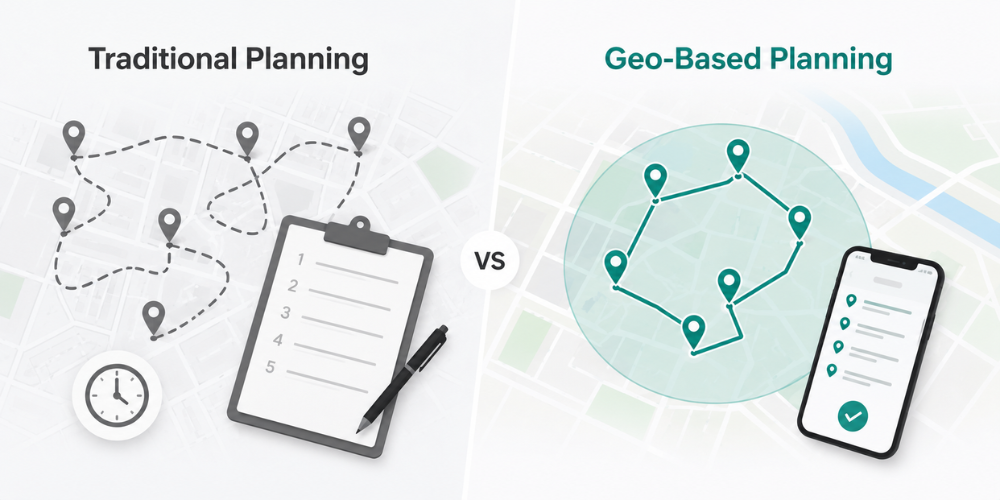
One of the biggest advantages of geo-based sales planning is its ability to create balanced and well-defined sales territories. When territories are assigned without considering geographic factors, multiple sales representatives may unknowingly cover the same area while other markets receive little or no attention. This leads to duplicated efforts, inconsistent customer service, and wasted resources. By organizing territories based on location, businesses can ensure that every market is covered efficiently. Sales representatives receive clearly defined areas, making it easier to manage customer relationships and maintain regular visit schedules. Managers also gain better visibility into territory performance and can quickly identify gaps in coverage. Geo-based planning helps businesses:
-
Ensure complete market coverage.
-
Reduce overlapping customer visits.
-
Balance workloads across sales representatives.
-
Improve retailer relationships through consistent visits.
-
Increase sales opportunities in every assigned territory.
Using sales territory management software, businesses can create, monitor, and adjust territories as markets evolve, ensuring resources are always allocated where they generate the highest value.
2. Aligns Sales Strategy with Real Market Potential
Every sales territory has its unique growth potential. Certain areas may boast a larger number of retailers, higher purchasing power, or a stronger appetite for specific products. When businesses treat all territories the same, they risk misallocating resources and overlooking valuable revenue opportunities. By embracing geo-based sales planning, companies can assess territories using actual market data instead of relying on assumptions. This approach allows managers to analyze important factors like customer density, past sales performance, outlet success, and regional demand, enabling them to focus on the most promising markets and effectively deploy their sales teams.
For example, instead of assigning the same number of sales representatives to two regions of similar size, businesses can allocate additional resources to the area with more active retailers or higher sales potential. This ensures that sales efforts are focused where they are most likely to generate results. With location-driven planning, businesses can:
-
Focus on territories that offer the most value.
-
Utilize sales representatives in a more strategic manner.
-
Boost revenue from their current markets.
-
Respond swiftly to shifts in market dynamics.
-
Foster sustainable sales growth through informed, data-driven choices.
3. Boosts Sales Rep Productivity and Accountability
Field sales representatives dedicate a considerable amount of their workday to traveling between customer sites. Ineffective territory planning frequently leads to excessive travel, convoluted routes, and diminished productive interactions with customers. By utilizing geo-based sales planning, productivity is enhanced through the assignment of nearby customers within the same territory and the establishment of efficient travel routes. This minimizes road time and enables sales representatives to concentrate on revenue-generating activities, including customer meetings, order collection, and relationship development. Companies that adopt geo-based sales planning can:
-
Boost the daily customer visits made by sales representatives.
-
Cut down on travel time and save on fuel costs.
-
Ensure that daily visit schedules are followed more closely.
-
Keep a closer eye on field activities.
-
Strengthen accountability within the sales team.
By integrating with Beat Planning Software, Field Sales Tracking Software, and Sales Force Automation Software, managers can facilitate the smooth execution of planned visits while gaining immediate insights into field operations. Geo-tracking further strengthens this process by providing real-time visibility into the location of field sales representatives. Managers can monitor movement, verify customer visits, identify route deviations, and ensure territories are covered as planned, improving both accountability and operational efficiency.
4. Enables Data-Driven Decision Making
Successful sales strategies rely on accurate data, not assumptions. Geo-based sales planning gives managers access to valuable location-based insights that help them make informed decisions about territories, customer coverage, and resource allocation. Instead of relying on spreadsheets or manual reports, businesses can analyze sales performance geographically to identify trends, compare territory performance, and uncover opportunities for improvement. These insights help managers answer important questions such as:
-
What are the top-performing territories in terms of revenue?
-
Which areas are experiencing a drop in sales?
-
Where are we missing opportunities for retailer visits?
-
Which sales team members could benefit from extra assistance?
-
Which markets present the best chances for growth?
By leveraging real-time analytics, companies can refine their sales approaches and swiftly adapt to evolving market dynamics, rather than waiting for issues to surface.
5. Reduces Costs and Improves Resource Allocation
Inefficient territory planning not only hampers productivity but also drives up operating costs. When travel distances are longer, visits are duplicated, and resources are poorly allocated, businesses face unnecessary fuel expenses, increased vehicle maintenance costs, and less time for selling.
By adopting geo-based sales planning, companies can enhance how they utilize their resources. This approach allows sales representatives to be assigned to territories that make sense geographically, minimizing unnecessary travel. Consequently, organizations can expand their reach without needing to grow their sales teams. The key benefits of this strategy include:
-
Reduced travel and transportation expenses.
-
Lower fuel consumption.
-
More effective use of field sales resources.
-
Improved return on sales investments.
-
Enhanced operational efficiency.
To fully leverage these advantages, businesses should integrate geo-based planning with route planning software, ensuring that every sales route is optimized for efficiency.
6. Helps Identify Untapped or Underserved Markets
One of the greatest advantages of geo-based sales planning is its power to uncover growth opportunities that might otherwise slip under the radar. By mapping out customer locations, sales coverage, and territory performance, businesses can spot areas where retailer visits are sparse, distributor presence is lacking, or customer demand is on the rise. These insights empower sales managers to make informed, strategic decisions rather than relying on guesswork. Geo-based planning allows businesses to:
-
Identify territories that need more attention.
-
Find new opportunities to acquire retailers.
-
Enhance distributor coverage.
-
Boost market penetration.
-
Confidently expand into regions with high potential.
Instead of waiting for sales to decline, businesses can take the initiative to discover new opportunities and strengthen their market presence using location intelligence.
Common Challenges Without Geo-Based Sales Planning
Many businesses that depend on manual territory planning, spreadsheets, or outdated sales methods often find it challenging to run their field operations smoothly. Without a strategy that focuses on location, sales managers struggle to see how well territories are being served, which makes it tough to distribute resources wisely or spot market gaps.
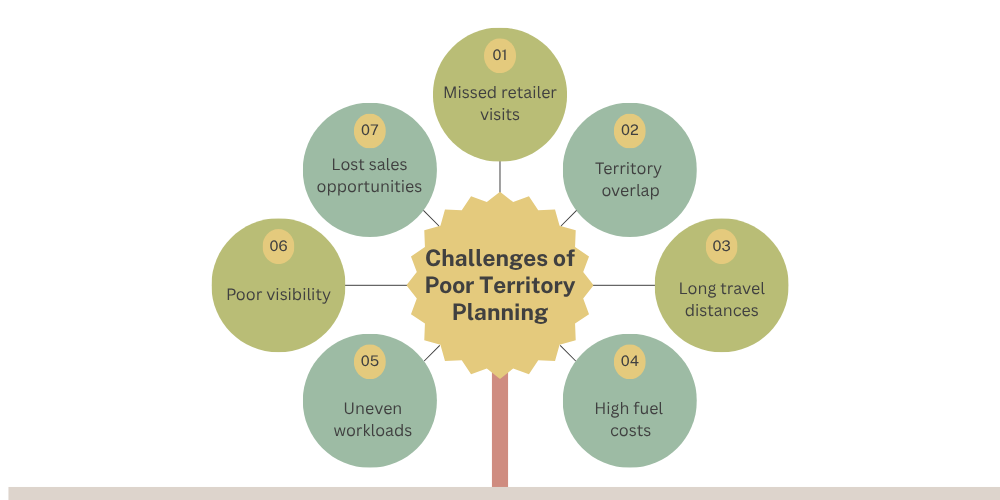
As these inefficiencies accumulate, they can result in decreased productivity, increased operating costs, and lost revenue opportunities. Here are some of the typical hurdles businesses encounter when they don't utilize geo-based sales planning.
Uneven Territory Coverage
When sales territories are not organized with geographic insights, some sales representatives may find themselves overwhelmed with more customers than they can handle, while others may be left with territories that offer limited opportunities. This uneven distribution can lead to a lack of consistent customer care, missed chances to connect with retailers, and sales resources that aren't being used to their full potential.
Overlapping Sales Efforts
When geographic boundaries aren't clearly defined, it's easy for several sales representatives to inadvertently reach out to the same customers or work within the same market. This overlap not only squanders precious time but also drives up travel costs and can lead to misunderstandings for both the sales teams and the customers they serve.
Higher Travel Time and Operational Costs
Sales territories that are not well thought out can lead to sales representatives spending excessive time on the road, traveling longer distances between customer visits. This not only cuts into their selling time but also increases costs for businesses due to higher fuel consumption, vehicle upkeep, and operational expenses. By implementing smarter geographic planning, companies can minimize unnecessary travel, allowing their sales teams to focus more on building relationships and closing deals, ultimately boosting overall productivity.
Missed Sales Opportunities
Sales managers often overlook regions that are receiving minimal attention until they notice a drop in sales. Without clear insights into market coverage, promising retailers and emerging markets can be missed, hindering the potential for business growth.
Limited Visibility into Field Activities
Monitoring field performance can be significantly more difficult when sales activities aren't tied to specific geographic areas. This can leave managers grappling with crucial questions like:
-
Which territories are consistently being served?
-
Which outlets have been missed?
-
Are sales representatives following their assigned plans?
-
Which markets require additional resources?
Without reliable location-based insights, identifying performance gaps becomes difficult.
Inefficient Resource Allocation
Sales representatives are frequently assigned based on assumptions instead of real market demand. As customer bases grow or market conditions shift, territories can become unevenly distributed, resulting in some representatives feeling overwhelmed while others have resources that go underused.
Poor Decision-Making
Without geographic insights, managers often find themselves depending on spreadsheets, manual reports, or gut feelings to make decisions about territories. This reliance can complicate the process of spotting high-performing markets, fine-tuning sales strategies, or determining where to invest for the best returns.
How Delta Sales App Simplifies Geo-Based Sales Planning
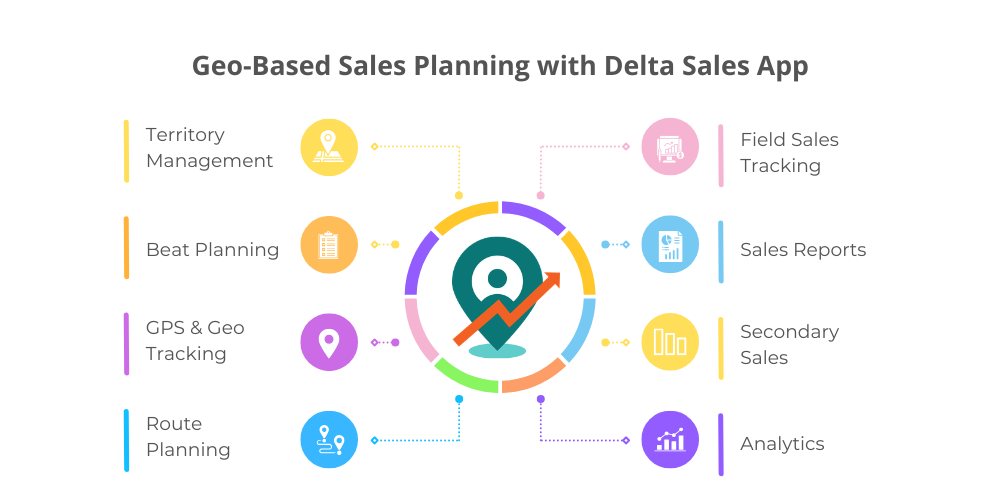
Successful geo-based sales planning goes beyond just marking customer spots on a map. Companies need a comprehensive solution that assists in territory planning, enhances field visits, tracks execution, and evaluates performance, all within one user-friendly platform. This is precisely the purpose of the Delta Sales App.
By integrating location intelligence with field sales automation, the Delta Sales App empowers businesses to move away from tedious manual planning, boost market coverage, and enable every sales representative to operate more effectively. Here’s how the Delta Sales App makes geo-based sales planning easier and more intuitive.
Create Equitable Sales Territories
Creating balanced sales territories manually can be time-consuming and often results in uneven workloads. Delta Sales App helps businesses organize territories based on location, customer distribution, and business requirements, ensuring every sales representative has a well-defined area to manage. With clearly assigned territories, businesses can:
-
Improve market coverage.
-
Reduce territory overlap.
-
Balance workloads across the sales team.
-
Strengthen customer relationships through consistent visits.
Create Smarter Beat Plans
A thoughtfully organized territory truly shines when sales representatives are clear about which outlets to visit and the order in which to do so. The Delta Sales App empowers managers to craft well-structured beat plans that enhance daily schedules and minimize unnecessary travel. By automating visit assignments, businesses can help field representatives navigate organized routes, ensuring they consistently connect with retailers. Here are some of the key benefits:
-
Enhanced daily planning.
-
Increased customer interactions each day.
-
Less time spent traveling.
-
Greater consistency in visits.
GPS tracking for field activities.
Effective planning is just one piece of the puzzle; how you execute is equally important. The Delta Sales App offers real-time GPS tracking, enabling managers to keep an eye on field activities and understand where sales representatives are throughout the day. This visibility supports businesses in several ways:
-
Confirming that customer visits have been completed.
-
Assess the performance of the field team.
-
Enhance accountability among team members.
-
Quickly address any issues that arise in the field.
With this increased transparency, managers can ensure that sales territories are being covered as intended, fostering a more connected and efficient sales process.
Optimize Sales Routes
Excessive travel can hinder productivity and drive up costs for businesses. The Delta Sales App is designed to help companies streamline their travel routes, enabling sales representatives to minimize their commute and maximize their time with customers. By optimizing routes, businesses can minimize commuting and spend more time meeting customers. Optimized routing helps businesses:
-
Shorten travel distances.
-
Lower fuel expenses.
-
Cut down on fuel costs.
-
Enhance the rate of daily visits completed.
This means that sales teams can reach more clients without extending their work hours.

Gain Real-Time Sales Insights
Effective sales planning relies on precise, real-time data. The Delta Sales App offers intuitive dashboards and reports that empower managers to keep an eye on territory performance, outlet visits, sales trends, and field productivity, all from one user-friendly platform. With these insights, businesses can:
-
Evaluate how different territories are performing.
-
Spot markets that need extra attention.
-
Assess the productivity of sales representatives.
-
Make quicker, informed decisions based on data.
Rather than relying on slow manual reports, managers can enhance their sales strategies with immediate business insights.
Monitor Secondary Sales Across Territories
Gaining insights into sales performance at both the distributor and retailer levels is crucial for uncovering market opportunities. The Delta Sales App empowers businesses to track secondary sales across various regions, allowing managers to see where products shine and where they might need a little extra care. This helps businesses to:
-
Recognize thriving territories.
-
Detect slow-moving markets.
-
Improve distributor performance.
-
Expand into underserved regions with confidence.
Conclusion
Geo-based sales planning has evolved from being a mere competitive edge to an essential strategy for businesses aiming to enhance their field sales performance. By structuring territories using geographic insights, companies can better cover markets, minimize travel time, avoid redundant visits, and direct resources to areas that yield the most significant results. When paired with a robust field sales tool like Delta Sales App, geo-based sales planning reaches new heights. It allows businesses to manage sales territories effectively, design optimized routes, monitor field activities, and assess real-time sales performance. Delta Sales App provides the necessary tools for making informed, data-driven choices that foster steady growth.
If you're eager to refine your territory management, boost your sales team's efficiency, and discover untapped market potential, Delta Sales App is here to assist.
Schedule a free demo today to see how Delta Sales App makes geo-based sales planning easier, enhances field operations, and empowers your sales team to achieve improved outcomes with every customer interaction.