
Why Are Digital Sales Tools Replacing Manual Processes?
-1786252523.png)
Every sales team wants to close more deals, but many still spend hours updating spreadsheets, searching through WhatsApp chats, filling out paper forms, or compiling reports manually. These outdated workflows slow down the sales process, increase the risk of errors, and leave managers without the real-time information they need to make quick decisions. This is one of the biggest reasons why digital sales tools are replacing manual processes across businesses of all sizes.
Manual processes are difficult to manage as companies grow their customer base and field operations. Businesses can automate repetitive tasks, improve collaboration, and gain complete visibility into their sales performance with modern sales automation software, field sales management software, and CRM tools. Sales teams can spend less time on admin work and more time building customer relationships and driving revenue.
In this blog, we’ll explore why businesses are moving away from manual sales processes, the benefits of utilizing digital sales tools, and how implementing the right solution can lead to increased efficiency, accuracy, and business growth over the long term.
What Is a Manual Sales Process?

A manual sales process depends heavily on the dedication and effort of individuals using traditional tools to manage leads, track customer interactions, and close deals, all without the support of automation or centralized software. Sales representatives often find themselves balancing spreadsheets, paper logs, sticky notes, and countless email threads to keep track of prospects and follow-ups. Although this method may be manageable for very small teams, it quickly becomes overwhelming as the business expands. Managers often discover problems only after they have already resulted in lost opportunities for the business.
Common manual sales practices include:
-
Tracking leads in Excel spreadsheets
-
Logging calls and emails manually
-
Following up based on memory or sticky notes
-
Preparing sales reports at the end of the day or week
-
Sharing updates through scattered emails or messaging apps
This lack of structure and visibility is one of the biggest reasons businesses eventually move toward digital sales tools.
What Are Digital Sales Tools?
Digital sales tools are user-friendly software solutions that simplify, automate, and enhance every step of the sales journey. Rather than depending on spreadsheets, paper records, emails, or manual data entry, these tools bring all sales activities together on one platform. This integration makes it much easier for sales teams to connect with customers, monitor their performance, and close deals more effectively.
Today’s businesses leverage digital sales tools to take care of repetitive tasks like managing leads, collecting orders, sending follow-up reminders, tracking attendance, generating reports, and forecasting sales. By minimizing manual work, these tools allow sales representatives to focus more on building relationships with customers and less on administrative tasks. Managers also gain valuable insights with real-time visibility into team performance, customer interactions, sales activities, and key business metrics, which helps them make quicker and more informed decisions. Digital sales tools come in different forms depending on a business's needs, including
-
Customer Relationship Management (CRM) software to manage customer data and interactions.
-
Sales Force Automation (SFA) software to automate field sales activities, order management, and reporting.
-
Field sales management software to track sales representatives, monitor customer visits, and optimize routes.
-
Pipeline management tools to organize and monitor sales opportunities through every stage of the sales cycle.
-
Sales analytics and reporting software to provide real-time dashboards, performance insights, and revenue forecasts.
-
AI-powered sales tools that assist with lead scoring, sales predictions, and workflow automation.
By bringing these features together in one cohesive system, digital sales tools enhance productivity, boost data accuracy, foster better teamwork, and enable businesses to provide a more personalized customer experience. Whether you're leading a small sales team or overseeing a large field force, embracing digital sales tools empowers you to grow your operations smoothly while making informed, data-driven choices.
Reasons Why Businesses Are Switching to Digital Sales Tools
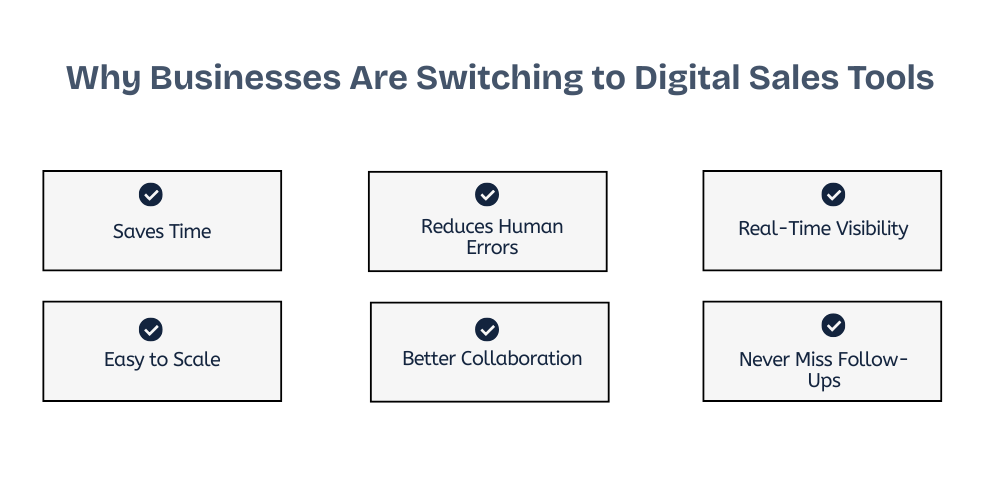
In the past ten years, the landscape of sales management has transformed dramatically. With rising customer expectations and fierce competition, businesses can no longer depend on outdated methods like spreadsheets, paper records, and fragmented communication to handle their sales processes. While manual methods might suffice for a small team just starting out, they quickly become cumbersome as the business grows. Here are some compelling reasons why companies are transitioning from these manual approaches to embracing digital sales tools:
-
Manual Processes Are Time-Consuming
Sales representatives often find themselves bogged down by the daily grind of updating spreadsheets, preparing reports, sifting through countless email threads, and entering customer information by hand. These necessary but tedious tasks eat into the precious time they could spend engaging with customers and making sales. Thankfully, digital sales tools are here to lighten the load. By automating routine tasks such as order entry, visit logging, attendance tracking, report generation, and customer information updates, these tools enable sales reps to capture data instantly on their mobile devices. This means they can dedicate more time to nurturing relationships and closing deals rather than getting lost in paperwork. Moreover, automation helps eliminate the repetitive nature of data entry, which not only reduces their workload but also boosts overall productivity. Managers benefit too, as they receive reports automatically, allowing them to make quicker decisions and enhance operational efficiency without the wait.
-
Higher Risk of Human Error
Manual processes can often lead to errors that impact the entire sales cycle. Mistakes like incorrect customer details, duplicate records, calculation errors, misplaced documents, and missed updates are common. However, digital sales platforms help mitigate these risks by ensuring data accuracy, streamlining workflows, and keeping all information in one accessible place. With automated calculations, user-friendly forms, and synchronized records, organizations can maintain a high level of accuracy. This reliable data not only enhances inventory planning and sales forecasting but also improves customer service and management reporting, ultimately reducing costly operational mistakes.
-
Lack of Real-Time Data and Visibility
Sales managers often find it challenging to make informed decisions when they receive sales information days after customer visits. The delays caused by manual reporting can hinder their ability to spot performance issues, keep track of field activities, or adapt to shifting market conditions. Fortunately, digital sales tools offer a solution with real-time dashboards, GPS-enabled tracking, instant order updates, and live sales reports. With these tools, managers can easily monitor sales performance, customer visits, pending orders, and team productivity all in one place. This streamlined approach not only speeds up decision-making but also allows for more effective resource allocation.
-
Difficulty Scaling as the Business Grows
As companies venture into new markets, hire additional sales representatives, or broaden their product offerings, they often find that managing manual processes becomes a daunting task. With larger teams comes an increase in customer records, orders, and reports, rendering traditional spreadsheets and paper systems less effective. Embracing digital sales software can be a game-changer for your business. Whether you're overseeing a small team of ten or a vast network of hundreds across various regions, automation helps streamline workflows, consolidate information, and maintain consistency in execution. Additionally, cloud-based platforms foster collaboration by allowing every team member to access the latest information from anywhere, making teamwork more efficient and effective.
-
Poor Collaboration Across Sales Teams
When customer information is spread across various emails, notebooks, and spreadsheets, it can feel like a puzzle with missing pieces. Sales representatives, managers, distributors, and support teams often find themselves relying on outdated or conflicting information, which can lead to confusion and frustration. Digital sales platforms offer a collaborative space where everyone can access up-to-date customer data, track sales activities, receive inventory updates, and view performance reports: all in one place. This shared source of truth fosters better communication and understanding among team members, making it easier to work together. As a result, issues can be resolved more quickly, customer service improves, and sales operations become more streamlined and effective.
-
Missed Follow-Ups and Lost Leads
Without automated reminders, sales representatives might overlook important customer callbacks, pending quotations, payment collections, or scheduled visits. These missed follow-ups can lead to lost opportunities and a dip in customer satisfaction. Thankfully, digital sales tools step in to help by automatically scheduling reminders and alerting sales reps about upcoming tasks. They also keep a comprehensive history of customer interactions, allowing teams to stay organized and ensuring that no sales opportunity is missed. By fostering consistent follow-ups, these tools not only boost conversion rates but also nurture long-lasting relationships with customers.
Key Benefits of Digital Sales Tools
Embracing digital sales tools goes beyond simply swapping out paper processes or spreadsheets; it’s about transforming your sales operation into a more intelligent, agile, and effective system. By automating everyday tasks and offering real-time insights, these tools empower businesses to boost productivity, strengthen customer connections, and make informed decisions based on data. Whether you lead a small sales team or a large field force, digital sales tools can provide tangible advantages at every step of the sales journey. Here are some of the key benefits you can look forward to:

-
Faster Sales Cycles
Digital sales tools streamline everyday tasks like entering orders, assigning leads, following up with customers, and generating reports. By taking care of these repetitive duties, sales representatives can focus more on building relationships with customers and sealing deals. This efficiency not only speeds up processes but also enables quicker responses to customer questions, ultimately helping businesses to shorten their sales cycles.
-
Improved Accuracy and Data Consistency
Relying on manual data entry can result in frustrating issues like duplicate records, calculation mistakes, and missing information. By using digital sales tools, businesses can gather all customer and sales data in one central location. This not only keeps the information accurate and current but also ensures consistency throughout the organization. As a result, reporting becomes clearer and more reliable, empowering teams to make informed business decisions.
-
Better Forecasting and Sales Analytics
Having real-time sales data allows businesses to spot trends, keep an eye on how their teams are doing, and predict future sales more reliably. With user-friendly dashboards and automated reports, managers gain valuable insights that help them make informed decisions about resource allocation, track key performance indicators, and adapt swiftly to shifts in the market.
-
Automated Follow-Ups and Task Reminders
Timely follow-ups play a vital role in turning leads into loyal customers. With digital sales tools, reminders for customer calls, meetings, order follow-ups, and payment collections are scheduled automatically. This ensures that every opportunity is captured, fostering stronger connections and enhancing customer engagement throughout the sales journey.
-
Scalability for Growing Businesses
As companies expand, the manual management of additional customers, products, and sales representatives becomes more complex. Digital sales solutions are crafted to grow alongside your business, enabling the seamless addition of users, territories, and products without interrupting current processes. This facilitates business growth while ensuring operational effectiveness.
-
Enhanced Customer Experience
Customers desire prompt replies, tailored experiences, and smooth service. By utilizing centralized customer data and immediate access to sales records, representatives can react more swiftly and offer better-informed assistance. Ongoing communication and streamlined order management foster stronger customer connections and enhance overall satisfaction.
-
Increased Visibility into Sales Operations
One of the key benefits of digital sales tools is the enhanced visibility they provide into daily sales operations. Managers can oversee customer interactions, monitor field sales representatives, check order statuses, and evaluate team performance through a unified dashboard. This level of transparency accelerates decision-making and allows for the identification of improvement opportunities before they affect business outcomes.
-
Improved Team Collaboration
Digital sales tools foster a unified understanding by bringing together customer information, sales activities, and communication in one place. This means that sales representatives, managers, distributors, and support teams can all access the latest information, which helps to minimize misunderstandings and enhances teamwork across different departments.
Manual Sales Process vs. Digital Sales Process
Both manual and digital sales processes share a common purpose: to empower sales teams in generating revenue and nurturing meaningful customer relationships. Yet, their methods of operation differ significantly. Manual processes depend on spreadsheets, paper records, and the hard work of individuals to handle daily sales tasks, while digital sales tools streamline these activities through automation, offering real-time insights into every phase of the sales journey. Let’s explore their differences in key areas:
1. Speed
Manual sales processes can feel cumbersome and time-consuming. They often require sales teams to painstakingly enter customer information into spreadsheets, manually prepare reports, and communicate updates through emails or messaging apps. This not only takes up precious time but can also lead to frustration and delays in decision-making.
On the other hand, digital sales tools bring a breath of fresh air to the sales process. They simplify tasks by automating data entry, order processing, reporting, and task management. Sales representatives can quickly update information from their mobile devices, allowing them to stay agile and responsive. Meanwhile, managers benefit from real-time updates, eliminating the need to wait for end-of-day reports. This transformation not only speeds up the sales cycle but also enhances overall productivity, making the work environment more efficient and enjoyable for everyone involved.
2. Accuracy
Mistakes are a natural part of manual sales management. Issues like duplicate customer records, incorrect order details, calculation errors, and reliance on outdated spreadsheets can result in misleading reports and suboptimal business choices.
On the flip side, digital sales tools bring a sense of clarity and organization. By centralizing data and automating calculations, they significantly lower the chances of errors. With all information housed in a single system, sales teams and managers can effortlessly access reliable, current data whenever they need it.
3. Cost
While manual processes might seem cheaper at first glance, they can lead to unexpected expenses. The hours spent on repetitive tasks, delays in reporting, mistakes in data, and lost sales opportunities can significantly impact a business's efficiency and profitability.
Investing in digital sales tools may require upfront costs, but they ultimately help reduce operational expenses by automating everyday tasks, enhancing team productivity, minimizing errors, and making better use of resources.
4. Scalability
As businesses expand, the challenge of managing sales activities by hand becomes more pronounced. With an influx of customers, an ever-growing product catalog, and larger sales teams, the operational intricacies can overwhelm traditional spreadsheets and paper-based systems.
Digital sales tools are crafted to grow alongside the business. Whether it's bringing on new sales representatives, exploring new territories, or collaborating with distributors, these tools empower businesses to navigate growth seamlessly, ensuring that efficiency and visibility remain intact.
5. Data Insights
Manual sales reporting often delivers insights only after the tasks are done, creating a lag that hinders managers from swiftly spotting problems or adapting to shifts in the market.
In contrast, digital sales tools present dynamic dashboards, automated reports, and sophisticated analytics that reveal valuable insights into sales performance, customer interactions, field activities, and revenue patterns. This empowers managers to make quicker, informed decisions that foster business growth.
6. Collaboration
Manual processes can create a chaotic environment where customer information is spread across various emails, notebooks, and spreadsheets. This fragmentation makes it difficult for sales representatives and managers to collaborate effectively.
On the other hand, digital sales tools bring all customer data, sales activities, and communication together in one user-friendly platform. This means that teams can easily access the same information in real time, fostering better coordination, bridging communication gaps, and ensuring that everyone is aligned and working toward shared goals.
Read a detailed comparison here: Manual vs. Automated Field Sales Management, where we compare traditional field operations with modern automation in greater detail.
How to Switch From Manual to Digital Sales Processes
Switching from manual sales processes to digital sales tools can feel daunting, but it doesn't have to be. The secret lies in taking a thoughtful approach, allowing your sales team to adjust comfortably while keeping daily operations running smoothly. Instead of rushing to digitize every aspect at once, businesses need to pinpoint their most significant challenges, select the appropriate technology, and refine their workflows over time. A carefully executed transition not only boosts efficiency but also empowers teams to embrace digital transformation with assurance and enthusiasm.
1. Audit Your Current Sales Workflows
To begin, it's essential to gain a clear understanding of how your sales process functions in its current state. Take the time to identify all the manual tasks your team engages in, whether it's managing leads, visiting customers, collecting orders, generating reports, or following up. Pay special attention to those repetitive tasks that tend to eat up a lot of time or often lead to mistakes. Consider asking yourself these questions:
-
What tasks does your team handle manually on a daily basis?
-
Where do you notice delays or bottlenecks in the process?
-
Which reports seem to take the longest to compile?
-
What information do you find challenging to track or access?
By carefully mapping out your existing workflow, you can pinpoint which processes stand to gain the most from automation and prioritize them effectively.
2. Choose the Right Digital Sales Tool
Every sales software solution is unique and tailored to different business needs. When choosing a digital sales tool, think about your specific industry, the size of your team, your sales approach, and your plans for future growth. The best solution will not only automate everyday tasks but also fit smoothly into your current workflows. Here are some key features to look for:
-
Management of customers and leads
-
Access via mobile devices for sales teams in the field
-
Efficient order management
-
Sales tracking using GPS technology
-
Automated reporting and insightful analytics
-
Reminders for tasks and follow-up management
-
Management of inventory and distributors
-
Integration with your CRM system
3. Train and Support Your Sales Team
To truly harness the power of your sales tool, it's essential that your team feels confident and capable in using it. Organize interactive training sessions that not only showcase how the new system can make their daily tasks easier but also enhance their overall productivity. Highlight real-world scenarios, like documenting customer visits, processing orders, generating insightful reports, and monitoring sales performance.
Foster an open environment where team members feel comfortable asking questions, providing feedback, and experimenting with the platform during its initial launch. Continuous support and regular training sessions will help your team embrace the new technology, ensuring they feel at ease and empowered in their roles.
4. Migrate Your Data Carefully
Before switching completely, ensure that your existing sales data is clean, organized, and accurate. Remove duplicate records, update outdated customer information, and verify product details before importing them into the new system. Data migration typically includes:
-
Customer and retailer information
-
Product catalogs
-
Pricing and discount details
-
Sales history
-
Outstanding orders
-
Payment records
Taking the time to migrate data correctly helps prevent future issues and ensures your team starts with reliable information.
5. Monitor Performance and Continuously Optimize
Digital transformation is a journey that continues well beyond the initial implementation. It's essential to keep a close eye on how your sales team interacts with the platform and to track improvements in key performance indicators (KPIs) like sales productivity, order accuracy, customer visit completion, response times, and revenue growth.
Utilize the built-in dashboards and analytics to pinpoint areas that need enhancement, actively seek feedback from your sales team, and continuously refine workflows. As your business grows and changes, don't hesitate to explore new automation features that can further enhance efficiency and elevate the customer experience.
By viewing digital transformation as an ongoing journey rather than a one-off project, businesses can truly unlock the long-term benefits of their investment.
How Delta Sales App Simplifies the Shift to Digital Sales
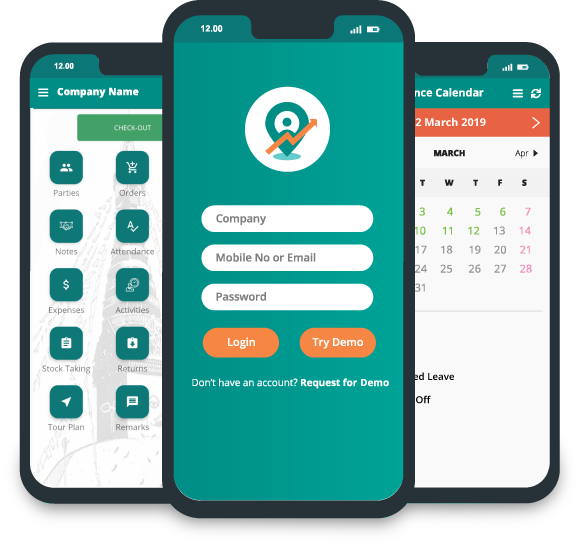
Making the shift from manual sales processes to a digital system can be daunting, particularly for businesses with field sales teams, distributors, and various sales territories. The Delta Sales App is designed to ease this transition, transforming tedious manual tasks into automated workflows that enhance efficiency, boost visibility, and simplify sales operations. Rather than struggling with spreadsheets, paper records, and fragmented communication, businesses can seamlessly oversee their entire sales process from one unified platform.
-1786252759.png)
-
Replace Manual Work with Automated Sales Processes
Handling tasks like taking orders, generating reports, keeping track of attendance, and reaching out to customers can consume precious time that salespeople could spend selling. The Delta Sales App simplifies these processes, allowing sales representatives to finish their tasks more quickly and cut down on administrative burdens. With user-friendly features like order management, attendance tracking, daily sales updates, and reminders for tasks, teams can maintain their productivity and ensure that no important activities slip through the cracks.
-
Gain Complete Visibility into Field Sales Activities
In the world of manual sales management, one of the most significant hurdles is the lack of visibility into field operations. The Delta Sales App steps in to bridge this gap, offering managers a clear view of their teams in action. With features like GPS-based tracking of field sales, monitoring customer visits, managing beat plans, and overseeing territories, it transforms how sales leaders operate. Thanks to real-time updates on sales activities and customer interactions, managers can keep a finger on the pulse of their team's performance, quickly spot any challenges, and make well-informed decisions without the delays of traditional reporting.
-
Make Better Decisions with Real-Time Reports and Analytics
In today's fast-paced business environment, the quality of decisions hinges on the data that informs them. The Delta Sales App takes the hassle out of data collection by seamlessly capturing sales information and transforming it into meaningful insights. With its intuitive real-time dashboards, automated reports, and comprehensive sales analytics, it empowers managers to stay on top of their game. By removing the tedious task of manual report preparation, the app allows leaders to focus on what truly matters: tracking key performance indicators, observing sales trends, and making swift, informed decisions that drive success.
-
Improve Collaboration Across Sales Teams
When customer information is stored across spreadsheets, emails, and messaging apps, communication gaps become inevitable. Delta Sales App centralizes customer data, sales activities, distributor information, and order details on one platform, ensuring every team member works with the latest information. This improves collaboration between sales representatives, managers, and distributors while creating a more consistent sales process.
-
Scale Your Sales Operations with Confidence
As your business grows, relying on manual processes can become a real challenge. The Delta Sales App is here to evolve alongside you, offering support for multiple users, territory management, distributor management, a retail execution system, and easy access through the cloud. Whether you're leading a small sales team or coordinating a large field force across various regions, this platform is designed to provide the adaptability and scalability necessary for sustainable growth.
Conclusion
In today's rapidly changing sales landscape, relying on manual processes can be a challenge, especially as businesses grow. While these methods may have sufficed in the past, they often fall short of meeting the increasing expectations of customers and the complexities of modern sales operations. Using spreadsheets, paper records, and manual reporting can lead to frustrating delays, costly errors, and missed opportunities.
Digital sales tools can transform this experience by automating routine tasks, enhancing data accuracy, and providing real-time insights. They foster better collaboration among sales teams, making it easier for everyone to stay on the same page. If you're aiming to simplify field operations, boost sales productivity, or make quicker, informed decisions, embracing the right digital sales solution can truly set your business apart from the competition.
Book a free demo today to see how Delta Sales App can help you eliminate manual processes, improve sales performance, and accelerate business growth.