
Why Do Sales Reps Spend Too Much Time on Non-Selling Activities?
-1790053808.png)
A field sales rep's real job is meeting customers, building relationships, generating orders, and driving revenue. Yet on a lot of sales teams, a big chunk of the workday goes to activities that don't directly contribute to any of that. Traveling inefficient routes, filling out reports, checking stock, chasing approvals, and managing expenses- all of it quietly eats into time that should've gone to customers.
The problem isn't always that reps are inefficient. Often it's the processes around them that are. When reporting is manual, territory planning is inconsistent, information is scattered across five different systems, and managers have no real-time visibility, reps end up spending selling hours on work that could've been simplified or automated in the first place.
For field sales teams, that lost time has a direct impact on productivity, customer coverage, order generation, and overall sales performance. The more time reps spend managing processes, the less time they have left to actually engage with retailers, distributors, and customers.
This blog looks at why reps spend too much time on non-selling activities, where those hours actually go, what causes the inefficiency, and how sales teams can claw back more time for real selling.
The Real Non-Selling Activities
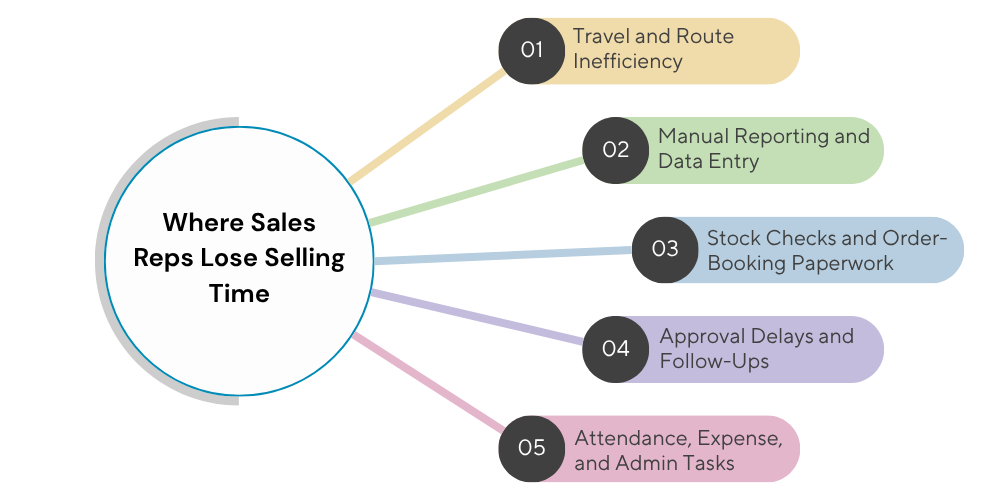
Non-selling time rarely comes from one big problem. It usually comes from a lot of small tasks that repeat all day long. A few minutes lost before every outlet visit doesn't look like much on its own. Multiply that across 20 or 30 visits, five or six days a week, and the lost capacity adds up to something genuinely significant.
-
Travel and Route Inefficiency
Travel is unavoidable in field sales. Wasted travel isn't. When beat plans are built manually, or customer locations aren't properly factored in, reps end up spending too much time moving between outlets and not enough actually meeting them. A rep might visit an outlet in one part of the territory, drive across town for the next customer, and later come back to an area they could've covered on that first trip. Poor route sequencing creates real problems: more kilometers traveled, higher fuel and travel expenses, fewer outlet visits per day, more fatigue on the rep, less time for actual productive conversations, and shrinking territory coverage. For FMCG teams, route inefficiency also messes with beat frequency. High-priority outlets can end up getting fewer visits simply because too much of the day got eaten up in transit.
-
Manual Reporting and Data Entry
Reporting is necessary. Reps need to record orders, collections, visit outcomes, customer feedback, and other field information. The problem starts when reporting means duplicate entry. A rep writes an order on paper, later types it into a spreadsheet, sends a message to a manager, and then updates yet another system. The same piece of information gets handled three or four times over. Manual data entry also creates a timing problem. If a rep finishes a retailer visit at 2 pm and enters the details at 8 pm, the manager doesn't have that information when it's actually useful. By then, the chance to act on a stock issue, a missed order, a customer complaint, or a follow-up has usually already passed.
-
Stock Checks and Order-Booking Paperwork
Field reps often need to check distributor stock, retailer inventory, SKU availability, previous purchases, schemes, pricing, and outstanding balances before finalizing an order. Without connected information, that means phone calls, paper notes, spreadsheets, or repeated back-and-forth with the distributor. A retailer asks, "Can you supply this SKU today?" and if the rep can't confirm availability on the spot, the order gets delayed or shrinks on the spot. The same goes for order paperwork. Manually recording quantities, calculating totals, checking schemes, and later transferring order details somewhere else creates unnecessary work and opens the door to real errors.
-
Approval Delays and Follow-Ups
Not every sales decision can be made by the rep alone. Discounts, credit limits, special pricing, expense claims, order exceptions, and other requests often need manager or distributor approval. That admin burden grows fast when approval happens through scattered phone calls, messages, emails, or spreadsheets. A rep submits a request, waits for a response, follows up again, explains the situation a second time, and finally gets back to the customer. The sales conversation itself might take 15 minutes. The approval process alone can take a lot longer.
-
Attendance, Expense, and Admin Tasks
Field reps also have to manage attendance, leave requests, travel expenses, daily work logs, and other admin requirements on top of everything else. These are legitimate business processes, but they shouldn't be swallowing a disproportionate share of a rep's day. When reps manually calculate kilometers, prepare expense statements, submit attendance information, and compile daily activity reports by hand, the company is effectively burning expensive sales capacity on admin processing. The issue isn't that these tasks exist. It's that they're often handled manually even when most of the underlying information is already sitting there digitally, just not connected to anything.
Why Hasn't This Problem Gone Away?
If non-selling work has been a productivity problem for years, why do field teams still burn so much time on it? Because many organizations have digitized individual tasks without ever fixing the overall workflow. A company might have software for accounting, spreadsheets for reporting, messaging apps for communication, a paper-based order process, and a separate attendance system, each one solving its own small problem in isolation. The rep is the one left connecting all of them by hand.

-
Disconnected, Offline, or Paper-Based Processes
A field rep often works in markets where connectivity is spotty at best. If the process assumes continuous internet access, reps end up delaying updates until they hit an area with a better signal. Paper-based processes create a different flavor of the same problem: information gets captured once, then has to be digitized later, which means delays, duplicate work, and more chances for something to get entered wrong. An offline mode workflow lets reps keep capturing orders, visits, and customer information even when connectivity is limited, with everything syncing automatically once the connection comes back.
-
Poor Territory and Beat Planning
A territory can have plenty of outlets and still produce poor sales coverage. Usually the problem is how those outlets get assigned and visited in practice. Without structured beat planning, reps naturally gravitate toward familiar customers, overlook lower-frequency outlets, or waste time traveling between accounts that are geographically nowhere near each other. Effective territory planning has to account for outlet location, visit frequency, customer importance, product needs, and the rep's realistic capacity. A good beat plan does more than just fill a calendar. It creates a route that actually makes sense to follow.
-
Lack of Real-Time Visibility for Managers
Managers can't improve field productivity if all they see is the final report. A DSR arriving at the end of the day might tell a manager a rep made 18 visits. It doesn't explain why six planned outlets got missed, why three visits produced no orders, how much time went to travel, or whether a route deviation caused the delay. Real-time field visibility changes that conversation entirely, since managers can catch issues while the day's still happening instead of waiting for the next review meeting to find out what already went wrong.
-
Too Many Manual Steps With No Automation Layer
This is the underlying problem behind a lot of administrative bottlenecks. Consider a simple process: visit → order → report → approval → manager review. If every stage requires a manual action, the whole thing slows to a crawl.
A better workflow captures information once and lets it flow through the relevant steps automatically. The rep records the visit and the order. The manager sees the update immediately. The order moves through the right workflow on its own. Reports get generated from that same data instead of a separate summary someone writes up later. The goal was never automating the rep out of the process. It's automating the repetitive work happening around the rep.
How Delta Sales App Helps Reps Reclaim Selling Time
The practical question is what a field sales organization can do once it identifies these productivity leaks.
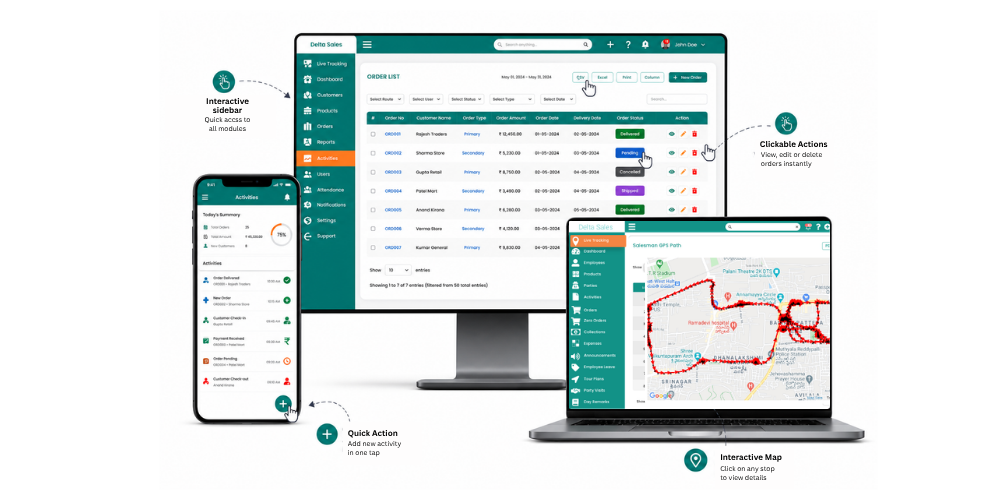
Delta Sales App brings field sales activities into a connected workflow, helping reps reduce repetitive reporting, plan visits more efficiently, capture orders in the field, and keep managers informed without relying on multiple manual reporting steps.
-
Automated Order and Visit Reporting
Instead of recording a retailer visit or order and preparing a separate report later, reps can capture field activity directly through the mobile sales app. Delta Sales App supports field order capture, visit tracking, and automated reporting, and managers can monitor orders and filter by employee, date, or customer, with automated reports cutting out the need for manual consolidation.
What matters here is that the information gets captured right at the point of activity. A rep can finish a customer visit, record the outcome, place the order, and move on to the next outlet without keeping a separate paper trail running in parallel.
-
Automated Route and Beat Planning
Route planning should account for the reality of field work, not just plot customers on a map. Beat planning capabilities cover pre-journey planning, outlet segmentation, planned visits, visit frequency, and route optimization, with route-management functionality that also handles priorities, time windows, and route changes.
For field sales managers, that gives a much more structured way to manage territory coverage. For reps, the benefit is straightforward: less time figuring out where to go next and more time actually meeting customers. The route should support whatever the sales strategy actually needs, whether that's more outlet coverage, better beat frequency, focus on high-value customers, or just less wasted travel.
-
Real-Time Data Sync With Managers
Field sales data becomes a lot more useful when managers can access it without waiting on an end-of-day spreadsheet. The GPS-based tracking app gives real-time visibility into sales activities, orders, customer engagement, GPS-based field activity, and reporting, and its mobile workflow supports offline activity with automatic syncing once connectivity returns. That's what lets managers act on problems while they're still relevant. If a planned visit gets missed, an order's delayed, a route changes, or a customer needs attention, the manager has a real shot at responding during the working day, not after it's already over.
-
Automated Approvals That Cut Follow-Up Time
Approval workflows are another place where automation cuts out unnecessary coordination. When orders and related information get captured digitally, managers can review it right within the sales workflow instead of relying on separate messages or paperwork floating around. The order-management functionality is built to streamline order capture and approvals while keeping managers visible into order status. The result isn't just faster admin for its own sake. It's a sales conversation that can keep moving instead of stalling out waiting for a sign-off.
What Does Lost Selling Time Actually Cost the Business?
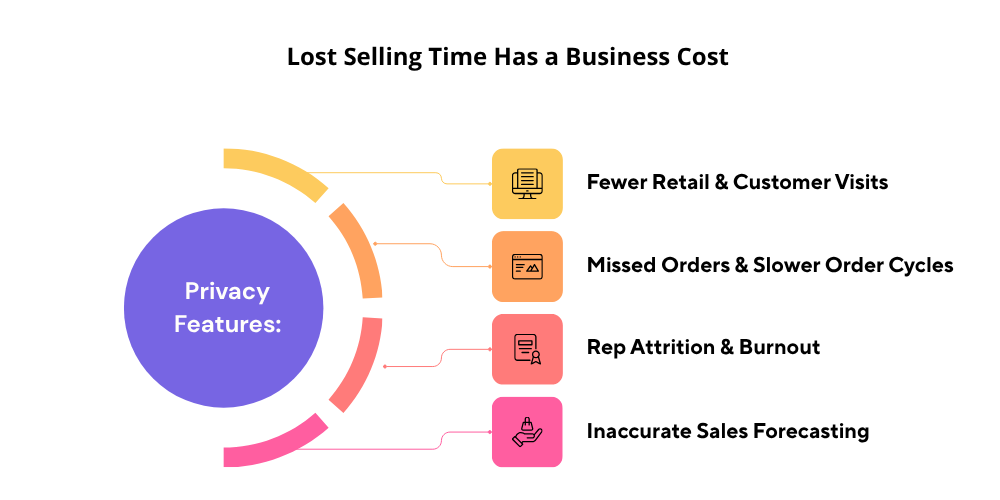
Lost selling time is easy to underestimate precisely because it never shows up as its own line item in the P&L. There's no invoice labeled "30 minutes lost to manual reporting." The cost shows up indirectly instead, through lower coverage, missed orders, slower decisions, higher operating costs, and field teams that are simply running on fumes by mid-afternoon.
-
Fewer Retail/Customer Visits Per Day
If a rep loses an extra 30 to 60 minutes a day to avoidable admin and travel, that time has to come from somewhere. Usually it comes straight out of customer-facing activity: fewer outlets visited, shorter conversations, a lower-priority retailer skipped, and prospecting pushed off yet again. Across a 20-person field team, a small daily loss like that turns into hundreds of hours of lost selling capacity over the course of a month.
-
Missed Orders and Slower Order-to-Delivery Cycles
A retailer can't order what the rep doesn't have time to discuss. Delayed stock information, slow approvals, or a late order submission can push a purchase into the next cycle entirely. For FMCG businesses, where purchase frequency and availability actually matter, delays like that ripple straight into secondary sales and distributor movement. A missed order isn't always about weak demand. Sometimes the sales process itself just made it harder for the customer to buy.
-
Rep Attrition and Burnout
Field sales is already demanding on its own. Long travel hours, targets, customer pressure, reporting requirements, and admin work pile up fast. When reps feel like they're spending more time proving what they did than actually doing the job, frustration builds. Cutting unnecessary admin doesn't just improve productivity. It makes the whole role a lot more manageable to actually stick with.
-
Inaccurate Sales Forecasting
Sales forecasting only works as well as the field information feeding into it. If reps update orders late, managers are working with incomplete data. If customer information gets entered manually, errors creep in. If visit outcomes get reconstructed from memory at the end of the day, real details go missing. What you end up with is a forecast built on information that doesn't actually reflect the current market. For FMCG organizations specifically, that ripples into production planning, distributor stock, replenishment, sales targets, and territory decisions, all built on numbers that were never quite right to begin with.
What Do Top-Performing Field Sales Teams Do Differently?
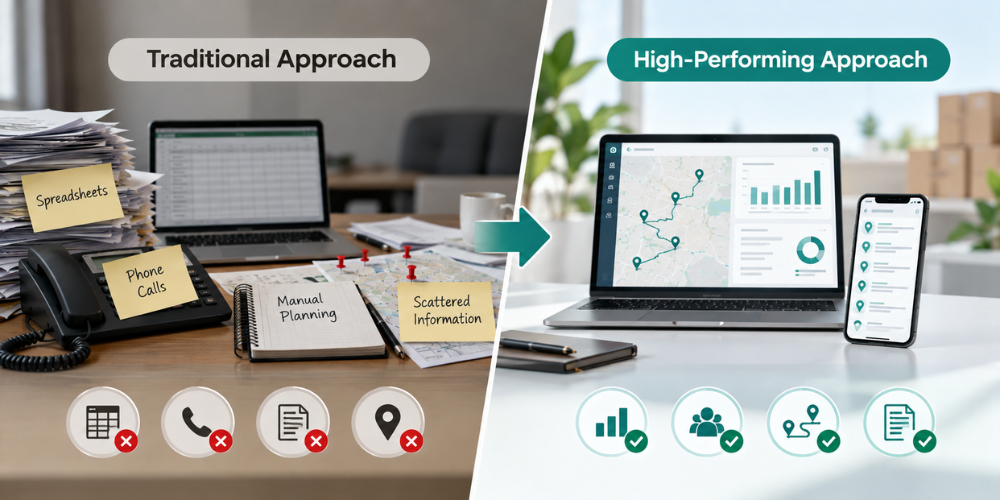
Top-performing field sales teams focus on maximizing selling time rather than simply increasing working hours. They reduce repetitive administrative work, improve route and beat planning, give managers real-time visibility, and automate routine approvals so reps can spend more of their day engaging customers and generating orders.
-
They Use Automated Route and Beat Planning
Top teams think about route planning as a sales choice, not a way to get from one place to another. They look at which stores matter most, how often they should be visited, how the territory is set up, how much potential each customer has, and how long travel really takes. This leads to coverage of the area without making reps work longer hours.
-
They Give Managers Real-Time, Automated Field Visibility
Managers need enough visibility to coach and intervene without constantly calling reps for updates. Real-time information on visits, orders, routes, attendance, collections, and field activity can reduce unnecessary status-checking while helping managers focus on exceptions and performance. A field sales management system provides managers with visibility into field activity and automated reports rather than requiring every update to be manually consolidated.
-
They Remove Manual Approvals With Automated Workflows
Every unnecessary approval handoff creates another opportunity for a sales process to stall. Top teams define clear approval rules, make relevant information available at the point of decision, and automate routine steps wherever possible. The objective is simple: reps should spend their working hours moving customers and orders forward, not chasing internal responses.
Conclusion
Sales reps spending much time on non‑selling activities is rarely a people problem. It is usually a process problem. When field teams rely on reporting, inefficient routes, paper‑based order capture, disconnected systems, repeated data entry, and slow approvals, selling time gets consumed by work that could be simplified or automated. The first step is to measure where the day actually goes. Look beyond visits and orders. Track travel time, reporting time, administrative work, approval delays, route deviations, and other activities that reduce customer‑facing capacity. Then remove the friction systematically.
A field sales management system can help connect beat planning, customer visit order capture reporting, GPS visibility, attendance, expenses, and sales analytics into one workflow. Delta Sales App is designed to help FMCG companies, distributors, manufacturers, and wholesalers reduce fieldwork while giving managers clearer visibility into what is happening across the territory. The goal isn’t to keep reps busy for hours. It is to make more of their working hours count.
Ready to reduce work and give your field team more time to sell? Book a free demo of Delta Sales App and see how a connected field sales workflow can fit your sales operation.