
Why Your Business Needs an Offline-First Field Sales App for Rural Markets
For field sales teams, every visit to a retailer counts. But in the country, poor connectivity can easily turn a productive sales day into a frustrating one. Sales reps have a hard time opening apps, loading customer info, uploading orders, or even marking attendance. Mobile internet is spotty.
Many companies put money in feature-rich sales applications expecting more productivity, but these applications work badly in villages, remote towns, and locations with low connectivity. Heavy apps are always connected to the internet, consume more resources from the device, and often break on budget Android phones that are usually used by field sales teams.
This is precisely the reason why businesses are adopting offline-first technology.
An offline-first application allows sales representatives to work without interruption rather than requiring a reliable internet connection. Orders, customer visits, attendance, collections, and reports are locally stored and automatically synchronized when the network becomes available.
In this blog, we will try to understand why heavy field sales apps fail in rural markets and how an offline order booking app built using offline-first technology can solve these problems.
The Reality of Rural Field Sales
Unlike urban areas where high-speed mobile internet is widely available, rural locations frequently experience unstable network coverage, slower 2G or 3G connections, and even complete network outages. Sales representatives often travel long distances between retailers, visit remote villages, and rely on affordable Android smartphones with limited processing power and storage. Under these conditions, even a simple task like opening a customer profile or booking an order can become frustrating if the application depends heavily on constant internet connectivity.
Sales representatives frequently experience:
- Weak mobile signals
- 2G and 3G connectivity
- Frequent network drops
- Remote locations with no internet coverage
- Budget Android devices with limited RAM and storage
These are typical conditions for companies selling FMCG products, pharmaceuticals, agricultural products, beverages, electrical goods, or consumer products. If your field sales app depends on cloud connectivity, then your sales operations depend on internet availability. This results in unnecessary delays and has a direct effect on sales performance.
Why Heavy Field Sales Apps Fail in Rural Areas
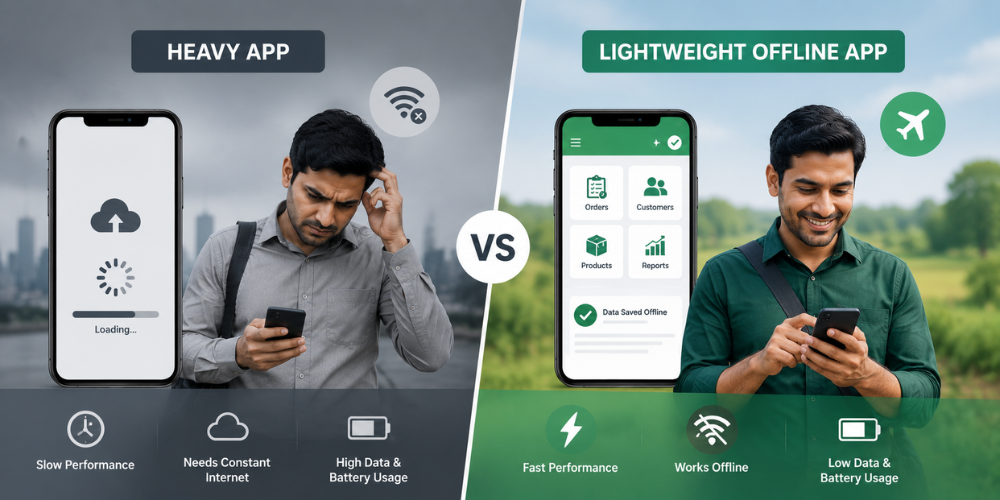
Not all field sales apps are designed to meet the realities of selling in rural areas. Many modern applications have advanced features and attractive interfaces, but the heavy architecture of such applications needs continuous internet access, more processing power, and larger device storage. These apps may work fine in urban areas with fast networks, but their performance is severely hampered in areas with weak connectivity and on low-end Android devices.
Some of the most common reasons heavy field sales apps struggle in rural areas include:
-
Constant Internet Dependency
Many field sales applications are designed to communicate with cloud servers almost continuously. They require an active internet connection to fetch customer information, load product catalogs, submit orders, update visit details, and refresh dashboards. In rural locations where connectivity is inconsistent, this dependency creates frequent interruptions. Sales representatives are often forced to wait for the network to recover before they can continue their work, reducing the number of productive customer visits in a day.
-
High Data Consumption
Heavy applications regularly download and upload large amounts of data in the background. This includes product images, reports, dashboards, customer records, and application updates. That means slow loading times on 2G or 3G networks, failed syncs, frozen screens, and laggy order submissions. The sales reps spend valuable time waiting for the application to respond instead of focusing on customers.
-
Poor Performance on Budget Android Devices
Many companies give their field teams inexpensive Android smartphones to control operational costs. These devices typically have limited RAM, storage, and processing capabilities. Apps with heavy architecture consume more system resources and cause slow performance, frequent crashes, excessive battery drain, and overheating. This impacts the overall user experience and makes it hard for sales reps to do their daily jobs efficiently.
-
Slow Access to Product Catalogs and Customer Data
Many companies have large catalogs of products, with hundreds or thousands of SKUs. If you need a live internet connection to do every product search or customer lookup, then in low-network areas, information retrieval is slow and unreliable. Sales reps may have difficulty confirming product availability, pricing, or promotional programs while on the road with retailers. This results in longer wait times and lost sales opportunities. An inventory management solution that allows you to access data offline ensures that product information is available even without an internet connection.
-
Incomplete Field Activity Tracking
Poor connectivity can also affect the accuracy of daily field activity records. Customer visits, attendance, payment collections, and retailer interactions may not sync or be complete until the device reconnects to the internet. Field activities can be logged in real time, and once the network is available, they can be synchronized automatically for complete visibility into team performance with features like GPS employee tracking, customer visit tracking, and attendance management.
-
Increased Battery Consumption
Apps that constantly refresh data, synchronize records, and talk to cloud servers use significantly more battery power. Regular charging may not be an option for field sales reps who are on the road visiting retailers all day long. Lightweight, offline-first apps reduce unnecessary background activity to extend device run times throughout the work day.
-
Reduced Overall Productivity
Sales reps become less effective when forced to deal with repeated delays caused by slow loading, app crashes, or failed synchronization. Visited fewer retailers, took longer to complete orders, and lost valuable selling time. A light-weight, offline-first field sales application keeps teams productive, no matter the network quality, so they can concentrate on building customer relationships and driving sales instead of technical issues.
-
Interrupted Order Booking
One of the biggest challenges in rural markets is the inability to place orders when the network becomes unavailable. In many traditional cloud-dependent applications, sales representatives must wait until connectivity is restored before submitting customer orders. An offline order management solution eliminates this issue by allowing representatives to continue capturing orders even without internet access, ensuring no sales opportunity is lost during field visits.
How Offline-First Technology Improves Field Sales
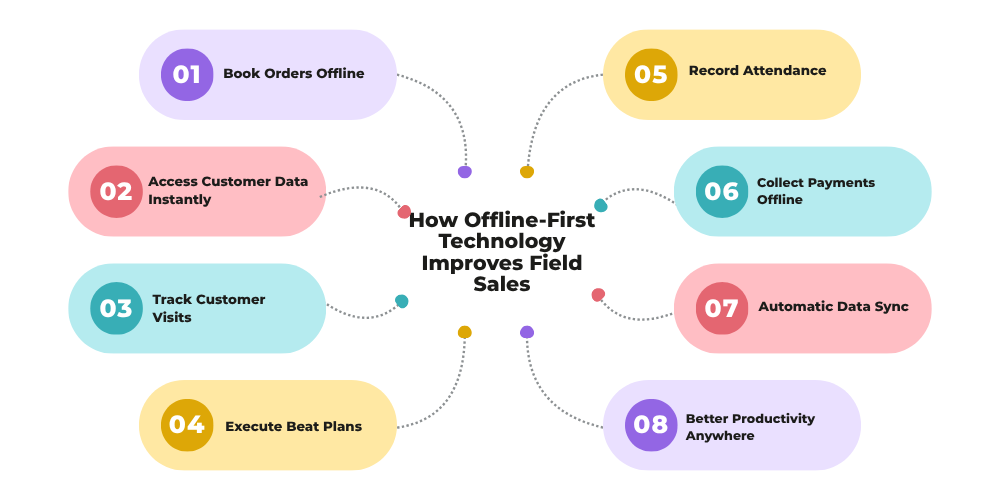
Offline-first technology is designed to keep field sales operations running without interruption, even when internet connectivity is weak or unavailable. Instead of depending on a constant network connection, the application stores essential business data securely on the device and synchronizes it automatically when the internet becomes available. This approach allows sales representatives to continue serving customers, recording activities, and completing their daily tasks without worrying about network issues. For businesses operating in rural and remote areas, offline-first technology ensures consistent productivity, better data accuracy, and an improved customer experience.
Here are some of the key ways offline-first technology enhances field sales operations:
-
Uninterrupted Order Booking
Sales reps can continue to take customer orders even when they are not connected to the Internet. Orders are stored securely on the device and are automatically synchronized with the central server when connectivity is available. The Offline Order Booking App makes sure that no sales opportunity is lost due to bad network coverage and retailers get faster service.
-
Accurate Rural Field Sales Tracking
Field teams in villages and remote areas can continue to record customer visits, location data, and sales activities, regardless of network availability. GPS-based employee tracking and customer visit tracking provide greater insight into your field operations and automatically sync the visit records upon gaining internet access. This makes tracking of rural field sales more reliable and accurate.
-
Faster Customer Visits
Offline first applications store customer information locally, allowing representatives to access essential details instantly without waiting for data to load from the cloud.
They can quickly view:
-
Customer profiles
-
Previous orders
-
Outstanding balances
-
Product catalogs
-
Price lists
-
Promotional schemes
This enables faster retailer interactions and reduces waiting time during customer visits.
-
Seamless Beat Execution
Field representatives can continue following their assigned routes and retailer schedules without relying on continuous internet connectivity. A well-planned beat planning system allows sales teams to access their daily visit plans, retailer lists, and schedules offline, helping them complete more productive customer visits throughout the day.
-
Secure Payment Collection Recording
Sales reps often collect payments when they visit retailers in remote areas. Using offline-first technology, these transactions can be recorded instantly without waiting for network availability. With Payment Collection Management, businesses can keep payment records secure and also update them automatically in the central system after synchronization.
-
Better Performance on Budget Android Devices
Offline-first applications are typically designed with lightweight architecture that consumes fewer device resources.
-
This results in:
-
Faster app performance
-
Lower RAM usage
-
Reduced battery consumption
-
Minimal storage requirements
-
Fewer application crashes
These optimizations make the application suitable for sales teams using affordable Android smartphones, which are common across rural markets.
-
Reliable Attendance and Daily Activity Recording
Employees should not be prohibited from taking attendance or daily work because of poor network coverage. Attendance and Leave Management enables your reps to mark attendance and keep recording field activities even in areas with poor connectivity. Once the device is back online, the data automatically synchronizes, reducing the need for manual corrections and ensuring accurate records.
-
Automatic Data Synchronization
One of the most significant advantages of offline first technology is intelligent background synchronization. Rather than requiring the representatives to upload data manually, the application auto-syncs orders, visits, attendance, collections and other field activities whenever there is a stable internet connection. This helps to delete duplicate entries, cut the risk of missing data and make sure managers always have access to current reports.
-
Improved Productivity and Customer Experience
When field representatives are not interrupted by poor connectivity, they can spend more time engaging with retailers and less time dealing with technical issues.
This leads to:
- More customer visits completed each day
- Faster order processing
- Improved retailer satisfaction
- Higher sales productivity
- More accurate business data
- Better decision-making through timely reporting
For businesses expanding into rural markets, offline first technology is no longer just a convenience. It is a critical capability that enables field sales teams to work efficiently, regardless of network conditions.
Why a Low Network Sales App Is Essential for Growing Businesses
As businesses expand into Tier 2, Tier 3, and rural markets, they face a new set of operational challenges. Unlike urban areas, these regions often have inconsistent internet connectivity, longer travel distances, and retailers located in remote locations. Relying on a field sales application that performs well only on high-speed networks can slow down operations and limit business growth.
A low-network sales app is designed to work best even in areas with poor or changing internet connectivity. It is built on a lightweight architecture with offline capabilities so that field sales teams can carry on working uninterrupted and network failures are never a barrier to business performance.
Here are the top reasons why a low network sales app is a must-have for growing businesses:
-
Ensures Business Continuity in Every Territory
Don’t stop your sales operations just because the internet’s slow or not available. A low network sales app still allows reps to do their daily work, whether they are calling on retailers in cities, small towns or remote villages. This provides consistency in operations across all sales territories and helps businesses to grow confidently into underserved markets.
-
Improves Field Team Productivity
When sales reps are not waiting for pages to load and data to sync, they can spend more time with customers and making sales. A light-weight app reduces delays, minimises technical interruptions and allows field teams to conduct more productive retailer visits per day.
-
Supports Reliable Rural Field Sales Tracking
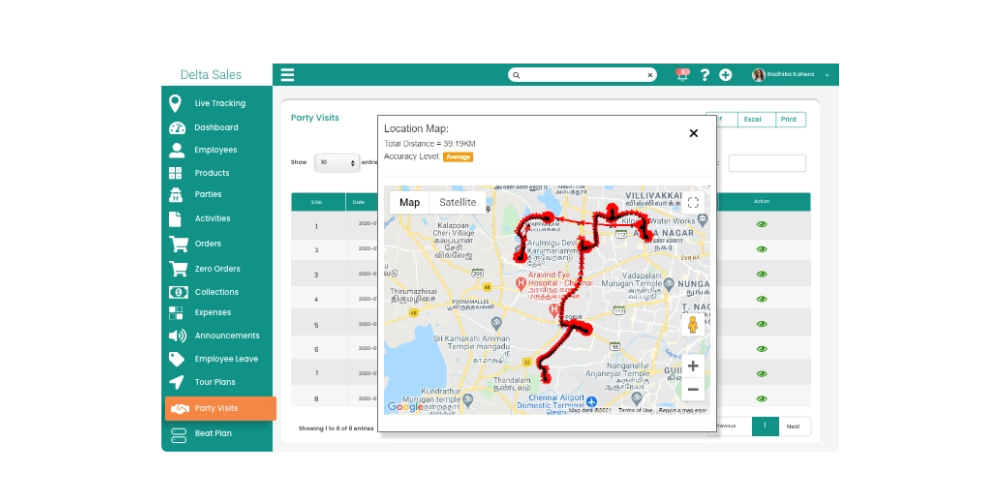
Poor network connectivity makes it tricky to track field activities in remote locations. A robust rural field sales tracking solution helps businesses record customer visit details, location information, and daily tasks even when offline. GPS Employee Tracking and Customer Visit Tracking provide managers with complete visibility into field operations, ensuring data is automatically synchronized once connectivity is restored.
-
Prevents Lost Orders
One of the biggest risks of poor connectivity is losing customer orders during field visits. If representatives cannot submit orders immediately, valuable sales opportunities may be delayed or missed altogether. An offline order booking app enables sales teams to capture orders instantly, even without internet access, ensuring every customer request is recorded and synchronized later.
-
Delivers a Better Retailer Experience
Every time they visit, retailers want fast and efficient service. Long loading times, application errors, or failed order submissions lead to unnecessary delays and lower customer confidence. A low network sales application enables reps to instantly access customer information, product catalogs, and pricing for improved interaction and greater satisfaction for retailers.
-
Performs Well on Budget Android Devices
Many growing businesses equip their sales teams with entry-level or mid-range Android smartphones to control operational costs. Heavy applications often struggle on these devices, leading to slow performance and frequent crashes. A lightweight application is optimized for lower hardware specifications, providing faster performance, lower battery consumption, and a more reliable user experience throughout the day.
-
Reduces Operational Delays
Slow applications impact all phases of the sales process, from attendance marking to order booking and collection of payments. A low-network sales app can help alleviate these delays by allowing reps to work offline and automatically sync data when access to the internet is available. Businesses can further optimize operations by integrating features like attendance and leave management, payment collection management, beat planning, etc. so that field activities can continue without interruption.
-
Improves Data Accuracy and Reporting
Manual data entry after reconnecting to the internet often leads to errors, duplicate records, and incomplete reports. Offline-first technology captures information as activities happen and synchronizes it automatically.
-
This results in:
-
More accurate sales records
-
Complete customer visit history
-
Reliable attendance data
-
Timely business reports
-
Better decision-making for managers
-
Helps Businesses Scale with Confidence
As organizations scale into new geographies, they need technology that reliably performs across a range of network conditions and device types. Low network sales app that gives you flexibility of growth without having to worry about connectivity limitations. In urban markets or in remote rural areas, your sales team can easily continue taking orders, scheduling customer visits and logging field activities.
How Delta Sales App Delivers Offline First Performance in Rural Areas
Field sales teams in rural markets need more than a feature-rich application. They want something that works well in the real world, where internet connections are often slow, flaky, or non-existent. The Delta Sales App is built on an offline-first architecture, allowing sales reps to continue working without interruption regardless of network conditions.
-1782992909.png)
Delta Sales App is not a heavy application that requires constant connection to cloud servers; it keeps essential business information on the device, enabling field teams to access information, record activities, and book orders even in places with weak 2G or 3G connectivity. Once an internet connection becomes available, all offline data is automatically synchronized with the central system.
Here's how Delta Sales App helps businesses maintain seamless field operations in rural areas.
-
Offline Order Booking Without Interruptions
One of the biggest challenges for field sales teams in remote locations is losing orders because of poor connectivity. Delta Sales App solves this with its offline order booking app capability. Sales representatives can continue creating and saving retailer orders even when there is no internet connection. The orders are securely stored on the device and automatically synchronized with the server once connectivity is restored. This ensures that no sales opportunity is missed because of network issues.
-
Reliable Rural Field Sales Tracking
Complete visibility of the day’s activities of the field teams working across villages and remote territories is a must. Delta Sales App enables accurate monitoring of field sales in rural areas by allowing sales reps to record customer visits irrespective of the Internet connectivity. GPS Employee Tracking and Customer Visit Tracking enable companies to monitor field movement, confirm visits to retailers, and keep detailed activity logs that are automatically synced when the device reconnects to the internet.
-
Smooth Performance on Low-End Android Devices
Many field sales representatives use entry-level Android smartphones with limited RAM and storage. Heavy applications often become slow, consume excessive battery power, or crash during customer visits. Delta Sales App is optimized with a lightweight architecture that delivers:
-
Faster application loading
-
Lower memory consumption
-
Reduced battery usage
-
Smooth navigation
-
Stable performance throughout the day
-
This allows businesses to equip their teams with cost-effective devices without compromising productivity.
-
Efficient Performance on 2G and 3G Networks
Many rural areas still rely on slower mobile networks where cloud-dependent applications cannot function effectively. Delta Sales App is a low-network sales app that works reliably in areas with poor 2G and 3G connectivity. Representatives can continue accessing essential business information and complete their daily tasks without waiting for a high-speed internet connection.
-
Offline Access to Customer and Product Information
Sales representatives should never have to keep customers waiting because product information cannot be loaded. Delta Sales App stores important business data locally, allowing representatives to instantly access:
-
Customer profiles
-
Product catalogs
-
Price lists
-
Previous orders
-
Outstanding balances
-
Running schemes
-
Seamless Beat Execution
Field teams will often travel long distances covering multiple retailers in rural markets. Internet failures should not disrupt their daily life. Beat Planning allows reps to work offline and view their assigned routes, retailer lists and visit schedule, keeping them organized and allowing them to make more productive customer visits.
-
Offline Attendance and Activity Recording
Bad connectivity should not impede employees from recording their attendance or daily work. With the Delta Sales App, reps can use Attendance and Leave Management even in low network areas. Local attendance and daily activities are recorded and synchronized automatically when connectivity is restored without any manual intervention to ensure accurate reporting.
-
Secure Payment Collection in Remote Locations
Payment collection is a critical part of field sales operations, especially for distributors serving rural retailers. With Payment Collection Management, representatives can record payments immediately during customer visits, even without internet access. The data is securely synchronized later, reducing the risk of missing or duplicate records.
-
Automatic Background Synchronization
One of the key strengths of Delta Sales App is its intelligent synchronization process. Instead of requiring representatives to manually upload data after reconnecting to the internet, the application automatically synchronizes:
-
Orders
-
Customer visits
-
Attendance
-
Payment collections
-
Expenses
-
Activity logs
This ensures that managers always have access to accurate and up-to-date field data while eliminating manual effort for sales representatives.
-
Built for Businesses Expanding Beyond Cities
Whether your business serves urban distributors or retailers in remote villages, Delta Sales App adapts to different network conditions without affecting sales operations. By combining offline-first technology, lightweight architecture, and powerful field sales automation features, the platform enables businesses to scale confidently across every market. Sales representatives remain productive, customer service remains uninterrupted, and managers receive complete visibility into field operations, regardless of where their teams are working.

Signs Your Current Field Sales App Is Too Heavy
A field sales app should make your team's work easier, not slower. If your sales representatives regularly experience performance issues in the field, especially in areas with poor connectivity, it could be a sign that your application is too heavy for real-world field operations. Heavy apps often depend on constant internet access, consume more device resources, and struggle to perform on budget Android smartphones, leading to lower productivity and a poor user experience.
Here are some common signs that your current field sales app may be slowing your business down:
- Orders fail when the internet is slow.
- Customer details take too long to load.
- The app crashes on budget Android devices.
- Sales representatives wait for data to sync before moving to the next retailer.
- Battery drains quickly during field visits.
- Retailers experience delays during order placement.
- Daily reporting becomes inconsistent in rural areas.
If these issues sound familiar, your application may not be built for offline first operations.
Conclusion
Success in rural field sales depends on more than just having a mobile app. It requires a solution that performs reliably in real-world conditions where weak connectivity, 2G and 3G networks, and budget Android devices are part of everyday operations. Heavy field sales applications often struggle in these environments, leading to delayed orders, interrupted customer visits, and reduced productivity. An offline-first approach eliminates these challenges by allowing sales representatives to continue working without an active internet connection. From order booking and customer visits to attendance and payment collection, every activity is captured seamlessly and synchronized automatically once connectivity is restored.
Delta Sales App is built with this offline-first philosophy, helping businesses manage field operations efficiently across urban, semi-urban, and rural markets. Its lightweight architecture, reliable offline capabilities, and comprehensive field sales automation features ensure your team stays productive wherever they work.
If your sales representatives frequently operate in low-network or remote areas, it's time to switch to a solution that works without limitations.
Schedule a free demo today of Delta Sales App and experience how offline-first technology can lead to more orders booked, better field productivity, and superior retailer experiences, no matter where business may take your team.