
How Field Sales Data Helps CPG Brands Improve Shelf Performance
Poor in-store execution and stock gaps cost CPG companies nearly 30% of their potential revenue.
This is more than just a number; it is the reality for many consumer packaged goods (CPG) brands. Despite strong marketing campaigns and high-quality products, brands lose millions of dollars each year due to poor shelf visibility and inconsistent in-store execution.
Field sales data is the secret weapon for turning things around. Brands can improve sales, visibility, and ROI by tracking what happens on shelves, such as where products are placed, whether promotions are active, and how competitors perform.
In this blog, we'll look at how field sales data transforms shelf performance for CPG brands, with real-world examples and actionable strategies.
What Is Field Sales Data, and Why Does It Matter for CPG Brands?
Field sales data is the information collected by sales teams during store visits, including product availability, shelf placement, promotional compliance, and competitor activity. It provides real-time insights that help CPG brands optimize shelf performance, prevent stock-outs, and improve in-store execution. Field sales data includes everything your sales team captures during their visits to retail outlets:
-
Product availability and stock counts
-
Shelf placement photos
-
Promotional compliance data
-
Competitor activity and pricing
-
Retailer feedback
Unlike traditional weekly or monthly reports that rely on delayed spreadsheets and estimates, field sales data is real‑time and accurate, giving brands a clear picture of what’s happening right now in thousands of stores.
For CPG brands, this data is crucial for:
-
Maximizing visibility on the shelf
-
Reducing lost sales due to stockouts
-
Ensuring promotions are implemented correctly
-
Beating competitors where it matters most at the point of purchase
According to industry insights, improving in‑store retail execution with data and disciplined field processes directly correlates with increased revenue and market share. You can explore more in the McKinsey research on improving retail execution in CPG. Here are the ways how it helps to improve the shelf visibility
1. Real‑Time Shelf Visibility: Seeing What Really Happens
One of the biggest challenges CPG brands face is the blind spot between strategy and execution. Managers might plan where products should be, but without real‑time visibility into actual shelf conditions, they never know what’s truly happening.
Field sales data eliminates this blind spot. With sales tools, reps can capture:
-
Shelf photos
-
SKU placement details
-
Stock levels
-
Promotional display compliance
This on‑the‑ground intelligence allows brands to confirm whether products are placed according to planograms, verify that key SKUs are front‑facing, and ensure that competitive products aren’t crowding your own shelf space.
Benefits of Real‑Time Visibility:
-
Detect misplaced or missing products instantly
-
Spot competitor dominance early
-
Ensure planogram compliance across all outlets
A regional beverage brand used field data to discover that new SKUs were hidden behind competitors' products in lower-tier stores. Managers used this insight to retrain reps and improve shelf placement, leading to increased visibility and sales within weeks.
2. Preventing Stock‑Outs: Keeping Shelves Always Ready
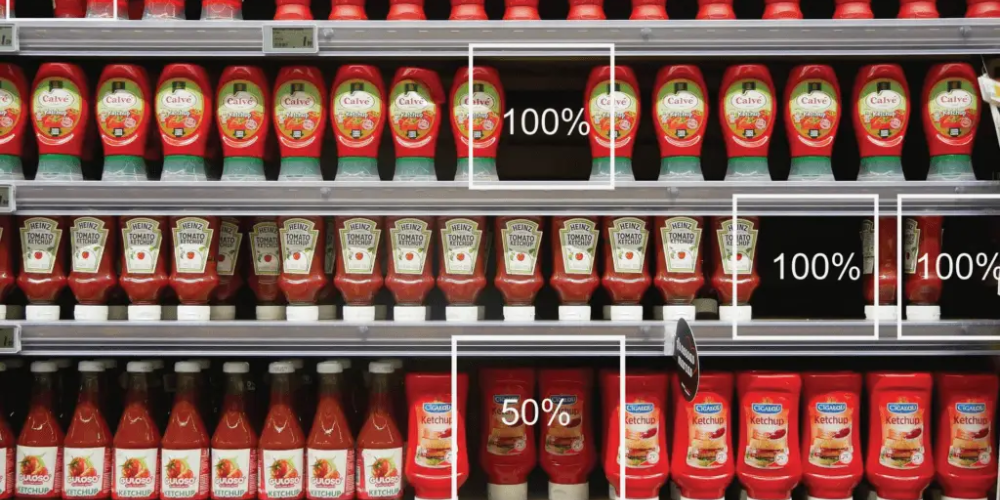
Nothing kills sales faster than a customer reaching for your product and not finding it. Stock‑outs not only lead to lost revenue but also damage brand credibility and push customers to competitors.
Field sales data lets brands monitor stock levels at the store level and catch potential shortages before they happen. Reps can report low inventory conditions as they visit outlets, which triggers timely restocking actions.
How Field Sales Data Helps Prevent Stock‑Outs:
-
Identify fast‑moving SKUs that need frequent replenishment
-
Spot slow movers to avoid overstocking
-
Trigger alerts for low inventory thresholds
By proactively addressing inventory gaps, brands can significantly reduce lost sales and improve retailer satisfaction.
3. Tracking Promotions for Higher ROI
Promotions are expensive. But a campaign only works if it reaches the shopper. Field sales data ensures that promotional materials and offers are actually implemented in stores as planned.
Reps can capture:
-
Photos of promotional displays
-
Status of point‑of‑sale materials
-
Whether promotional SKUs are properly stocked
This removes the guesswork around promotion execution and allows managers to analyze real results, not assumptions. Campaigns can be refined, shifted, or stopped based on real feedback, delivering a higher return on promotional investment.
For instance, a snack brand running a “buy one get one free” campaign found through field data that many stores had no signage or stock for the offer. Within days, adjustments were made, and the promotion delivered measurable lift that otherwise would have been lost.
4. Competitive Benchmarking: Know Where You Stand
Field sales data doesn’t just tell you about your products; it also reveals your competitors’ activity at the store level. You can measure:
-
Competitor product placement
-
Shelf share relative to others
-
Competitor promotions and pricing strategies
This intelligence equips CPG brands to react strategically, whether that’s increasing product facings, adjusting pricing, or shifting promotional focus.
Understanding in‑store competitive dynamics is a huge advantage. It helps you not only measure performance but also improve execution where your competitors might be gaining ground.
5. Uncovering Growth Opportunities
Field sales data is used not only to solve problems but also to identify new opportunities, such as underserved stores and regions.
-
Identifying underserved stores and regions.
-
Identifying cross-sell and upsell opportunities
-
Recognize category trends before competitors do.
A health and beauty brand used field sales insights to identify unmet demand in certain districts. By re-allocating stock and increasing visibility in specific outlets, they saw a significant increase in revenue without increasing overall inventory levels.
6. Mobile Field Sales Apps: Data at the Point of Action
Modern field sales teams operate in fast‑paced environments. Mobile field sales app empower reps to capture accurate and standardized data quickly during their visits. Key features that make field sales data powerful include
-
Barcode scanning for quick SKU logging
-
Photo capture for visual shelf evidence
-
Offline working with auto‑sync when online
-
GPS‑tagged activity for accountability
These features ensure that managers receive quality data with minimal delay, enabling decisions that are timely, accurate, and impactful.
7. Analytics That Drive Actionable Insights
Collecting data is necessary, but analyzing it is where the real value lies. Field sales analytics can turn raw information into meaningful insights. Through dashboards and reporting, managers can understand:
-
Store‑level performance trends
-
SKU velocity and turnover
-
Promotion effectiveness
-
Regional execution gaps
Actionable analytics help brands allocate resources better, plan smarter campaigns, and make informed operational decisions that enhance shelf performance and sales outcomes.
Overcoming Common Challenges in Field Data Collection
The practical difficulties CPG brands face when gathering field sales data from store visits. It signals to readers that the blog will not only explain the benefits of field data but also how to overcome real-world obstacles, making the content actionable.
Challenges in Field Sales Data Collection
-
Data Accuracy
Field data is only valuable if it’s accurate. Manual entry, inconsistencies in reporting formats, and human error can all lead to mistakes. Inaccurate data can mislead decision-makers, resulting in stockouts, poor merchandising, and misaligned promotions. For example, a representative may report that a shelf is fully stocked when, in fact, certain SKUs are missing, resulting in lost sales if not corrected. -
Connectivity Gaps
Field teams often work in areas with poor or no internet connectivity. Without proper tools, data collection can be delayed, incomplete, or lost, preventing timely decision-making.
Example: A remote store might not sync its sales or shelf information until the rep returns to a connected area, causing delayed insights. -
Data Overload
Collecting too much data can overwhelm managers. When every metric is tracked, it becomes difficult to identify actionable insights. Without prioritization, important signals like stock-outs or merchandising compliance can get lost in the noise.
Example: Tracking dozens of minor details per visit can distract from critical KPIs like SKU availability or promotional execution.
How to Address These Challenges
-
Standardize reporting templates in your field sales app
Using consistent, predefined templates ensures reps report data uniformly. This improves accuracy and makes it easier to analyze across stores or regions. -
Use offline capture with automatic sync
Mobile field sales apps allow data to be captured offline and automatically synced once connectivity is restored. This ensures no information is lost and enables timely decision-making. -
Focus on key performance metrics relevant to shelf visibility
Prioritize metrics that matter most, such as SKU stock levels, planogram compliance, and promotional execution. This reduces data overload and highlights actionable insights.
Sales Automation App solves these by providing structured data input, offline functionality and analytics dashboards that simplify insights and actions.
The Future of Shelf Performance in CPG
As technology advances, more CPG brands are adopting predictive analytics and AI-driven insights to move from reactive decision-making to proactive strategy. Instead of responding to problems after they occur, brands can anticipate issues and optimize shelf performance in advance.
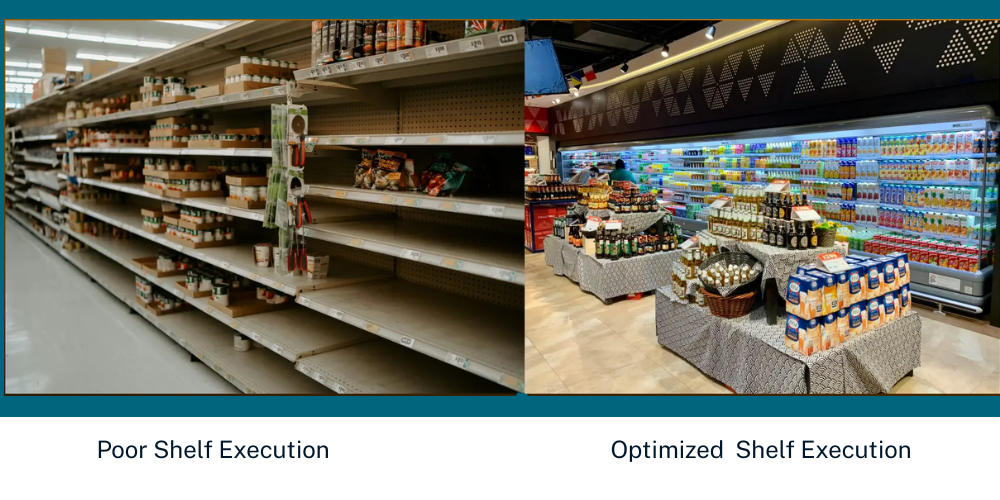
Here’s what this means in practical terms:
1. Forecasting Stockouts Before They Happen
Traditional inventory management reacts to stockouts after shelves are already empty. Predictive analytics changes that approach.
By analyzing historical sales data, SKU velocity, regional demand patterns, and seasonal trends, AI models can identify when a product is likely to run out before it actually does.
How this improves shelf performance:
-
Ensures continuous product availability
-
Reduces lost sales opportunities
-
Improves retailer relationships
-
Maintains customer trust
For example, if data shows that a particular SKU consistently spikes in sales every weekend in high-traffic stores, predictive systems can recommend replenishment before the spike occurs, preventing empty shelves.
This shifts brands from reactive restocking to proactive inventory planning.
2. Personalizing Promotions Based on Purchase Behavior
Not all stores perform the same way, and not all customers respond to the same promotions. AI-driven insights allow CPG brands to analyze purchasing behavior at a granular level.
By evaluating:
-
Past promotional performance
-
Store-level buying patterns
-
Customer basket combinations
-
Regional demand preferences
Brands can design highly targeted promotions instead of running generic campaigns.
How this improves shelf performance:
-
Increases promotion effectiveness
-
Boosts sell-through rates
-
Improves return on promotional investment
-
Enhances in-store visibility for high-performing SKUs
For example, if data shows that a beverage SKU sells better when paired with snack promotions in specific stores, brands can introduce cross-promotional strategies tailored to those locations.
Personalization ensures shelves carry the right mix of products with the right offers at the right time.
3. Anticipating Seasonal and Trend-Based Demand
Consumer demand fluctuates due to seasons, festivals, weather patterns, and emerging trends. Predictive analytics helps brands anticipate these shifts early.
By combining historical data with external trend signals, brands can:
-
Increase stock of high-demand seasonal SKUs
-
Reduce inventory of products likely to slow down
-
Prepare marketing campaigns in advance
-
Allocate shelf space strategically
How this improves shelf performance:
-
Prevents overstocking after peak seasons
-
Reduces stockouts during demand surges
-
Optimizes shelf space allocation
-
Improves category performance
For instance, cold beverages may surge during summer months, while certain packaged foods spike during festive seasons. Predictive systems help brands prepare inventory and promotions ahead of time instead of reacting mid-season.
The Strategic Impact on Shelf Performance
When predictive analytics and AI-driven insights are combined with real-time field sales data, CPG brands gain a powerful advantage:
-
Shelves Stay Stocked Consistently
By analyzing sales velocity and inventory trends, brands can anticipate demand and restock products before they run out. This reduces stock-outs, prevents lost sales, and ensures customers always find the products they expect on shelves.
-
Promotions Become Smarter and More Targeted
AI-driven insights help brands understand which promotions work best in specific stores or regions. Instead of running blanket campaigns, companies can tailor offers based on purchasing behavior, improving promotion effectiveness and shelf visibility.
-
Inventory Decisions Become Data-Driven
Rather than relying on assumptions, brands use real-time field sales data to decide how much inventory to distribute, where to allocate stock, and which SKUs to prioritize. This minimizes overstocking and improves working capital efficiency.
-
Sales Forecasting Becomes More Accurate
Predictive analytics analyzes historical data, seasonal patterns, and market trends to forecast future demand more precisely. Accurate forecasting helps brands plan production, logistics, and shelf allocation strategically.
Instead of simply tracking what happened, brands begin shaping what will happen next.
For CPG companies focused on improving shelf performance, predictive technology is no longer optional. It is becoming a competitive necessity.
How Delta Sales App Makes a Difference
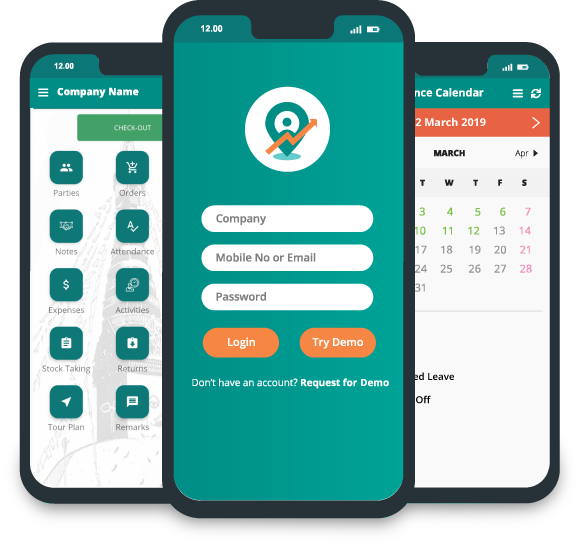
The Delta Sales App helps CPG brands turn field sales data into measurable business results by connecting store-level activity with strategic decision-making. Each feature plays a direct role in improving shelf performance and driving sales growth.

This immediate visibility allows brands to respond quickly to issues. If a product is out of stock or incorrectly placed on the shelf, corrective action can be taken without delay. Faster response times reduce lost sales opportunities and ensure that shelves remain fully stocked and properly executed.
-
Offline Functionality
Field teams often operate in areas where internet connectivity is unreliable or completely unavailable. The offline functionality of Delta Sales App allows sales representatives to continue capturing data without disruption. All information is stored securely on the device and automatically syncs once an internet connection is restored.
This ensures that no data is lost due to network limitations. Brands gain complete visibility across urban, semi-urban, and rural markets alike. By eliminating reporting gaps caused by connectivity issues, companies maintain accurate and consistent shelf performance tracking across all territories.
-
Analytics Dashboards
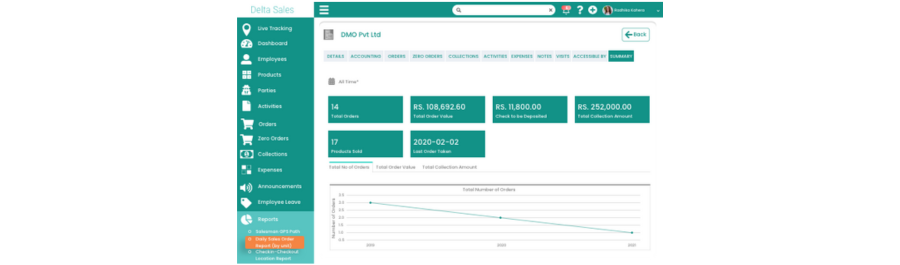
Collecting data alone is not enough; the real value lies in analyzing it. Delta Sales App provides intuitive analytics dashboards that transform raw field sales data into clear, visual insights. Managers can monitor SKU performance, track stock availability, measure promotion effectiveness, and identify compliance gaps across regions.
These dashboards simplify complex data, making it easier to spot trends and performance issues quickly. Instead of manually reviewing spreadsheets, decision-makers can rely on visual reports to guide inventory planning, merchandising strategies, and promotional investments. This data-driven approach strengthens overall shelf performance and improves operational efficiency.
-
Real-Time Reporting
Real-time reporting enables field representatives to instantly capture and submit critical store data during their visits. This includes information such as product availability, stock-outs, shelf placement, competitor activity, and promotional execution. Instead of waiting for manual reports at the end of the day or week, managers receive immediate updates from the field.
Conclusion
In today’s fast-moving CPG environment, shelf performance determines whether a brand wins or loses at the point of sale. Consistent product availability, correct merchandising, timely replenishment, and smart promotions all depend on accurate field sales data. Brands that leverage real-time insights can prevent stock-outs, optimize inventory, benchmark competitors, and respond quickly to market changes.
With Delta Sales App, CPG companies can seamlessly capture, analyze, and act on field data to improve execution at every store. By connecting field operations with strategic decision-making, brands gain better visibility, stronger compliance, and measurable sales growth across regions.
Ready to improve your shelf performance?
Book a demo of Delta Sales App today and turn field data into real business results.