
Field Sales Using AI vs Ready-to-Use Sales App: What Actually Works?
Field sales teams today are under constant pressure to improve productivity, reduce leakage, and ensure real-time visibility across operations. In this scenario, two major approaches are often compared: Artificial Intelligence (AI) and ready-to-use sales applications.
AI focuses on predictive insights, automation, and intelligent decision-making by analyzing large volumes of sales and customer data. In contrast, ready-to-use solutions like a field sales app or field force management software are designed for execution, tracking, and day-to-day operational control.
The real debate is not about which technology is more advanced, but which one actually solves real-world field sales execution challenges more effectively.
Understanding AI in Field Sales Operations
AI in field sales is typically used for advanced analytics, forecasting, and pattern recognition. It processes large datasets from CRM systems, customer behavior, and historical sales records to generate actionable insights for decision-making.
Common AI use cases include:
Sales forecasting based on historical trends
AI analyzes past sales patterns to predict future demand, helping businesses plan inventory, targets, and resource allocation more effectively.
Lead scoring and prioritization
AI evaluates and ranks leads based on conversion probability, enabling sales teams to focus on high-value prospects first.
Route optimization suggestions
AI recommends the most efficient travel routes for field executives to reduce travel time and improve daily visit productivity.
Customer behavior prediction
AI identifies buying patterns and preferences, helping businesses anticipate customer needs and improve personalized engagement strategies.
Automated reporting dashboards
AI generates real-time dashboards and reports, reducing manual effort and providing managers with quick visibility into performance metrics.
AI works best when there is already structured, clean, and consistent data available. Without this foundation, its output becomes unreliable and misleading.
In many organizations, especially in FMCG, retail, and distribution-driven businesses, field data is often incomplete, delayed, or inconsistently recorded. This directly limits the effectiveness of AI-driven systems.
As a result, sales intelligence tools often struggle when they are not supported by strong ground-level execution systems such as a field force management software or sales tracker app that ensures accurate real-time data collection from the field.
What a Ready-to-Use Sales App Actually Does
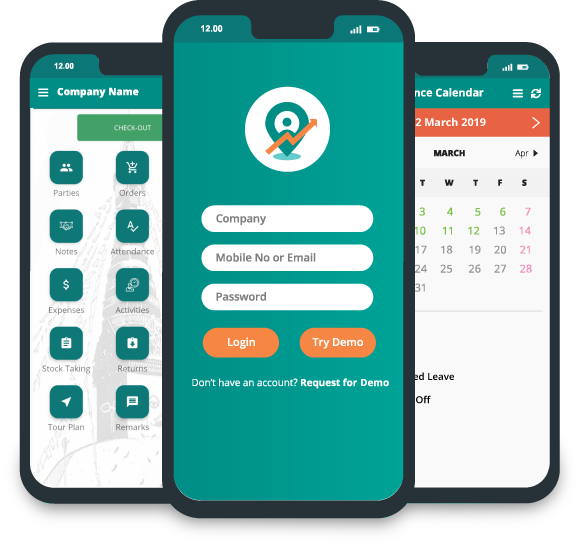
A ready-to-use sales app is designed for immediate field execution. Unlike AI systems that analyze data, these tools focus on capturing and managing real-time activity from the field.
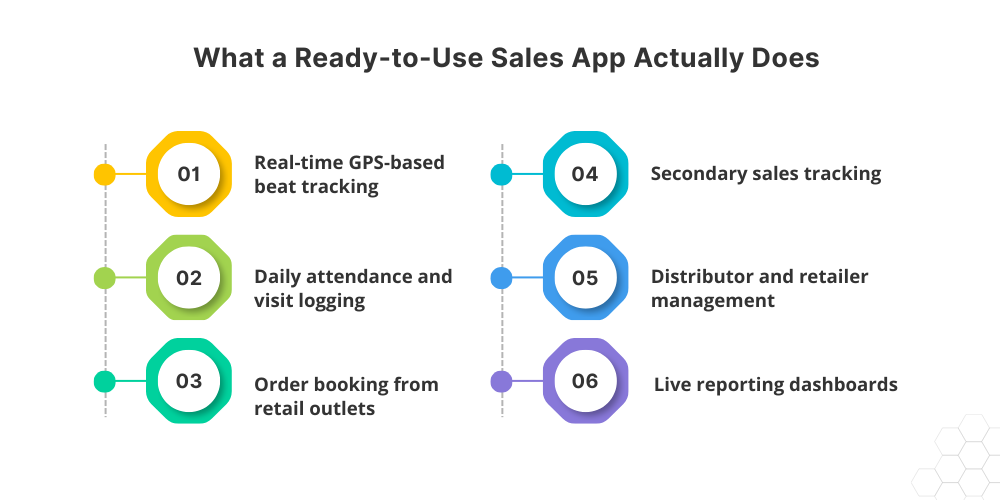
A typical sales tracking app or field sales tracking app enables:
- Real-time GPS-based beat tracking
Enables live monitoring of field executives’ movement using a GPS tracking app for field sales, ensuring route adherence, accurate territory coverage, and elimination of fake or missed visits. - Daily attendance and visit logging
Allows employees to mark attendance and log customer visits digitally through a field sales attendance management system, improving workforce accountability and reducing manual reporting errors. - Order booking from retail outlets
Facilitates instant digital order capture during field visits using a mobile order booking app for sales teams, improving order accuracy, reducing delays, and speeding up fulfillment cycles. - Secondary sales tracking
Provides visibility into product movement from distributor to retailer via secondary sales tracking software FMCG, helping businesses understand actual market demand and inventory flow. - Distributor and retailer management
Centralizes all distributor and retailer data through a distributor management system software, enabling better coordination, communication, and relationship management across the sales network. - Live reporting dashboards
Delivers real-time performance insights to managers using a real-time sales dashboard software, helping track sales activity, productivity, and field execution without waiting for manual reports.
These systems fall under field force automation software, ensuring that every field activity is recorded accurately and consistently.
Unlike AI, these tools don’t depend on perfect data, they create the data.
Key Differences: AI vs Sales Automation Apps
The difference between AI systems and ready-to-use sales automation apps is fundamental because both serve very different roles in field sales.
AI in field sales is focused on intelligence and prediction. It analyzes historical and structured data to generate insights such as forecasting, customer behavior patterns, and performance trends. However, it depends heavily on clean and consistent data, which is often a challenge in real-world field operations.
A sales automation app like a field sales app or field force management software, on the other hand, is built for execution. It captures real-time field data such as visits, orders, attendance, and route tracking, giving companies direct visibility into on-ground activity.
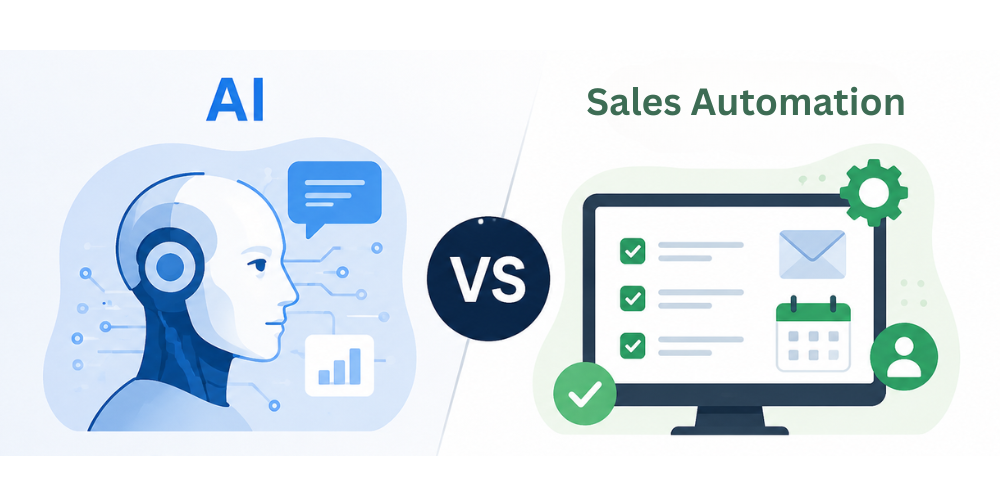
Implementation is another key difference. AI systems are complex and require data preparation and technical setup, while sales apps are quick to deploy and easy for field teams to start using immediately.
The output also differs: AI provides insights and suggestions, while sales apps deliver real-time operational control and visibility.
In simple terms, AI supports decision-making, but sales force automation tools ensure execution happens correctly in the field.
Execution vs Intelligence: What Field Teams Really Need
Most field sales problems are not intelligence problems, they are execution problems.
Common issues include:
- Missed retailer visits
Sales executives often skip assigned outlets, resulting in poor coverage, lost opportunities, and reduced overall territory sales performance. - Fake or inaccurate reporting
Manual reporting leads to data manipulation, incorrect visit records, and unreliable insights that impact decision-making and performance tracking. - Lack of route discipline
Field teams deviate from assigned beats, causing inefficient travel, wasted time, and inconsistent customer visit coverage across territories. - Poor attendance tracking
Attendance is often recorded manually, leading to inaccuracies, lack of accountability, and limited visibility into actual field workforce presence. - Delayed order capture
Orders collected in the field are reported late, causing delays in processing, inventory updates, and overall supply chain efficiency. - No visibility into field activity
Managers lack real-time insight into field operations, making it difficult to track performance, productivity, and on-ground execution effectively.
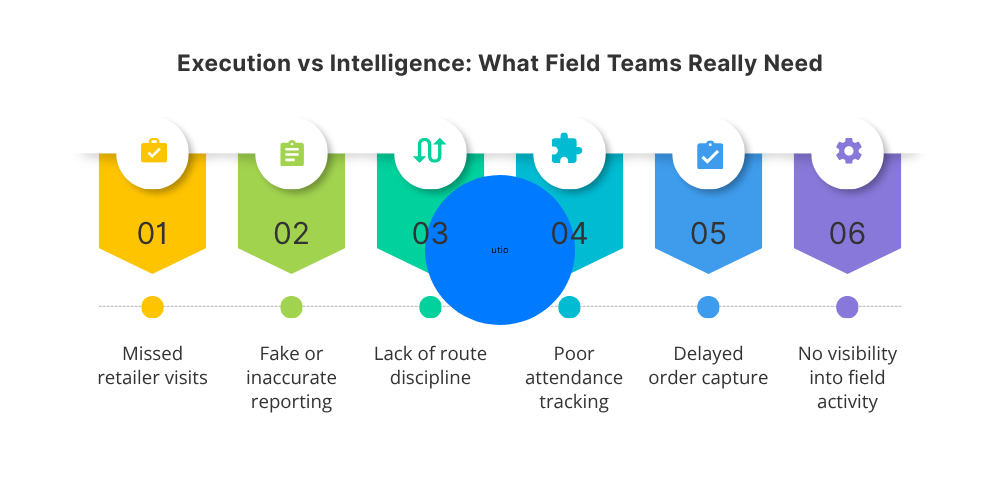
This is why field sales force tracking apps and field employee tracking systems often deliver faster ROI than AI tools.
Execution must come first. Intelligence becomes meaningful only when execution data is reliable.
Where AI Works Well in Sales Processes
AI is not ineffective; it is highly context-dependent and delivers the best results only when applied in the right environment.
AI works well in:
- Demand forecasting for large datasets
AI analyzes historical sales patterns and seasonality to accurately predict future demand, helping businesses optimize inventory planning and reduce stock issues. - Identifying high-value customer segments
AI segments customers based on behavior, value, and engagement, enabling sales teams to focus efforts on the most profitable accounts. - Predicting churn in B2B accounts
AI detects early signs of customer inactivity or dissatisfaction, helping businesses take proactive steps to retain valuable B2B clients. - Optimizing pricing strategies
AI evaluates market demand, competition, and trends to recommend optimal pricing, maximizing revenue while maintaining competitiveness in dynamic markets. - Advanced sales analytics dashboards
AI-powered dashboards provide real-time insights into sales performance, trends, and KPIs, helping leadership make faster and better decisions.
In mature organizations with strong CRM adoption and disciplined field reporting, AI adds a strategic layer on top of execution systems.
However, without consistent field data, even the best AI models become speculative.
Where Sales Apps Deliver Immediate Impact
Ready-to-use systems like a field force management app deliver immediate and measurable impact in day-to-day operations.
They help organizations:
- Ensure real-time field sales tracking
Enables continuous live monitoring of field executives’ activities, improving transparency, visibility, and accurate reporting of on-ground sales operations. - Improve discipline through GPS-based monitoring
Ensures field teams follow assigned routes and schedules using GPS tracking, increasing accountability and reducing unnecessary travel deviations. - Reduce reporting manipulation
Minimizes chances of fake reporting by validating field activities in real time, ensuring accurate data capture and reliable sales insights. - Increase outlet coverage accuracy
Helps ensure all assigned retail outlets are visited as planned, improving territory coverage efficiency and maximizing sales opportunities. - Speed up order-to-delivery cycles
Enables faster digital order capture and processing, reducing delays between field orders and delivery execution across the supply chain.
For FMCG, pharma, telecom, and distribution-heavy industries, this operational visibility is critical.
Unlike AI, these systems do not require training models or historical datasets, they work from day one.
Real Challenges in Field Sales That AI Cannot Fix Alone
Real challenges in field sales are not just technological, they are deeply rooted in execution discipline, human behavior, and ground-level process gaps. AI can analyze patterns, but it cannot directly correct field-level operational breakdowns without reliable inputs.
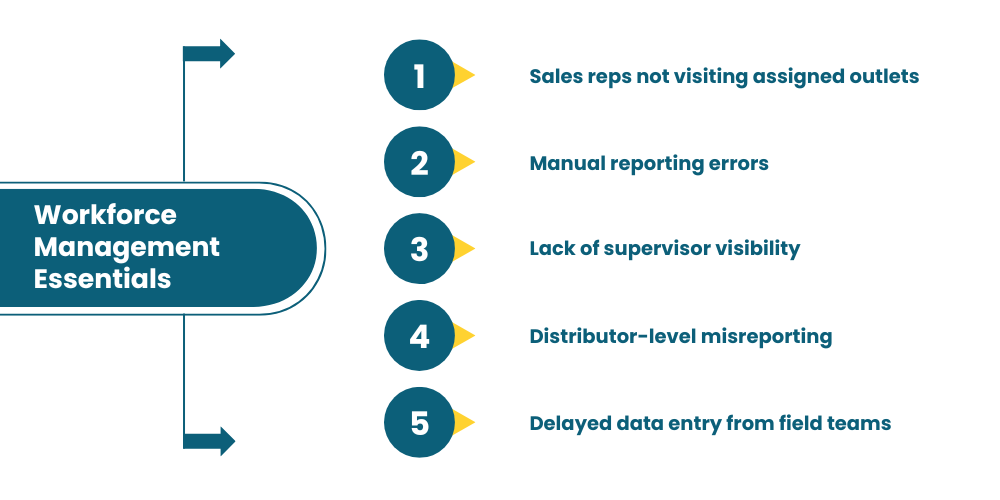
1. Sales reps not visiting assigned outlets
Sales representatives often skip assigned outlets due to workload, weak monitoring, or incentives misalignment, reducing market coverage and execution efficiency.
2. Manual reporting errors
Manual reporting leads to inaccurate data entry, human mistakes, duplication issues, and delayed updates, ultimately distorting sales performance visibility teams.
3. Lack of supervisor visibility
Lack of supervisor visibility prevents real-time tracking, reduces accountability, delays corrective actions, and weakens overall field sales performance management systems.
4. Distributor-level misreporting
Distributor-level misreporting creates inflated sales numbers, hides demand gaps, distorts forecasting accuracy, and leads to poor inventory planning decisions outcomes.
5. Delayed data entry from field teams
Delayed data entry from field teams reduces decision-making speed, impacts reporting accuracy, and prevents timely strategic sales interventions execution efficiency.
Without a mobile field sales app, even advanced AI systems will continue to produce flawed insights because the input data itself is unreliable.
How Sales Apps Solve Ground-Level Execution Problems
A field force automation system addresses execution challenges directly:
- GPS validation ensures genuine visits
GPS-based tracking verifies whether a sales rep actually visited the assigned outlet location. This eliminates false reporting, improves transparency, and ensures that field activity data reflects real-world movement instead of manual claims. - Mobile check-in/check-out improves attendance accuracy
Digital attendance marking replaces manual registers or backdated entries. Every check-in and check-out is time-stamped and location-verified, ensuring accurate working hour tracking and reducing attendance manipulation. - Route tracking enforces discipline
Pre-defined daily routes guide field reps through optimized outlet sequences. This reduces random movement, prevents missed outlets, and ensures better territory utilization with higher coverage efficiency. - Real-time order booking eliminates delays
Orders captured directly in the field are instantly synced with the system. This removes dependency on phone calls, paperwork, or end-of-day consolidation, significantly speeding up order processing and fulfillment cycles. - Live dashboards improve manager visibility
Supervisors and managers get real-time insights into team movement, visit completion, and order activity. This enables faster decision-making, proactive intervention, and better performance monitoring without waiting for reports. - Creates a controlled, measurable sales environment
When every activity, visit, order, route, and attendance, is tracked digitally, field sales become structured and measurable. This shifts operations from assumption-based management to data-driven control. - Enables AI and analytics on reliable data
Once execution becomes stable and standardized, organizations can confidently apply analytics and AI. Because the underlying data is clean and verified, insights become actionable rather than misleading.
Cost, Complexity, and Implementation Differences
One of the most practical differences between AI systems and ready-to-use apps is implementation effort.
AI Systems:
- High implementation cost: AI systems require heavy upfront investment in infrastructure, integration, and customization, making enterprise AI sales automation solutions costly for businesses initially.
- Requires data engineering: AI adoption depends on structured pipelines, cleaning, and integration, requiring skilled teams for sales data engineering and analytics infrastructure setup processes.
- Needs model training and maintenance: AI models require continuous training, retraining, and monitoring to stay accurate, increasing dependency on machine learning sales optimization systems expertise long-term.
- Long deployment cycles: AI systems take months to deploy due to integration complexity and testing phases, delaying ROI in AI-powered field sales platforms implementations significantly.
Sales Apps:
- Subscription-based pricing: Sales apps follow predictable subscription models, reducing upfront investment and making SaaS field sales automation platforms affordable for growing businesses.
- Quick deployment (days or weeks): These systems can be implemented rapidly without complex setup, enabling fast adoption of mobile field sales tracking software across teams.
- Minimal training required: Simple interfaces ensure field reps adapt quickly, reducing onboarding effort for digital sales force automation tools and improving productivity immediately.
- Immediate usability for field teams: Field teams can start using features instantly for visits, orders, and attendance through real-time field sales execution systems effectively.
For most SMEs and mid-sized businesses, field sales management software is significantly more accessible and cost-effective.

Which Solution Works Better for Small and Mid-Sized Businesses?
Small and mid-sized businesses don’t usually fail because of poor strategy, they struggle because execution on the ground is inconsistent, untracked, and often subjective. In such environments, intelligence-driven systems (like AI platforms) cannot compensate for weak operational discipline.
A sales force automation app or field sales tracking system directly solves this execution gap by standardizing daily field operations, improving transparency, and ensuring consistent performance across teams.
Why?
1. It fixes daily operational inefficiencies
It removes manual reporting, reduces paperwork, automates beat plans, and ensures sales reps follow structured daily workflows consistently.
2. It improves visibility instantly
Managers can see real-time location, visit status, orders, and field activity, enabling faster decisions and better territory control.
3. It reduces manual dependency
Eliminates reliance on handwritten reports, WhatsApp updates, and verbal communication by centralizing all field data into one system.
4. It enforces accountability in the field
Every visit, route, and order is tracked with timestamps and GPS, making field reps more disciplined and performance-driven.
AI becomes valuable only after this foundation is stable.
How AI and Sales Apps Will Work Together
The future of field sales is not about choosing between AI and sales apps, it is about combining both into a layered system where each plays a distinct role. AI cannot function effectively without structured, real-world execution data, and sales apps alone are limited without intelligence on top.
The most effective model evolving in the industry is a hybrid architecture, where field sales apps form the operational backbone and AI acts as an intelligence and automation layer built on top of it.
This evolution typically unfolds in three stages:
Stage 1: Execution Layer (Sales Apps as the Foundation)
At the base level, field sales automation systems capture ground-level activity with accuracy. They ensure every visit, order, and route is recorded in real time, eliminating guesswork and manual reporting errors.
Stage 2: Intelligence Layer (AI for Data Interpretation)
Once reliable structured data is available, AI systems analyze patterns, identify performance gaps, forecast demand, and generate actionable insights for managers and leadership teams.
Stage 3: Automation Layer (AI-Driven Decision Support)
In the most advanced stage, AI begins actively assisting execution by suggesting optimized routes, recommending next-best actions, identifying high-potential outlets, and automating repetitive decision-making tasks.
Final Thoughts:
AI and sales apps are not competitors, they work in layers. Field sales apps solve the real problem first: execution. They ensure accurate tracking, real-time visibility, and disciplined field operations. AI becomes useful only after this foundation is in place, where it can analyze clean data and generate insights.
For small and mid-sized businesses, execution matters more than prediction. A field sales tracking system delivers immediate control, while AI adds value later as intelligence on top of reliable data.
If your field team lacks visibility or consistency, start with the right foundation.
Book a free demo of Delta Sales App and streamline your field sales execution from day one.

-1792906895-resized320.png)