
What Is Retail Growth Strategy?
Growing a retail business has become more challenging than ever. Customers have more choices, competitors are constantly launching new products, and shopping habits continue to evolve. Whether you operate through supermarkets, local retail stores, distributors, or modern trade outlets, simply having a good product is no longer enough to drive consistent sales.
To succeed in this competitive environment, businesses need a clear retail growth strategy, a structured plan that helps increase sales, expand market reach, strengthen customer relationships, and improve overall retail performance. Rather than focusing only on short-term revenue, a retail growth strategy creates a roadmap for sustainable business growth by aligning sales, marketing, distribution, merchandising, and customer engagement efforts.
For manufacturers, distributors, and FMCG companies, retail growth also depends on how effectively products reach retail outlets, how visible they are on store shelves, and how well field sales teams execute market activities. Businesses that regularly monitor retail performance, optimize outlet coverage, and make data-driven decisions are better positioned to grow in an increasingly competitive market.
In this guide, you'll learn what a retail growth strategy is, why it matters, its key objectives, and how businesses can use proven strategies and technology to drive long-term retail success.
What Is Retail Growth Strategy?
A retail growth strategy is a long-term business plan designed to increase sales, expand market presence, improve customer satisfaction, and maximize profitability across retail channels. It focuses on identifying opportunities to attract new customers, retain existing ones, improve retail operations, and increase product availability in the market.
Unlike short-term sales campaigns, a retail growth strategy takes a holistic approach by combining multiple business functions, including sales, marketing, distribution, inventory management, merchandising, and customer experience.
For example, a consumer goods company looking to increase sales in a new region may develop a strategy that includes:
-
Expanding distribution to more retail outlets.
-
Improving shelf visibility through better merchandising.
-
Strengthening relationships with retailers and distributors.
-
Launching targeted promotional campaigns.
-
Equipping field sales teams with digital tools to improve market execution.
When these activities work together, businesses can achieve sustainable growth instead of relying on occasional promotional offers or price discounts.
Retail growth strategy ensures that the right products are available at the right outlets, at the right time, and supported by effective sales and marketing efforts.
Why Is Retail Growth Strategy Important?
Without a structured growth strategy, businesses often struggle with inconsistent sales, limited market visibility, declining customer loyalty, and inefficient retail operations. A well-defined retail growth strategy helps businesses overcome these challenges while creating a competitive advantage.
Here are some of the key reasons why a retail growth strategy is essential.
Increases Retail Sales
One of the primary goals of any growth strategy is to increase revenue. By improving product availability, optimizing pricing, and strengthening retail execution, businesses can drive higher sales across different retail channels.
Instead of relying on guesswork, companies use market insights and sales data to identify high-performing outlets, profitable product categories, and new sales opportunities.
Expands Market Reach
Business growth depends on reaching new customers and entering new markets.
A retail growth strategy helps organizations:
-
Expand into new territories.
-
Increase outlet coverage.
-
Strengthen distributor networks.
-
Enter modern trade and e-commerce channels.
-
Improve product accessibility.
Greater market coverage creates more opportunities to generate sales while reducing dependence on a limited customer base.
Improves Customer Satisfaction
Customers expect products to be available whenever they need them. Frequent stockouts, inconsistent pricing, or poor shopping experiences can quickly push customers toward competing brands.
An effective retail growth strategy focuses on:
-
Maintaining product availability.
-
Enhancing customer experience.
-
Delivering consistent pricing.
-
Improving service quality.
-
Strengthening retailer relationships.
Satisfied customers are more likely to become repeat buyers, increasing long-term profitability.
Enhances Retail Execution
Even the best products can underperform if they are not properly displayed or consistently available.
Strong retail execution ensures that products are:
-
Available in retail outlets.
-
Displayed prominently.
-
Supported by promotional materials.
-
Regularly replenished.
-
Properly merchandised.
Businesses that invest in better retail execution often achieve higher product visibility and stronger sales performance.
Supports Data-Driven Decision Making
Modern retailers generate large amounts of sales and market data every day.
A retail growth strategy encourages businesses to analyze this information to answer questions such as:
-
Which products perform best?
-
Which outlets generate the highest sales?
-
Which territories require additional support?
-
Which promotional campaigns deliver the best results?
Using retail analytics helps businesses make informed decisions rather than relying on assumptions.
Strengthens Competitive Advantage
Markets are constantly changing, with competitors introducing new products, promotions, and pricing strategies.
Businesses with a clear retail growth strategy regularly monitor competitor activities, customer preferences, and market trends. This allows them to adapt quickly and maintain a strong competitive position.
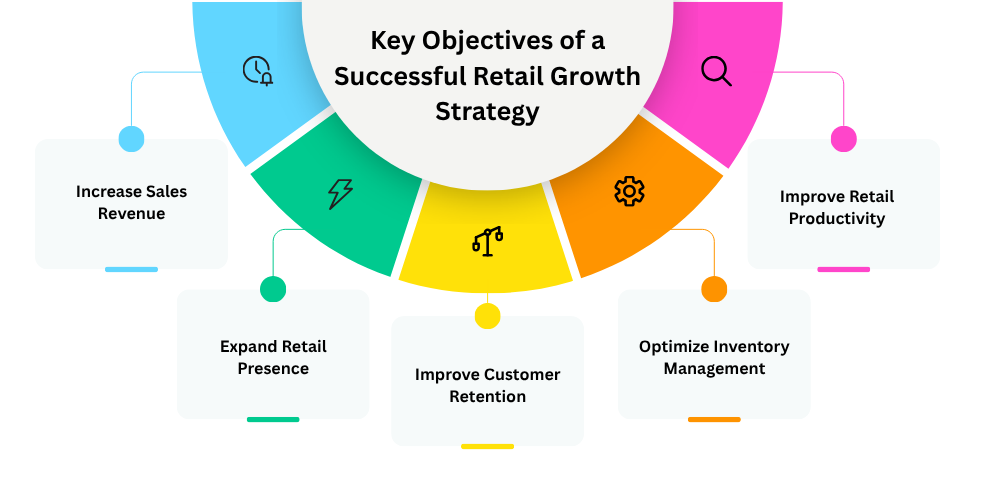
Key Objectives of a Successful Retail Growth Strategy
Every retail business has unique goals, but the most successful growth strategies typically focus on improving sales performance, expanding market coverage, and building stronger customer relationships.
Let's explore the key objectives that drive sustainable retail growth.
Increase Sales Revenue
The most obvious objective is increasing sales.
However, successful businesses don't simply try to sell more products, they focus on selling the right products through the right channels while maximizing profitability.
This can be achieved by:
-
Expanding product availability.
-
Improving promotional effectiveness.
-
Increasing average order value.
-
Optimizing pricing strategies.
-
Encouraging repeat purchases.
Higher sales become sustainable when supported by efficient retail operations and customer-focused strategies.
Expand Retail Presence
A business cannot grow if its products are available in only a limited number of outlets.
Expanding retail presence involves:
-
Increasing outlet coverage.
-
Entering new geographic regions.
-
Partnering with additional distributors.
-
Strengthening retailer relationships.
-
Exploring emerging retail formats.
Greater availability naturally increases sales opportunities and improves brand visibility.
Improve Customer Retention
Acquiring new customers is important, but retaining existing customers is often more cost-effective.
Retail growth strategies should focus on:
-
Delivering consistent product quality.
-
Providing better customer service.
-
Offering loyalty programs.
-
Maintaining product availability.
-
Building trust with retailers.
Long-term customer relationships create stable revenue and reduce customer acquisition costs.
Optimize Inventory Management
Inventory plays a critical role in retail success.
Too much inventory increases storage costs, while insufficient inventory leads to stockouts and lost sales.
An effective retail growth strategy aims to:
-
Improve demand forecasting.
-
Reduce inventory shortages.
-
Optimize replenishment cycles.
-
Minimize excess stock.
-
Improve warehouse efficiency.
Better inventory management ensures products remain available without increasing unnecessary operational costs.
Improve Retail Productivity
Growth also depends on how efficiently sales teams and retail operations perform.
Businesses should aim to:
-
Increase productive outlet visits.
-
Improve sales representative efficiency.
-
Optimize sales routes.
-
Reduce manual reporting.
-
Improve territory management.
Higher productivity enables organizations to serve more customers while controlling operational expenses.
Build Stronger Distributor and Retailer Relationships
Distributors and retailers are essential partners in driving retail growth.
A successful strategy focuses on strengthening these relationships by:
-
Providing reliable product supply.
-
Offering retailer support programs.
-
Maintaining transparent communication.
-
Responding quickly to market feedback.
-
Delivering consistent service.
Strong partnerships improve product availability, retailer satisfaction, and overall market performance.
Prepare for Long-Term Business Growth
Retail growth is not achieved through one successful promotion or a temporary increase in sales. It requires continuous improvement, regular market analysis, and the ability to adapt to changing customer needs and industry trends.
Businesses that invest in technology, strengthen field sales operations, and make data-driven decisions are better equipped to achieve sustainable growth while remaining competitive in the long run.
Essential Components of a Retail Growth Strategy
A successful retail growth strategy is built on several interconnected elements that work together to improve sales, customer satisfaction, and operational efficiency. Focusing on just one area, such as pricing or promotions, is rarely enough to achieve sustainable growth. Instead, businesses should adopt a balanced approach that strengthens every stage of the retail journey.
-1785758346.png)
1. Understanding Your Target Customers
Every successful retail strategy begins with understanding the customer. Knowing who your customers are, what they need, and how they make purchasing decisions helps businesses offer the right products and create better shopping experiences.
Businesses should analyze:
-
Customer demographics
-
Buying behavior
-
Purchasing frequency
-
Preferred sales channels
-
Product preferences
-
Seasonal demand
Customer insights help businesses personalize marketing campaigns, improve product offerings, and increase customer loyalty.
2. Expanding Retail Market Coverage
A business cannot grow if its products are available in only a few outlets. Expanding market coverage allows companies to reach new customers and increase brand visibility.
Businesses can grow their retail presence by:
-
Adding new retail outlets.
-
Expanding into new territories.
-
Partnering with additional distributors.
-
Entering modern trade and e-commerce channels.
-
Increasing productive outlet visits.
A broader retail network creates more opportunities for sales while reducing dependence on a limited customer base.
3. Product Availability and Inventory Management
Customers expect products to be available whenever they visit a store. Frequent stockouts not only result in lost sales but can also encourage customers to switch to competing brands.
Effective inventory management helps businesses:
-
Reduce stockouts.
-
Improve demand forecasting.
-
Optimize warehouse inventory.
-
Speed up replenishment.
-
Maintain consistent product availability.
Ensuring products are always available builds customer trust and improves retailer satisfaction.
4. Competitive Pricing Strategy
Pricing has a direct impact on customer purchasing decisions. A well-planned pricing strategy should balance competitiveness with profitability rather than relying on frequent discounts.
Businesses should regularly evaluate:
-
Competitor pricing
-
Retail margins
-
Consumer demand
-
Seasonal pricing trends
-
Promotional pricing
Using market intelligence and sales data allows businesses to make informed pricing decisions while protecting long-term profitability.
5. Retail Merchandising and Product Visibility
Even high-quality products can struggle to sell if customers cannot easily find them.
Effective retail merchandising focuses on improving:
-
Shelf placement
-
Product visibility
-
Store displays
-
Point-of-sale materials
-
Brand presentation
-
Planogram compliance
Well-merchandised products attract more attention, encourage impulse purchases, and contribute to stronger retail performance.
6. Customer Experience and Engagement
Customer experience has become a key differentiator in today's competitive retail environment. Businesses that consistently deliver positive shopping experiences are more likely to retain customers and generate repeat purchases.
Improving customer engagement involves:
-
Providing excellent service.
-
Maintaining product availability.
-
Offering personalized promotions.
-
Resolving customer issues quickly.
-
Creating loyalty programs.
Satisfied customers often become long-term brand advocates.
7. Omnichannel Retail Strategy
Modern customers expect a seamless shopping experience across both online and offline channels.
An effective omnichannel retail strategy integrates:
-
Physical retail stores.
-
E-commerce platforms.
-
Mobile applications.
-
Social commerce.
-
Distributor networks.
This approach allows customers to interact with the brand through their preferred channels while ensuring a consistent experience.
8. Data-Driven Decision Making
Retail businesses generate valuable information every day through sales transactions, field visits, inventory records, and customer interactions.
Using automated reports and analytics enables businesses to:
-
Measure sales performance.
-
Identify top-performing products.
-
Monitor outlet productivity.
-
Forecast demand.
-
Optimize sales strategies.
Data-driven decisions reduce uncertainty and improve business performance.
Proven Retail Growth Strategies to Increase Sales
Understanding retail growth is only the first step. Businesses must also implement practical strategies that help increase revenue, improve customer satisfaction, and strengthen market presence.
Here are some of the most effective retail growth strategies.
-1785758346.png)
1. Expand into New Markets
Entering new geographic regions allows businesses to reach untapped customer segments and increase overall sales.
Before expanding, businesses should evaluate:
-
Market demand
-
Competition
-
Distribution capabilities
-
Retail infrastructure
-
Consumer preferences
A well-planned expansion strategy minimizes risk while maximizing growth opportunities.
2. Improve Retail Execution
Strong retail execution ensures that products are consistently available, properly displayed, and supported by promotional activities across every outlet.
Businesses should focus on:
-
Improving shelf visibility.
-
Reducing stockouts.
-
Maintaining merchandising standards.
-
Monitoring outlet compliance.
-
Increasing productive outlet visits.
Better execution directly contributes to higher sales and stronger brand visibility.

3. Strengthen Distributor and Retailer Relationships
Distributors and retailers are critical partners in retail success.
Businesses should work closely with them by:
-
Providing consistent inventory.
-
Offering promotional support.
-
Sharing sales insights.
-
Addressing operational challenges.
-
Maintaining regular communication.
Strong relationships improve market coverage and increase retailer confidence.
4. Optimize Field Sales Operations
Field sales teams represent the bridge between businesses and retail outlets.
Improving field sales management helps businesses:
-
Increase outlet coverage.
-
Reduce travel time.
-
Improve visit productivity.
-
Capture real-time market intelligence.
-
Strengthen retailer relationships.
Technology enables field sales teams to spend more time selling and less time on manual reporting.
5. Use Promotions and Loyalty Programs
Strategic promotions encourage customers to try new products while increasing repeat purchases.
Examples include:
-
Seasonal discounts.
-
Cashback offers.
-
Bundle pricing.
-
Retailer incentive programs.
-
Customer loyalty rewards.
Well-designed promotional campaigns increase customer engagement without relying solely on permanent price reductions.
6. Leverage Sales Analytics
Businesses that regularly analyze sales data make better strategic decisions.
Sales analytics helps organizations:
-
Identify sales trends.
-
Measure product performance.
-
Evaluate territory productivity.
-
Track retailer performance.
-
Forecast future demand.
These insights support continuous improvement across the retail business.
7. Upselling and Cross-Selling
Encouraging customers to purchase complementary or premium products increases average order value.
Examples include:
-
Suggesting larger product packs.
-
Offering complementary products.
-
Creating bundled offers.
-
Promoting premium product variants.
These strategies improve profitability while enhancing customer satisfaction.
8. Personalize Customer Experiences
Today's customers appreciate personalized shopping experiences.
Businesses can improve engagement by:
-
Offering customized promotions.
-
Recommending relevant products.
-
Sending personalized offers.
-
Rewarding loyal customers.
-
Using customer purchase history.
Personalization helps build stronger customer relationships and increases repeat sales.
Common Challenges in Retail Growth
Although every business aims to grow, achieving sustainable retail growth comes with several operational and market challenges.
Below are the common challenges in retail growth:
-1785758346.png)
Increasing Competition
Retail markets are becoming increasingly competitive as new brands enter the market and existing competitors introduce innovative products and promotional campaigns.
Businesses must continuously monitor market trends and competitor activities to remain competitive.
Inconsistent Product Availability
Frequent stockouts reduce customer trust and create opportunities for competing brands to capture market share.
Improving inventory planning and distribution efficiency helps maintain consistent product availability.
Poor Retail Execution
Products may fail to perform even when demand exists if merchandising standards are inconsistent or shelf visibility is poor.
Regular outlet monitoring and field audits help improve retail execution across different locations.
Limited Market Visibility
Without accurate data from retail outlets, businesses often struggle to understand customer demand, retailer expectations, and competitor activities.
Collecting real-time market intelligence enables better decision-making.
Manual Sales Processes
Businesses relying on spreadsheets, paper reports, or phone calls often experience reporting delays, data inaccuracies, and limited operational visibility.
Digital field sales management solutions help automate reporting, improve productivity, and provide real-time business insights.
Best Practices for Building a Successful Retail Growth Strategy
Developing a retail growth strategy is not a one-time exercise. As customer expectations, market conditions, and competition evolve, businesses must continuously refine their approach to maintain growth. The following best practices can help retailers, distributors, and manufacturers achieve sustainable success.
Set Clear and Measurable Goals
Every retail growth strategy should begin with clearly defined objectives. Instead of focusing on general goals like increasing sales, businesses should establish measurable targets such as:
-
Increase retail sales by 20% over the next 12 months.
-
Expand into 500 new retail outlets.
-
Improve outlet coverage across key territories.
-
Reduce stockouts by 30%.
-
Increase repeat customer purchases.
Tracking these KPIs allows businesses to evaluate performance and make informed improvements.
Focus on Retail Execution
Even the strongest marketing campaigns cannot deliver results if products are unavailable or poorly displayed. Businesses should regularly monitor:
-
Product availability
-
Shelf visibility
-
Merchandising compliance
-
Promotional execution
-
Outlet coverage
Consistent retail execution improves brand visibility and creates a better shopping experience for customers.
Build Strong Distributor and Retailer Partnerships
Distributors and retailers are essential partners in retail growth. Maintaining strong relationships helps businesses improve product availability, strengthen market coverage, and respond quickly to changing customer demand.
Regular communication, retailer support programs, and timely product replenishment build trust and encourage long-term collaboration.
Empower Your Field Sales Team
Your field sales team plays a vital role in executing your retail growth strategy. They interact directly with retailers, monitor competitor activities, collect market insights, and ensure products are available across retail outlets.
Providing field representatives with digital tools helps them:
-
Plan productive outlet visits.
-
Capture orders quickly.
-
Report market activities in real time.
-
Monitor retail execution.
-
Improve retailer engagement.
An empowered sales team contributes directly to stronger retail performance.
Monitor Performance Regularly
Retail growth requires continuous evaluation. Businesses should regularly review key metrics such as:
-
Sales growth
-
Product availability
-
Outlet coverage
-
Inventory turnover
-
Customer retention
-
Distributor performance
Using retail analytics helps identify improvement opportunities before they affect business performance.
How Technology Supports Retail Growth
Technology has transformed the way retailers, manufacturers, and distributors manage their operations. Instead of relying on manual reporting and delayed decision-making, businesses now use digital tools to improve efficiency, visibility, and customer engagement.
Here are some ways technology supports retail growth.
-1785758346.png)
Real-Time Sales Reporting
Sales teams can instantly update order details, market feedback, and retail activities, allowing managers to make faster business decisions.
Field Sales Automation
Sales force automation simplifies daily field activities by digitizing outlet visits, order collection, attendance tracking, and reporting.
Inventory Visibility
Businesses can monitor stock availability across different locations, helping reduce stockouts and improve replenishment planning.
Retail Analytics
Interactive dashboards provide insights into sales trends, outlet performance, and territory productivity, enabling data-driven decision-making.
GPS-Based Field Tracking
GPS-enabled field sales tracking helps businesses verify outlet visits, improve route planning, and increase sales team accountability.
Technology enables businesses to streamline operations while creating better experiences for retailers and customers.
How Delta Sales App Helps Businesses Execute Their Retail Growth Strategy
A successful retail growth strategy depends on consistent execution in the market. From improving outlet coverage to monitoring field activities, businesses need complete visibility into their sales operations. Delta Sales App provides the tools needed to manage these activities efficiently.
With Delta Sales App, field sales representatives can:
-
Record outlet visits with GPS verification.
-
Capture customer orders directly from the market.
-
Track product availability at retail outlets.
-
Collect retailer feedback and market insights.
-
Monitor competitor activities during outlet visits.
-
Submit reports instantly through the mobile app.
For managers and business owners, the platform provides:
-
Real-time visibility into field sales activities.
-
Centralized dashboards for sales performance.
-
Territory-wise outlet coverage reports.
-
Sales team productivity tracking.
-
Retail execution monitoring.
-
Data-driven insights for better decision-making.
By replacing manual reporting with digital workflows, Delta Sales App helps businesses improve field sales management, strengthen retail execution, increase productivity, and support long-term retail growth.
Conclusion
A successful retail growth strategy goes beyond increasing sales, it focuses on creating a stronger retail presence, improving customer experiences, optimizing operations, and building lasting relationships with retailers and distributors. Businesses that consistently invest in retail execution, field sales management, and data-driven decision-making are better equipped to adapt to changing market conditions and achieve sustainable growth.
Your field sales team plays a crucial role in bringing this strategy to life. By improving outlet coverage, capturing market insights, monitoring product availability, and strengthening retailer relationships, they help drive consistent retail performance across every territory.
Instead of relying on manual processes and delayed reports, businesses can use Delta Sales App to streamline field sales operations, monitor retail activities in real time, and make informed decisions backed by accurate data. With better visibility into your sales operations, you can improve productivity, strengthen distribution, and accelerate retail growth.
Ready to Grow Your Retail Business?
Discover how Delta Sales App helps businesses improve retail execution, increase outlet coverage, empower field sales teams, and drive sustainable retail growth.
Book a free demo today and see how Delta Sales App can help you turn every field visit into measurable business growth.