
10 Best Customer Visit Tracking Software for Field Sales Teams in 2026
Field sales teams rarely struggle because customer visits are impossible to record. The bigger problem is knowing whether the right customers were visited, whether planned outlets were covered, how much time was spent at each location, and what happened after the visit.
A sales representative may complete a full day's route, but a manager reviewing a manually prepared DSR may still have limited visibility into actual outlet coverage, travel activity, order booking, collections, and follow-ups.
Customer visit tracking software closes this gap by linking field activity to GPS location, customer records, visit history, route plans, and sales data. For FMCG companies, distributors, manufacturers, and wholesalers, the value becomes greater when visit tracking works alongside beat planning, secondary sales, retail execution, order management, and reporting.
The market includes standalone visit and location tracking tools as well as broader field sales platforms. The following 10 options cover different requirements, from route optimization and CRM mapping to FMCG distribution and complete field-force automation.
This blog explores the 10 best customer visit tracking software options for field sales teams in 2026, covering their key features, pricing, strengths, limitations, and suitability for different sales operations. The comparison also highlights the features that matter most when selecting a visit tracking platform for FMCG, distribution, and field-sales teams.
What Is Customer Visit Tracking Software
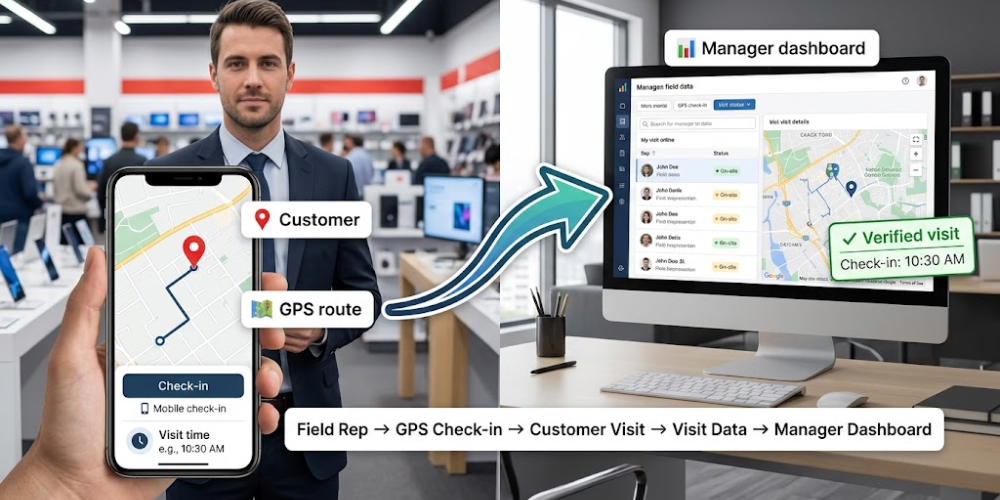
Customer visit tracking software records and monitors field representatives' visits to customers, retailers, distributors, and other business locations. Depending on the platform, visit tracking can include GPS check-ins, customer location verification, visit duration, route history, planned versus completed visits, notes, photographs, orders, collections, and follow-up activities.
Traditional field reporting often depends on spreadsheets, phone calls, WhatsApp updates, paper-based DSRs, or end-of-day submissions. These processes can make it hard to know exactly what happened during a field representative's day. A dedicated system creates a digital record of field activity.
For an FMCG representative, for example, a customer visit can involve outlet check-in, stock checking, SKU availability, order booking, scheme verification, payment collection, merchandising, and follow-up. Connecting those activities to the visit record provides substantially more operational context than GPS location alone.
Core Problems It Solves: Fake Visits, Missed Follow-ups, No Visibility
-
Unverified customer visits: Manual reports can confirm that a visit was reported, but not necessarily that the representative reached the intended outlet. GPS and geofencing can provide an additional layer of location verification.
-
Missed outlets: A planned beat may contain 25 outlets, while the actual route covers only 17. Visit tracking can make the coverage gap visible.
-
Limited visibility into field activity: A DSR may show orders and collections without showing the complete route or time spent at individual customers.
-
Missed follow-ups: Customer notes, previous visit history, order information, and follow-up activities can be stored against the customer record rather than scattered across messages and spreadsheets.
-
Unproductive travel: Route history can reveal excessive travel, repeated route deviations, or inefficient territory coverage
-
Inconsistent reporting: Automated visit records reduce dependence on manually compiled daily reports and provide managers with a more consistent view of field activity.
Key Features to Look For in Customer Visit Tracking Software
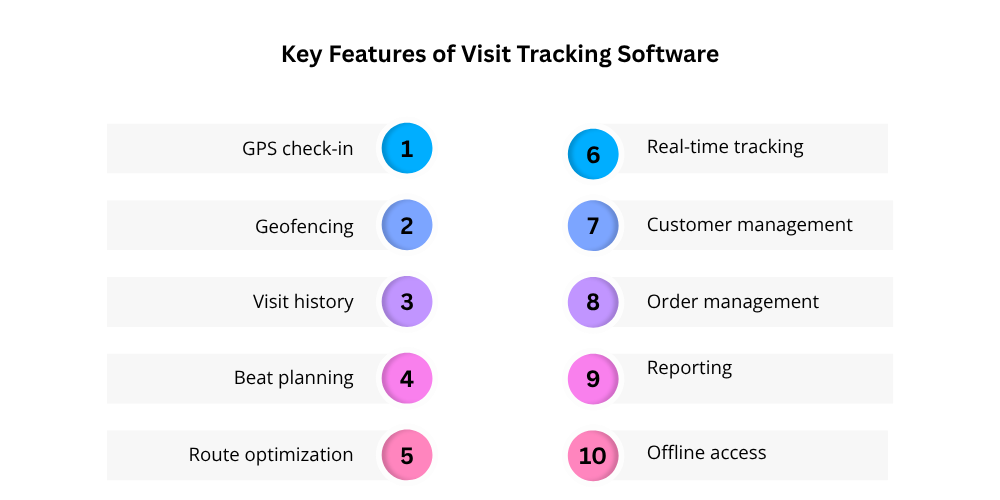
The usefulness of customer visit tracking software depends on more than simply recording a field representative's location. A complete platform should help connect customer visits with route plans, territory coverage, sales activities, and reporting. This gives field managers a clearer picture of what happened in the market and helps identify gaps that may not be visible through manual DSRs. Several features are particularly important when evaluating a platform for FMCG, distribution, manufacturing, and other field-sales operations.
-
GPS Check-in and Check-out
GPS check-in and check-out records the field representative's location when a customer visit begins and ends. This creates a digital record of the visit and provides managers with greater visibility into actual outlet coverage. It can also help determine whether a planned customer visit was completed at the expected location rather than being reported manually later.
-
Geofencing
Geofencing creates a defined geographic boundary around a customer, retailer, distributor, or other business location. A visit can then be verified based on whether the representative is within the permitted area. This is particularly useful for reducing false visit reporting and ensuring that field activities are associated with the correct outlet.
-
Visit History
Visit history maintains a record of previous customer interactions, including visit dates, frequency, and other activities captured during the visit. Managers can use this information to identify customers that have not been visited according to the planned frequency. For FMCG teams, visit history can also help evaluate whether priority outlets are receiving sufficient coverage.
-
Beat Planning
Beat planning organizes customers and outlets into structured routes or recurring visit schedules. Field representatives can receive assigned outlets for a particular day, territory, or sales cycle. When combined with visit tracking, beat planning allows managers to compare planned coverage against actual completed visits and identify missed outlets.
-
Route Planning and Optimization
Route planning determines the sequence in which customers should be visited, while route optimization can help reduce unnecessary travel between outlets. This can improve territory coverage and give representatives more time for customer interactions instead of spending excessive hours travelling between locations.
-
Real-Time Location Tracking
Real-time location tracking provides managers with visibility into the current location and movement of field representatives during working hours. This can be useful for monitoring territory coverage and understanding how representatives are progressing through their assigned routes. Historical route information can also help identify repeated travel patterns, route deviations, or areas requiring better territory planning.
-
Customer and Distributor Management
Customer and distributor management keeps important account information connected to field activities. Retailers, distributors, wholesalers, and other parties can be organized within a central system instead of being maintained across separate spreadsheets. A centralized customer record also makes previous visits, orders, collections, and follow-up activities easier to access.
-
Order and Collection Management
Customer visits often involve more than a conversation. In FMCG and distribution operations, representatives may book orders, collect payments, check outstanding balances, or record returns during the same visit. Connecting these activities with visit records provides a clearer view of what happened at each outlet and reduces the need to reconcile separate sales and visit reports.
-
CRM and ERP Integration
CRM and ERP integration allows customer visit information to work alongside existing business data. This can connect field activity with customer profiles, sales records, inventory information, or other operational systems. Integration is particularly useful for organizations already using a CRM or ERP and looking to avoid maintaining duplicate customer records.
-
Automated Reporting and Dashboards
Automated reports turn field activity into measurable information for sales managers. Common reports can include customer visits, outlet coverage, route activity, orders, collections, attendance, and representative performance. Real-time dashboards can reduce dependence on manually prepared DSRs and give managers faster visibility into field operations.
-
Offline Functionality
Field representatives do not always operate in areas with reliable mobile internet. Offline functionality allows visits, orders, customer information, and other activities to be recorded without a continuous connection. Once connectivity returns, the stored information can synchronize with the central system. This is particularly important for sales teams covering rural, remote, or low-connectivity territories.
-
Mobile-Friendly Interface
Customer visit tracking is only useful when field representatives actually use the application consistently. A mobile-friendly interface should make common actions such as customer check-in, order booking, visit completion, and note-taking quick and straightforward. A simpler workflow can reduce data-entry friction and improve adoption among representatives who spend most of the working day outside the office.
For FMCG and distribution teams, the most useful platforms combine these capabilities into one connected workflow. Customer location, visit activity, beat coverage, orders, collections, and sales reporting become much more valuable when the information can be viewed together rather than maintained across separate systems.
Top 10 Customer Visit Tracking Software
Customer visit tracking software varies in its approach to location tracking, route planning, field activity management, CRM integration, and sales execution. Some platforms focus primarily on mapping and visit visibility, while others combine customer visits with broader field-force automation and sales workflows.
The following platforms address different field-sales requirements, ranging from basic visit and location tracking to comprehensive solutions for FMCG, distribution, and field sales operations.
1. Delta Sales App
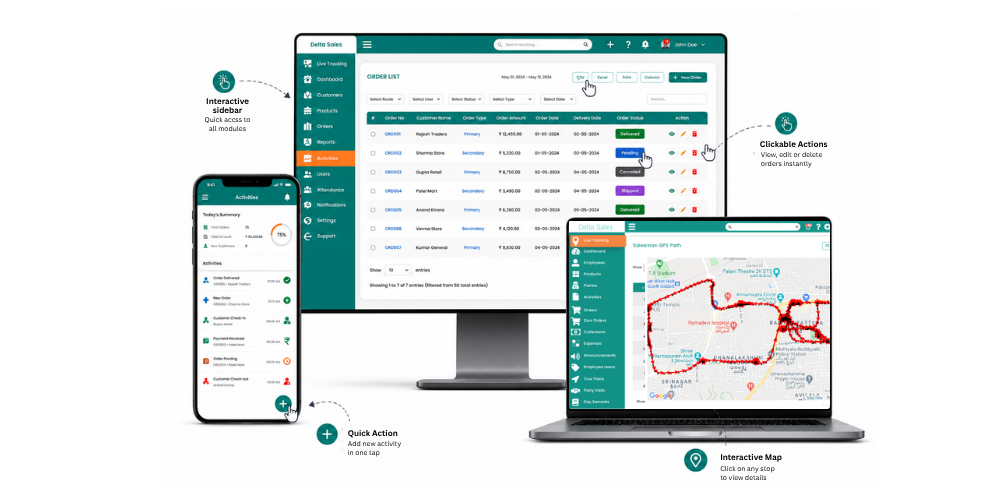
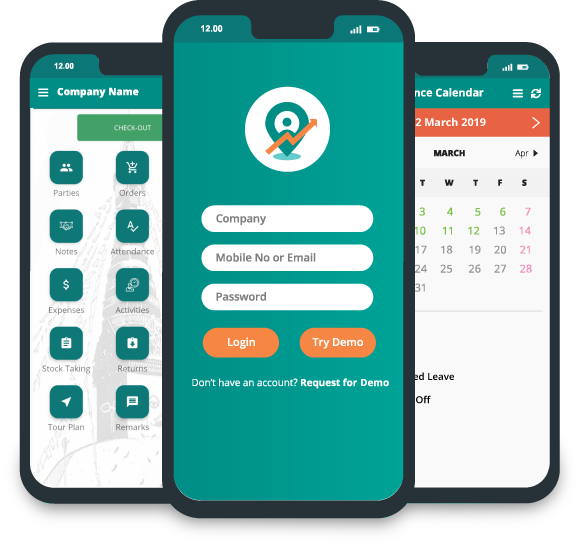
Delta Sales App is a leading customer visit tracking and field sales automation platform designed for FMCG companies, distributors, manufacturers, wholesalers, and other field-driven sales organizations. The platform combines customer visit tracking with GPS employee tracking, beat planning, order management, attendance, expense management, retail execution, secondary sales, and automated sales reporting.
Rather than treating a customer visit as a standalone location event, Delta Sales App connects field activity with the wider sales process. A single outlet visit can include stock verification, secondary sales order booking, payment collection, merchandising checks, customer follow-ups, and other field activities, with these activities managed through a connected workflow.
Customer visit tracking provides visibility into where and when field representatives visit customers, including visit frequency and time spent at customer locations. GPS-based tracking and geofencing add greater visibility into field activity and help verify whether scheduled customer visits are taking place at the expected locations.
The platform also supports beat and tour planning, real-time employee location tracking, offline order booking, customer and distributor management, attendance, collections, retail execution, and automated DSR and sales reports. This broader functionality makes Delta Sales App particularly relevant for organizations looking for customer visit tracking software that can support the complete field sales cycle rather than location tracking alone.
Key Features
-
GPS-based customer visit tracking: Records field activity based on the representative's location and provides managers with visibility into customer visits.
-
Geofencing: Helps verify visits by establishing location boundaries around customers, outlets, or other business locations.
-
Beat and tour planning: Allows sales managers to organize customer visits according to territories, routes, and recurring sales schedules.
-
Real-time employee tracking: Provides visibility into field representatives' current locations and travel activity.
-
Customer and party management: Centralizes retailer, distributor, wholesaler, and customer information.
-
Order booking: Allows representatives to record orders directly during customer visits.
-
Secondary sales management: Supports sales workflows involving distributors and retail outlets.
-
Collection management: Helps representatives record customer payments and collection activities during field visits.
-
Attendance and leave management: Connects field attendance with employee location and working activity.
-
Expense management: Supports recording field expenses and relevant travel information.
-
Retail execution: Helps capture outlet-level execution activities and field observations.
-
Automated DSR and reporting: Reduces manual reporting by converting field activity into structured sales reports.
-
Sales dashboards and analytics: Gives managers visibility into visits, sales activity, territory performance, and other field KPIs.
-
Offline functionality: Allows field representatives to continue recording important activities in areas with weak connectivity and synchronize information when the connection returns.
Best Suited For
Delta Sales App is particularly suited to FMCG companies, distributors, manufacturers, wholesalers, and other businesses managing field sales teams. The platform is especially relevant when customer visit tracking needs to work alongside beat planning, secondary sales, order booking, collections, retail execution, attendance, and sales reporting. For teams looking for more than employee location tracking, the broader field-sales workflow can reduce the need for separate systems for visits, attendance, orders, collections, and daily reporting.
2. Badger Maps
Badger Maps is a sales mapping and route planning platform that helps field sales teams organize customer locations, plan efficient routes, and manage territory coverage. Its features center on route optimization, customer mapping, territory visualization, and sales activity planning. It's especially useful for teams where daily travel efficiency and geographic territory management are top priorities, though organizations needing broader FMCG sales execution capabilities will likely need additional tools alongside its mapping and routing.
Best suited for: Field sales teams focused on route planning, territory management, and sales mapping.
3. SalesRabbit
SalesRabbit is a field sales platform built around lead management, territory organization, sales activity tracking, and rep management. It works well for teams that rely heavily on mobile selling and structured field activity, with tools for managing leads, appointments, territories, and rep performance. It suits sales organizations that need structured field selling workflows, though organizations with heavier FMCG distribution needs may require additional capabilities beyond what it offers.
Best suited for: Field sales organizations focused on lead management, territory organization, and rep activity tracking.
4. Map My Customers
Map My Customers combines CRM functionality with mapping and field sales management. The platform helps sales teams visualize accounts geographically, manage customer information, plan routes, and track sales activity from a map-based interface. That geographic approach works well for organizations with large customer bases spread across multiple territories, though teams needing deeper order management, distribution workflows, or FMCG-specific execution may need complementary systems alongside it.
Best suited for: Field sales teams managing geographically distributed customer accounts.
5. Salesforce Maps
Salesforce Maps extends the Salesforce ecosystem with location intelligence, route planning, territory visualization, and field activity management. It lets organizations tie geographic sales data to the customer and CRM data they already manage in Salesforce. It fits best for enterprises already on Salesforce looking to add mapping and field planning on top of what they have, though how well it suits a smaller or highly FMCG-focused team depends a lot on existing Salesforce infrastructure and implementation requirements.
Best suited for: Salesforce-based organizations requiring advanced mapping, territory planning, and field sales capabilities.

6. Outfield
Outfield is a field activity management platform designed to help organizations monitor field representatives, customer visits, territory activity, and sales execution. Its capabilities include location tracking, visit verification, scheduling, task management, and field performance monitoring. The platform is useful for organizations that need greater visibility into activities taking place across distributed field teams. More specialized distribution, order management, and secondary sales requirements may require additional systems.
Best suited for: Field teams requiring activity tracking, visit monitoring, and execution visibility.
7. SPOTIO
SPOTIO is a field sales software platform focused on sales rep tracking, lead management, territory management, and field activity visibility. Its location-based capabilities help managers monitor field activities and understand how sales representatives are working across assigned territories. The platform is particularly relevant to organizations with highly mobile sales teams and territory-based selling models. Businesses with broader FMCG distribution workflows may need additional functionality beyond field sales tracking.
Best suited for: Field sales teams focused on rep tracking, territory management, and lead-driven selling.
8. Repsly
Repsly is a field team management platform built around retail execution, customer visits, task management, and field rep performance. It suits organizations that need to monitor activity across stores, outlets, and other customer locations while keeping execution standards consistent. Its retail-focused feature set makes it relevant for consumer goods and retail operations, though organizations needing integrated order booking, secondary sales, collections, or broader distribution management may need something more comprehensive.
Best suited for: Consumer goods and retail teams focused on store visits, retail execution, and field team management.
9. Zoho RouteIQ
Zoho RouteIQ combines route planning and location intelligence with the broader Zoho ecosystem. It helps field teams optimize routes, visualize customer locations, and manage geographically distributed sales activities. Its integration with Zoho CRM makes it a practical option for organizations already working within the Zoho environment. Teams needing a dedicated FMCG sales execution platform may still need additional tools on top of it for order management, secondary sales, collections, and field reporting.
Best suited for: Zoho CRM users requiring route optimization and location-based sales planning.
10. BeatRoute
BeatRoute is a sales force automation and distribution management app built for organizations running structured field sales and distribution operations. Its capabilities cover sales execution, distributor management, retail execution, beat planning, and field force management. It fits especially well for consumer goods and distribution businesses whose sales activities span multiple channels and territories, though implementation requirements and feature configuration can vary depending on how complex the sales operation actually is.
Best suited for: FMCG, consumer goods, and distribution businesses managing structured field sales operations.
Conclusion:
Customer visit tracking software has become a core part of modern field sales management, helping organizations improve visit visibility, territory coverage, route planning, and field execution. Which platform actually fits depends on team size, sales processes, CRM requirements, distribution model, and how much automation the business actually needs.
For FMCG companies, distributors, manufacturers, and field sales organizations, visit tracking usually needs to work alongside order booking, beat planning, attendance, collections, secondary sales, retail execution, and automated reporting, not sit apart from them. Delta Sales App brings all of these into a single platform, which makes it a strong fit for organizations that need more than basic location or visit monitoring.
Teams looking to streamline customer visits and get real visibility into their field sales operations can explore Delta Sales App and book a free demo to see how the platform supports their workflow.