
What Causes Inventory Imbalances Between Distributors and Retailers?
A distributor may have plenty of stock in the warehouse, while retailers in the same market are struggling to get the products they need. In another case, a retailer may keep asking for a product that appears available in the distributor's records, only to find that the actual quantity is much lower.
These situations are common in distribution businesses. They usually happen when retailer demand, sales orders, and inventory records do not stay aligned.
For businesses serving hundreds or thousands of outlets, even small gaps in stock information can create bigger problems. Products may sit at the wrong locations, retailers may face stockouts, and distributors may carry more inventory than the market can absorb.
Understanding the reasons behind inventory imbalances between distributors and retailers is the first step toward fixing them. The solution is not always about holding more stock. In many cases, businesses need better information about what is selling, where it is selling, and what retailers actually need.
What Are Inventory Imbalances?
Inventory imbalances occur when the amount of stock available at a distributor or retailer does not match actual customer demand. In simple terms, a business may have too much inventory of some products while having too little inventory of others.
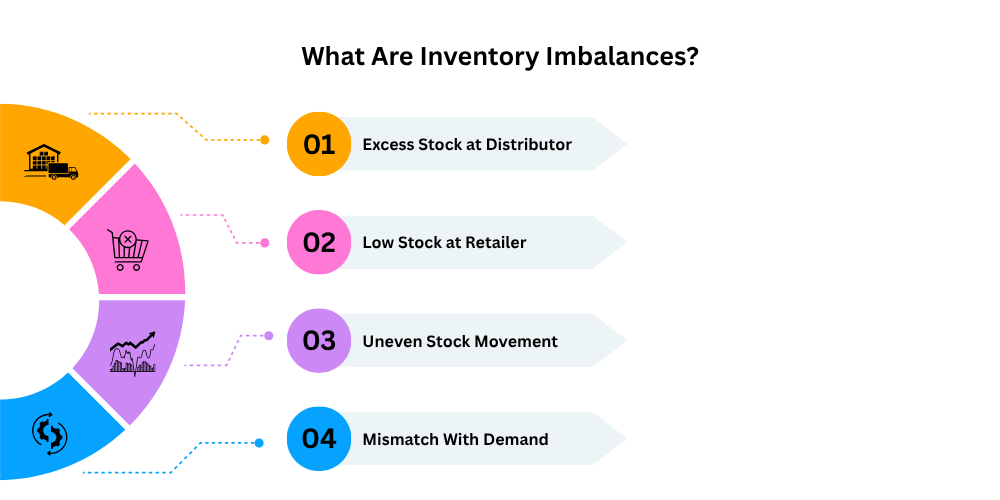
Inventory imbalances can also develop when recorded stock does not match the actual quantity available. Products may have been sold, returned, damaged, transferred, or expired without the inventory records being updated properly.
For distributors and retailers, common signs include:
-
Stockouts of products that sell quickly
-
Excess stock of slow-moving products
-
Retailers repeatedly requesting unavailable SKUs
-
Differences between physical and recorded stock
-
Delayed replenishment after retailer orders
-
Products sitting at one location while demand exists elsewhere
In a distribution business, inventory balance is not just about maintaining enough products. It is about keeping distributor stock aligned with retailer demand. Accurate sales orders, timely market information, and regular stock updates help businesses identify these imbalances before they turn into lost sales or excess inventory.
What Are Inventory Imbalances Between Distributors and Retailers?
An inventory imbalance occurs when the amount of stock available at one point in the distribution chain does not match actual market requirements.
For example, a distributor may have 500 units of a product in its warehouse, but only 50 units may be available in the locations where retailers currently need them. At the same time, another product may be sitting in excess because retailers are ordering it less frequently.
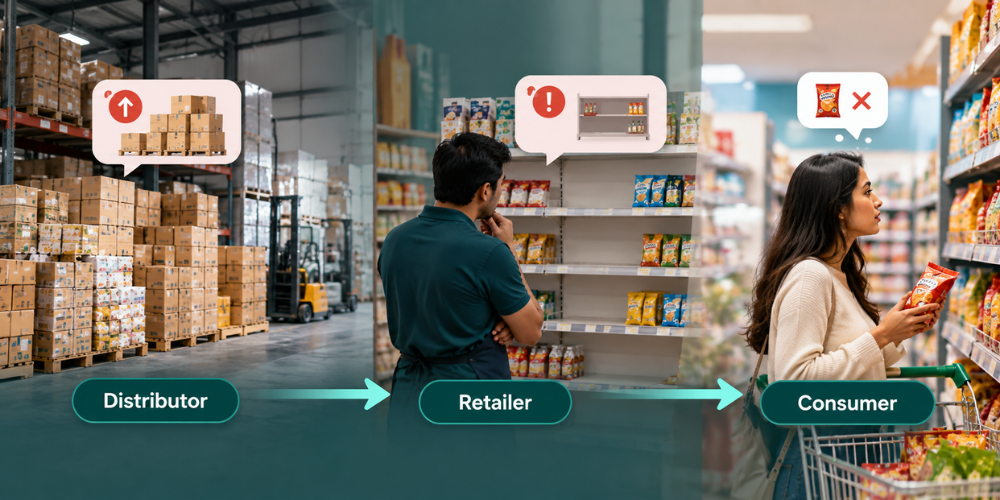
The issue can also happen because the recorded stock is different from the physical stock. A system might show 100 units, while only 70 are actually available because of unrecorded returns, damaged goods, transfers, or previous sales.
Common examples include:
-
A retailer runs out of a fast-moving product before the next sales visit.
-
A distributor holds excess stock of products with weak demand.
-
A sales representative records an order, but the distributor receives the information late.
-
Returned or damaged products remain in the system as sellable stock.
-
Retailer demand changes, but replenishment decisions are based on older information.
The important point is that inventory imbalance is not simply a warehouse problem. It can start with what happens during a sales visit.
How Do Inventory Imbalances Develop Across the Distribution Chain?
The movement from distributor to retailer involves several steps. Stock has to be purchased, stored, ordered, delivered, sold, returned, and recorded correctly.
A typical process looks simple:
Distributor stock → Sales visit → Retailer order → Order processing → Delivery → Retailer stock → Consumer sale
Problems appear when information is delayed or missed at any stage.
A sales representative may visit a retailer and learn that a particular SKU is selling quickly. If that order is recorded manually and shared with the distributor hours or days later, the distributor may not have enough time to prepare the stock.
The opposite can also happen. A distributor may replenish products based on historical sales while current retailer demand has already changed.
This is why stocktaking, sales order management app, and accurate market information matter. Physical products may move through the distribution chain, but the information about those products needs to move just as reliably.
What Causes Inventory Imbalances Between Distributors and Retailers?
There is rarely one reason behind the problem. Several operational issues can contribute to it.
1. Inaccurate Retailer Stock Information
Distributors cannot plan replenishment properly if they do not know what retailers actually have. Retailer stock can change every day, particularly in FMCG and other fast-moving categories. If stock information is collected irregularly, the distributor may continue working with outdated numbers.
A sales representative visiting an outlet can often identify this gap quickly. They may find that a product shown as available has already sold out or that another product has been sitting on the shelf for weeks.
Reliable retailer inventory data gives distributors a better view of what is happening at the outlet level.
2. Delayed Order Updates From the Field
Field sales teams are often the first people to know what retailers want. When orders are written on paper, entered into spreadsheets, or communicated through multiple messages, there is more room for delay and error.
A retailer may place an order in the morning, but the distributor may not receive the final details until later. During that time, stock could be allocated to another outlet or become unavailable.
Digital order capture helps reduce this gap by allowing sales representatives to record product quantities during the retailer visit.
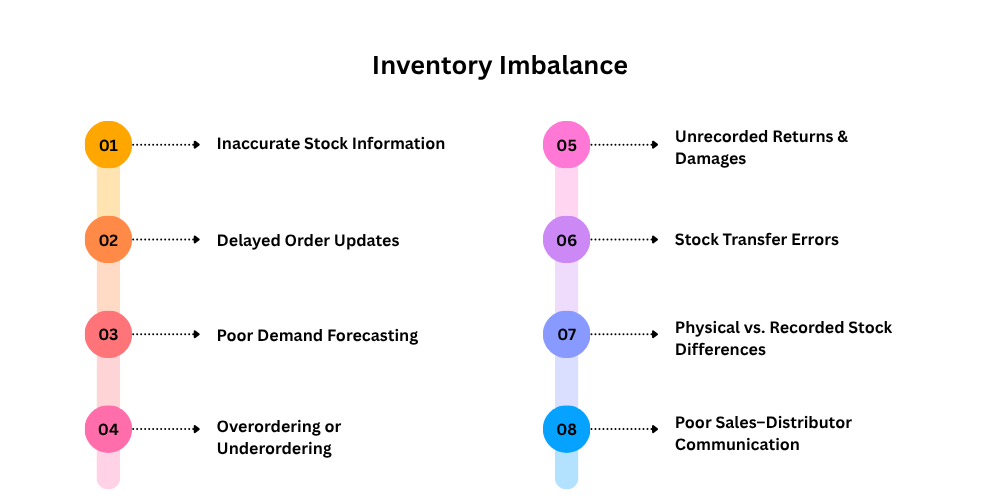
3. Poor Demand Forecasting
Past sales can provide useful information, but they do not always reflect current demand. Seasonal changes, promotions, local events, pricing changes, weather, and competitor activity can all affect what retailers need.
If a distributor continues ordering based only on previous sales figures, the business may end up with excess inventory in some SKUs and shortages in others.
Good demand forecasting should therefore include recent market activity, retailer orders, sales trends, and changes in outlet demand.
4. Overordering or Underordering by Retailers
Retailers also influence the balance. A retailer may order too much because they expect higher demand, or too little because they are unsure whether a product will sell. If distributors do not have enough information about the reasons behind these order patterns, replenishment becomes harder to manage.
Regular sales visits can help representatives understand why an outlet is ordering more or less than usual.
5. Unreported Returns, Damages, and Expired Products
Not every unit that enters a retailer or distributor location remains available for sale. Products may be returned because of damage, expiry, incorrect delivery, packaging issues, or other reasons. If these changes are not recorded promptly, the inventory system can show stock that cannot actually be sold.
This creates a stock variance between recorded quantities and usable products. Businesses need a clear process for recording product returns, damages, replacements, and expired stock.
6. Stock Transfers Without Proper Records
Products may move between distributors, warehouses, sales vehicles, or retail outlets. If those movements are not recorded correctly, one location may appear to have stock that has already been transferred elsewhere.
This is particularly difficult for businesses with large field teams and multiple distribution points. Every movement should have a clear record so that managers know where inventory is actually located.
7. Differences Between Physical and Recorded Stock
A system can only provide useful information when the underlying data is accurate. Manual entry mistakes, duplicate records, missed transactions, and incorrect quantities can gradually create differences between physical inventory and system records.
Regular inventory reconciliation helps identify these differences before they affect customer orders.
8. Poor Communication Between Sales Reps and Distributors
Field sales representatives, distributors, warehouse teams, and managers all see different parts of the sales process.
The sales representative knows what retailers are asking for. The distributor knows what is available. The warehouse knows what has been dispatched. If these teams work with separate or delayed information, decisions become disconnected. Better sales and distribution coordination can help close this information gap.
What Problems Do Inventory Imbalances Create?
The impact goes beyond having too much or too little stock.
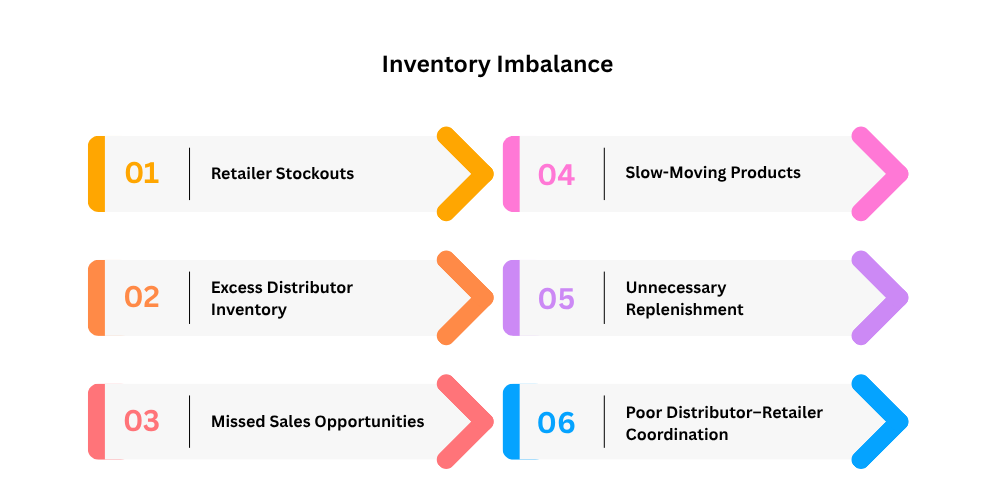
Retailer Stockouts
When fast-moving products are unavailable, retailers cannot fulfill customer demand. Repeated stockouts can also encourage retailers to purchase competing products.
Excess Distributor Inventory
Products that do not move quickly can occupy warehouse space and tie up working capital.
Missed Sales Opportunities
A product may be available somewhere in the distribution network but unavailable at the outlet where demand exists. This creates a lost sales opportunity.
Slow-Moving Products
Poor visibility into retailer demand can result in distributors continuing to hold products that are not moving at the expected rate.
Unnecessary Replenishment
If stock records are inaccurate, distributors may reorder products they already have or delay products that actually need replenishment.
Poor Distributor-Retailer Coordination
When retailers repeatedly receive incorrect quantities or face availability problems, trust between the two sides can suffer.
How Can Businesses Detect Inventory Imbalances Early?
Waiting until a retailer complains about a stockout is too late. Businesses can identify problems earlier by comparing sales orders, stock levels, and actual market movement.
Useful checks include:
-
Compare physical stock with recorded stock regularly.
-
Monitor products with frequent stockouts.
-
Identify unusually high or low retailer orders.
-
Track returns and damaged products.
-
Review product movement by outlet.
-
Monitor changes in sales representative orders.
-
Look for products accumulating at distributor locations.
-
Compare distributor inventory with recent retailer demand.
For field sales organizations, the quality of information collected during daily market visits can make a significant difference.
How Can Distributors and Retailers Prevent Inventory Imbalances?
Prevention starts with keeping inventory information close to what is happening in the market.
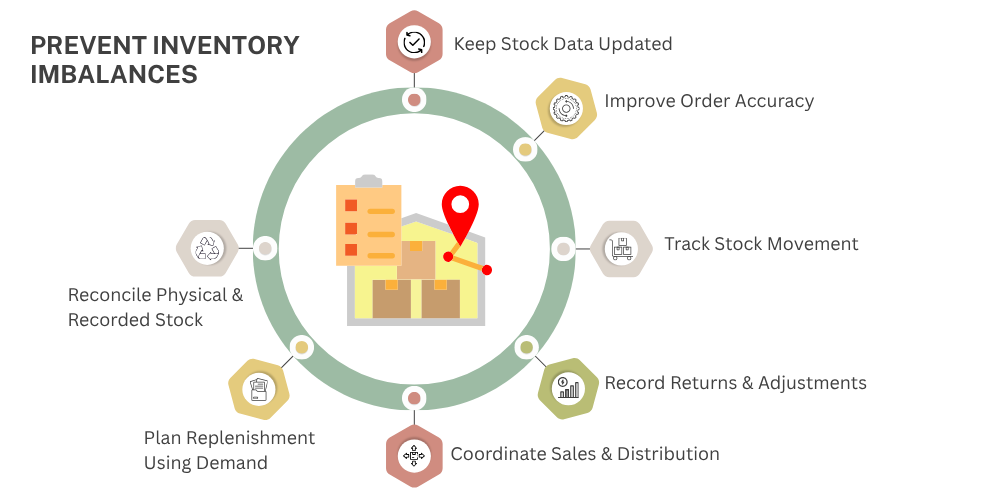
Keep Stock Data Updated
Inventory records should reflect sales, returns, transfers, and adjustments as soon as practical. The longer information remains outdated, the harder it becomes to make accurate decisions.
Improve Retailer Order Accuracy
Sales representatives should capture product names, SKUs, quantities, and other order details correctly during the visit. This reduces mistakes between the retailer, sales team, and distributor.
Track Sales and Stock Movement Regularly
Looking at inventory only at the end of the month can hide problems for too long. Regular monitoring makes it easier to spot unusual changes.
Record Returns and Adjustments Properly
Returned, damaged, or expired products should not continue appearing as available sellable stock.
Improve Sales and Distribution Coordination
Sales teams should be able to share market information with managers and distribution teams without relying entirely on manual communication.
Use Demand Data for Replenishment Planning
Recent retailer orders and outlet-level sales activity can provide useful signals for deciding what needs to be replenished.
Conduct Regular Inventory Reconciliation
Physical checks still matter. Digital records and actual stock should be compared periodically to identify inventory discrepancies, unexplained losses, and recording errors.
How Can Field Sales Teams Help Reduce Inventory Imbalances?
Field sales representatives have a direct connection with retailers. They see product availability, customer demand, competitor activity, and retailer requirements during their daily visits.
This makes the field team an important source of inventory information.
During a visit, representatives can:
-
Check which products the retailer needs.
-
Capture orders accurately.
-
Record quantities requested by the outlet.
-
Report changes in retailer demand.
-
Update outlet information.
-
Share sales activity with managers.
-
Identify products that are moving slowly.
-
Report stock-related issues found at the outlet.
When this information is captured digitally, managers have a clearer picture of what is happening across the market.
For example, if several retailers in the same area start ordering more of a particular SKU, the business can identify the change earlier instead of waiting for month-end reports.
This is where field sales automation becomes useful. A field sales app can help representatives record retailer visits, capture orders, update outlet information, and submit activity reports from the market.
For businesses operating in areas with unreliable connectivity, offline functionality is also important. Sales information can be captured during the visit and synchronized when a connection becomes available.

What Inventory Metrics Should Distributors Monitor?
Distributors should track key inventory metrics to understand whether stock is moving efficiently and whether retailer demand is being met. Important metrics include:
-
Inventory accuracy: Shows whether recorded stock matches the actual quantity available.
-
Stockout rate: Tracks how often products become unavailable when retailers need them.
-
Inventory turnover: Shows how quickly products are moving through the distribution chain.
-
Stock variance: Identifies differences between expected and actual stock quantities.
-
Order fulfillment rate: Measures how consistently retailer orders are supplied as requested.
-
Return rate: Helps identify how frequently products are being returned due to damage, expiry, or other issues.
-
Outlet sales rate: Shows how products are performing across individual retailers.
-
Overstock level: Identifies products being held in quantities higher than current demand.
These metrics become more useful when reviewed alongside field sales activity and retailer orders. For example, frequent stockouts may be caused by delayed order updates, inaccurate outlet information, or poor replenishment timing not simply insufficient distributor stock.
Tracking these signals together helps distributors identify inventory imbalances earlier and keep stock closer to actual retailer demand.
How Can Technology Improve Distributor-Retailer Inventory Visibility?
Technology cannot fix poor processes on its own, but it can make information easier to collect, share, and review.
For field sales teams, digital tools can bring several activities into one workflow:
Sales visit → Retailer order → Field report → Manager visibility → Distributor action
Instead of waiting for handwritten reports or separate messages, managers can review sales activity and order information from a centralized system.
An inventory management software solution can help businesses maintain better stock visibility, while a retail execution app can help field teams track sales visits, check product availability, capture retailer orders, and update outlet information. Distributor management software can further help teams manage distributor operations and improve coordination between distributor stock and retailer demand.
This does not replace the distributor's inventory system. Its value is in improving the flow of accurate market information from the people visiting retailers every day.
When managers know which outlets were visited, what orders were captured, and how market demand is changing, they can coordinate more effectively with distributors and make better replenishment decisions.
Final Takeaway:
Inventory imbalances between distributors and retailers often occur when stock information and market demand are not updated together. A distributor may have enough inventory overall, while retailers still face shortages of the products they need.
Businesses can reduce these problems by maintaining accurate stock records, capturing retailer orders promptly, and improving communication between field sales teams and distributors.
Delta Sales App helps businesses track sales visits, capture retailer orders, manage outlet information, and monitor daily field activity.
Want better visibility into your market sales team?
Book a demo with Delta Sales App and see how it can support your field sales operations.