
Transforming CPG in 2025: Key Digital Trends Shaping the Industry
The consumer packaged goods (CPG) industry is undergoing a rapid transformation driven by digital innovation. In 2025, traditional business models are being replaced by data-driven strategies, automation, and customer-centric approaches.
From supply chain optimization to personalized marketing, CPG companies are leveraging advanced technologies to improve efficiency, reduce costs, and enhance customer experiences. Businesses that fail to adapt risk losing competitive advantage in an increasingly dynamic market.
What is Driving Change in the CPG Industry?
The CPG industry is experiencing a major shift as businesses adapt to evolving market dynamics and consumer expectations. Digital transformation is no longer optional, it is essential for staying competitive and relevant.
Several key factors are accelerating this change:
- Changing consumer behavior and demand for personalization
Today’s consumers expect tailored experiences, personalized recommendations, and seamless interactions across channels. Brands must leverage data and technology to meet these expectations. - Growth of eCommerce and direct-to-consumer (DTC) models
The rapid expansion of online shopping and DTC channels is enabling brands to connect directly with customers, gain valuable insights, and improve profit margins. - Increasing competition and margin pressures
With new entrants and evolving market dynamics, CPG companies are under constant pressure to optimize costs, improve efficiency, and differentiate their offerings. - Need for real-time data and visibility
Businesses require instant access to sales, inventory, and field performance data to make informed decisions and respond quickly to market changes. - Rising importance of sustainability and ethical practices
Consumers are increasingly favoring brands that prioritize eco-friendly practices, ethical sourcing, and transparency, making sustainability a critical business priority.
These factors are pushing CPG companies to embrace innovative technologies, streamline operations, and rethink traditional strategies to achieve long-term growth.
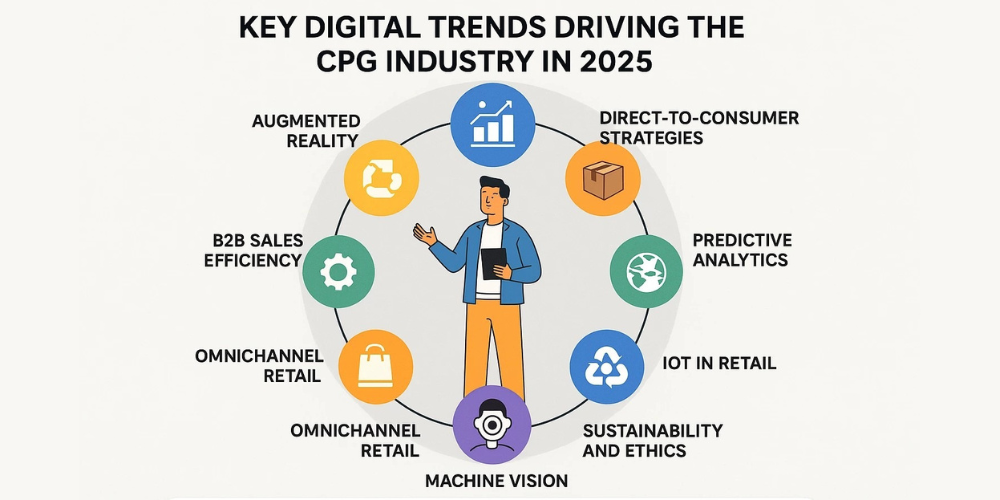
AI-Driven Personalization in CPG
Artificial Intelligence (AI) is redefining how CPG brands engage with consumers by enabling highly personalized and data-driven interactions. Instead of relying on broad, one-size-fits-all campaigns, companies can now analyze customer behavior, purchase history, browsing patterns, and preferences to deliver tailored experiences at scale.
AI-powered systems help brands recommend the right products at the right time, optimize pricing and promotions, and create hyper-targeted marketing campaigns that resonate with individual consumers. This level of personalization not only enhances the customer experience but also significantly improves marketing efficiency.
Key Benefits:
- Improved customer engagement
Personalized content and recommendations capture attention and encourage deeper interaction with the brand. - Higher conversion rates
Targeted offers and relevant product suggestions increase the likelihood of purchase. - Enhanced brand loyalty
Consistent and meaningful experiences build trust and long-term customer relationships. - More effective marketing campaigns
Data-driven insights allow marketers to optimize campaigns for better ROI and performance.
AI enables CPG companies to transition from traditional mass marketing to precision marketing, where every customer interaction is relevant, timely, and impactful, driving both satisfaction and sales growth.
Augmented Reality (AR) for Enhanced Consumer Experience
Augmented Reality (AR) is transforming how consumers explore and interact with products by blending digital elements with the physical world. It effectively bridges the gap between online and offline shopping, allowing customers to experience products in a more immersive and interactive way.
By using smartphones or in-store devices, shoppers can visualize products in real-time, access detailed information, and engage with brands beyond traditional displays. This creates a more engaging and informative buying journey.
Key Use Cases:
- Virtual product visualization
Customers can see how products look or fit in their own environment before making a purchase decision. - Interactive product packaging
AR-enabled packaging can display additional product details, usage instructions, or promotional content when scanned. - In-store AR experiences
Retailers can offer interactive displays and guided experiences to enhance product discovery and engagement.
AR not only increases customer engagement but also empowers shoppers with better information, leading to more confident purchase decisions. As a result, brands can reduce product returns, improve customer satisfaction, and strengthen overall brand experience.
Direct-to-Consumer (DTC) Strategies for Modern Brands
Direct-to-Consumer (DTC) strategies are rapidly gaining traction in the CPG industry as brands seek to build direct, meaningful customer relationships. By selling products through their own digital channels such as websites, mobile apps, and social media companies can bypass traditional intermediaries and take full control of the customer journey.
This shift not only enhances brand visibility but also allows businesses to gather valuable insights into customer behavior, preferences, and purchasing patterns, enabling more informed decision-making.
Advantages of DTC:
- Better control over brand experience
Brands can manage every touchpoint, from product discovery to post-purchase engagement, ensuring a consistent and high-quality experience. - Access to first-party customer data
Direct interactions provide valuable data that can be used for personalization, targeting, and improving product offerings. - Higher profit margins
Eliminating intermediaries reduces costs and increases overall profitability. - Improved customer loyalty
Personalized communication and direct engagement help build stronger, long-term customer relationships.
By leveraging digital platforms and data-driven strategies, CPG companies can create more personalized experiences, respond quickly to market trends, and establish a competitive edge in an increasingly customer-centric landscape.

Predictive Analytics for Demand Forecasting and Sales Optimization
Predictive analytics is enabling CPG companies to move from reactive decision-making to proactive strategy. By leveraging historical data, market trends, and consumer behavior insights, businesses can accurately anticipate demand and optimize their operations in real time.
This data-driven approach helps companies align production, inventory, and distribution with actual market needs, reducing inefficiencies and improving overall performance.
Key Applications:
- Demand forecasting
Predict future product demand based on historical sales data and market trends, ensuring better planning and availability. - Inventory planning
Stock taking helps to avoid overstocking or stockouts, reducing carrying costs and wastage. - Sales trend analysis
Identify patterns in sales performance to make informed business decisions and adjust strategies accordingly. - Promotion effectiveness tracking
Evaluate the impact of marketing campaigns and promotions to refine future strategies and maximize ROI.
With predictive analytics, CPG companies can minimize risks, enhance supply chain efficiency, and make smarter, faster decisions that directly impact revenue growth and customer satisfaction.
IoT in Retail: Enabling Smart and Connected Operations
The Internet of Things (IoT) is revolutionizing retail execution by connecting physical assets, devices, and systems to deliver real-time data and actionable insights. In the CPG industry, IoT enables smarter, faster, and more efficient operations by providing complete visibility across the supply chain and retail environment.
Through connected devices such as sensors, smart shelves, and tracking systems, businesses can monitor product movement, stock levels, and in-store performance with high accuracy. This allows companies to respond instantly to changes in demand and operational challenges.
Benefits of IoT in CPG:
- Smart shelves for inventory tracking
Automatically track product availability and shelf movement to ensure optimal stock levels at all times. - Real-time stock monitoring
Gain instant visibility with the inventory management software across multiple locations, reducing stockouts and overstock situations. - Improved supply chain transparency
Track products throughout the distribution process, enhancing accountability and reducing inefficiencies. - Enhanced in-store execution
Ensure better merchandising, product placement, and compliance through real-time data insights.
By leveraging IoT, CPG companies can make faster, data-driven decisions, improve operational efficiency, and ensure products are always available where and when customers need them, ultimately driving better sales performance and customer satisfaction.
Sustainability and Ethical Practices in CPG
Sustainability has evolved from a compliance requirement to a core business strategy in the CPG industry. In 2025, it is a key differentiator that directly influences consumer trust, brand reputation, and long-term profitability.
Modern consumers are more conscious than ever about the environmental and social impact of their purchases. As a result, CPG companies are adopting sustainable and ethical practices not only to meet regulatory standards but also to align with customer expectations and values.
Key Focus Areas:
- Eco-friendly packaging
Using recyclable, biodegradable, or reduced packaging materials to minimize environmental impact. - Responsible sourcing
Ensuring raw materials are sourced ethically, with fair labor practices and sustainable methods. - Carbon footprint reduction
Optimizing manufacturing, logistics, and distribution to lower emissions and energy consumption. - Waste management
Implementing efficient waste reduction, recycling, and circular economy practices.
By prioritizing sustainability, CPG brands can build stronger customer relationships, enhance brand loyalty, and future-proof their business. Companies that integrate ethical practices into their core operations are more likely to gain a competitive edge in an increasingly value-driven market.
Machine Vision for Retail Execution and Shelf Monitoring
Machine vision technology is transforming retail execution by enabling automated, image-based analysis of in-store shelves. Using advanced image recognition and AI algorithms, CPG companies can capture shelf photos through mobile devices or cameras and instantly assess product availability, placement, and compliance.
This eliminates the need for manual audits and provides accurate, automated reports and analytics into how products are displayed across retail outlets.
Key Benefits:
- Automated shelf audits
Instantly analyze shelf images to detect stock levels, gaps, and compliance issues without manual intervention. - Improved product placement
Ensure products are positioned correctly to maximize visibility and drive higher sales. - Real-time compliance tracking
Monitor adherence to planograms and promotional displays across multiple locations. - Enhanced merchandising strategies
Use data insights to refine in-store execution and optimize product performance.
By leveraging machine vision, CPG brands can maintain consistency across retail outlets, improve execution quality, and make data-driven merchandising decisions that directly impact sales and brand visibility.
Omnichannel Retail: Creating Seamless Customer Journeys
Today’s consumers engage with brands across multiple touchpoints, online stores, mobile apps, social media, and physical retail outlets. Omnichannel retail focuses on delivering a unified and consistent experience across all these channels, ensuring that customers can seamlessly switch between them without disruption.
For CPG companies, this means integrating systems, data, and processes to create a cohesive customer journey from discovery to purchase and beyond.
Key Elements:
- Integrated online and offline experiences
Ensure customers receive a consistent brand experience whether they shop in-store or online. - Unified inventory management
Maintain real-time visibility of stock across all channels to enable accurate order management, seamless order fulfillment, and avoid stock-related issues. - Consistent pricing and promotions
Align pricing strategies and offers across platforms to build trust and avoid confusion. - Cross-channel customer engagement
Interact with customers through multiple touchpoints while maintaining continuity in communication and service.
A well-executed omnichannel strategy enhances customer convenience, improves satisfaction, and builds long-term loyalty, ultimately driving higher retention and increased revenue.
B2B Sales Automation for Operational Efficiency
B2B sales automation is reshaping how CPG companies manage complex sales operations, distributor networks, and field teams. By digitizing and automating repetitive tasks, businesses can streamline workflows, reduce errors, and gain better control over the entire sales cycle.
From lead management to order processing and performance tracking, automation ensures that sales processes are faster, more accurate, and highly efficient.
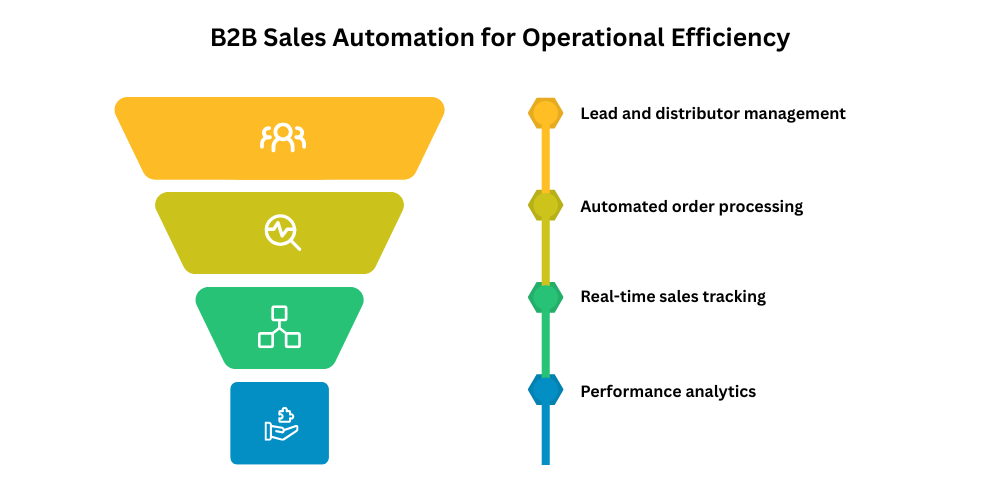
Key Features:
- Lead and distributor management
Organize and track leads, distributors, and retailers in a centralized system for better visibility and control. - Automated order processing
Simplify order creation, approval, and fulfillment with minimal manual intervention. - Real-time sales tracking
Monitor field sales activities, orders, and performance instantly for faster decision-making. - Performance analytics
Analyze sales data, team productivity, and market trends to optimize strategies and improve outcomes with the help of performance management systems.
By adopting B2B sales automation software, CPG companies can reduce manual workload, eliminate inefficiencies, and empower their sales teams to focus on relationship-building and revenue generation, driving sustainable business growth.
Challenges in CPG Digital Transformation
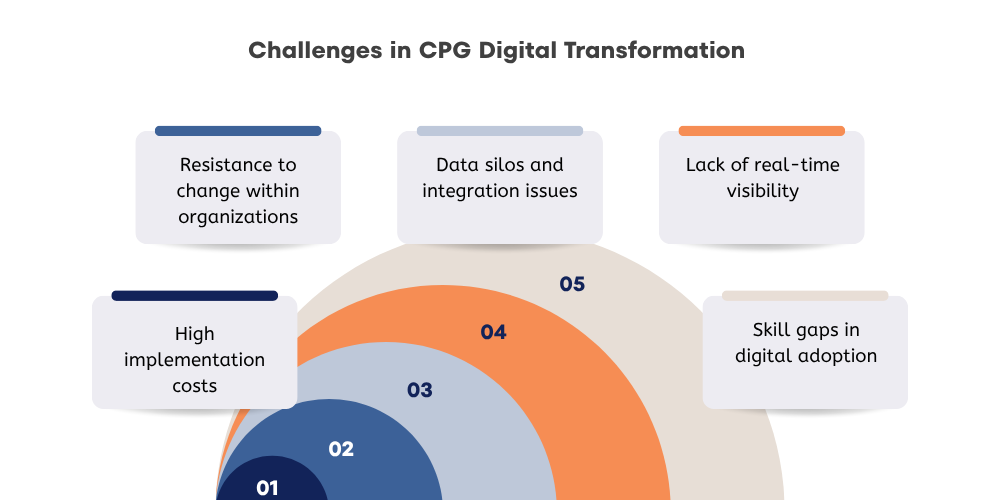
While digital transformation offers significant advantages, CPG companies often face multiple challenges during implementation. Transitioning from traditional systems to modern, technology-driven operations requires not just investment, but also a shift in mindset and processes.
Key Challenges:
- High implementation costs
Adopting advanced technologies, infrastructure, and training programs can require substantial upfront investment. - Resistance to change within organizations
Employees and stakeholders may be hesitant to adopt new systems, slowing down the transformation process. - Data silos and integration issues
Disconnected systems can lead to fragmented data, making it difficult to achieve a unified view of operations. - Lack of real-time visibility
Without proper tools, businesses struggle to access timely data for quick decision-making. - Skill gaps in digital adoption
Teams may lack the technical expertise required to effectively use new digital tools and platforms.
To overcome these challenges, CPG companies need a well-defined digital strategy, strong leadership support, and scalable technology solutions. Partnering with the right platform provider can significantly simplify implementation and ensure long-term success.
How to Implement Digital Transformation in CPG
Successfully implementing digital transformation in the CPG industry requires a structured and strategic approach. Rather than making abrupt changes, companies should focus on gradual adoption, aligning technology with business goals and operational needs.
Key Steps to Follow:
- Identify operational inefficiencies
Analyze existing processes to pinpoint gaps in sales, distribution, inventory, and field operations that need improvement. - Invest in scalable and flexible technology
Choose solutions that can grow with your business and adapt to changing market demands. - Train teams on digital tools
Ensure employees are well-equipped to use new systems effectively through proper training and onboarding. - Integrate systems for unified data flow
Connect various platforms (sales, inventory, CRM) to eliminate data silos and enable real-time visibility. - Continuously monitor and optimize performance
Track key performance indicators (KPIs) and refine strategies based on data insights.
Adopting a phased approach helps minimize disruption, improves user adoption, and ensures a higher return on investment (ROI). With the right execution strategy, digital transformation can deliver long-term efficiency, scalability, and competitive advantage.
Key Benefits of Digital Trends in the CPG Industry
Digital Trends in the CPG industry adopting companies to transform their operations, enhance customer experiences, and drive sustainable growth. As competition intensifies and consumer expectations evolve, leveraging digital tools has become essential for staying ahead in the market.
Key Benefits:
- Increased operational efficiency
Automation of routine tasks and streamlined workflows reduce manual effort, minimize errors, and improve overall productivity. - Better decision-making through data
Real-time analytics and insights empower businesses to make informed, data-driven decisions quickly and accurately. - Improved customer engagement
Personalized experiences and targeted communication help brands connect more effectively with their audience. - Enhanced supply chain visibility
Digital tools provide end-to-end visibility, enabling better inventory management and faster response to demand fluctuations. - Higher sales and profitability
Optimized operations, better targeting, and improved execution contribute to increased revenue and stronger profit margins.
Digital transformation is no longer a luxury, it’s a strategic necessity. Companies that embrace these trends can unlock new growth opportunities, improve efficiency, and build a strong competitive advantage in the evolving CPG landscape.
What’s Next for CPG in 2025 and Beyond
The future of the CPG industry will be defined by deeper integration of advanced technologies, enabling faster, smarter, and more agile business operations. As digital maturity increases, companies will move beyond basic automation toward fully connected, intelligence-driven ecosystems.
Emerging innovations will continue to reshape how brands interact with consumers, manage supply chains, and drive sales performance.
Key Trends to Watch:
- Hyper-personalization
Leveraging AI and real-time data to deliver highly tailored experiences, offers, and product recommendations at an individual level. - Smart supply chains
Using automation, IoT, and predictive analytics to create responsive, efficient, and resilient supply chain networks. - Advanced retail execution tools
Adoption of technologies like machine vision, mobile field apps, and real-time tracking to improve in-store performance and compliance. - Data-driven decision-making
Increased reliance on analytics platforms to guide strategic decisions, optimize operations, and identify growth opportunities.
As competition intensifies, brands that proactively embrace innovation and invest in digital capabilities will lead the market. Those that delay transformation risk falling behind in an increasingly data-driven and customer-centric landscape.
Conclusion
The CPG industry in 2025 is being reshaped by powerful digital trends. From AI-driven personalization to IoT-enabled retail execution, technology is unlocking new opportunities for growth and efficiency.
Businesses that adopt these innovations can improve operations, enhance customer experiences, and stay ahead in a competitive landscape.
For companies looking to streamline field sales, improve visibility, and automate operations, adopting a unified digital solution can significantly accelerate growth and performance.
Ready to transform your CPG sales operations?
Book a free demo of Delta Sales App today and discover how you can boost team productivity, gain real-time insights, and drive smarter sales decisions.
FAQs
1. Why is digital transformation important for CPG companies?
Digital transformation improves operational efficiency, enhances customer engagement, enables real-time insights, reduces costs, and helps CPG companies stay competitive.
2. What are the key digital trends in the CPG industry?
Key trends include AI, IoT, predictive analytics, DTC models, machine vision, and omnichannel retail, driving efficiency, innovation, and better customer experiences.
3. How does predictive analytics benefit CPG companies?
Predictive analytics helps forecast demand, optimize inventory levels, reduce waste, improve planning, enhance decision-making, and increase overall operational efficiency.
4. What is omnichannel retail?
Omnichannel retail integrates online and offline channels, ensuring consistent customer experiences, seamless interactions, unified data, and improved engagement across touchpoints.
5. How can CPG companies start digital transformation?
CPG companies can start by identifying gaps, adopting scalable technologies, training teams, integrating systems, and continuously monitoring performance for better outcomes.