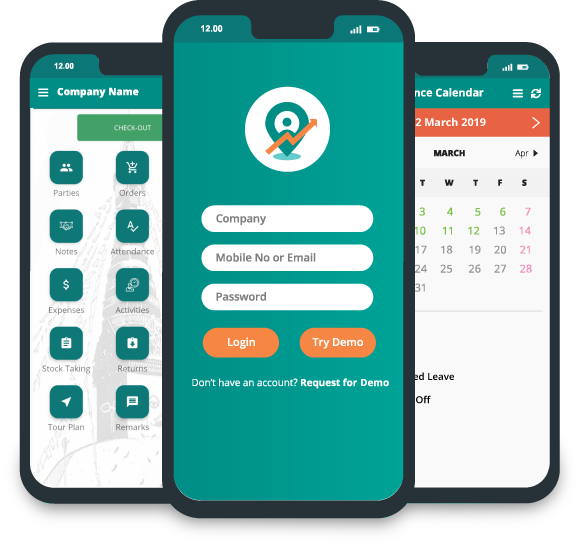

Field Sales Attendance & Time Tracking: The Complete Guide for Managers
Managing field sales teams is far more complex than managing office employees. Sales representatives operate across different territories, travel continuously, meet customers on-site, and often work without direct supervision. In such an environment, tracking attendance, working hours, travel time, and productivity manually becomes difficult and error-prone.
Modern businesses are now adopting digital solutions to gain real-time visibility into field operations. A smart attendance management system helps managers monitor employee attendance, track work hours, verify field visits, and improve accountability without depending on spreadsheets or manual reporting.
Field sales attendance and time tracking are no longer limited to punch-in and punch-out processes. Today, organizations require intelligent systems that integrate GPS tracking, route monitoring, geo-fencing, task updates, and workforce analytics to improve operational efficiency.
What Is Field Sales Attendance Management?
Field sales attendance management refers to the process of tracking the presence, availability, working hours, and activity status of sales representatives operating outside the office.
Unlike traditional attendance systems, field attendance management uses mobile applications, GPS technology, and cloud-based platforms to verify employee location and work activity in real time.
A modern field attendance solution typically allows sales representatives to:
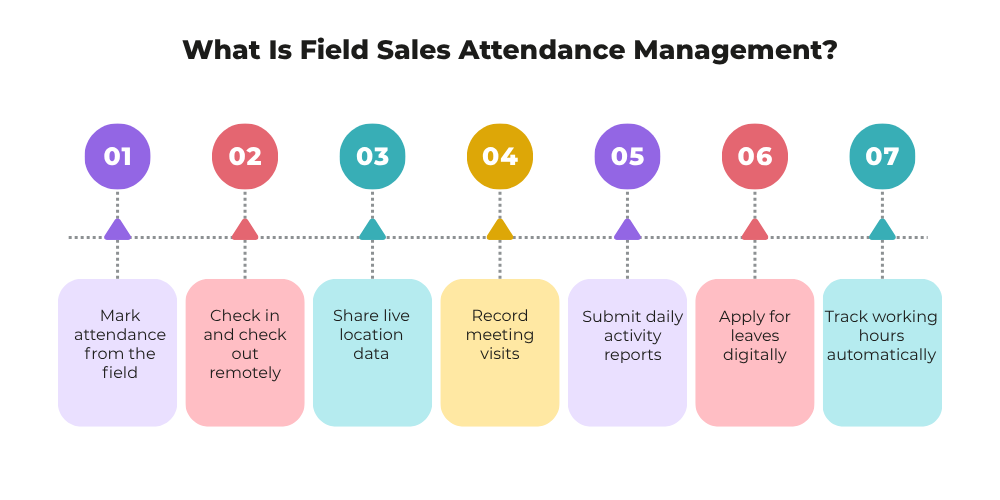
- Mark attendance from the field
Field employees can mark attendance remotely using GPS-enabled mobile attendance systems for accurate field workforce tracking and monitoring. - Check in and check out remotely
Remote check-in and check-out features help businesses monitor employee availability, working hours, and daily field sales activities efficiently. - Share live location data
Live location sharing improves route visibility, employee tracking, territory management, and real-time coordination between managers and field representatives. - Record meeting visits
Sales representatives can record customer meetings digitally to improve visit verification, sales reporting accuracy, and field activity transparency. - Submit daily activity reports
Field teams can submit daily sales activity reports instantly, helping managers monitor productivity, task completion, and customer engagement performance. - Apply for leaves digitally
Digital leave application features simplify leave approvals, employee scheduling, workforce planning, and overall attendance management for field operations. - Track working hours automatically
Automatic working hour tracking helps businesses monitor productivity, overtime, travel duration, and employee time utilization across field operations.
This creates greater transparency between managers and field teams while reducing administrative workload.
Why Attendance Tracking Matters for Field Sales Teams
Attendance tracking plays a critical role in field sales performance. Without accurate attendance visibility, businesses struggle to monitor workforce productivity, territory coverage, and employee accountability.
An automated attendance process helps organizations:
- Improve discipline among field employees
Attendance tracking encourages punctuality, accountability, and structured work routines while improving employee productivity across distributed field sales teams. - Reduce buddy punching and fake attendance
GPS-enabled attendance systems prevent fake check-ins, buddy punching, and attendance manipulation through location-based employee verification technologies. - Verify actual customer visits
Real-time visit verification ensures sales representatives complete assigned customer meetings, improving field sales monitoring and reporting accuracy significantly. - Track employee movement in real time
Live employee tracking helps managers monitor movement, optimize routes, improve territory coverage, and increase field workforce visibility effectively. - Ensure better route adherence
Attendance and route tracking systems help field teams follow planned sales routes, reducing missed visits and unnecessary travel delays. - Simplify payroll calculations
Automated attendance records improve payroll accuracy by calculating working hours, overtime, absences, and employee attendance data efficiently. - Increase operational transparency
Digital attendance systems provide transparent workforce monitoring, helping businesses improve reporting accuracy, accountability, and overall operational efficiency across teams.
For managers handling large distributed teams, attendance data becomes an important source of operational intelligence. It helps identify underperforming territories, inactive sales representatives, and inefficient travel patterns.
Common Challenges in Manual Attendance Tracking
Many organizations still rely on spreadsheets, calls, WhatsApp updates, or physical registers for attendance tracking. These traditional methods create several operational issues.
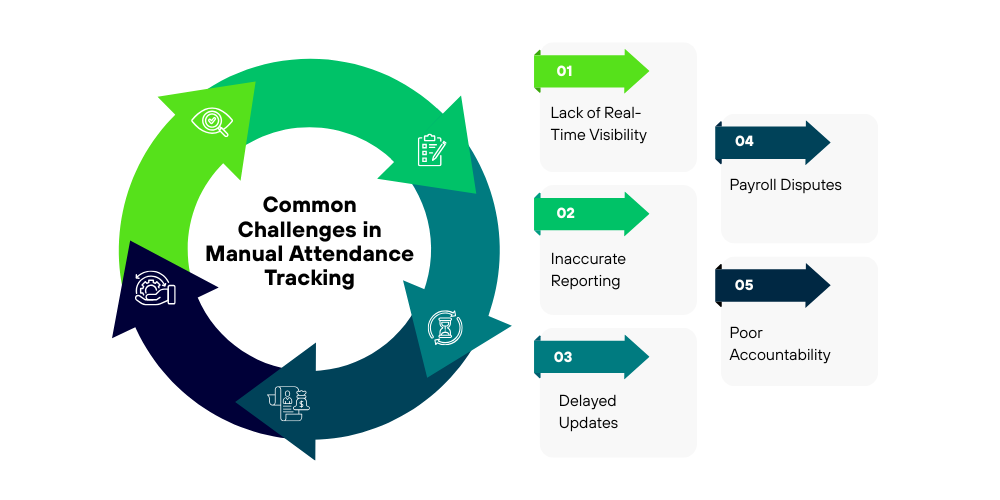
Some common challenges include:
Lack of Real-Time Visibility
Managers struggle to monitor employee attendance, live location, and work status instantly, reducing visibility into daily field sales operations and workforce productivity.
Inaccurate Reporting
Manual attendance entries often create inaccurate reports, duplicate records, and data manipulation issues, affecting employee monitoring, payroll processing, and operational transparency.
Delayed Updates
Field employees submitting attendance reports late reduce real-time decision-making, delay managerial responses, and negatively impact field workforce coordination and productivity tracking.
Payroll Disputes
Incorrect attendance records and overtime calculations frequently create payroll disputes, reimbursement errors, and salary inconsistencies between businesses and field sales employees.
Poor Accountability
Without GPS verification and live tracking, businesses cannot confirm customer visits, employee movement, or route completion, reducing workforce accountability and transparency significantly.
These limitations affect productivity, customer service quality, and operational efficiency.
Understanding Time Tracking in Field Operations
Time tracking goes beyond attendance marking. It measures how employees spend their working hours throughout the day.
In field sales operations, time tracking helps organizations understand:
-
Time spent on customer visits: Time tracking helps businesses analyze customer visit duration, improve sales engagement quality, and measure field employee productivity during on-site meetings effectively.
-
Travel duration between meetings: Tracking travel duration between meetings helps optimize sales routes, reduce fuel costs, improve scheduling efficiency, and maximize productive field working hours daily.
-
Idle time during working hours: Businesses can identify idle time patterns, reduce productivity gaps, improve employee accountability, and ensure efficient utilization of field sales working hours.
-
Average meeting duration : Monitoring average meeting duration helps managers evaluate customer interaction quality, improve sales strategies, and optimize field representative performance across territories effectively.
-
Productivity per territory : Territory-wise productivity tracking helps businesses compare sales performance, identify underperforming regions, and allocate field resources more efficiently for better coverage.
-
Working hour utilization: Working hour utilization tracking improves workforce efficiency by analyzing active time, travel hours, breaks, and employee productivity throughout daily field operations.
Businesses increasingly use staff time tracking software to analyze employee efficiency and optimize field execution strategies.
With detailed time insights, managers can improve route planning, reduce travel inefficiencies, and increase customer coverage.
Key Features of a Field Sales Attendance & Time Tracking System
An effective field sales attendance solution should provide comprehensive monitoring and reporting capabilities.
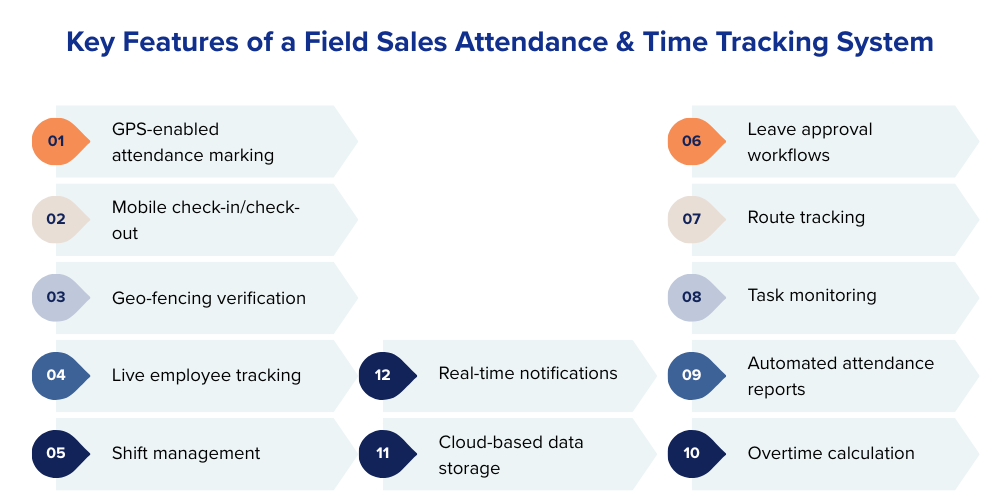
Important features include:
-
GPS-enabled attendance marking: GPS-enabled attendance marking verifies employee location during check-in, improves attendance accuracy, prevents fake entries, and strengthens field workforce accountability significantly.
-
Mobile check-in/check-out: Mobile check-in and check-out features allow field employees to mark attendance remotely using smartphones, improving flexibility, productivity, and attendance tracking efficiency.
-
Geo-fencing verification: Geo-fencing verification ensures employees mark attendance only within authorized locations, improving visit authenticity, route discipline, and operational transparency across field operations.
-
Live employee tracking: Live employee tracking software provides real-time visibility into workforce movement, helping managers monitor territory coverage, optimize routes, and improve field coordination efficiently.
-
Shift management: Shift management features help businesses schedule employee shifts, manage weekly offs, monitor attendance compliance, and improve workforce planning across multiple territories.
-
Leave approval workflows: Automated leave approval workflows simplify leave requests, manager approvals, attendance adjustments, and workforce scheduling while reducing manual administrative workload significantly.
-
Route tracking: Route tracking helps businesses monitor employee travel paths, optimize field visit planning, reduce travel inefficiencies, and improve customer coverage effectively daily.
-
Task monitoring: Task monitoring features help managers track sales activities, task completion status, customer visits, and employee productivity across distributed field sales teams.
-
Automated attendance reports: Automated attendance report generate real-time workforce insights, helping businesses analyze attendance trends, employee productivity, overtime records, and operational performance accurately.
-
Overtime calculation: Overtime calculation automatically tracks extra working hours, improves payroll accuracy, simplifies reimbursement processing, and ensures fair compensation for field employees consistently.
-
Cloud-based data storage: Cloud-based data storage securely maintains attendance records, employee activities, and workforce reports while enabling remote access and centralized operational management easily.
-
Real-time notifications: Real-time notifications instantly alert managers and employees about attendance updates, missed check-ins, leave approvals, and operational activities for better coordination and communication.
These features help businesses automate workforce operations and improve team coordination.
GPS-Based Attendance Tracking for Sales Teams
GPS attendance tracking allows businesses to verify employee location during attendance marking.
When a sales representative checks in, the system captures:
-
Exact GPS coordinates: The system captures precise GPS coordinates during check-in, enabling accurate employee location tracking, improving field monitoring, and eliminating attendance fraud in sales teams.
-
Time stamp: Each attendance entry records an exact time stamp, ensuring accurate working hour tracking, better payroll calculation, and improved employee productivity analysis in field operations.
-
Employee identity: Employee identity verification ensures secure attendance marking, prevents proxy check-ins, and strengthens workforce authentication within field sales attendance management systems efficiently and reliably.
-
Location history: Location history tracking provides complete visibility of employee movements, helping managers analyze routes, improve territory planning, and enhance field sales performance insights.
This eliminates fake attendance and ensures that employees are physically present at assigned locations.
GPS-based tracking is especially useful for industries such as:
-
FMCG distribution: In FMCG distribution, GPS attendance tracking improves route efficiency, ensures distributor visits, and enhances sales execution accuracy across fast-moving consumer goods networks.
-
Pharmaceutical sales: Pharmaceutical sales teams benefit from GPS tracking by ensuring doctor visit compliance, improving territory coverage, and maintaining accurate field reporting and accountability.
-
Telecom field operations: Telecom field operations use GPS attendance to monitor technician visits, service delivery accuracy, and workforce efficiency across large distributed service networks.
-
Building material distribution: Building material distribution companies use GPS tracking to verify dealer visits, improve delivery efficiency, and optimize field sales workforce performance effectively.
-
Consumer goods sales: Consumer goods sales teams use GPS attendance tracking to improve retail coverage, monitor store visits, and enhance field execution accuracy and productivity significantly.
Location-based verification also improves customer visit authenticity and sales reporting accuracy.
Real-Time Location Monitoring & Route Visibility
Real-time location tracking enables continuous monitoring of field sales employees, improving visibility, operational control, workforce efficiency, and ensuring better decision-making in daily sales operations.
Monitor territory coverage
Territory coverage monitoring ensures complete sales area visibility, helps identify unvisited locations, improves distribution efficiency, and strengthens overall field sales performance across regions.
Optimize travel routes
Route optimization helps reduce travel time, improve fuel efficiency, increase customer visits, and maximize productive working hours for field sales representatives effectively.
Reduce unnecessary travel
Reducing unnecessary travel minimizes operational costs, saves employee time, improves efficiency, and ensures field teams focus more on productive customer-facing activities.
Respond to customer escalations quickly
Quick response to customer escalations improves service efficiency, reduces resolution time, enhances customer satisfaction, and strengthens field sales team responsiveness significantly.
Improve field coordination
Improved field coordination ensures better communication between managers and employees, enhances task execution, reduces confusion, and increases overall sales team productivity.
Managers can analyze travel patterns and identify gaps in route planning or customer visit frequency.
Mobile Check-In and Check-Out for Field Employees
Mobile attendance systems simplify the attendance process for remote teams.
Using a smartphone app, employees can:
-
Mark attendance instantly: Employees can mark attendance instantly using mobile apps, improving speed, accuracy, GPS-based verification, and eliminating delays in field sales attendance management systems.
-
Start work remotely: Remote work start enables field employees to begin shifts from any location, improving flexibility, productivity tracking, and real-time workforce monitoring for managers.
-
End shifts digitally: Digital shift ending allows accurate logging of working hours, improves attendance records, supports payroll processing, and ensures transparent field workforce time tracking.
-
Upload meeting notes: Uploading meeting notes helps capture customer interaction details, improves sales reporting accuracy, enhances communication, and supports better field sales performance analysis.
-
Submit visit photos: Visit photo submission provides proof of customer engagement, improves visit verification, increases accountability, and enhances transparency in field sales operations management.
-
Share customer updates: Sharing customer updates enables real-time communication between field teams and managers, improves decision-making, enhances coordination, and boosts overall sales effectiveness.
This removes dependency on office-based attendance systems and supports hybrid or remote workforce structures.
Mobile attendance also improves operational flexibility and employee convenience.
Geo-Fencing for Accurate Attendance Verification
Geo-fencing creates virtual boundaries around assigned locations such as customer sites, distributor outlets, warehouses, or office branches. Employees can mark attendance only when they are inside authorized zones, enabling real-time validation of presence and improving transparency in field workforce management systems.
Key Benefits of Geo-Fencing for Attendance Verification
-
Prevent location fraud: Geo-fencing ensures employees can only mark attendance within approved areas, eliminating fake check-ins from incorrect or manipulated locations completely effectively.
- Ensure genuine customer visits: Geo-fencing verifies that field employees physically visit assigned customer locations, improving accountability and ensuring authentic customer engagement during daily operations.
- Improve route discipline: Geo-fencing helps sales teams follow predefined routes by restricting attendance marking outside planned areas, improving discipline and operational efficiency significantly.
- Increase operational control: Managers gain better control over field operations through geo-fencing, allowing real-time tracking, monitoring attendance accuracy, and improving workforce management decisions.
- Validate field activity automatically: Geo-fencing automatically validates employee field activity by confirming presence at designated locations, reducing manual verification and administrative workload significantly efficiently.
How Automated Attendance Improves Field Sales Productivity
Automation significantly improves productivity by reducing manual processes and improving operational visibility. It streamlines attendance tracking, minimizes errors, and enhances overall field workforce efficiency.
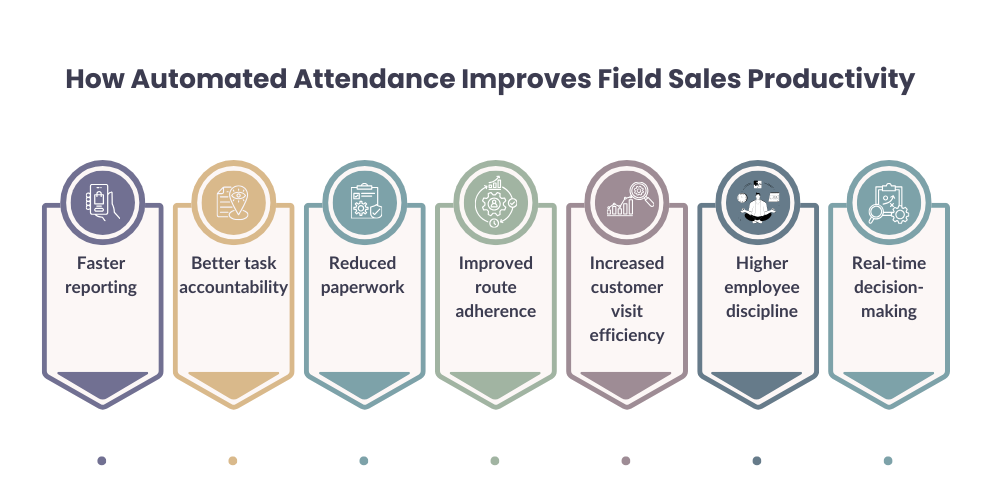
Key Productivity Benefits
- Faster reporting: Automated attendance systems instantly capture field data, eliminating manual entry delays and enabling managers to access real-time attendance reports for quicker operational decisions and analysis.
- Better task accountability: Employees become more accountable as every check-in, check-out, and location update is recorded automatically, ensuring transparency in task execution and reducing performance ambiguity effectively.
- Reduced paperwork: Automation removes the need for physical registers and manual attendance sheets, significantly reducing administrative workload, saving time, and promoting a completely paperless field sales environment.
- Improved route adherence: Field employees follow optimized routes more strictly since attendance is location-verified, ensuring planned customer visits are completed in sequence, improving travel efficiency and reducing unnecessary movement.
- Increased customer visit efficiency: Sales representatives spend more productive time with customers as automation reduces manual reporting tasks, allowing them to focus on engagement, sales conversions, and relationship building effectively.
- Higher employee discipline: Automated systems enforce structured workflows, encouraging employees to follow schedules properly, maintain punctuality, and adhere to assigned tasks consistently, improving overall field team discipline significantly.
- Real-time decision-making: Managers receive live updates on field activity, enabling them to make faster and more informed decisions regarding resource allocation, performance tracking, and operational adjustments instantly.
Automation also helps organizations scale field operations efficiently by standardizing attendance processes, improving visibility across teams, and supporting seamless expansion without increasing administrative complexity or overhead.
Role of Attendance Data in Performance Evaluation
Attendance and activity data provide valuable, measurable insights into employee performance, helping managers move from subjective judgment to structured, data-driven performance evaluation systems.
Key Performance Insights from Attendance Data
- Visit frequency: Managers can track how often field employees visit assigned customers, ensuring adequate coverage and identifying gaps in engagement or missed opportunities across territories consistently.
- Territory coverage: Attendance data reveals how effectively sales representatives are covering assigned regions, helping identify under-served areas and ensuring balanced distribution of field sales efforts across locations.
- Customer engagement levels: By analyzing visit patterns and time spent at locations, managers can assess customer interaction quality, helping improve relationship building and strengthen long-term business outcomes effectively.
- Working hour utilization: Attendance tracking shows how efficiently employees use their working hours in the field, distinguishing productive time from idle time to optimize workforce utilization and planning.
- Productivity trends: Historical attendance and activity data help identify productivity patterns over time, allowing managers to understand peak performance periods and improve workforce scheduling strategies effectively.
- Route efficiency: Attendance location logs help evaluate whether employees follow optimized routes, reducing unnecessary travel, improving fuel efficiency, and increasing overall daily field productivity significantly.
This structured attendance data enables more objective performance evaluations and supports data-driven incentive planning. Managers can reward performance based on real activity metrics rather than assumptions or manual reports.
Attendance analytics also help identify coaching opportunities for underperforming sales representatives by highlighting behavioral gaps, inefficiencies, and missed targets, enabling targeted training and continuous improvement programs.

Attendance Reports and Analytics for Managers
Modern attendance systems generate detailed reports and dashboards that simplify workforce monitoring and strengthen field sales performance tracking and sales force automation software capabilities across organizations.
Common Attendance Reports & Analytics
- Daily attendance summary: Provides a consolidated view of employee attendance status each day, supporting attendance management system processes by helping managers quickly track present, absent, and on-leave field employees for better workforce control.
- Late arrival reports: Tracks employees who arrive late, improving discipline within field force management software environments and enabling managers to address punctuality issues and enhance overall operational consistency in field sales teams.
- Absent employee reports: Identifies employees who are absent during working days, supporting field employee tracking app usage by ensuring accurate workforce visibility and helping managers manage manpower allocation efficiently.
- Route deviation reports: Detects deviations from planned sales routes using GPS tracking app for employees, helping organizations improve route adherence, reduce inefficiencies, and strengthen sales route optimization strategies.
- Overtime reports: Monitors extra working hours recorded by employees, supporting workforce productivity analytics and helping businesses balance workload distribution while maintaining fair compensation structures in field operations.
- Customer visit reports: Tracks customer visits completed by field representatives, strengthening customer visit tracking software usage and improving sales productivity monitoring across territories for better engagement and conversion analysis.
- Productivity dashboards: Offers visual insights into key performance metrics using sales performance dashboard systems, helping managers evaluate trends, optimize field sales reporting tools, and improve decision-making efficiency.
These analytics help businesses improve workforce planning and operational efficiency. Managers can make faster decisions using real-time data instead of manual spreadsheets, enhancing real-time attendance tracking and reducing dependency on outdated reporting methods.
Compliance, Transparency, and Workforce Accountability
Automated attendance systems significantly enhance organizational transparency by maintaining accurate, tamper-proof digital records within modern attendance management systems and workforce management frameworks.
This helps businesses strengthen compliance, reduce disputes, and improve operational governance across field teams.
Key Compliance & Accountability Benefits
- Reduce attendance disputes: Automated records eliminate manual errors and manipulation, ensuring clear, verifiable logs through employee monitoring software that help resolve attendance conflicts quickly and fairly.
- Maintain audit-ready records: Digital attendance systems generate structured logs that are always audit-ready, supporting compliance requirements in field force management software and simplifying internal or external audits efficiently.
- Improve payroll accuracy: Accurate attendance data directly integrates with payroll systems, ensuring salary calculations are error-free and aligned with actual working hours recorded through GPS tracking app solutions.
- Ensure policy compliance: Organizations can enforce attendance and field policies consistently using sales force automation tools, ensuring employees follow defined rules regarding timing, visits, and field reporting standards.
- Build employee accountability: Transparent tracking increases responsibility among field employees as every movement is recorded, improving discipline and trust within workforce management system environments across sales operations.
Digital tracking systems also strengthen trust between management and field employees by ensuring fair, transparent, and unbiased monitoring processes supported by real-time attendance tracking technologies.
Many organizations now integrate attendance automation into broader field force management software and sales force automation software strategies to streamline operations, improve workforce governance, and achieve scalable, data-driven field sales efficiency.
Choosing the Right Attendance & Time Tracking Software
Selecting the right software depends on operational requirements, team size, and industry structure. The right solution should align with field sales automation software and broader workforce management system needs to ensure smooth execution and real-time visibility.
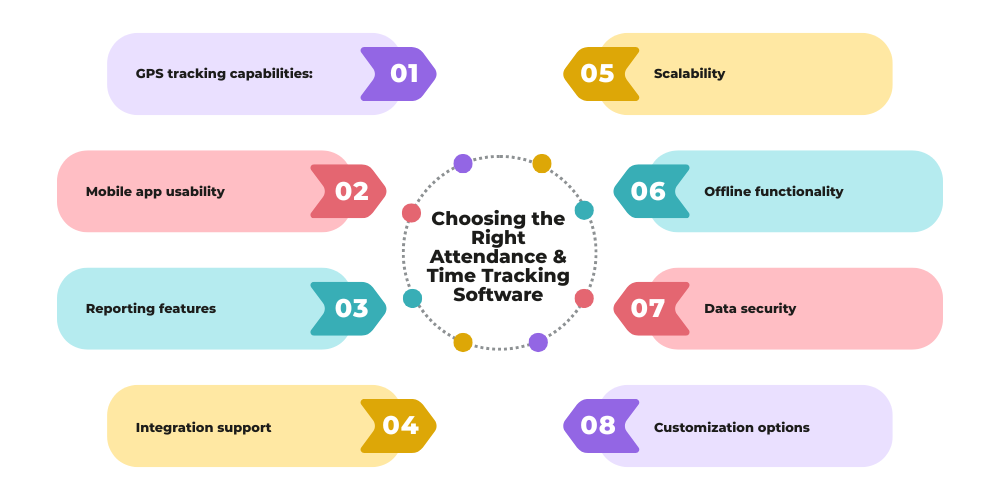
Businesses should evaluate the following key factors:
- GPS tracking capabilities: Ensures accurate location-based attendance using GPS tracking app for employees, helping verify field presence, prevent fraud, and improve route transparency in sales operations.
- Mobile app usability: A simple and intuitive mobile interface in a field employee tracking app ensures quick adoption by field teams, reduces training time, and improves daily attendance compliance efficiency.
- Reporting features: Strong analytics and dashboards within sales force automation software provide actionable insights like attendance trends, visit reports, and productivity metrics for better decision-making.
- Integration support: The system should integrate with CRM, payroll, and field force management software to ensure seamless data flow across departments and eliminate manual duplication errors.
- Scalability: A scalable attendance management system supports growing teams, multiple territories, and expanding operations without performance issues or system limitations over time.
- Offline functionality: Offline mode ensures attendance capture even in low connectivity areas, syncing data later, which is crucial for remote and rural field sales tracking app operations.
- Data security: Strong encryption and access control in employee monitoring software protect sensitive workforce data and ensure compliance with organizational security policies and regulations.
- Customization options: Flexible configurations in a workforce management system allow businesses to adapt workflows, approval rules, and reporting structures based on specific operational requirements.
The ideal solution should support both operational visibility and long-term business scalability, ensuring organizations can optimize real-time attendance tracking, improve productivity, and strengthen overall field workforce efficiency.
How Delta Sales App Simplifies Field Attendance Management
Delta Sales App provides a comprehensive field force management software solution designed to streamline field employee attendance, tracking, and productivity management in a single unified platform.
The system replaces manual attendance methods with an automated, real-time approach, making it highly effective for modern sales force automation software requirements.
Key Ways It Simplifies Attendance Management
- Track employee attendance in real time: Field employees can mark attendance instantly through a mobile-based attendance management system, ensuring accurate and time-stamped records without manual intervention.
- Monitor live locations: Built-in GPS tracking app functionality enables managers to view real-time employee movement, improving transparency and ensuring proper field execution.
- Verify customer visits: The system validates on-site customer visits using location-based check-ins, strengthening accountability and improving the effectiveness of field employee tracking app processes.
- Manage leaves digitally: Employees can apply for and manage leave requests directly through the platform, reducing paperwork and simplifying HR workflows within field operations.
- Analyze field productivity: Managers gain access to detailed performance insights through sales performance analytics, helping evaluate productivity based on visits, time spent, and territory coverage.
- Generate automated reports: The platform automatically creates attendance, visit, and productivity reports, reducing dependency on spreadsheets and improving decision-making speed.
- Improve territory visibility: Businesses get complete visibility into assigned territories, enabling better planning, optimized routes, and improved sales route optimization strategies.
Its mobile-first approach makes it ideal for industries with large on-ground sales operations such as FMCG, pharma, distribution, and telecom.
By centralizing attendance, tracking, and reporting workflows, businesses can improve operational efficiency while reducing manual administrative work.
Future Trends in Field Workforce Tracking
Field workforce tracking is evolving rapidly with advancements in automation, artificial intelligence, and field force management software, transforming how organizations manage on-ground teams and performance.
Emerging Trends
- AI-powered productivity analytics: Artificial intelligence will analyze field activity patterns in sales force automation software, helping managers predict performance gaps, optimize workflows, and improve overall workforce efficiency using data-driven insights.
- Predictive workforce planning: Future systems will forecast staffing needs using historical attendance management system data, enabling businesses to allocate resources efficiently and prevent workload imbalance across territories.
- Automated route optimization: Intelligent algorithms in GPS tracking app for employees will automatically design the most efficient travel routes, reducing fuel costs, saving time, and improving daily field productivity.
- Smart attendance verification: Advanced verification methods will combine geolocation, behavioral data, and real-time validation in field employee tracking app systems to eliminate fraud and improve attendance accuracy.
- Facial recognition attendance: Biometric-based attendance integrated into mobile systems will enhance security and reduce proxy check-ins, strengthening transparency within modern workforce management system environments.
- IoT-enabled workforce monitoring: Internet of Things devices will connect field assets, vehicles, and employees, enabling real-time synchronization with real-time attendance tracking platforms for improved operational visibility.
- Advanced mobile workforce analytics: Next-generation dashboards in sales performance analytics tools will deliver deeper insights into employee productivity, customer engagement, and territory performance for smarter decision-making.
Future systems will focus more on intelligent automation, employee experience, and real-time operational optimization.
Conclusion
Field sales attendance and time tracking have become essential components of modern business operations. Manual tracking methods no longer provide the visibility, accuracy, and operational control required to manage distributed sales teams effectively.
By implementing automated attendance solutions, businesses can improve workforce accountability, optimize productivity, simplify reporting, and enhance field sales performance.
Organizations that invest in digital attendance and workforce tracking technologies gain stronger operational control, better decision-making capabilities, and improved customer service outcomes in increasingly competitive markets.
If you want to simplify and optimize your field operations with automation, real-time visibility, and accurate workforce tracking, Delta Sales App offers a complete solution to transform your field sales execution.
Book a free demo today to discover how automated attendance, GPS tracking, and sales force automation can help you improve productivity, strengthen control, and scale your field teams efficiently.