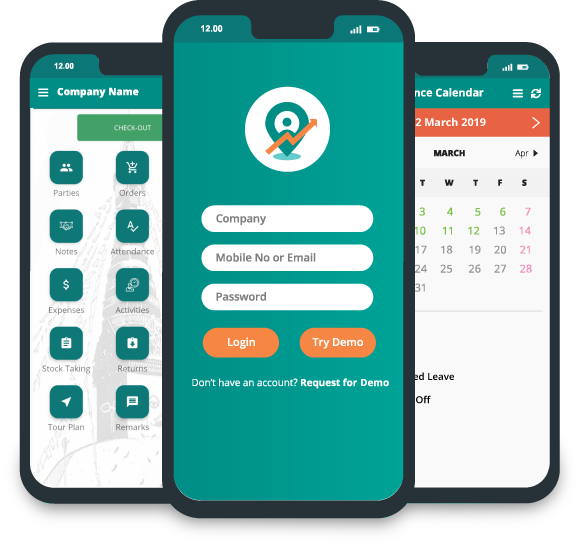

Why Companies with Field Teams Are Moving Away From Generic CRMs To Purpose-Built Delta Sales Apps
Field sales teams operate in a completely different environment compared to inside sales or office-based teams. Their work happens on the move, across territories, customer locations, retail outlets, and distributor points where speed, accuracy, and real-time decision-making matter far more than structured pipeline updates.
For years, companies have tried to manage these teams using generic CRM systems. While CRMs work well for tracking leads and managing desk-based sales processes, they often struggle to support the realities of field execution. This includes inconsistent connectivity, fast-paced customer visits, territory planning, and the need for instant reporting from the ground.
As a result, many organizations are now rethinking their approach. Instead of forcing field teams to adapt to CRM workflows, they are moving toward purpose-built field sales solutions like the Delta Sales App, which are designed specifically to handle on-ground sales operations, tracking, and productivity management.
This shift is not just about software preference. It reflects a deeper operational change in how companies want to manage visibility, accountability, and performance across distributed field teams.
The Problem with Generic CRMs for Field Sales Teams
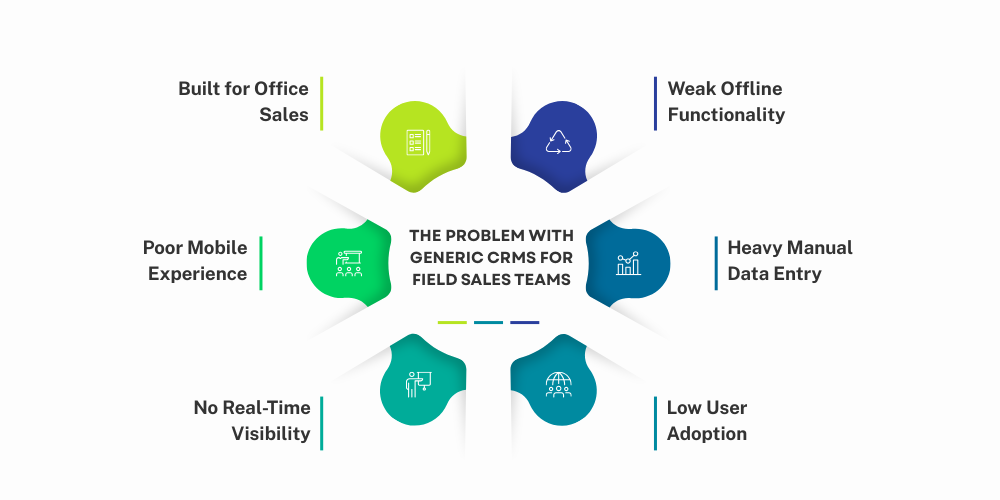
Generic CRM systems have become quite popular, but when it comes to field sales management, field workforce tracking, and on-ground sales execution, generic systems often are not enough. Here’s a clear breakdown of the main problems field teams face, one at a time.
-
Built for office-based sales, not field execution
Most CRMs are built for inside sales workflows related to tracking leads and deal stages and pipeline reporting. These systems assume that users have the time and are sitting at a desk to update detailed records.
But in field sales, the reps are always running between customers, distributors, and retail outlets. They do not need complicated forms; they need quick and easy steps. This mismatch renders CRMs slow and inconvenient in daily field use.
-
Mobile and on-the-go updates have poor usability
Field sales executives depend heavily on mobile devices when on the road. Generic CRMs aren’t always built for speed on mobile or offline-first workflows.
Hence, updating customer visits, recording orders, or capturing field data becomes a time-consuming process. A lot of reps don’t update or update late, which results in less accurate data and problems tracking sales and monitoring field performance.
-
Lack of real-time field visibility for managers
Traditional CRMs have a huge limitation in that they do not have live field activity tracking. Managers tend to use manual updates or end-of-day reporting.
This creates a gap between what is really happening in the field and what is being reported. Without the ability to see real-time data, it’s difficult to track field sales productivity, employee movement, and the completion of visits.
-
Offline functionality is bad in areas with low networks.
Field teams often work in remote locations, rural areas, or places with unstable internet connectivity. Many generic CRMs do not support full offline functionality.
This forces field reps to either wait for network access or enter data later, which increases the risk of errors, missing records, or inaccurate reporting in sales force automation systems.
-
Heavy manual data entry reduces productivity
Field reps already spend most of their day traveling and meeting customers. Adding complex CRM data entry on top of that creates additional workload.
In many cases, reps spend hours each week updating CRM records instead of focusing on actual selling. This reduces overall field sales productivity and efficiency, leading to frustration and low system adoption.
-
Low adoption among field sales teams
Because CRMs are not designed around real field workflows, many sales executives find them difficult or time-consuming to use consistently.
This results in incomplete data, delayed reporting, and low engagement with the system. Over time, businesses lose visibility into true field operations, which impacts decision-making and sales performance management.
CRM Adoption Is High, But Field Execution Gaps Still Exist
CRM systems have become a standard part of sales tech stacks in most industries. Now most organizations use some form of CRM to manage customer data, track leads, and forecast sales performance. In fact, research shows that over 70% of businesses are using CRM adoption statistics, which is proof of how ingrained these systems are in today’s selling processes.
High adoption doesn’t always translate to effective usage, though, and that is especially true when it comes to field sales management and field workforce execution. Many companies find their CRM is actively used at the management level but does not capture the real-world activity that is happening in the field.
However, adoption does not guarantee effective usage in the field.
Research consistently highlights key challenges:
- Field sales reps often struggle with consistent CRM updates
- Many organizations report incomplete or delayed data from field teams
- A large portion of CRM usage is limited to post-activity reporting rather than real-time execution
More importantly, productivity data reveals a major gap:
- Field sales reps typically spend only 28% to 33% of their time actually selling
- The remaining time is consumed by travel, reporting, coordination, and administrative tasks
This inefficiency is one of the strongest reasons companies are rethinking their CRM-first approach.
Why Generic CRMs Are Losing Effectiveness in Field Operations
As companies scale their field sales management, mobile workforce tracking, and on-ground execution, the limitations of generic CRM systems become increasingly clear. These tools were built for structured office-based sales processes, not for fast-moving field environments. Below is a clearer breakdown of why they are losing effectiveness in real-world field operations.
-
Not built for real-time field execution
Generic CRMs are built for structured workflows, like pipeline updates and deal tracking, which are great in an office environment but not so much in field sales situations. Field executives need to act on the spot during customer visits, for example, by recording meetings, taking orders, and updating visit results. However, traditional CRMs are multi-step processes requiring stable Internet connectivity and are thus difficult to update in real time. This has a direct impact on productivity on the ground as it reduces the speed of field sales execution and live activity tracking.
-
Heavy dependency on manual data entry
One of the biggest drawbacks of traditional CRMs is the reliance on manual input for every activity. Field sales representatives are required to enter detailed visit notes, customer interactions, and sales updates after each meeting, which becomes time-consuming during a busy field schedule. Instead of focusing on selling, reps spend significant time on administrative updates. This reduces overall field sales productivity, sales force automation efficiency, and daily operational output, leading to lower system engagement.
-
Lack of GPS-based tracking and visit verification
Generic CRMs don’t usually have GPS-based employee location tracking or location-based validation of field activity built in. This makes it hard for managers to know if customer visits are being made or if territory coverage is being done correctly. This results in accountability gaps and difficulties in tracking field employees, route compliance, and real-time sales visitation verification, which are critical to effectively managing dispersed sales teams.
-
Limited offline capabilities for field settings.
Field teams are often deployed in locations with little or no internet connectivity, such as rural markets, industrial zones, or remote retail locations. Old-school CRMs are not up to the task because they depend on always being online. Connectivity interruptions result in incomplete records and inconsistent reporting due to delayed or missing data entry. This directly impacts offline field data capture and real-time sales sync, both critical to accurate field reporting systems.
-
Disjointed tools, not integrated field execution systems
In many organizations, field teams are stuck with a CRM and a handful of disconnected tools. They might use spreadsheets to plan, messaging apps to coordinate, and different systems to take attendance or report. This fragmented setup leads to duplication of work and increases the risk of inconsistent data across systems. It also disrupts field sales workflow automation and centralized sales operations management, making it harder for businesses to maintain a single source of truth.
-
Limited use by field sales reps
Because generic CRMs are not optimized for mobile-first usage or fast field interactions, many sales representatives find them difficult to use consistently. The lack of speed, simplicity, and field-focused features leads to delayed updates or incomplete reporting. Over time, the CRM becomes more of a reporting obligation than an active tool for daily work. This results in lower overall field CRM adoption, sales team engagement, and mobile sales force productivity, limiting its longer-term impact.
The Shift: From CRM Systems to Field Execution Platforms
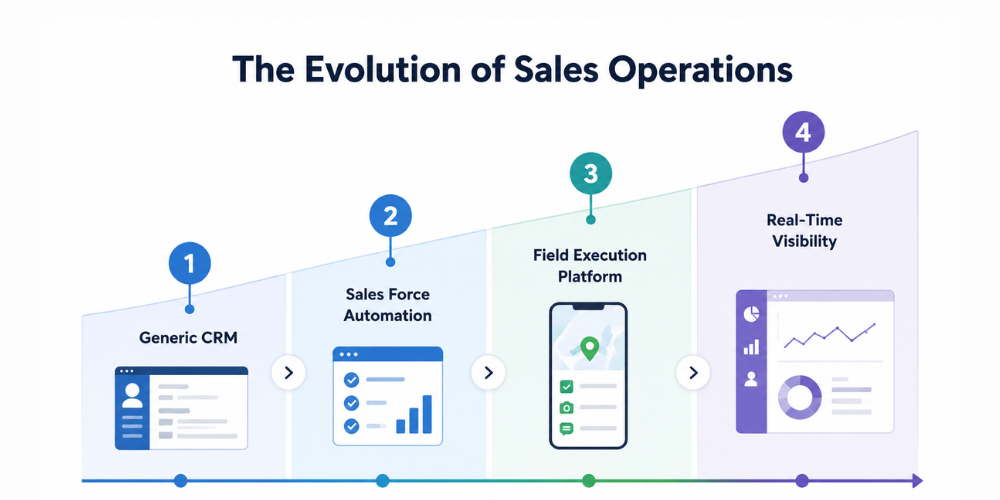
Over the past few years, we have seen a clear evolution in the way companies have been managing their field sales operations, mobile workforce management, and on-ground execution teams. Companies are moving beyond traditional CRM systems to measure field performance. Rather, they are going to dedicated field execution platforms that are built specifically for real-world sales activity.
This change is more than a technology upgrade. It’s a change of thinking, from merely capturing sales data to actively managing field productivity, accountability, and execution in real time.
-
From data tracking to execution management
The traditional CRMs are mainly built for capturing and storing sales data like leads, opportunities, and pipeline stages. This is useful for reporting but not very useful for managing day-to-day field activities.
Sales Force Automation App, on the other hand, focuses on what is actually happening on the ground. They help businesses track customer visits, monitor field movement, and manage daily sales activities in real time. This is a change that allows better tracking and operational control of field sales execution, not just historical reporting.
-
From delayed reporting to real-time visibility
In generic CRM systems, managers usually depend on end-of-day or delayed updates from field teams. This creates a gap between actual activity and reported information.
Field execution platforms solve this by offering real-time visibility into field operations. Managers can instantly see visit status, employee location, and task completion. This improves live field workforce tracking, sales activity monitoring, and decision-making speed, allowing businesses to respond quickly to on-ground situations.
-
From manual processes to automated field workflows
Traditional CRMs rely heavily on manual updates for every activity, which increases workload for field sales representatives. This often results in data entry not being completed on time, or at all.
Many of these processes, such as logging visits and reporting attendance and activities, are automated via field execution platforms. This reduces the manual effort and enhances the sales force automation, field productivity, and workflow efficiency. As a result, sales teams can spend more time in customer interactions than on the system updates.
-
From fragmented tools to unified field systems
CRMs are often used by organizations that utilize several disparate tools for attendance, route planning, and communication. This causes fragmentation and reduces operational efficiency.
All these functions are combined in a single system, the field execution platform. It provides features like attendance tracking, beat planning, order management, and reporting, all in one platform. This enhances field sales management efficiency and centralized workforce coordination, leading to greater consistency across teams.
-
From static records to dynamic field intelligence
CRMs mainly store historic data, which is great for analysis but not so useful when it comes to making operational decisions. They offer little insight into field behavior in real time.
Field execution platforms generate insights in real time from live field activity. This includes route compliance, visit frequency, productivity patterns, and territory coverage. Such insights enhance the analytics of field sales, performance optimization, and territory management strategies to take better operational decisions.
How Delta Sales App Solves Real Field Sales Challenges
As companies move away from generic CRMs, the real need is not just “better software” but a complete solution designed for field sales execution, mobile workforce management, and real-time sales tracking. The Delta Sales App is built specifically to solve these ground-level challenges that traditional CRMs fail to address.
Below is how it directly solves key field sales problems.
-
GPS-based attendance and live field tracking
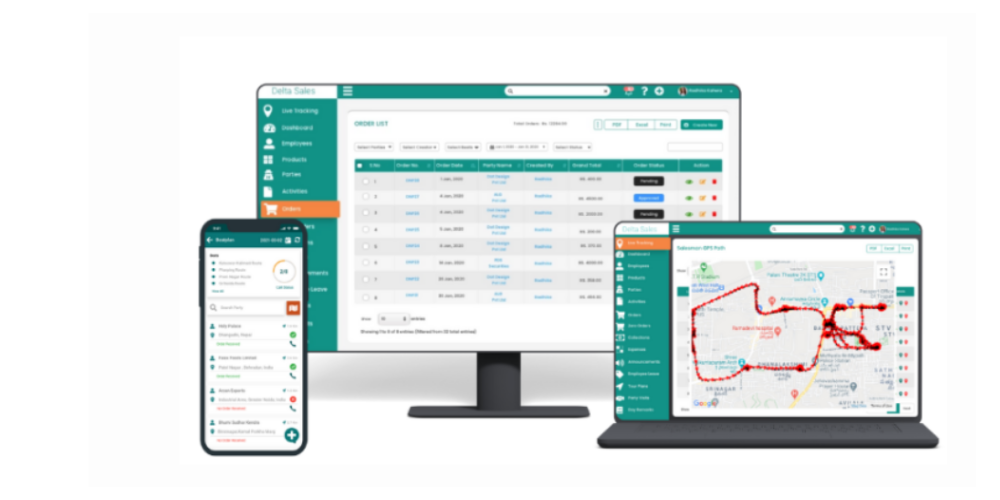
One of the toughest things about field sales is knowing where your employees are during working hours. The Delta Sales App does this with GPS-enabled attendance and live tracking features, which give managers real-time visibility into the movement of their field executives.
No more manual check-ins or waiting for the end of a shift for reports. Businesses can track location-based attendance, where customers are in the store and how they move throughout the day. This improves field employee tracking, sales force accountability, and territory monitoring, ensuring full transparency in field operations.
-
Intelligent route optimization and beat planning.
Poor planning often leads to wasted travel time and low customer coverage in field sales. The Delta Sales App provides structured beat planning tools and route optimization tools that help teams organize daily visits efficiently.
The sales managers can allocate territories, plan the routes of customers and ensure optimum travel sequences for the field executives. This reduces unnecessary travel and increases the number of productive visits per day, thereby improving overall field sales productivity, route optimization and territory coverage efficiency.
-
Offline-first functionality for uninterrupted field work
Field teams are often located in areas with poor connectivity, which can interrupt data entry in traditional systems. The Delta Sales App is built on an offline-first approach so users can work without a network connection.
Any data you enter offline will automatically sync when you’re back online. This means zero data loss and consistent offline field data capture, remote sales operations and uninterrupted workflow management.
-
Fast mobile-first lead and order management
Old-school CRMs have several steps to update leads or make orders, which slows down field operations. The app makes this simple with a mobile-first interface built for speed.
Field executives can quickly capture leads, update customer details, and place orders directly from their mobile devices during visits. This ensures faster response times and improves sales order management, lead conversion efficiency, and on-the-go sales execution.
-
Unified platform for all field operations
Instead of pushing a patchwork of unrelated tools, the Delta Sales App integrates attendance, CRM, reporting and field tracking into one platform.
No more spreadsheets. No more WhatsApp coordination. No more separate tracking systems. It increases field sales automation, centralized sales management and operational efficiency, providing companies with a single version of the truth for all field activities.
-
Real-time sales activity visibility for managers
With the Delta Sales App, managers no longer have to wait until the end of the day for a report; they are getting live updates of what’s happening in the field. It can track in real time which customers have been visited, what has been happening, and how teams are doing.”
This improves decision-making and helps businesses respond quickly to issues in the field. It strengthens real-time sales monitoring, field performance tracking, and operational visibility, making management more proactive rather than reactive.
Why Businesses Are Making The Switch Now
The shift from generic CRMs to purpose-built field execution platforms is not happening randomly. It is being driven by real operational pressure across industries like FMCG, pharmaceuticals, distribution, telecom, and B2B field services. As companies scale their field sales operations, mobile workforce management, and sales force automation, the limitations of traditional CRMs become too costly to ignore.
Below are the key reasons why businesses are actively making this switch now.
-
Rising demand for real-time field visibility
Today’s sales leaders don’t want reports that take forever or end of day recaps. They want to know what is happening in the field in real time.
Now, businesses need to know:
-
Where are field executives during working hours?
-
Which customers are being seen in real-time
-
Whether planned routes and beats are being adhered to
This is something that generic CRMs can’t tell you in real time. This is driving companies to platforms that allow real-time tracking of the field, GPS-based monitoring and live updates of sales activity.
-
Increasing pressure to improve field productivity
Field sales teams are constantly under pressure to do more within the limited working hours. But studies show field reps spend only about a third of their time actually selling. The rest is travel, reporting and administrative tasks.
This productivity gap is making companies rethink their systems. Businesses today are investing in tools that help them reduce manual effort and increase field sales efficiency, daily visit productivity and sales execution speed.
Purpose-built platforms help streamline workflows so reps can focus more on customer engagement rather than system updates.
-
Scaling field teams requires better control systems
As organizations grow, managing large and distributed field teams becomes increasingly complex. Territory coverage, beat planning, and performance tracking become difficult to manage using spreadsheets or generic CRM systems.
Companies need structured systems that provide:
-
Territory-wise visibility
-
Standardized visit tracking
-
Centralized field reporting
-
Performance monitoring across regions
This need for scalability is driving adoption of dedicated field workforce management and sales execution platforms.
-
Demand for automation in sales operations
In fast-moving field environments, manual reporting and data entry are no longer sustainable. Important areas of attendance, visit logging, order booking, and reporting are being automated by businesses.
Modern field sales platforms have advantages over traditional CRMs through built-in sales force automation, automated field reporting, and digitization of workflows.
Automation eliminates human error, saves time, and ensures data consistency across the organization.
-
Unifying fragmented field tools
Today, most companies are running the gamut of disconnected tools for field operations, CRMs to manage customer data, spreadsheets for planning, messaging apps for coordination, and disparate systems for attendance tracking.
This broken approach creates inefficiency, duplication of work, and inconsistent reporting. Now businesses are consolidating everything into one system, creating a unified platform that provides greater efficiency of field sales management and consistency of operations.
-
Competitive pressure and faster decision-making
In highly competitive markets, speed matters. Companies that can respond faster to field insights, customer needs, and sales gaps have a clear advantage.
Generic CRMs often delay insights due to manual updates and lack of real-time tracking. In contrast, modern field execution platforms provide instant visibility into performance, enabling faster and more informed decisions across sales teams.
Generic CRM vs Delta Sales App: A Practical Comparison
A generic CRM system is primarily designed for pipeline management and office-based sales processes, whereas Delta Sales App is purpose-built for field sales execution, mobile workforce management, and real-time field operations. This makes a significant difference for companies relying on on-ground sales teams.
Below is a clear point-wise comparison:
Purpose & Design
-
Generic CRM systems are built for inside sales, deal tracking, and structured office workflows.
-
Delta Sales App is designed for field sales automation, real-time execution, and mobile workforce operations.
Field Usability
-
Generic CRMs have complex interfaces and are not optimized for quick on-the-go field updates.
-
Delta Sales App offers a mobile-first, simplified interface for fast visit logging and order capture.
Real-Time Visibility
-
Generic CRMs rely on manual updates, leading to delayed or incomplete field visibility.
-
Delta Sales App provides live GPS tracking and real-time field activity updates for managers
Attendance Tracking
-
Generic CRMs require manual attendance entry or third-party tools.
-
Delta Sales App includes built-in GPS-based attendance with geo-fencing for accurate tracking.
Offline Functionality
-
Most generic CRMs offer limited or no offline capabilities.
-
Delta Sales App supports offline data entry with automatic sync when internet is restored.

Workflow Structure
-
Generic CRMs require multiple disconnected tools like spreadsheets and messaging apps.
-
Delta Sales App provides a unified system for CRM, attendance, order management, and reporting.
Beat & Route Planning
-
Generic CRMs lack native route planning and require external tools.
-
Delta Sales App includes built-in beat planning and route optimization for field efficiency
Data Entry Process
-
Generic CRMs involve heavy manual data entry after each visit.
-
Delta Sales App enables quick, minimal-click data capture designed for field productivity.
Productivity Impact
-
Generic CRMs reduce selling time due to administrative workload.
-
Delta Sales App increases productivity by simplifying field operations and reducing manual effort.
Field Execution Focus
-
Generic CRMs focus mainly on reporting past sales activity.
-
Delta Sales App focuses on real-time execution, visibility, and field performance control.
Conclusion
As companies build out their field sales operations, their mobile workforce management, and their on-ground execution teams, the line between generic CRM systems and purpose-built field execution platforms is becoming clearer and clearer. While CRMs still help manage structured customer data and sales pipelines, they often fall short in terms of real-time field visibility, offline usability, and fast-paced sales activities happening in the field. This gap creates inefficiencies, lower productivity, and a lack of real control over field operations.
That’s why companies are now embracing solutions like the Delta Sales App , which is built specifically for field sales teams. It helps companies go from passively tracking data to actively managing field execution, with GPS tracking, beat planning, offline data capture, and real-time reporting. The result: increased visibility, accountability, and field sales productivity.
Book a Free Demo Today and see how Delta Sales App can transform your field sales execution in real time.