
Customer vs Consumer in FMCG: Key Differences Every Sales Team Should Know
A product can be bought by one person. Used by someone else. This is a fact that is very important to the difference between the customer and the consumer in the fast-moving consumer goods business. A lot of companies and sales teams do not get this. The words customer and consumer are used all the time to mean the thing but really they are not the same when you are selling things.
When you are selling something it is very important to know what makes a customer different from a consumer. Understanding the customer and the consumer can make a difference in how you sell things to the customer and the consumer.
This is very important in the fast-moving consumer goods business, where companies that make products need to work with suppliers, wholesalers, stores, and sales teams to get their products to the people. The customers help get the products to the stores and sell a lot of them while the consumers decide what they want to buy and help the company by being loyal to the brand and buying the products again.
In this blog we will talk about the difference between the customer and the consumer in the fast-moving consumer goods business. We will give examples to help explain the difference and show why it is so important for sales and getting the products to the stores. We will also talk about how companies can use this information to make decisions work better with the stores and make the consumers happy.
Who Is a Customer?
A customer is the person or business that buys something from a company. This customer is the one who pays for the product that the company is selling. The customer pays money to the company for the product they want to buy. The customer is very important to the company because the customer is the one who buys the products that the company makes.
There are kinds of customers in this business, such as:
- Distributors
- Wholesalers
- Retailers
- Supermarkets
- Modern trade outlets
- Kirana stores
- E-commerce sellers
For example, when a food company sells boxes of biscuits to a distributor the distributor is the customer. When a store buys drinks from a distributor to sell to people the store is the customer because they are buying the products to sell to customers, the people who will use the food and drink products. The customer, in this case is the store, not the person who will drink the drink because the store is the one buying the product from the distributor, the food and drink company.
Who Is a Consumer?
A consumer is someone who uses a product. The person who uses it does not have to be the buyer. They can be a person altogether. The consumer just needs to be the one who actually uses the product.
The consumer starts using the product after it has been purchased. This makes them the last person to use the product and their happiness with the product is what decides if a brand will be successful in the run.
In the industry that makes things people use every day like food and soap the consumer is the person who uses these things. What they like to buy and how they feel about the products they use affects how well these products sell.
Some examples of consumers are:
- A kid who eats biscuits that their parents bought.
- A family that uses cooking oil they bought from a store.
- A worker who drinks a soda that they bought from a convenience store.
- A patient who uses medicine that a family member bought for them.
- A person who uses shampoo or toothpaste that they bought when they went shopping for groceries.
In all these cases the person who uses the product is the consumer. It does not matter who paid for it. For people who sell products in the field it is just as important to know what consumers like as it's to have a good relationship with the people who buy from them. When these salespeople visit stores they talk to the people who own the stores and find out what consumers are buying and what they like. They also see what products are available what other companies are doing and what the store owners think. This information, combined with data helps companies that make everyday products make better decisions, about how many products to make, what to sell them for and where to sell them.
Customer vs Consumer in FMCG: Key Differences
Although the terms customer and consumer are often used interchangeably, they have distinct meanings in the FMCG industry. Understanding this difference is essential for manufacturers, distributors, retailers, and field sales teams because each plays a different role in the product lifecycle.
A customer is the person or business that purchases the product from the manufacturer or distributor. In the FMCG sector, customers are typically retailers, wholesalers, distributors, or other channel partners who buy products for resale. Their purchasing decisions are influenced by factors such as pricing, profit margins, product availability, inventory turnover, and supplier relationships. Customers interact directly with sales representatives, place orders, and ensure products are stocked and available in stores.
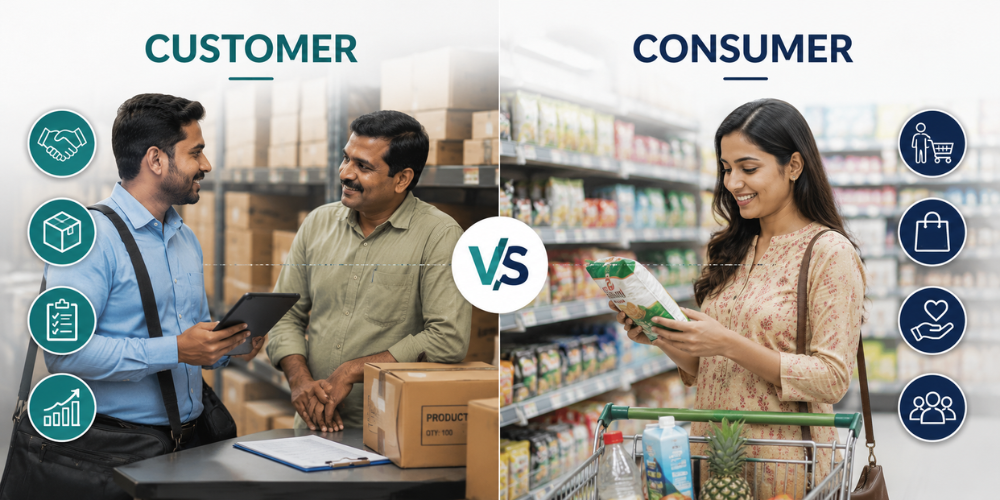
A consumer, on the other hand, is the person who actually uses or consumes the product. Consumers may or may not be the ones who purchase the product. Their decisions are driven by product quality, value, packaging, brand reputation, convenience, and overall user experience. Consumer preferences ultimately create market demand, influence repeat purchases, and determine a brand's long-term success.
Both customers and consumers are equally important to FMCG businesses, but they contribute in different ways. Customers help businesses achieve efficient distribution, maintain inventory levels, and ensure products reach the market. Consumers drive demand by purchasing and using the products, providing feedback, and building brand loyalty through repeat purchases and recommendations.
The Customer-Consumer Relationship in FMCG Distribution
The success of an FMCG business does not just depend on making products. It also needs a distribution network where customers and consumers are equally important. Customers help get products to the market. Consumers buy these products. If a business understands how customers and consumers work together, it can make its distribution network better, sell products, and make customers loyal to its brand.
A typical FMCG distribution chain works like this:
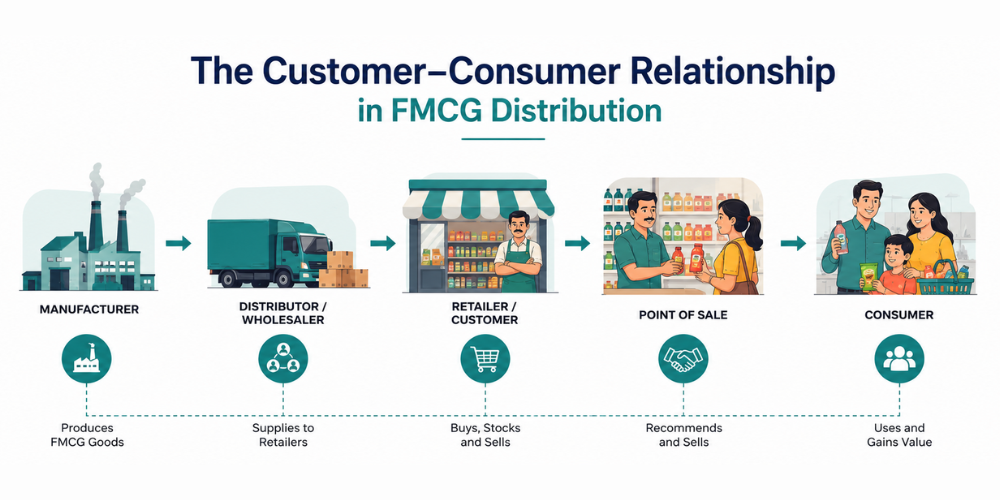
Each person in the chain has a task to complete. The manufacturers are the ones who make the products. The distributors are responsible for buying the products in bulk. They have to ensure that these products get to the wholesalers and the retailers when they are supposed to. The wholesalers play a role in helping to get the products to the retailers.
If consumers stop buying products because they are not good or are not available retailers will not order as much. Distributors will have many products and manufacturers will not sell as much. This shows that businesses need to make both customers and consumers happy not just one or the other.
For people who sell products in the field this is very important. They go to stores to get orders check if products are available see how products are displayed ask retailers what they think and watch what consumers are buying. This helps businesses know what is happening and make sure products are available where consumers want to buy them.
Modern sales force automation solutions make this easier. They give sales teams the information they need in time so they can see what is happening with orders, sales and how retailers are doing. With this information businesses can work better with customers. Know what consumers want, which makes the FMCG distribution network work better.
Why the Difference Matters in FMCG Sales
Understanding the difference between a customer and a consumer in FMCG is really important. It is not about knowing two business terms. It helps companies make decisions about sales and marketing and how to get products to stores. Customers are the ones who buy products from companies and stock them in stores. Consumers are the people who actually use these products. When companies know what customers and consumers need they can make sure products are available when people want to buy them. They can also build relationships with the stores that sell their products and sell more products overall.
- Better Sales Planning
To plan sales well, companies need to know who their customers are and what consumers want. Stores decide how much of a product to order. They do this based on how much consumers want to buy. If companies look at what customers are buying and what consumers are doing, they can make better plans for sales. They can use their resources wisely. Help their sales teams focus on the areas that will sell the most products.
- More Accurate Demand Forecasting
If companies look at what customers are ordering and what consumers like, they can guess what people will want to buy in the future. Just looking at how many products are sold to stores is not enough. Companies should also look at what consumers are buying and how well products are selling in stores. This helps them predict what will happen next and reduces the chance that they will run out of products or have many.
- Stronger Retailer Relationships
Stores are very important to companies that make FMCG products. Companies need to build relationships with these stores to be successful. Salespeople who visit stores regularly, help stores with problems, deliver products on time and offer deals can build trust with stores. owners. When stores trust a company, they are more likely to order products, put them in a good spot on the shelves, and help the company sell more.
- Improved Product Availability
People really want to buy things when they need them. So if a product is very popular, it does not matter if it is not on the shelves. Product availability is important. Companies have to know what products people are ordering and what products consumers want. This way companies can keep the number of products in the stores.
- Better Inventory Management
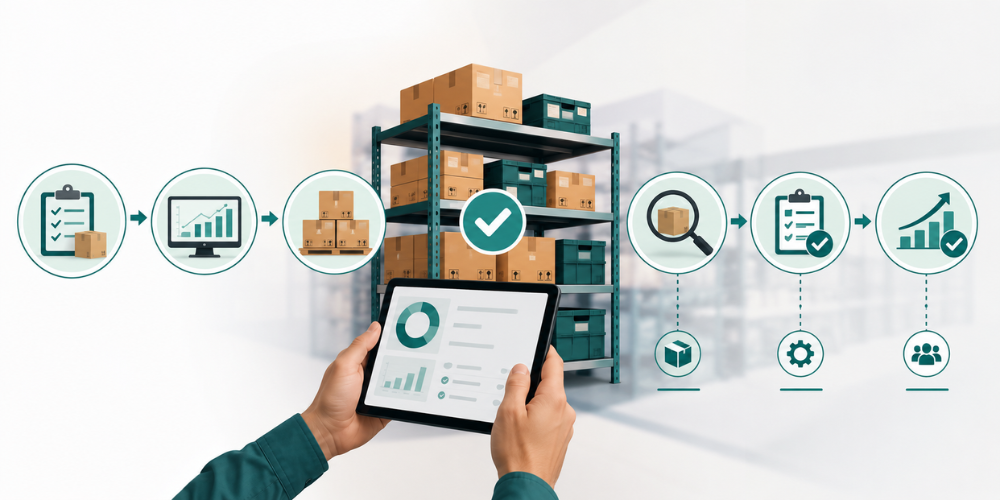
When companies know the difference between customers and consumers, they can manage their products better. They can see how products are moving through the system and how quickly consumers are buying them. With this information, companies can keep the amount of products in stock, reduce waste, and make sure products do not expire.
- Smarter Sales and Marketing Strategies
Sales teams work with customers to sell products while marketing teams try to get consumers interested in products. If companies know what customers and consumers need, they can make plans that work together. They can make offers that stores like to have which are deals that people want to buy. These deals can make people want to shop at these stores.
- Enhanced Field Sales Performance
The people who sell products in the field are very important. People who work with products take orders from customers. They also check if the products are on the shelves. These people talk to the owners of the stores where the products are sold. They want to see what the people who buy the products are doing. If these people have tools like a sales force automation solution they can get the information they need very quickly. They can make sure the products are, on the shelves.
Challenges Sales Teams Face When Customers and Consumers Are Confused
When sales teams do not understand the difference between customers and consumers, they make decisions that are not well thought out. The sales teams need to know that customers are the ones who place orders and keep the distribution network running. On the other hand, consumers are the ones who actually buy and use the products from the customers. If the sales teams only focus on the customers, they will not do a job. If the sales teams only focus on the consumers, they will also not do a job. The sales teams have to think about both the customers and the consumers to do their job. The customers and the consumers are two groups that the sales teams need to understand in order to do a good job.
- Overstocking and Slow Inventory Movement
A lot of businesses think that if retailers are ordering a lot of products, it means that consumers really want them. But if consumers are not buying the products as fast as expected, the products will just sit in stores. This causes problems like overstocking, higher storage costs, and products going bad. Both retailers and distributors lose money.
- Inaccurate Demand Forecasting
If sales teams only look at customer orders to predict sales, they will get it wrong. Retailers might order a lot of products during sales or holidays, but consumers might not buy them fast. If businesses do not watch sales and consumer buying trends, they will make too much or too little of a product. This causes problems with inventory.
- Weak Retailer Relationships
Retailers want products to sell fast. If products do not sell because consumers do not want them, retailers will lose trust in the brand. Order less in the future. Sales teams need to know what consumers want. This helps them assist retailers better. If they do not understand consumer needs, building a relationship with retailers becomes tough. Sales teams must grasp consumer wants to help retailers.
- Poor Product Availability
Sometimes businesses focus much on getting new customers and forget about what consumers really want. This causes problems with getting products to stores. Some stores might have much of a product, while others do not have enough. If consumers cannot find the products they want, they will buy from another brand.
- Ineffective Sales and Marketing Decisions
When businesses confuse customers and consumers, they make decisions. Sales plans that are meant for retailers might not work for consumers. Marketing plans that are meant for consumers will not work if the products are not in stores. Successful businesses make sure to think about both customers and consumers when making sales and marketing plans.
- Limited Market Insights
When sales teams go to stores, they find out a lot of things. They learn what the retailers think about their products. They see what consumers are actually buying. They also get to know what their competitors are up to. They find out how their own products are doing in the stores. If businesses just look at the orders they get from customers, they are missing out on a lot of useful information. This information can really help them make their business better. Sales teams can use all this information to make plans for the future of their business, like how the sales teams store and make plans for the future of the sales teams and the business.
- Reduced Field Sales Productivity
If sales teams do not know what is happening with customers and consumers, they will waste a lot of time. They might go to the stores to promote products that customers and consumers do not want. They might take the wrong route to get to the stores. Using a Sales Force Automation solution with features like field sales tracking and retail execution and sales analytics will really help sales teams. Sales teams will know which stores to go to, and they will make decisions. Sales teams will work efficiently with Sales Force Automation. Sales force automation helps sales teams with sales analytics and execution and field sales tracking.
How Field Sales Teams Can Serve Both Customers and Consumers
Field sales teams connect a company with its customers and consumers. They do not just take orders from distributors, wholesalers, and retailers. They also gather information about what consumers like, how they buy and market conditions. This helps businesses sell more and distribute products better.
- Build Relationships with Retailers
Retailers are the people we sell to in the food and drink business. When we visit them, talk to them often, and fix problems quickly, they start to trust us and want to do business with us. If we have relationships with retailers, they will put our products on the shelves where people can see them, and we will get regular orders.
- Make Sure Products Are Always On The Shelves
People can only buy things that're actually in the stores. Our sales team should check how many products are in stock, find out when we are running low, and work with the people who deliver our products to get more when they visit the stores. When our products are always available, our customers are happy. This stops people from buying products from companies instead of ours.
- Monitor What Consumers Are Buying
Field sales teams work with customers. Should also observe consumers interacting with products. They should monitor selling items, seasonal demand, popular product variants and purchasing patterns. This provides insights to help businesses forecast demand plan inventory, and select products.
- Collect Retailer Feedback
Retailers get feedback from consumers daily. Sales reps should collect information about customer complaints, product preferences, pricing concerns and competitor activity. Sharing this with management helps businesses make decisions, about product improvements, promotions and sales strategies.
- Improve Retail Execution
Effective retail execution means products are displayed correctly and easily accessible. Sales reps should verify shelf visibility, promotional displays, pricing accuracy and merchandising compliance during every outlet visit. Executed retail operations improve the shopping experience and increase product purchases.
- Use Data to Make Better Sales Decisions
Field sales teams should use real-time sales data to identify growth opportunities than relying on experience or assumptions. Tracking sales, retailer performance order history and consumer demand helps prioritize high-potential outlets improve territory coverage and make smarter sales decisions.
How Sales Force Automation Helps Bridge the Gap
Understanding the difference between customers and consumers is valuable when businesses can act on that knowledge. In a moving FMCG environment, manually tracking retailer visits customer orders, inventory levels and consumer demand can cause delays, data inaccuracies and missed sales opportunities. This is where Sales Force Automation (SFA) plays a role. It connects field sales teams, distributors, retailers and management on a platform. This helps businesses make data-driven decisions that benefit both customers and consumers.
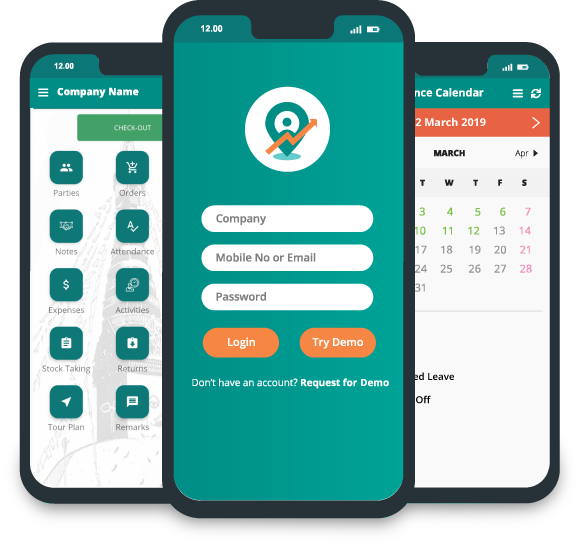
With an SFA solution like Delta Sales App businesses get real-time visibility into field activities, sales performance, and market trends. By relying on manual reports or spreadsheets, sales managers can monitor customer interactions. They can also understand the consumer demand driving those sales.
- Automates Order Collection
Collecting orders manually takes a lot of time. Increases the chances of errors. A Sales Force Automation solution allows field sales representatives to capture retailer orders digitally during outlet visits. This speeds up the ordering process. Improves order accuracy. It ensures products are replenished on time. This helps customers maintain stock while meeting consumer demand.
- Improves Beat Planning and Retail Coverage
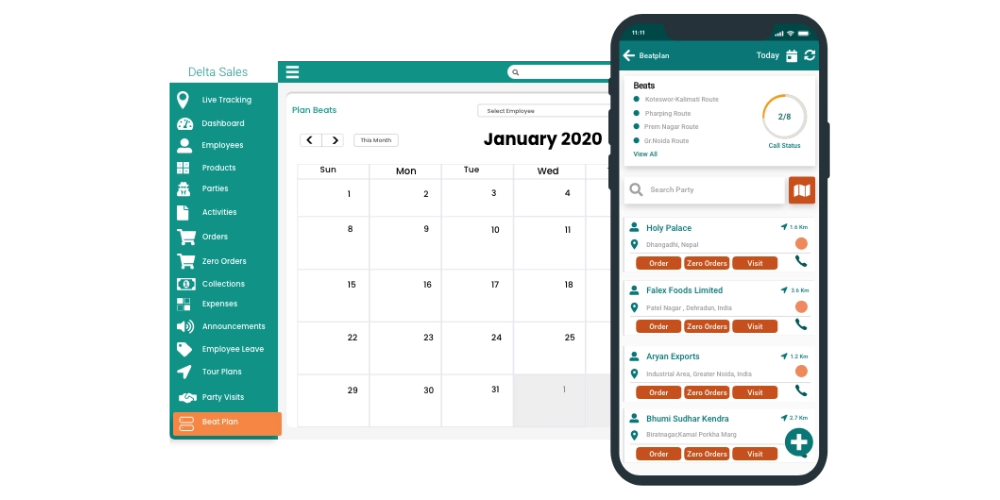
Visiting the outlets at the right time is essential for maintaining strong customer relationships. With beat planning, sales representatives can follow optimized routes. They can increase coverage and ensure every retailer receives regular visits. Better coverage improves product availability. It reduces the risk of stock-outs that could affect consumers.
- Tracks Secondary Sales in Real Time
Sales only show how much stock has been sold to distributors or retailers. Secondary sales automation app provides visibility into how quickly products are moving from retailers to consumers. This helps businesses identify performing products. They can monitor demand. Make informed decisions about inventory replenishment and future sales strategies.
- Enhances Retail Execution
Successful FMCG brands depend on retail execution. Sales representatives can use an SFA solution to verify shelf availability. They can capture outlet images. Monitor promotional displays. They ensure products are correctly positioned. Better retail execution improves product visibility. It enhances the shopping experience. Increases the likelihood of consumer purchases.
- Provides Actionable Market Insights
Every retailer visit generates information about consumer preferences, competitor activity, pricing, and product performance. An SFA platform enables sales representatives to record retailer feedback and market observations. Managers can then analyze this information. They can identify emerging trends. Adjust sales strategies. They can respond quickly to changing consumer behavior.
- Enables data-driven decision-making
Modern sales teams perform best when decisions are based on real-time data rather than assumptions. An SFA solution provides dashboards and reports. They track customer visits, order history, field sales team performance, retailer productivity, and market trends. These insights help businesses optimize inventory. They improve sales planning. Allocate resources more effectively across territories.
- Strengthens Customer Relationships While Meeting Consumer Demand
The goal of sales force automation is to help businesses serve both customers and consumers more effectively. By streamlining order management, improving field sales tracking, monitoring sales, and supporting better retail execution, the DeltaSales App enables businesses to maintain stronger retailer relationships. They ensure products remain available where consumers want them. This balanced approach leads to customer satisfaction. It improves consumer loyalty and sustainable business growth in the FMCG market.
Common Mistakes to Avoid
It is really important for companies that make things people use every day to know the difference between customers and consumers. If they do not understand this, they can make mistakes that hurt their sales. For example, they might not have products in stores, or they might not have good relationships with the stores that sell their products. If customers and consumers are treated like they are the same, it can lead to planning and missed chances to sell things to consumers. If sales teams are aware of these mistakes, they can make better choices and sell more things.
- Focusing on Primary Sales
A lot of companies think they are doing well if they sell a lot of products to stores. This does not tell them if consumers are actually buying these products. They should also look at sales to see what is really happening. This helps them know how many products to make and prevents them from having many products that they cannot sell.
- Ignoring Consumer Buying Behavior
Stores might order products regularly, but consumers can change what they want to buy because of prices, quality, or what is popular at the time. If companies do not pay attention to what consumers are buying, they might try to sell things that consumers do not want anymore. This can lead to sales and customers losing trust in the company.
- Neglecting Retailer Feedback
The people who work in stores talk to consumers every day and know what they like and do not like. If companies do not listen to what these people have to say, they might not find out about problems with their products until it is too late. This makes it harder for them to make their products better or to come up with plans for selling and distributing them.

- Assuming Product Availability Is Guaranteed
Just because a company gets an order from a customer does not mean that the product will always be available in stores. Sometimes products can be late. The company might not have enough of them. If consumers cannot find the products they want, they might buy something instead. Companies should visit stores often. Have a good system for managing orders to make sure products are always available.
Relying on Manual Reporting
Using fashioned ways of keeping track of sales like paper or spreadsheets can lead to mistakes and delays. If companies do not have up-to-date information about what's happening in stores, they cannot make good decisions. A Sales Force Automation (SFA) system can help them get the information they need to make choices.
- Overlooking Retail Execution
Even if a product is in a store, it might not be easy for consumers to find it. It might not be priced correctly. If companies do not check how their products are being displayed in stores they might miss out on sales. They should visit stores often to make sure everything is okay and that their products look good to consumers.
- Not Using Sales Data for Decision-Making
A lot of companies collect information about their sales. They do not use it to make decisions. If they look at what customers are buying, how well stores are doing and what consumers want, they can see what is working and what is not. This helps them plan for the future. Make better decisions about their products and sales strategies. Making decisions based on facts is better than guessing or relying on what has happened in the past. Companies should use sales data and other information to make informed decisions about their field sales activities and retail execution.
Conclusion
Understanding the difference between customer and consumer in FMCG is really important. Customers, like distributors and retailers, help get products to the market. Consumers decide if a product will be successful in the long run by choosing to buy it and staying loyal to the brand. By focusing on both customers and consumers, FMCG businesses can do a job with sales planning. They can also get along better with retailers, do a job with retail execution, sell more products to retailers,, and make smarter decisions about inventory and distribution. Using the technology makes managing these processes much simpler. The Delta Sales App helps businesses with tasks like sales force automation, managing orders, planning sales routes, tracking field sales, and monitoring sales to retailers.
If you want to see more of what's happening with your sales, make your field team more productive. Improve your FMCG distribution network
Book a free demo of the Delta Sales App today. See how automation can help you serve both your customers and consumers better.