
What is Distribution Management? Everything You Need to Know
_1741500504.png)
In today’s fast-paced business world, efficient distribution management is key to success. Whether you’re a small business or a large corporation, understanding distribution management can help streamline operations, reduce costs, and improve customer satisfaction. This blog explains what distribution management is, its key components, benefits, challenges, and best practices to optimize your supply chain.
What is Distribution Management?
Distribution management is the process of planning, coordinating, and overseeing the movement of goods from suppliers or manufacturers to the point of sale, such as distributors, retail stores, online marketplaces, or directly to customers. It covers key activities including inventory management, warehousing, transportation, order fulfillment, and delivery.
The main goal of distribution management is to ensure that the right products reach the right place, at the right time, and in the right condition while minimizing operational costs and maximizing efficiency. An effective distribution management process helps businesses maintain product availability, reduce delivery delays, optimize logistics, and improve overall customer satisfaction.
Key Components of Distribution Management
Distribution management involves several interconnected components:
1. Inventory Management
Tracking and controlling stock levels to meet customer demand without overstocking or stockouts.
2. Warehousing
Storing products in a facility until they are ready for shipment, ensuring they are accessible and protected.
3. Transportation
Moving goods from one location to another, whether from a manufacturer to a warehouse, a warehouse to a retailer, or directly to customers.
4. Order Fulfillment
Processing and delivering customer orders, including picking, packing, and shipping.
5. Demand Forecasting
Predicting future customer demand to plan inventory levels and distribution strategies.
6. Customer Service
Ensuring customers receive orders on time and resolving any issues, such as returns or damaged goods.
Benefits of Effective Distribution Management
Effective distribution management offers several advantages:
-
Improved Customer Satisfaction: Timely and accurate deliveries lead to happier customers and repeat business.
-
Reduced Costs: Optimizing inventory, transportation, and warehousing lowers operational expenses.
-
Faster Delivery Times: Streamlined processes enable quicker order fulfillment.
-
Better Inventory Control: Maintaining optimal stock levels prevents overstocking or stockouts.
-
Competitive Advantage: Efficient distribution helps businesses respond quickly to market changes.
Best Practices for Distribution Management
To maximize efficiency, follow these best practices:
-
Leverage Technology: Use distribution management software, AI, and IoT to automate and optimize processes.
-
Optimize Warehouse Layout: Organize warehouses for easy access and faster order processing.
-
Choose Reliable Transportation Partners: Work with carriers that offer cost-effective and timely delivery.
-
Monitor KPIs: Track metrics like order accuracy, delivery times, and inventory turnover.
-
Focus on Sustainability: Adopt eco-friendly practices like optimizing routes and using sustainable packaging.
-
Train Your Team: Ensure employees are skilled in the latest tools and technologies.

Challenges in Distribution Management
Despite its benefits, distribution management comes with challenges:
-
Supply Chain Disruptions: Natural disasters, pandemics, or geopolitical issues can disrupt operations.
-
Rising Transportation Costs: Fluctuating fuel prices and high shipping demand increase costs.
-
Inventory Management Issues: Poor inventory control can lead to stockouts or overstocking.
-
Customer Expectations: Customers demand faster and cheaper shipping, putting pressure on businesses.
What Is Distributor Management?
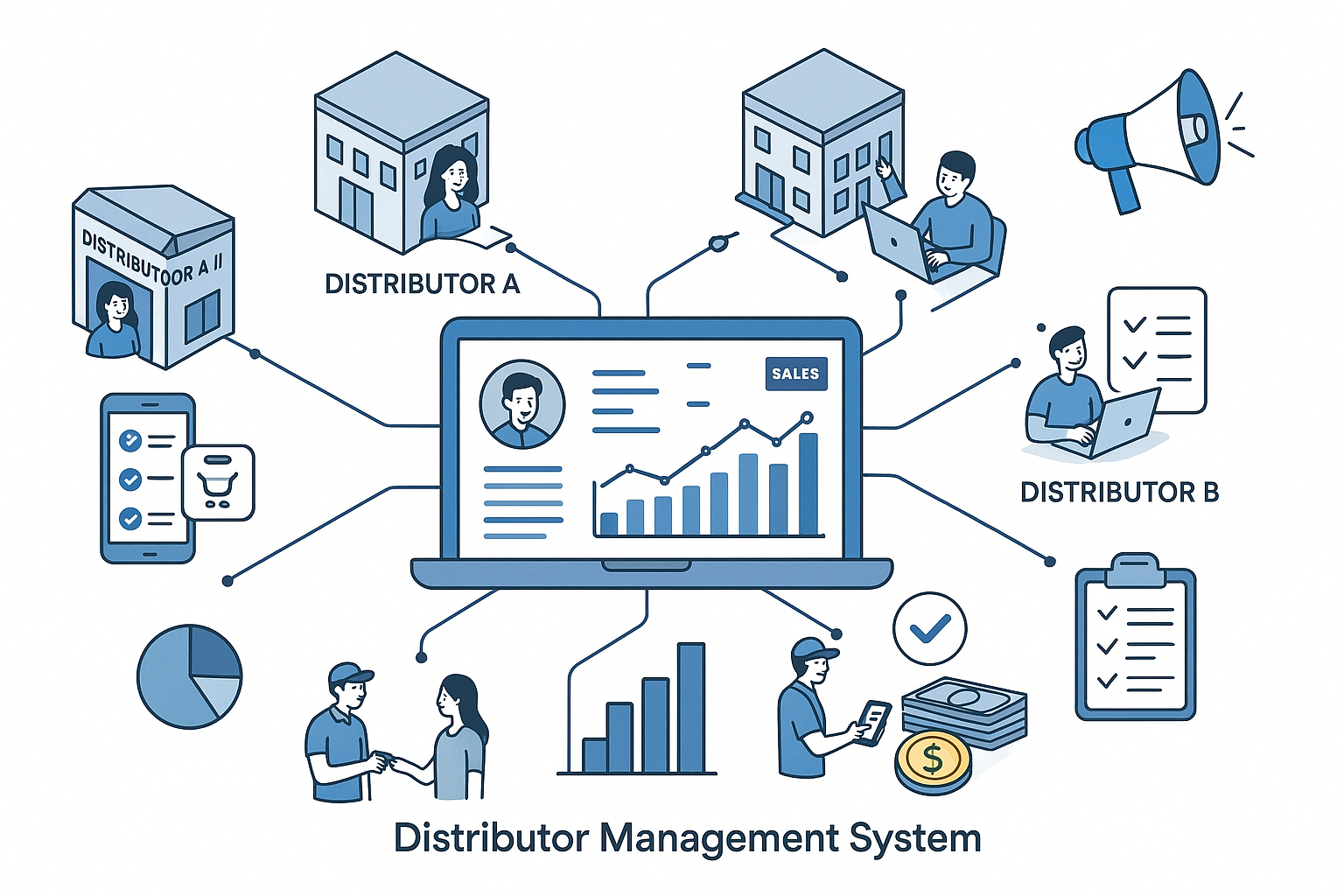
Distributor Management refers to the strategic oversight, coordination, and optimization of relationships and processes involving a company's network of distributors. These distributors act as intermediaries between the manufacturer (or brand) and the end customer, often selling products to retailers, wholesalers, or directly to consumers depending on the business model.
Effective distributor management ensures that goods move efficiently from production to the final point of sale, while also maintaining control over pricing, inventory levels, promotions, credit, and overall brand representation in the market.
Why is Distributor Management Important?
For companies that rely on an indirect sales model, distributor management is a critical pillar of success. Without structured systems and processes in place, the following challenges are common:
-
Geographical Complexity:
As businesses expand across multiple cities, states, or countries, managing operations with numerous distributors becomes increasingly complex. -
Lack of Visibility:
In manual systems, brands often lack real-time insights into distributor stock levels, secondary sales, and territory performance. -
Inefficient Order Processing:
Manual order handling leads to delays, errors, and missed sales opportunities. -
Inconsistent Promotions and Pricing:
Poor control over scheme execution (e.g., discounts, incentives) can lead to market distortion and distributor dissatisfaction. -
Cash Flow Problems: Delayed collections, poor credit monitoring, and inconsistent billing can lead to working capital bottlenecks.
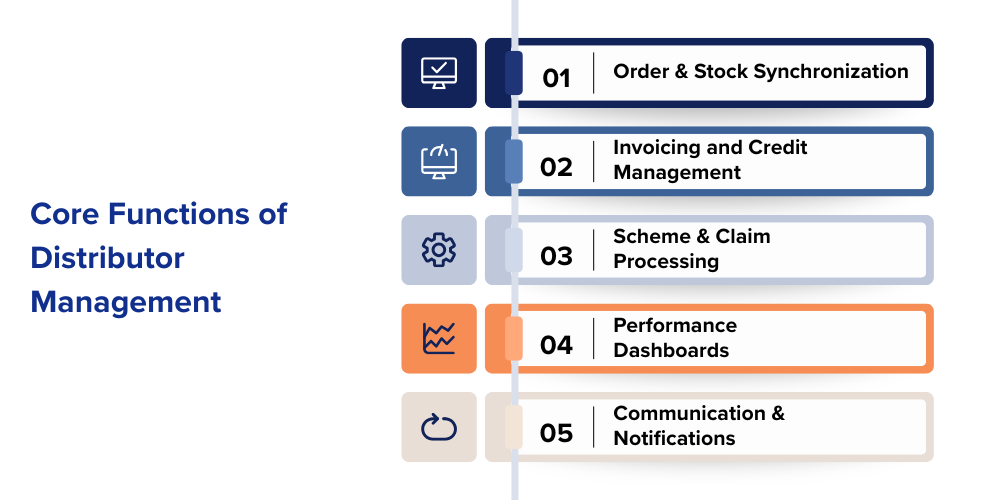
Core Functions of Distributor Management:
-
Order & Stock Synchronization
Distributors can place orders directly via a centralized app. Brands receive real-time updates on stock availability and order status, reducing the need for endless back-and-forth via email or phone. -
Invoicing and Credit Management
Automates the management of credit limits, payment schedules, and overdue amounts, ensuring smoother cash flow and fewer financial disputes. -
Scheme & Claim Processing
Trade promotions, discounts, and incentive schemes can be launched digitally. Distributors can submit claims with documentation, and brands can approve or reject them in real time. -
Performance Dashboards
Gain visibility into distributor-wise sales performance, fulfillment rates, territory penetration, and more, all through a single dashboard. -
Communication & Notifications
Share promotional content, new launches, and payment reminders directly with your distributor network.
How Do You Choose the Right Distributor Management System?
Choosing the right Distributor Management System (DMS) requires evaluating how well the solution fits your distributor network, business processes, and growth plans. Consider these key factors:
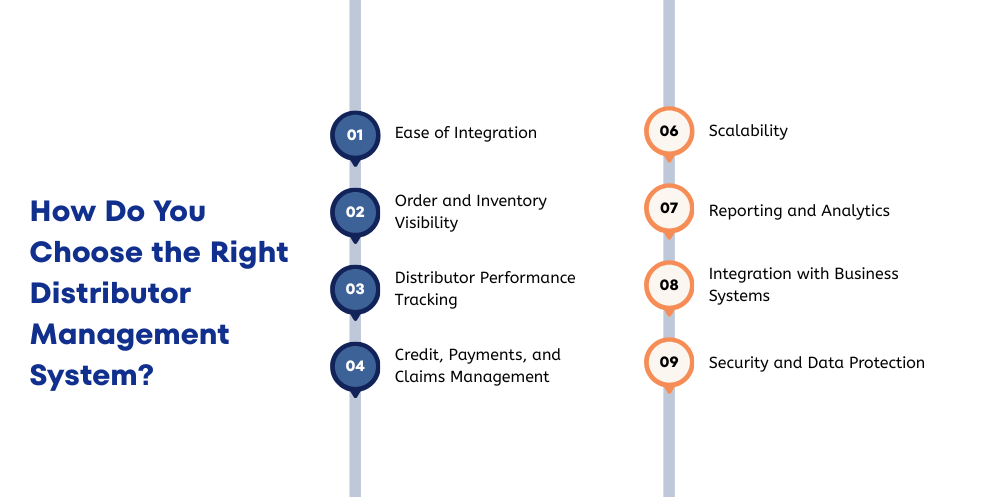
Ease of Integration
Choose a system that integrates with existing ERP, accounting, inventory management, and sales systems to ensure smooth data flow and reduce manual data entry.
Order and Inventory Visibility
Look for order management and inventory features that provide real-time visibility into distributor orders, stock levels, product movement, and replenishment requirements.
Distributor Performance Tracking
The right distributor management software should help monitor sales performance, order frequency, stock movement, territory coverage, and other important distributor KPIs.
Credit, Payments, and Claims Management
Choose a solution that simplifies credit management, payment tracking, invoicing, schemes, and claims to improve financial control and reduce administrative work.
Scalability
Your DMS should support a growing number of distributors, users, products, territories, and transactions without creating operational complexity as your business expands.
Reporting and Analytics
Look for distributor analytics and customizable reports that help managers understand sales trends, distributor performance, inventory movement, and market opportunities.
Mobile Accessibility
A mobile-friendly system allows distributors and sales teams to access information, place orders, check stock, and manage daily activities from anywhere.
Security and Data Protection
Ensure the platform provides strong security measures, user access controls, and data protection to safeguard sensitive distributor, customer, transaction, and business information.
Effective Distributor Management Strategies
A well-planned distributor management strategy can help businesses strengthen channel relationships, improve sales performance, and create a more efficient distribution network.
1. Select the Right Distributors
Choose distributors based on market reach, infrastructure, financial stability, product handling capabilities, and knowledge of the local market.
2. Set Clear Performance Goals
Define measurable targets for sales, order volume, market coverage, inventory turnover, and product availability to evaluate distributor performance effectively.
3. Maintain Strong Distributor Relationships
Build long-term relationships through regular communication, transparent processes, training, marketing support, and timely assistance with operational challenges.
4. Improve Order and Inventory Management
Use distributor management software to digitize orders, monitor inventory levels, identify stock shortages, and improve product replenishment across territories.
5. Offer Performance-Based Incentives
Use incentives, discounts, bonuses, and promotional schemes to motivate distributors and encourage them to achieve sales and market coverage targets.
6. Monitor Distributor Performance
Regularly track distributor performance using sales, order fulfillment, inventory, payment, and territory-level data to identify gaps and improvement opportunities.
7. Improve Communication and Collaboration
Use digital communication tools and centralized platforms to share product updates, pricing information, promotional schemes, and important business announcements.
8. Use Data for Better Decisions
Leverage distribution analytics to identify sales trends, high-performing distributors, slow-moving products, and market opportunities for better strategic planning.
9. Review and Optimize Regularly
Continuously evaluate your distributor management strategy and make improvements based on distributor performance, market demand, customer needs, and changing business goals.
When Do You Need a DMS?
You should consider implementing a DMS if:
-
Your business relies on a wide network of distributors.
-
You face delays in scheme execution and claim settlements.
-
Cash flow suffers from poor credit tracking.
-
You’re unable to monitor distributor performance consistently.
-
You're trying to eliminate manual or Excel-based processes.
Distributor Management vs. Distribution Management
In simple terms:
Distributor Management = Managing distributors and their business activities.
Distribution Management = Managing the broader sales and distribution process across multiple levels.
The two systems are not necessarily alternatives. Depending on the size and complexity of a business, they can work together to provide better visibility and operational control.
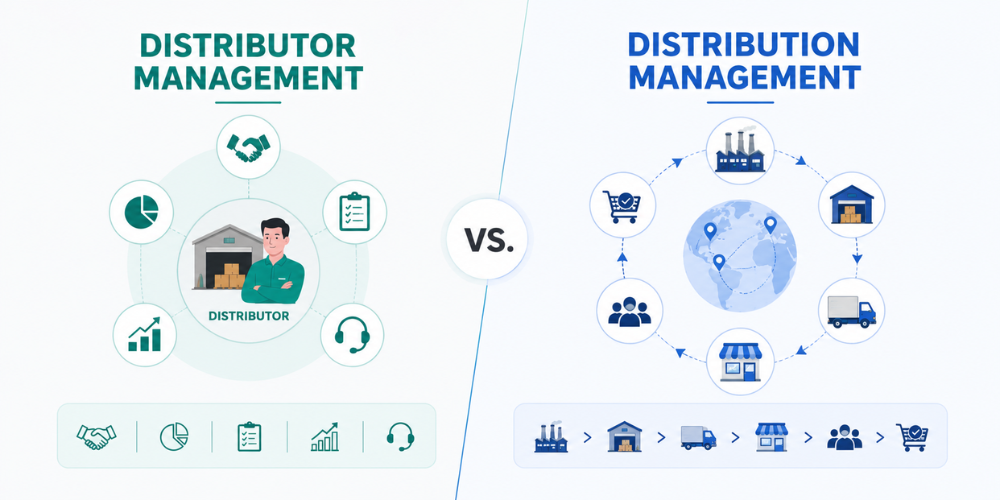
Understanding these differences can help businesses identify the right approach for their specific distribution needs.
|
Criteria |
Distributor Management |
Distribution Management |
|
Core Focus |
Manages relationships and transactions with individual distributors. |
Manages the complete distribution network from warehouse to retail shelf. |
|
Functionality |
Automates tasks like distributor order processing, sales tracking, invoicing, and credit management. |
Offers end-to-end control of the supply chain, including inventory, routing, secondary sales, and delivery. |
|
Primary Objective |
Enhances communication, transparency, and coordination with distributors. |
Optimizes the entire distribution process across multiple tiers and stakeholders. |
|
Real-World Example |
FMCG brands like Unilever or Procter & Gamble use DMS to manage distributor orders, schemes, and performance efficiently. |
Companies like Amazon rely on Distribution Management Systems to oversee logistics, stock levels, and multi-region deliveries. |
|
Sales Tracking |
Tracks primary sales and performance at the distributor level. |
Tracks both primary and secondary sales across regions, outlets, and channels in real time. |
|
Integration Capability |
Offers limited integration, typically focused on distributor-level processes. |
Highly integrated with manufacturers, distributors, retailers, and sales teams for seamless collaboration. |
|
Ideal For |
Small to medium-sized brands with focused or localized distributor networks. |
Large-scale or enterprise brands managing complex, multi-tiered distribution systems. |
|
Data Visibility |
Limited to distributor metrics like order volume, dues, and scheme utilization. |
Complete visibility into the entire supply chain, from warehouse to the last-mile retailer. |
|
Operational Control |
Provides control at the first distribution level (primary sales). |
Provides control over multiple distribution levels (primary + secondary sales). |
|
Scalability |
Best suited for businesses in the early stages of digital transformation. |
Designed for growing or enterprise brands needing real-time data and large-scale coordination. |
The Future of Distribution and Distributor Management
The future of distribution management is evolving with advancements in technology, changing consumer preferences, and increasingly complex distribution networks. Businesses are adopting digital solutions to improve efficiency, increase visibility, and make faster, data-driven decisions across their sales and distribution operations.
Key trends shaping the future of distribution and distributor management include:
-
Automation and Robotics: Warehouses are increasingly using automation to improve efficiency, reduce manual work, and speed up order processing.
-
E-commerce Growth: The growing demand for same-day delivery, faster fulfillment, and click-and-collect services is encouraging businesses to optimize their distribution networks.
-
Data Analytics: Businesses are using automated reports and analytics to gain insights into sales performance, inventory levels, distributor performance, and market demand, enabling more informed decisions.
-
Digital Distributor Management: Businesses are increasingly adopting digital distributor management solutions to improve distributor collaboration, streamline orders, monitor inventory, manage claims and schemes, and gain better visibility into distributor performance.
-
Real-Time Visibility: Modern distribution and distributor management systems are helping businesses gain real-time visibility into orders, inventory, sales activities, market coverage, and distributor operations.
-
Sustainability: Eco-friendly practices, optimized transportation routes, sustainable packaging, and reduced waste are becoming priorities for businesses and consumers.
As technology continues to advance, integrating distribution management and distributor management processes will become increasingly important for businesses looking to improve operational efficiency, strengthen channel relationships, and build a more connected and responsive distribution network.
Why You May Need Both: A Strategic Growth Path?
Businesses do not always have to choose between Distributor Management and Distribution Management. As operations grow, many organizations may start with one solution and gradually expand their technology stack to address broader sales and distribution requirements.
Start with Distributor Management: If your business is beginning its digital transformation, focus on automating distributor orders, improving inventory visibility, managing credit and claims, and tracking distributor performance.
Expand into Distribution Management: As your business grows and adds field sales teams, multiple territories, and retail outlets, a broader distribution management system can help improve market coverage, sales execution, inventory planning, and real-time visibility.
Integrate Both Systems: Businesses with complex distribution networks can connect distributor management software with field sales and distribution operations to create a unified flow of data. This enables better visibility from distributor orders and sales activities to retailer-level execution, helping managers make faster, data-driven decisions.
The right approach depends on your business size, distribution network, and operational complexity. Starting with your immediate needs and scaling as your requirements evolve can help create a more efficient and future-ready distribution ecosystem.
Conclusion
Effective distribution management plays a crucial role in ensuring that products move smoothly from suppliers and manufacturers to distributors, retailers, and customers. By optimizing inventory, warehousing, transportation, and order fulfillment, businesses can reduce operational costs, improve delivery efficiency, and enhance customer satisfaction.
As distribution networks become more complex, businesses need better visibility and control over their field sales and distribution activities. Delta Sales App helps businesses manage and monitor their field sales operations with features such as GPS tracking, outlet coverage, order capture, route planning, and real-time sales activity reports.
Ready to improve visibility and efficiency across your field sales operations?
Book a demo with Delta Sales App today and discover how you can simplify sales team management, track market activities, and strengthen your distribution operations.
FAQs
1. What is the role of distribution management in a business?
Distribution management ensures products move efficiently from suppliers to customers, optimizing inventory, transportation, and order fulfillment to meet demand and reduce costs.
2. How does distribution management improve customer satisfaction?
By ensuring timely and accurate deliveries, distribution management enhances the customer experience, leading to higher satisfaction and loyalty.
3. What technologies are used in distribution management?
Technologies like distribution management software, AI, IoT, and automation tools are commonly used to streamline processes and improve efficiency.
4. What are the biggest challenges in distribution management?
Common challenges include supply chain disruptions, rising transportation costs, inventory management issues, and meeting high customer expectations.
5. How can businesses make distribution management more sustainable?
Businesses can adopt eco-friendly practices like optimizing transportation routes, using sustainable packaging, and reducing waste in warehouses.
6. What is the difference between distribution management and supply chain management?
Distribution management focuses primarily on the movement, storage, and delivery of finished goods from suppliers or manufacturers to distributors, retailers, and customers. Supply chain management encompasses a broader process that can include raw material sourcing, procurement, manufacturing, inventory, logistics, distribution, and final delivery.