
How FMCG Businesses in the Middle East Are Adopting Sales Force Automation
FMCG selling across the Middle East rarely follows one standard route. A distributor may serve modern retail chains in Dubai, independent groceries in Sharjah, wholesale markets in Riyadh, and smaller outlets spread across a much larger territory. Sales reps may work with pre-sell orders, van sales, distributor stock, collections, merchandising checks, and outlet-level promotions in the same working day.
That makes field execution difficult to manage with disconnected spreadsheets, paper forms, phone calls, and WhatsApp updates. As sales teams expand across territories, managers need faster visibility into where reps are working, which outlets are being covered, what orders are being booked, and whether planned activities are actually being completed.
Sales force automation software (SFA) brings these activities into a connected workflow through mobile applications and centralized dashboards. Instead of waiting for end-of-day reports, managers can monitor visits, orders, collections, attendance, outlet activity, and territory coverage with less manual consolidation. For FMCG businesses operating across the Middle East, the shift is not simply about replacing paper with an app. It is about connecting field execution with sales, distribution, and management processes while accommodating the realities of different markets.
In this blog, we explore how FMCG businesses in the Middle East are adopting sales force automation, where SFA is being used across field operations, what regional requirements businesses should consider, and how to evaluate an SFA platform for Middle East sales teams.
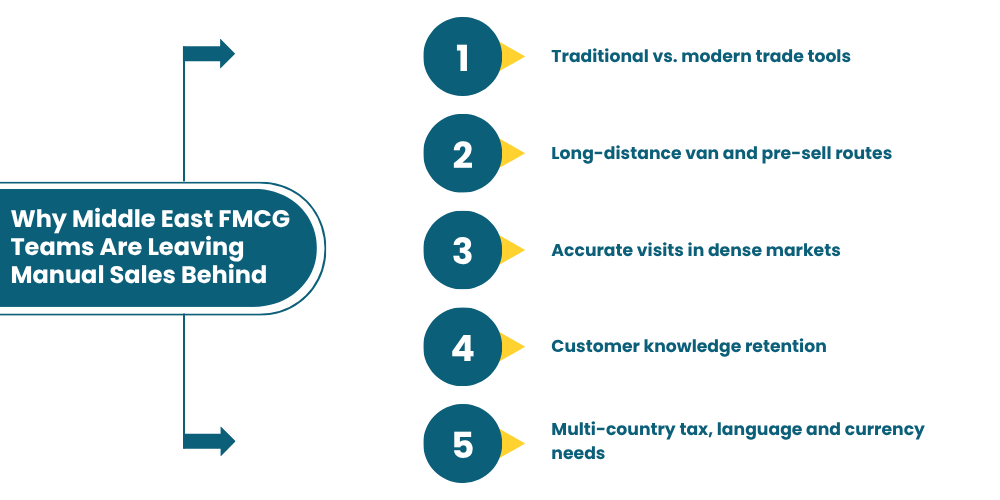
Why FMCG companies in the Middle East are moving away from manual field sales
Manual processes can work fine for a small sales team covering a limited territory. They get much harder to control as the number of reps, SKUs, outlets, distributors and countries grows.
Picture a manager who gathers DSRs over WhatsApp, merges Excel sheets, and phones reps to confirm visits. That manager has almost no chance to act during the day, and problems only show up after they've already hurt sales execution. An SFA system changes this by keeping field activity in a structured record from the start.
-
Traditional and modern trade need different tools
FMCG companies in the Middle East usually sell through a mix of channels: modern trade, traditional trade, wholesalers, supermarkets, convenience stores, groceries, and independent retailers. A modern retail account can call for structured orders, promotions, planogram checks, SKU availability, and compliance reporting. A small independent outlet needs a quicker visit built around taking the order, collecting payment, checking stock, and merchandising. An SFA platform has to handle both kinds of visits, and every outlet shouldn't be pushed through the same process. Managers can set customer types, attach different forms or visit requirements to each, and track coverage by territory or channel.
-
Van sales and pre-sell routes across long distances
Route structure matters most when a sales team covers a large territory. In a pre-sell model, the rep visits outlets and takes orders, and the distributor or a delivery team fills them later. In van sales, the rep carries stock and sells straight from the vehicle. Either way, the routes need to be planned accurately. With no structured beat plan, reps lose time on the road and miss priority outlets. They also tend to keep going back to easy accounts while outlets on a lower visit frequency get less attention than they should. SFA software can group territories into beats and tour plans, guide the route, log customer visits, and capture orders in the field. For a manager, knowing where a rep's phone is doesn't answer much. What they need to know is whether the planned territory coverage is actually getting done.
-
Dense markets where visit accuracy matters more than distance
A common mistake when measuring field productivity is to focus only on distance traveled. In a dense retail market, a representative might cover many outlets within a relatively small geographic area. The more important question is whether those outlets were actually visited and whether the planned activities were completed. A GPS-based visit tracking system can help distinguish a genuine customer visit from a route that merely passed near an outlet.
-
Outlet knowledge that leaves when reps leave
Manual field sales has another weak spot: what a company knows about its customers tends to live in individual reps' heads. One rep knows which retailer likes certain SKUs, which outlet pays on time, which distributor runs short of stock, and which customer needs a particular promotion. If that knowledge sits in notebooks, memory, or chat messages, the company can't see much of it. An SFA system gives each customer a structured record. Outlet details, order history, collections, visit history, notes, stock information, and sales activity all attach to the customer profile. So when a rep moves to another territory or leaves, the business keeps what it knew about its customers and doesn't have to start over.
-
Multiple countries with different tax, language, and currency rules
A regional FMCG group may sell in several Middle Eastern markets, and those markets don't work the same way. Currency, tax rules, invoicing requirements, languages, customer structures, distributor arrangements, and reporting rules can all differ from one country to the next. A regional sales platform therefore has to be flexible enough for country-specific workflows and still give the head office a central view. Every country doesn't have to follow an identical process. The core sales data should be standardized, and local teams can then work the way their market requires.
Where FMCG teams use sales force automation
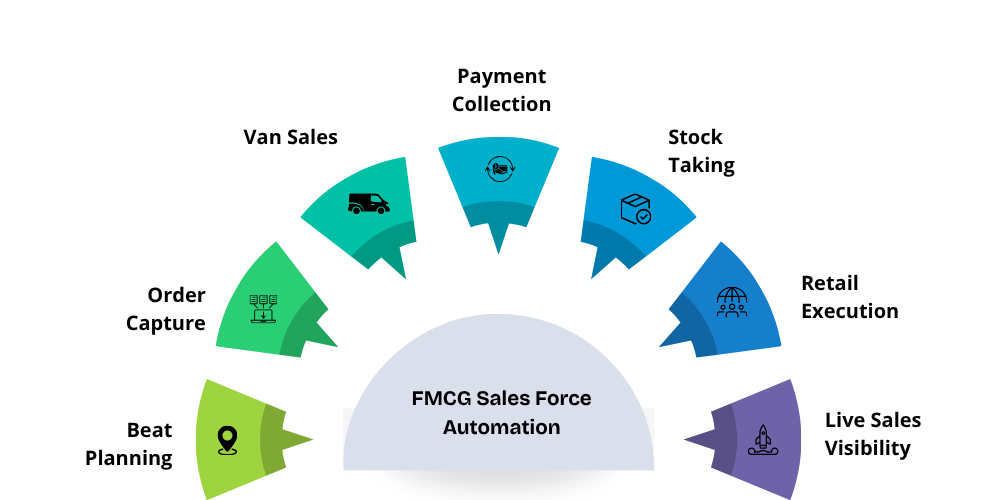
SFA is most useful when it connects activities that previously existed in separate systems. For FMCG field teams, those activities usually start with route planning and continue through the complete outlet visit.
-
Beat planning and tour plans
A beat plan sets out which outlets a rep should visit and on which day. A rep might cover high-volume supermarkets on Sunday and independent groceries on Monday, with a separate route for wholesale customers. An SFA platform can lay out those routes, assign the outlets to them, and show managers how planned coverage compares with what actually happened. Reps make fewer random changes to their routes, and it's easier to judge how a territory is performing.
-
Order capture and van sales
With mobile order management, a rep takes the order right at the outlet. They pick SKUs, quantities, prices, schemes, and any other details in the app, and they don't have to write the order on paper and key it into another system later. Van sales teams can go further and handle the stock on the vehicle and sell directly from the van. Nobody enters the same order twice, and managers see sales activity sooner.
-
Payment collection and outstanding dues
In FMCG distribution, collecting payment is a big part of the job, especially when reps deal with retailers face to face. An SFA platform ties each collection to the customer record and the outstanding balance. Before or during a visit, the rep can check the customer's details, record the payment, and get it to managers without waiting on a paper report. Sales leaders also get a clearer picture of overdue accounts and how collections are going.
-
Stock taking and custom forms at the outlet
An order only shows part of what happened at an outlet. Reps often need to log stock availability, damaged products, competitor activity, how displays were set up, whether promotions were followed, outlet details, and other things they noticed. Custom forms let a company collect those details during the visit itself. For an FMCG team, that turns a routine customer visit into a structured retail execution activity.
-
Live visibility for sales managers
Live visibility changes the most when it replaces delayed reporting. A manager can follow today's planned, completed, and missed visits, along with orders booked, collections recorded, sales by rep or territory, outlet coverage, attendance, field expenses, and DSR information. The morning no longer goes to asking reps for updates. Managers can spend it acting on what's already on the screen.
How SFA adoption is progressing across the region
Every FMCG business adopts this differently. Some start with attendance and GPS tracking, others with order booking or distributor management. Larger companies may begin by linking their ERP, DMS, and field apps. Regardless of where adoption starts, the objective is the same: moving field information from isolated systems into connected operational data.

-
GCC markets leading the shift
The GCC provides an important environment for sales digitization because many FMCG businesses operate across sophisticated retail networks, distributors, wholesalers, and geographically dispersed territories. Saudi Arabia and the UAE are also implementing broader digital tax and invoicing initiatives. In Saudi Arabia, ZATCA's Phase 2 e-invoicing integration has been implemented in waves since January 2023, requiring targeted businesses to integrate their e-invoicing solutions with ZATCA systems.
-
Manufacturer-led and distributor-led rollouts
SFA adoption does not always start with the manufacturer. A manufacturer may introduce an SFA system to improve visibility across its direct sales force. A distributor may adopt one to control territory coverage, order booking, collections, and delivery coordination. In some cases, both sides benefit from connected information. The manufacturer gains better visibility into secondary sales and market execution, while the distributor gains better control over its reps, customers, orders, collections, and routes. The rollout can also start with one territory or one sales team before expanding across the organization.
-
From paper, spreadsheets, and WhatsApp to mobile apps
Many sales teams do not move directly from manual processes to a fully integrated enterprise system. The transition often looks more like this:
Paper order forms → Excel reporting → WhatsApp updates → mobile sales application → integrated sales and distribution workflow.
The important change is that field data becomes structured at the point where it is created.
A rep should not have to complete one form for attendance, another for orders, and another for the DSR if the same information can be captured through one connected workflow.
-
E-invoicing and government digitization programs
E-invoicing is pushing FMCG technology stacks to connect with each other. Saudi Arabia's Phase 1 requirements have been in force since December 4, 2021, and Phase 2 integration has been rolled out in stages since January 2023. The UAE is heading toward mandatory electronic invoicing too, with official guidelines on the national framework, technical requirements, accredited service providers, and implementation. For FMCG companies, this means a sales app can't stay a standalone tool for much longer. Order capture, invoicing, ERP, DMS, inventory, finance, and field execution will need to pass reliable data back and forth.
What an SFA tool needs to work in Middle East markets
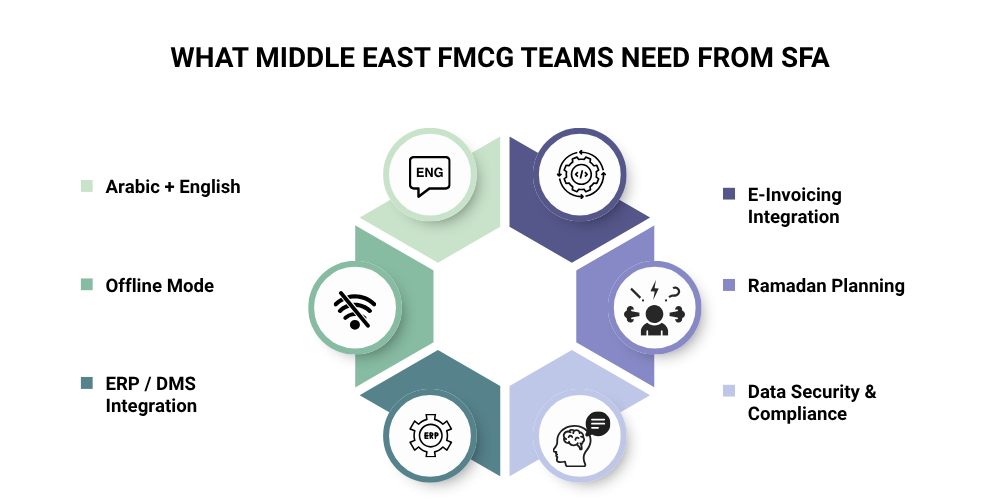
Choosing an SFA platform for the Middle East requires more than checking whether it has GPS tracking and order management. The field environment, workforce, connectivity, integrations, and regulatory requirements all affect whether the system will actually be adopted.
-
Arabic and English with right-to-left screens
Language support matters when a business has multilingual sales teams or operates customer-facing processes in Arabic. Arabic support should go beyond translating a few labels. If Arabic is required, users should be able to navigate the application comfortably, including right-to-left layouts where appropriate. At the same time, many regional businesses operate bilingually, so English support remains important for managers, administrators, and regional teams.
-
Offline mode for weak connectivity
A field sales application that stops working when connectivity drops is a poor fit for field sales. Reps may enter basements, warehouses, industrial areas, remote routes, or locations where mobile coverage is inconsistent. Offline-first functionality allows representatives to continue important tasks such as viewing assigned outlets, recording visits, capturing orders, and completing forms. Once connectivity returns, the data can synchronize with the central system. For a field team, this is not a minor convenience. It can determine whether the application gets used consistently.
-
ERP, DMS, and e-invoicing integration
An SFA system shouldn't turn into one more silo of information. Before picking a platform, a business should find out how it would exchange data with the ERP, distributor management system, accounting software, inventory system, CRM, and e-invoicing setup it already runs. Saudi Arabia's e-invoicing rules are a good example: Phase 2 systems have to integrate with ZATCA's systems and meet specific technical and invoice-format requirements. An SFA platform may not replace the ERP or the e-invoicing solution, and it doesn't need to. Its job is to bring field activity into the wider flow of information.
-
Data residency and compliance
For regional businesses, data handling should be discussed before implementation rather than after deployment. Ask where customer, employee, location, and transaction data are stored. Understand access controls, encryption, backup procedures, retention policies, user permissions, and the vendor's security practices. The right requirements will depend on the organization's country, industry, contractual obligations, and internal policies.
How Delta Sales App supports FMCG field teams
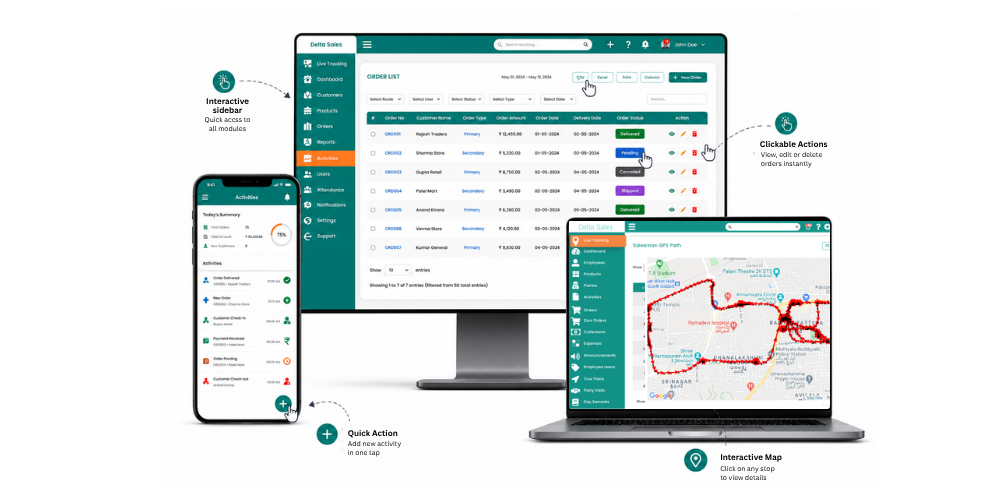
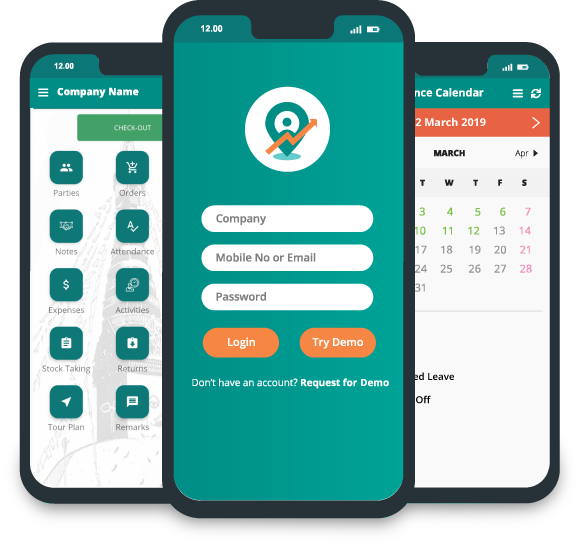
Delta Sales App is built around what field sales teams do every day, and GPS tracking is only one piece of it. For FMCG businesses, it links field activity to sales execution, customer management, reporting, and what managers can see.
-
Beat plans, visit tracking, and GPS rep tracking
Sales managers can set up their field teams around defined beats and tour plans, and GPS tracking shows how reps move and which customers they visit. That lets managers set planned coverage next to what actually happened. Visit data is linked to customer records, so it's easier to tell whether reps are getting to the outlets they were assigned. For companies with field teams spread out, this is a more structured way to keep track than end-of-day phone calls or manual reports.
-
Order management, van sales and payment collection
Reps can take customer orders in the field, so there's no need to write them on paper and enter them later. The workflow handles different FMCG sales models, including regular order booking and van sales. Payments are recorded alongside the customer's details, which lets managers connect sales activity to outstanding dues and collections. Together, that shows a fuller picture of what happened during the visit.
-
Distributor panel and direct retailer ordering
Many FMCG businesses sell through distributors and also deal with retailers directly. Delta Sales App handles distributor-focused workflows, and it also lets field teams manage retailer orders and customer activity. That helps manufacturers get a better view of what's happening downstream in the market, and it keeps them from depending on manual reports for every step of the distribution process.
-
Offline mode and automated reports for managers
Field teams can't count on a strong internet connection. Delta Sales App supports offline order booking, so reps can keep working in the field and sync their data once they're back online. Automated reports also spare managers from putting DSR information together by hand. Rather than waiting for updates from each rep one by one, they can watch sales activity, visits, attendance, orders, collections, and other field metrics on central dashboards and reports. For FMCG companies growing across Middle Eastern markets, a connected field workflow like this is a practical way to move from manual sales management to structured sales force automation.
Conclusion
Sales force automation is becoming an important part of how FMCG businesses manage field execution across the Middle East. As teams expand across territories, distributors, retailers, and sales channels, relying on paper reports, spreadsheets, and scattered updates makes it harder to maintain accurate visibility.
An effective SFA platform can bring beat planning, GPS-based visit tracking, order management, collections, retail execution, attendance, and sales reporting into one connected workflow. For businesses operating across multiple markets, features such as offline functionality, multilingual support, integrations, and flexible workflows can make adoption more practical for field teams.
The right platform should fit the way your sales representatives actually work, from the first outlet visit of the day to the final DSR.
If you are looking to simplify field sales management and gain better visibility across your FMCG team, book a free demo of Delta Sales App and see how it can fit your sales workflow.