
What Factors Affect Secondary Sales Growth?
-1786509676.png)
Expanding a distributor network is key, but that doesn’t always mean bigger sales. If products are sitting on shelves instead of making their way to customers, primary sales may look healthy while actual market demand remains weak. This is why secondary sales growth is one of the most important performance indicators for FMCG manufacturers, distributors, and field sales teams. This is a more accurate reflection of the movement of products from distributors to retailers and then into the hands of consumers, rather than just primary sales, and is therefore a better indicator of business performance.
Industry data demonstrates the importance of secondary sales. NielsenIQ said that better retail execution, product availability, and store coverage can boost FMCG sales significantly, with brands reporting up to 33% sales gains by getting products into the right outlets and keeping them on shelves consistently. These insights demonstrate that sustainable secondary sales growth is more than just demand; it's about efficient field operations, strong relationships with retailers, optimized inventory, and data-driven decision-making.
In this blog, we will examine the factors behind secondary sales growth and how companies can improve performance throughout their distribution network. We will also discuss how technologies such as secondary sales tracking software empower FMCG companies to identify opportunities, eliminate inefficiencies, and drive consistent sales growth.
What Is Secondary Sales Growth?
-1786509672.png)
Secondary sales growth is all about the rise in products sold from distributors or wholesalers to retailers over a certain timeframe. Unlike primary sales, which track shipments from manufacturers to distributors, secondary sales show how well products are making their way to the retail market. For fast-moving consumer goods (FMCG) companies, this metric paints a clearer picture of real market demand. By keeping a close eye on secondary sales, businesses can:
-
Spot high-performing territories
-
Improve retailer relationships
-
Reduce stock shortages
-
Prevent excess inventory
-
Forecast demand more accurately
-
Increase market penetration
According to McKinsey, companies that leverage advanced sales analytics can improve sales productivity by 15% to 25% through better decision-making and execution.
Why Secondary Sales Growth Matters
Secondary sales growth goes beyond being just a number; it truly captures the genuine demand for your products in the marketplace. While primary sales tell us how much inventory manufacturers sell to distributors, secondary sales provide insight into how swiftly those products are moving from distributors to retailers. When you see consistent growth in secondary sales, it’s a clear sign that your products are resonating with consumers, retailers are frequently restocking, and your distribution strategy is hitting the mark.
Here’s why secondary sales growth is so important:
-
Reflects true market demand: It indicates whether your products are actually reaching retailers and being restocked based on what customers want.
-
Enhances demand forecasting: Having accurate secondary sales data allows businesses to better predict future demand and plan their production accordingly.
-
Minimizes stock issues: Keeping an eye on sales trends helps distributors maintain the right inventory levels, reducing the chances of running out of stock or having too much.
-
Builds strong retailer relationships: When products are consistently available and restocked on time, it fosters trust with retailers and encourages them to place repeat orders.
-
Boosts field sales effectiveness: Secondary sales data equips managers with the tools to assess outlet coverage, sales productivity, and the success of retail visits.
-
Facilitates informed business decisions: Real-time sales insights empower businesses to fine-tune their pricing, promotions, inventory, and distribution strategies.
-
Promotes sustainable revenue growth: Healthy secondary sales reflect a robust distribution network, which can lead to better cash flow, increased market share, and long-term growth for the business.
For FMCG businesses, paying attention to secondary sales growth offers a more relatable insight into market performance compared to just looking at primary sales. By regularly monitoring sales at the retail level, companies can spot opportunities, tackle operational challenges proactively, and make informed decisions based on real data, all of which contribute to steady business growth.
Major Factors That Affect Secondary Sales Growth
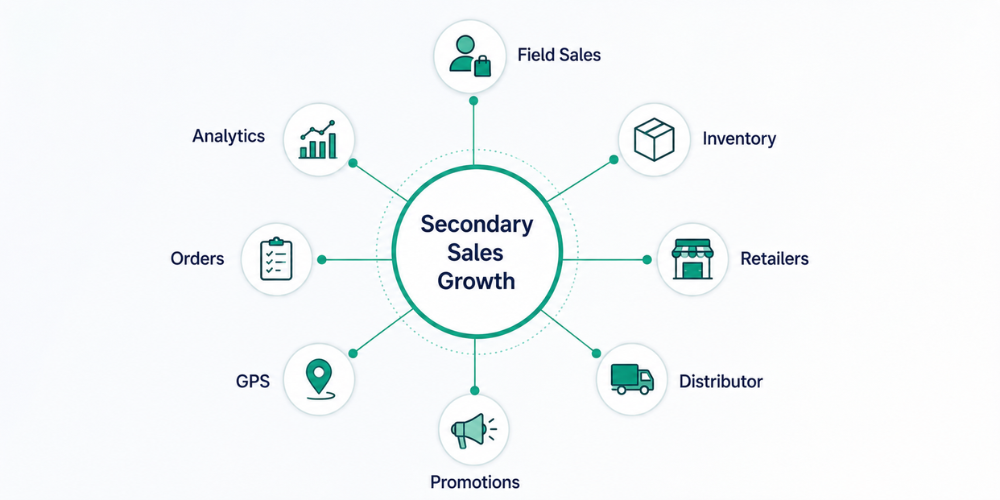
Secondary sales growth serves as a vital sign of a thriving FMCG distribution network. Unlike primary sales, which simply reflect the volume of inventory sold to distributors, secondary sales provide insight into how well those products are actually selling in retail outlets. When secondary sales are strong, it suggests that consumers are actively seeking these products, field sales teams are performing effectively, and distribution processes are running smoothly. By keeping a close eye on this important metric, businesses can uncover new growth opportunities, address operational challenges before they escalate, and make data-driven decisions that enhance overall sales performance.
Here's why secondary sales growth is critical for FMCG businesses:
1. Field Sales Execution
Even the best products struggle if sales representatives do not execute properly in the market. Daily retail visits, merchandising, relationship building, and order collection all influence retailer purchasing decisions. Poor field execution often leads to:
-
Missed outlets
-
Incomplete beat coverage
-
Lost sales opportunities
-
Poor product visibility
Businesses using Beat Planning Software can ensure every salesperson follows optimized routes and visits the right retailers consistently. Similarly, GPS Sales Employee Tracking helps managers verify field activity without relying on manual reports.
2. Retail Outlet Coverage
Many companies focus only on existing retailers while ignoring expansion opportunities. Increasing outlet coverage is one of the fastest ways to improve secondary sales growth. Ask questions like:
-
How many retailers remain uncovered?
-
Which areas receive infrequent visits?
-
Which stores have stopped ordering?
3. Product Availability
Customers cannot purchase products that are unavailable. Frequent stock-outs remain one of the largest causes of lost secondary sales. Reasons include:
-
Poor inventory planning
-
Delayed replenishment
-
Inaccurate demand forecasting
-
Communication gaps between distributors and sales teams
4. Order Collection Efficiency
Manual order-taking creates unnecessary delays. Sales representatives often:
-
Forget orders
-
Make pricing mistakes
-
Submit incomplete information
-
Delay order processing
Digital ordering significantly improves accuracy.
5. Retailer Relationships
Retailers recommend products they trust. Regular visits, prompt issue resolution, consistent stock availability, and transparent communication encourage repeat purchases. Businesses should monitor:
-
Visit frequency
-
Order history
-
Payment behavior
-
Complaint resolution
-
Retailer engagement
6. Pricing and Promotional Schemes
Competitive pricing alone is no longer enough. Retailers expect:
-
Trade offers
-
Seasonal discounts
-
Quantity-based incentives
-
Loyalty rewards
-
Promotional schemes
However, promotions must be carefully managed. Without proper monitoring, businesses risk reduced profitability without improving sales.
7. Sales Representative Productivity
Not every salesperson contributes equally. Some representatives:
-
Visit fewer outlets
-
Spend less time in stores
-
Miss scheduled appointments
-
Generate lower order values
Measuring productivity helps managers identify coaching opportunities.
8. Market Intelligence
Markets change quickly. Competitors introduce new products, adjust pricing, and launch promotional campaigns regularly. Businesses need real-time visibility into:
-
Competitor pricing
-
Product availability
-
Retailer feedback
-
Consumer demand
-
Shelf visibility
Companies collecting field intelligence respond much faster than competitors.
9. Distributor Performance
Not all distributors contribute equally to sales growth. Evaluate distributors based on:
-
Sales volume
-
Order fulfillment
-
Inventory turnover
-
Retail coverage
-
Payment collection
How Technology Improves Secondary Sales Growth
Managing secondary sales manually becomes increasingly difficult as your distribution network expands. With multiple distributors, hundreds of retailers, and field sales teams working across different territories, relying on spreadsheets, phone calls, or delayed reports often leads to missed opportunities and slower decision-making. Modern sales technology helps businesses overcome these challenges by providing real-time visibility into every stage of the distribution process.
Here are some of the ways technology helps improve secondary sales growth:
-
Automates Order Collection
Digital order-taking eliminates manual paperwork and reduces the chances of errors or missed orders. Sales representatives can capture retailer orders directly from the field, allowing distributors to process them faster and ensure timely deliveries. This not only improves operational efficiency but also encourages retailers to reorder more frequently.
-
Improves Field Sales Execution
Technology enables businesses to monitor field sales activities in real time. Features such as beat planning, GPS sales tracking, and attendance management help ensure sales representatives follow their schedules, visit the right outlets, and spend adequate time with retailers. Better execution leads to improved retailer engagement and higher order volumes.
-
Provides Real-Time Sales Visibility
Instead of waiting for end-of-day or weekly reports, managers can access live sales data through centralized dashboards. Real-time visibility makes it easier to identify declining sales, underperforming territories, and stock shortages, allowing businesses to take corrective action before these issues impact revenue.
-
Optimizes Inventory Management
Technology helps businesses maintain the right inventory levels across distributors and warehouses by tracking stock movement in real time. This reduces the risk of stock-outs and overstocking, ensuring retailers always have products available when customers need them.

-
Enhances Distributor Performance
A centralized platform allows businesses to monitor distributor sales, inventory levels, order fulfillment, and payment collections from one place. With better visibility into distributor operations, managers can identify performance gaps, improve coordination, and ensure products reach retailers without unnecessary delays.
-
Strengthens Retailer Relationships
Technology enables sales teams to maintain accurate retailer records, track purchase history, manage follow-ups, and respond to issues quickly. By understanding retailer buying patterns and ensuring consistent product availability, businesses can build stronger relationships and encourage repeat orders.
-
Delivers Actionable Sales Insights
Advanced reporting and analytics transform raw sales data into meaningful insights. Businesses can analyze product performance, territory-wise sales, outlet productivity, and secondary sales trends to identify growth opportunities and make data-driven decisions. Instead of reacting to problems after they occur, managers can proactively optimize their sales strategy.
-
Supports Smarter Decision-Making
When all sales, inventory, distributor, and retailer data are available in one system, businesses can make faster and more informed decisions. Whether it's launching a promotional scheme, reallocating inventory, or assigning sales representatives to high-potential areas, technology provides the information needed to improve execution and drive sustainable secondary sales growth.
Best Practices to Increase Secondary Sales Growth
Improving secondary sales growth is all about blending effective sales execution, smart distribution management, and making decisions based on solid data. Companies that keep a close eye on market trends, fine-tune their field operations, and embrace technology are in a stronger position to boost retailer orders, ensure product availability, and enhance their distribution networks. By adopting tried-and-true best practices, FMCG businesses can not only achieve lasting growth but also elevate customer satisfaction and streamline their operations.
Here are some best practices to help increase secondary sales growth:
-
Create structured beat plans to enhance retail coverage.
-
Track secondary sales in real time to identify growth opportunities.
-
Maintain consistent product availability by managing inventory levels effectively.
-
Digitize the order collection process to minimize errors and speed up processing.
-
Use GPS and performance reports to track field sales productivity.
-
Build strong relationships with retailers through regular visits and timely support.
-
Regularly assess distributor performance and address any operational gaps.
-
Leverage sales data and analytics to make quicker, informed business decisions.
-
Develop personalized trade promotions that resonate with market needs and retailer success.
-
Invest in Sales Force Automation (SFA) software to streamline field sales operations.
-
Regularly assess territory performance and adjust resources to meet evolving demands.
-
Continuously evaluate key performance indicators like outlet coverage, strike rate, average order value, and sales growth to foster ongoing improvement.
How Delta Sales App Helps Improve Secondary Sales Growth
To thrive in the fast-paced world of FMCG, businesses need to have a firm grip on their field operations, interactions with retailers, distributor performance, and market insights. Unfortunately, handling these tasks manually can lead to gaps in visibility, delays in reporting, and less effective execution. The Delta Sales App is here to change that. It offers a user-friendly, centralized platform that allows businesses to effortlessly track sales activities, streamline field operations, and access real-time insights into their distribution networks.
Tailored specifically for FMCG sales teams, the Delta Sales App empowers businesses to enhance their retail coverage, boost sales performance, close operational gaps, and make quicker, informed decisions that drive secondary sales growth.
Key ways Delta Sales App helps improve secondary sales growth:
-1786509657.png)
-
Secondary Sales Tracking
Gaining a clear understanding of sales at the retailer level is crucial for enhancing secondary sales performance. The Delta Sales App's Secondary Sales automation feature allows businesses to keep a close eye on how products move from distributors to retailers in real time. This empowers sales managers to assess performance by territory, spot products that aren’t selling well, observe sales trends, and take swift action to boost market performance.
-
Beat Planning and Route Optimization
Consistent retailer visits directly impact order frequency and product availability. Delta Sales App's Beat Planning Software helps sales teams create structured visit schedules, assign routes efficiently, and ensure better outlet coverage. By reducing missed visits and improving field execution, businesses can increase retailer engagement and unlock more sales opportunities.
-
Order Management
Delayed or inaccurate order collection can negatively impact secondary sales growth. With order management software, field sales representatives can capture retailer orders digitally during store visits and share them instantly with distributors. This reduces manual errors, speeds up order processing, and ensures retailers receive products on time.
-
Inventory Management
Stock availability plays a major role in FMCG sales performance. Delta Sales App's Inventory Management Software provides better visibility into stock movement across distributors and sales channels. Businesses can monitor inventory levels, reduce stock-outs, avoid excess stock, and ensure products are available where demand exists.
-
Distributor Management
Distributors are a critical part of the FMCG supply chain, and their efficiency directly affects secondary sales. Through distributor management software, businesses can track distributor performance, monitor order fulfillment, analyze sales contribution, and improve coordination between manufacturers, distributors, and field teams.
-
GPS-Based Field Sales Tracking
Effective field execution requires knowing whether sales representatives are completing planned market visits. Delta Sales App's GPS Field Sales Tracking feature helps managers monitor salesperson locations, verify retailer visits, and improve accountability. Better visibility into field activities ensures sales teams focus on productive outlets and maximize market coverage.
-
Sales Reports and Analytics
Data-driven decisions are essential for sustainable secondary sales growth. Using sales reports and Analytics, businesses can analyze sales performance, territory growth, retailer productivity, and salesperson efficiency from a single dashboard. These insights help managers identify opportunities, address performance gaps, and improve overall sales strategies.
-
Retailer Management
Strong retailer relationships encourage repeat orders and long-term brand loyalty. Delta Sales App's Retailer Management System helps businesses maintain detailed retailer information, track purchase history, monitor interactions, and understand buying patterns. This allows sales teams to provide better support and improve retailer engagement.
-
Scheme Management
Promotional schemes can significantly influence retailer buying decisions when executed properly. With scheme management software, businesses can create, assign, and monitor retailer schemes effectively. This ensures promotional campaigns reach the right retailers while helping managers measure their impact on sales growth.
-
Sales Team Productivity Tracking
A productive sales team is essential for improving secondary sales performance. Delta Sales App's Field Sales Management Software helps businesses track daily activities, sales visits, attendance, order achievements, and key performance indicators. Managers can identify improvement areas, provide better guidance, and improve overall team efficiency.
Conclusion
Secondary sales growth is the foundation of sustainable success for FMCG businesses. While increasing primary sales may help expand distribution, long-term growth depends on how effectively products move through distributors, retailers, and the market. Factors such as field sales execution, retailer coverage, inventory availability, distributor performance, and data-driven decision-making all play a crucial role in improving secondary sales.
However, managing these areas manually can limit visibility and slow down decision-making. By adopting a modern Sales Force Automation (SFA) solution like Delta Sales App, businesses can automate field operations, track secondary sales, improve retailer management, optimize inventory, and empower sales teams with real-time insights. Whether you are a growing FMCG brand or an established distribution network, having the right technology can help you identify opportunities faster, reduce operational challenges, and build a more efficient sales process.
Ready to improve your secondary sales performance and gain complete visibility into your field operations? Book a free demo of Delta Sales App today and discover how automation can help your business achieve faster, smarter, and sustainable sales growth.