
Why FMCG Brands Need Field-Level Data to Get Pricing Right
A pricing strategy might seem flawless on paper, but the true challenge unfolds at the retail shelf. An FMCG brand may set a price of ₹20 for a product, yet retailers in various markets might sell it for ₹18, ₹22, or even combine it with other items. Competitors can unexpectedly drop their prices in certain areas. Promotional offers might not reach retailers as planned, and distributors may implement varying prices across different regions. When there’s no clear view of what’s happening in the market, pricing decisions turn into mere guesses instead of informed strategies.
This is why top FMCG brands are turning to field-level data for their pricing choices. Rather than waiting for monthly reports or depending on distributor insights, companies are now gathering real-time market data from sales representatives who visit retailers daily. With tools like field sales automation software, businesses can obtain pricing information directly from the market and respond swiftly to prevent revenue loss.
In this blog, we’ll delve into the importance of field-level data for contemporary pricing strategies, how it empowers FMCG brands to make more informed pricing decisions, and how the right technology can convert routine retail visits into valuable business insights.
What Is Field-Level Data in FMCG?
-1784871213.png)
Field-level data refers to the real-time insights gathered by sales representatives, merchandisers, and field executives as they interact with retail stores, distributors, wholesalers, and various sales outlets. Rather than relying on assumptions or waiting for those weekly or monthly reports, FMCG companies can tap into genuine insights about what’s truly happening in the market. It’s like getting a firsthand look at the “ground reality” of your business.
For example, imagine an FMCG company notices that sales of a popular snack have dropped in one city. A traditional sales report will only show declining numbers. However, field-level data collected during retailer visits might reveal that a competitor recently reduced its price, retailers are offering additional discounts on competing products, or the company's own promotional scheme isn't being implemented properly. This context allows managers to take corrective action much faster.
The insights gathered by FMCG sales teams at the field level are incredibly valuable. They include:
-
Real retail selling prices
-
Prices of competitor products
-
Current promotional offers and discounts
-
Availability of products and stock levels
-
Shelf placement and visibility of products
-
Feedback from retailers and their buying behaviors
-
Trends in consumer demand
-
Instances of out-of-stock products
-
Launches of new competitor products
When this data is consistently collected from hundreds or thousands of retail locations, it paints a detailed picture of the market landscape. Managers can analyze pricing across various regions, spot unusual price discrepancies, keep an eye on competitor actions, and ensure that pricing strategies are being implemented effectively. Rather than relying on traditional paper forms or spreadsheets, many FMCG companies have adopted field sales automation software. This technology allows sales representatives to capture market observations directly from their mobile devices, ensuring that the data is accurate, uniform, and readily accessible to decision-makers in real time.
Why Pricing Decisions Often Go Wrong
Setting the right price is one of the most important decisions an FMCG brand can make, but it is also one of the easiest to get wrong. Even with careful planning, pricing strategies often fail because they rely on outdated information or assumptions instead of real market conditions.
Here are some of the most common reasons pricing decisions go wrong.
-1784871213.png)
-
Limited Visibility Into the Retail Market
Many FMCG companies are aware of the prices they set for distributors, yet they frequently lack insight into what customers are actually paying in retail stores. Retailers might provide extra discounts, create product bundles, or modify prices in response to local competition. By conducting regular store visits and utilizing retail execution software, brands can gather real-time market insights and see how pricing varies from one location to another. Without this crucial visibility, it becomes challenging to assess whether the pricing strategy they intended is truly being implemented.
-
Competitor Pricing Changes Faster Than Internal Reporting
The FMCG market is constantly evolving. Competitors are always finding new ways to entice customers, whether through discounts, cashback offers, combo packs, or seasonal promotions. These shifts can occur in just a matter of days, particularly in fiercely competitive environments. If companies only check competitor pricing once a month, they risk overlooking significant changes. By the time management receives reports, competitors may have already taken the lead. Implementing field sales automation software allows sales teams to capture competitor pricing during their store visits, providing decision-makers with up-to-date market insights.
-
Regional Markets Behave Differently
A pricing strategy that works effectively in one area might not yield the same success in another. Factors like how much consumers can spend, the way retailers operate, the level of local competition, and the demand for products can differ greatly from one market to the next. For instance, high-end products might thrive in bustling city centers, while smaller, budget-friendly options tend to resonate more with shoppers in semi-urban and rural areas. Companies that stick to a uniform pricing approach across all regions may miss out on valuable sales opportunities by not taking local market dynamics into account.
-
Promotional Schemes Are Not Always Executed Properly
Many brands launch promotional campaigns expecting retailers to pass discounts and offers on to customers. In reality, promotions are not always executed as planned. Promotional materials may not be displayed, customers may not be informed about ongoing offers, or promotional prices may not be applied consistently. Using customer visit tracking allows companies to verify execution during store visits and identify issues before they affect campaign performance.
-
Pricing Decisions Depend on Delayed Data
In today's fast-paced business environment, many companies still rely on traditional methods like spreadsheets, phone calls, WhatsApp messages, or distributor reports to gauge market conditions. Although these approaches can offer valuable insights, they often come with delays and inconsistencies. By the time the reports are gathered and analyzed, the market landscape may have shifted significantly. Having access to real-time sales reports empowers businesses to react swiftly and make informed pricing decisions that reflect the current market dynamics, rather than relying on outdated data.
-
Retailer Feedback Doesn't Reach Decision-Makers
Retailers engage with customers daily, gaining insights into their buying motivations. They are aware of which products customers perceive as pricey, which promotions resonate, and how competitors are positioning similar items. Sadly, this crucial feedback often gets overlooked when communication relies on manual reports or casual chats. By gathering retailer insights during organized store visits, companies can spot pricing challenges early and make smarter, more empathetic business choices.
-
Lack of Verified Field Data
Pricing decisions hinge on the quality of the data backing them. When businesses struggle to verify if sales representatives have genuinely visited stores or gathered accurate information, it can lead to doubts about the data's reliability. Implementing GPS-based tracking for sales employees not only confirms their field visits but also ensures that pricing information comes from authentic retail locations. This approach fosters greater trust within the organization, empowering teams to assess market trends and make pricing decisions with confidence and clarity.
How Field-Level Data Improves Pricing Accuracy
The difference between an average pricing strategy and a successful one often comes down to the quality of data behind it. When FMCG brands have access to real-time field-level data, pricing decisions are no longer based on assumptions or delayed reports. Instead, they are driven by actual market conditions observed at the retail level. Every store visit allows sales teams to collect valuable information about pricing, competition, retailer behavior, and customer demand. When this information is consolidated across hundreds or thousands of retail outlets, it provides a clear picture of how products are performing in different markets and where pricing adjustments may be needed.
Here are some of the key ways field-level data helps improve pricing accuracy.
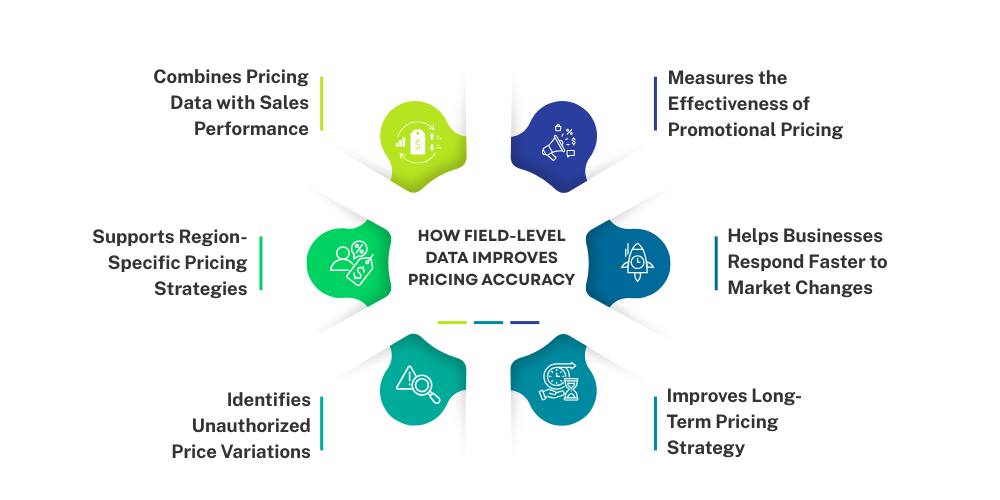
Enables Real-Time Competitor Price Monitoring
Competitor pricing plays a crucial role in shaping customer purchasing choices. Even a slight price drop from a rival brand can significantly affect sales if businesses overlook it. Field sales representatives, while visiting retailers, can jot down competitor prices during each market visit. Rather than relying on infrequent market surveys, managers get immediate updates whenever there are changes in pricing.
This empowers businesses to:
-
Spot competitors with lower prices.
-
Keep an eye on regional pricing tactics.
-
Identify aggressive promotional efforts.
-
Act swiftly to prevent losing market share.
With field sales automation software, competitor pricing information is gathered instantly and made accessible to decision-makers through centralized dashboards.
Combines Pricing Data with Sales Performance
Pricing is just one piece of the puzzle. To truly gauge the effectiveness of a pricing strategy, businesses must also look at how sales are performing in conjunction with pricing data. For instance, insights from field-level data might show that
-
A small price hike barely affected sales.
-
Offering discounts boosted sales volume but cut into profits.
-
Competitor pricing only influenced certain regions.
-
Some products thrived even with higher price tags.
By merging pricing insights with automated analytics, companies can better understand how their pricing choices impact revenue, profit margins, and customer interest.
Supports Region-Specific Pricing Strategies
Every market has its unique characteristics. Factors like consumer spending power, competition, and shopping behaviors differ from one city to another, and even between towns and rural areas. A pricing strategy that succeeds in one location might not yield the same success in another. By gathering field-level data, businesses can gain insights into these local nuances, collecting real-time pricing and sales information directly from the ground.
For instance, companies might find that
-
Premium products resonate more with consumers in bustling metropolitan areas.
-
Smaller, budget-friendly packages tend to sell better in rural communities.
-
Tourist hotspots can command higher prices during busy seasons.
Rather than sticking to a single pricing model across the country, companies can tailor their pricing decisions to reflect the unique dynamics of each region.
Identifies Unauthorized Price Variations
Many fast-moving consumer goods (FMCG) companies suggest a selling price for their products, but keeping prices consistent across numerous retail locations can be quite a challenge. Some retailers might lower prices to draw in customers, while others may raise them during peak demand times. These price fluctuations can undermine customer trust, diminish distributor confidence, and lead to conflicts between sales channels. Field representatives play a crucial role by noting the actual retail prices during their visits, enabling businesses to swiftly pinpoint areas where pricing guidelines are not being adhered to. This proactive approach allows managers to address inconsistencies before they start to impact how the brand is perceived by consumers.
Measures the Effectiveness of Promotional Pricing
Promotional discounts and offers aim to boost product sales, but their success hinges on effective execution at the retail level.
On-the-ground data empowers companies to check if:
-
Promotional prices are actually being applied.
-
Retailers are showcasing promotional materials effectively.
-
Customers are benefiting from the discounts.
-
Sufficient promotional stock is on hand.
By merging pricing insights with feedback from retailers, businesses can assess whether a campaign is achieving its goals or needs some fine-tuning.
Helps Businesses Respond Faster to Market Changes
Market conditions can change within days. Competitors introduce new offers, retailers adjust prices, and consumer demand shifts due to festivals, weather, or local events. Companies that depend on monthly reports frequently find themselves responding too slowly. By utilizing field-level data, decision-making becomes more agile, equipping managers with up-to-date market insights. This enables pricing teams to swiftly assess the landscape and implement necessary adjustments before sales take a hit.
Improves Long-Term Pricing Strategy
Pricing shouldn't be changed based on one-off events. Instead, companies should gather ongoing market insights to spot long-term patterns. As time goes on, data collected from the field allows businesses to tackle key questions like:
-
Which areas are more sensitive to price changes?
-
Which competitors are known for frequently adjusting their prices?
-
Which products can command higher prices?
-
What promotional tactics yield the best outcomes?
-
How do seasonal shifts influence pricing strategies?
These valuable insights empower brands to shift from a reactive approach to a more proactive pricing strategy, grounded in trustworthy market evidence.

Why Manual Pricing Reports No Longer Work
Over the years, FMCG companies have depended on traditional reporting methods to grasp market dynamics. Sales representatives would jot down competitor prices in notebooks, update Excel sheets at the end of their shifts, share photos and price updates via WhatsApp, or verbally relay their findings during team meetings. Although these approaches may have sufficed in smaller markets, they fall short in today's rapidly evolving and fiercely competitive FMCG environment.
Now, let’s delve into the reasons why manual pricing reports are becoming ineffective for FMCG brands.
-
Information Reaches Decision-Makers Too Late
One significant drawback of manual reporting is the lag in information sharing. Throughout the day, sales representatives gather valuable market insights and only compile their reports after finishing their visits. These reports then undergo several rounds of review before they finally reach the managers. By the time this crucial pricing information lands in the hands of decision-makers, the market landscape might have already shifted. Competitors could have wrapped up a promotional campaign, retailers might have tweaked their prices again, or customer preferences may have evolved.
-
Manual Data Is More Prone to Errors
Gathering pricing information by hand can lead to mistakes. Sales representatives might unintentionally jot down the wrong prices, overlook essential notes, or miss key details when moving data from paper forms to spreadsheets. Even minor errors can result in misguided business choices. For instance, if a competitor's discounted price is inaccurately recorded, management could react with an unwarranted price cut that impacts profits.
-
Inconsistent Reporting Across Sales Teams
As each salesperson approaches reporting in their own unique way, the collection of information can vary significantly. One representative might meticulously document competitor prices, while another may simply jot down whether products are available. Some may take the time to gather insights from retailers, whereas others might overlook this valuable feedback altogether. This variation creates a challenge for managers, making it hard to effectively compare pricing data across different regions or spot important trends that could inform strategic decisions. A standardized reporting system ensures that every sales representative collects the same pricing information using predefined checklists, giving management consistent and reliable market intelligence.
-
Limited Visibility Into Daily Market Changes
The FMCG market is in a constant state of flux. Retailers frequently tweak their prices to stay competitive, distributors roll out limited-time offers, and brands initiate promotional campaigns to boost their sales. Traditional reporting methods often capture just a moment in time, lacking the ongoing visibility that businesses truly need. While companies might have a clear picture of prices at the week's end, they often overlook the daily shifts that can sway customer purchasing choices.
-
Difficult to Verify the Accuracy of Market Data
One of the significant hurdles with manual reporting is the difficulty in ensuring the accuracy of the information. Managers frequently find themselves unable to verify if a sales representative truly visited the retailer, noted the correct prices, or updated the report promptly. This uncertainty can undermine trust in the data that informs pricing strategies. By implementing GPS-based employee tracking and digital visit verification, businesses can confidently gather pricing information during real store visits
-
Manual Reports Make Trend Analysis More Difficult
Pricing decisions should not rely on one-off observations. Managers need to look at pricing trends across various products, regions, distributors, and competitors over extended periods. When pricing data is spread out across different spreadsheets, emails, or messaging apps, it can be challenging and often misleading to analyze trends effectively.
-
Manual Reporting Slows Decision-Making
In today's competitive FMCG environment, speed is a competitive advantage. The faster a business identifies a pricing issue, the faster it can respond with a revised strategy, promotional campaign, or distributor communication. Manual reporting creates unnecessary delays because information must be collected, compiled, reviewed, and shared before any action can be taken.
The Role of Analytics in Pricing Strategy
Every day, field sales teams gather crucial insights from the market, such as competitor pricing, feedback from retailers, details on promotional activities, product availability, and sales performance. While each piece of information may seem insignificant on its own, when combined and analyzed, they uncover trends that empower businesses to make informed pricing choices. Rather than depending on guesses or outdated reports, contemporary FMCG companies leverage sales analytics software to spot market trends, evaluate pricing effectiveness, and predict how future pricing changes will impact their business.
Here are some ways in which analytics enhance pricing strategies.
Identifies Pricing Trends Across Different Markets
Pricing is seldom uniform across various markets. Factors like consumer purchasing power, local competition, retailer behavior, and buying preferences play a significant role in determining how products are priced in different areas. By examining pricing data from different cities, distributors, and sales territories, businesses can uncover regional trends and tailor their pricing strategies to align with the unique conditions of each local market.
Measures the Impact of Price Changes on Sales
Adjusting product prices without tracking the outcomes can result in misguided business choices. Analytics empowers companies to grasp how these pricing adjustments impact key performance indicators, such as:
-
Units sold
-
Revenue growth
-
Profit margins
-
Retailer participation
-
Market share
-
Customer demand
By looking beyond just sales revenue, businesses can develop a holistic understanding of how pricing strategies influence their overall performance.
Tracks Competitor Pricing Patterns
Competitor pricing is always in flux, which makes it crucial for businesses to keep a close eye on the market. Instead of just making sporadic observations, companies can leverage field sales reporting software to track competitor pricing trends over time. This approach helps them uncover important patterns, such as:
-
Competitors who regularly provide discounts
-
Trends in seasonal promotions
-
Markets where price competition is particularly fierce
-
Products that are often priced similarly to each other
By understanding these dynamics, businesses can better predict their competitors' strategies and make proactive decisions rather than simply reacting to changes after they occur.
Evaluates Promotional Effectiveness
Promotional campaigns often include discounts, cashback offers, bundle deals, or retailer incentives. However, without proper analysis, it is difficult to know whether these promotions are delivering the expected results. Combining field observations with sales reporting and analytics helps businesses answer important questions such as:
-
How effective was the promotional pricing in boosting product sales?
-
Which areas showed the strongest response to the campaign?
-
Were retailers executing the promotion as intended?
-
Did the campaign enhance profitability, or did it merely inflate sales figures?
These valuable insights enable companies to fine-tune their future pricing and promotional approaches.
Detects Pricing Anomalies Quickly
Analytics simplifies the process of spotting unusual pricing behaviors before they can harm business performance. Intuitive dashboards can swiftly bring attention to concerns like:
-
Retailers pricing products below suggested levels
-
Surprising price hikes in certain regions
-
Abrupt drops in competitor pricing
-
Discrepancies in pricing across different sales areas
By identifying these issues early, managers can delve into the problems and implement corrective measures, safeguarding revenue and protecting brand reputation.
Combines Pricing Data with Other Business Metrics
Pricing decisions become more effective when analyzed alongside other business data. Integrating pricing insights with sales analytics allows businesses to understand how pricing influences:
-
Secondary sales performance
-
Retail coverage
-
Product availability
-
Inventory movement
-
Order values
-
Customer demand
Viewing these metrics together provides a more complete understanding of market performance and supports better decision-making.
Supports Predictive and Long-Term Pricing Decisions
Analytics is not only useful for evaluating past performance but also for planning future pricing strategies. By combining historical sales data with current market information, businesses can forecast demand, identify seasonal trends, and make pricing decisions with greater confidence.
Analytics helps answer questions such as:
-
Which products are likely to face greater price competition during festive seasons?
-
Which markets respond best to promotional pricing?
-
How have previous price increases affected customer demand?
-
Which products have enough customer loyalty to support premium pricing?
These insights enable businesses to build pricing strategies that are proactive, data-driven, and aligned with long-term business goals.
How Delta Sales App Supports Smarter Pricing Decisions
Making effective pricing choices goes beyond just having experience and understanding the market. It hinges on having timely, accurate, and verified data gathered from the ground. This is where the Delta Sales App truly empowers FMCG brands to stand out in a competitive landscape. Rather than depending on spreadsheets, phone calls, or waiting for reports, the Delta Sales App allows businesses to tap into real-time market insights directly from their field sales teams. Each visit to a retailer transforms into a chance to collect meaningful pricing information, keep an eye on competitors, and grasp the evolving market dynamics.
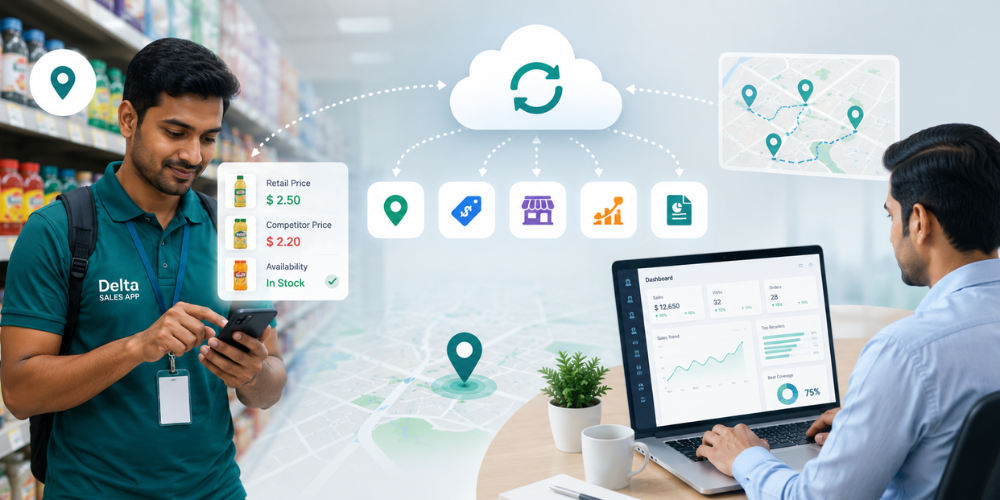
Here’s how the Delta Sales App facilitates more informed pricing decisions.
Capture Real-Time Pricing Data During Every Retail Visit
Sales representatives have the opportunity to gather vital pricing information during their visits to retailers, making sure that market data is collected directly from the source rather than relying on later reports. Field teams can effortlessly capture:
-
The actual prices at which products are sold
-
Prices of competing products
-
Current discounts and promotional offers
-
Observations made about retailers
-
Availability of products on the shelves
-
Feedback from the market
With the information being updated in real-time through the mobile app, managers gain immediate insights into pricing trends across various territories.
Verify Every Market Visit with GPS Tracking
Effective pricing strategies hinge on trustworthy field data. When businesses are unable to verify if market visits occurred, the reliability of pricing information comes into doubt. The Delta Sales app employs GPS-based employee tracking to confirm each retailer visit through location tracking, timestamps, and visit history. Managers can trust the data, knowing it originates from actual store visits rather than being estimated or entered manually afterward. This enhances both the accuracy of the data and the accountability of the field team.
Monitor Competitor Pricing Across Multiple Markets
Competitor pricing is often dynamic, particularly during seasonal promotions or localized campaigns. The Delta Sales App empowers field representatives to gather competitor pricing information during each store visit, building a comprehensive database of market insights. This allows managers to easily compare competitor prices across various cities, distributors, and sales territories without the delays associated with manual reporting.
This capability supports businesses in several ways:
-
Discovering areas where competitors may be undercutting prices.
-
Keep an eye on promotional efforts.
-
Identify aggressive pricing tactics.
-
Adapt swiftly to shifts in market conditions.
Access to real-time competitor intelligence equips pricing teams to make quicker and more informed choices.
Gain Actionable Insights Through Sales Reporting and Analytics
Gathering pricing data becomes truly beneficial when businesses can interpret it meaningfully. The Delta Sales App offers intuitive sales reporting and analytics that convert field observations into user-friendly dashboards and reports. Managers can effortlessly spot pricing trends, track regional performance, compare competitor actions, and assess the success of promotional campaigns. Rather than sifting through numerous spreadsheets, decision-makers enjoy a unified, centralized perspective of market performance, empowering them to make informed decisions with assurance.
Combine Pricing Data with Retail Execution Insights
Pricing decisions are seldom determined by price alone. Factors like product availability, shelf visibility, promotional efforts, and retailer relationships significantly impact sales performance. The Delta Sales App empowers businesses to merge pricing insights with essential retail execution data gathered during field visits. This enables managers to pinpoint whether falling sales stem from pricing challenges, stock shortages, suboptimal product placement, or ineffective promotions. With this comprehensive market visibility, businesses can tackle the real issues at hand rather than resorting to unnecessary pricing adjustments.
Improve Collaboration Between Field Teams and Management
In numerous organizations, the crucial market insights gathered by sales representatives often take too long to reach the pricing teams. This delay in communication can hinder timely decision-making and lessen the impact of pricing strategies. The Delta Sales App effectively closes this gap by enabling real-time data transfer from the field to management. With this tool, sales representatives, supervisors, and business leaders can all access the same up-to-date information, fostering better discussions about market conditions, more informed evaluations of pricing strategies, and quicker actions when necessary.
Make Faster and More Confident Pricing Decisions
The standout feature of the Delta Sales app is its remarkable speed. Instead of waiting for weekly reports or spending time manually gathering market data, businesses can access pricing insights immediately after field representatives finish their visits. This swift access empowers pricing teams to:
-
Quickly react to changes in competitor pricing.
-
Ensure compliance with retail pricing standards.
-
Assess the effectiveness of promotions.
-
Discover pricing opportunities in various regions.
-
Make informed pricing decisions backed by real-time market data.
Consequently, businesses can safeguard their profit margins, stay competitive, and enhance customer satisfaction, all while moving away from guesswork.
Turn Field Data Into a Competitive Advantage
Pricing serves as a vital asset for FMCG brands, but its true potential is unlocked only when supported by reliable market insights. The Delta Sales App empowers businesses to gather trustworthy field-level data, keep an eye on competitor movements, track pricing patterns, and achieve a comprehensive view of retail execution, all from one user-friendly platform. By shifting from manual reporting to real-time field sales automation, FMCG brands can make quicker, more informed, and ultimately more profitable pricing choices. Rather than responding to stale information, they can proactively adapt to market shifts with actionable insights gathered straight from the field.
Conclusion
Pricing has evolved beyond a mere finance function; it’s now a strategy driven by real-world insights. The brands that excel in pricing are those that truly grasp the dynamics of every market, every single day. By harnessing real-time field-level data, FMCG companies can swiftly react to competitor moves, ensure consistent pricing, enhance promotional efforts, and safeguard their profitability. In a landscape where competition is fierce and consumer preferences are constantly shifting, relying on outdated reports simply won’t cut it. Companies that blend market intelligence with cutting-edge technology are in a stronger position to make informed pricing decisions that foster sustainable growth. With the help of field sales automation and real-time analytics, FMCG brands can transform routine retail visits into meaningful pricing insights that boost performance across all territories.
If your business is still dependent on spreadsheets, outdated reports, or manual market updates, it’s time for a smarter solution. The Delta Sales App empowers FMCG brands to turn everyday retailer interactions into actionable pricing insights, providing your team with the clarity needed to stay ahead of the competition.
Schedule a free demo today and see how Delta Sales App can assist your sales team in gathering real-time field data, refining pricing strategies, and driving sustainable growth for your business.