
How Top FMCG Brands Ensure 100% Retail Coverage Without Hiring More Reps
For brands and distributors, 100% retail coverage has always been a key priority in the highly competitive FMCG industry. Historically, companies believed that the only way to increase outlet reach and improve market penetration was to grow the field sales team. More salespeople meant more visits, more orders and in the end better sales results.
But the FMCG landscape has changed so much. Rising operational costs, rising expectations of retail and the faster pace of market competition have made the manpower-heavy models less effective. Despite having large sales teams, many distributors still miss outlets, have uneven beat coverage, and lack visibility into field execution.
Today, leading FMCG brands are moving away from this traditional model and looking at smarter ways of achieving complete retail coverage without adding ongoing headcount. Instead of adding more reps, they are investing in field sales automation, GPS tracking, real-time sales visibility, and digital beat planning systems to help existing teams become more efficient.
This change is not just about technology; it is about changing the way FMCG distribution and field sales execution happens at the ground level. Better tools and real-time data can allow companies to ensure all outlets are covered, all visits are tracked, and all sales opportunities are captured.
In this blog, we’ll take a look at how leading FMCG brands are getting to 100% retail coverage without increasing the number of sales reps and how modern sales force automation systems are redefining distribution efficiency.
The Traditional FMCG Coverage Problem
The FMCG industry used a large field sales team to improve retail coverage for many years. The logic was simple. More sales reps meant more outlets covered. This was effective in previous market conditions but in FMCG distribution management where complexity, competition and the need for real-time execution visibility are on the rise, this is no longer enough.
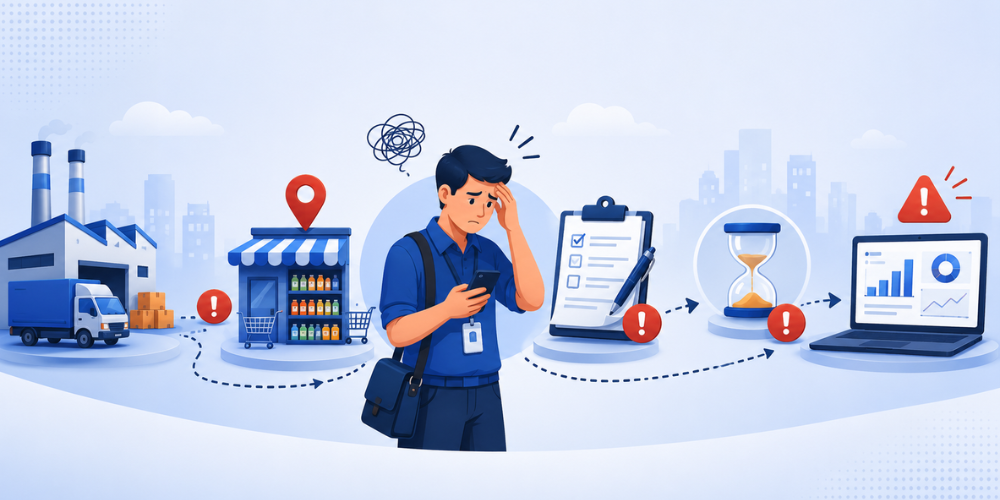
However, this approach created multiple challenges:
- Uneven retail coverage
And even with large sales teams, many FMCG brands are unable to cover all outlets consistently. Beat planning is not efficient and there are gaps in field sales execution leading to weak product availability on shelves.
- Lack of real-time field visibility
It is difficult to track field sales activities, visits to outlets and sales performance in real time as managers often depend on delayed reports rather than live updates.
- Poor beat planning and route optimization
In the absence of digital tools, sales reps take unstructured routes, which increases travel time and reduces the number of outlets covered in a day. This impacts overall FMCG sales efficiency.
- Low field sales productivity
The field sales force automation process is less effective because a good part of a sales rep’s time is spent on manual reporting and travel instead of selling.
- Heavy dependency on manual reporting
Distribution ERP and FMCG sales tracking systems are sluggish and error-prone because of data entry lag and manual updates.
- Missed sales opportunities at retail level
Due to inconsistent coverage and delayed execution, many retail outlets remain under-serviced, resulting in lost revenue and weak market presence.
Large teams still had missed outlets, uneven coverage and low productivity per sales rep even with a large team. Industry studies show that approximately 30–40% of retail outlets in traditional FMCG distribution models are not regularly serviced leading to lost sales opportunities and poor shelf presence. It was clear that hiring more reps was not the long-term solution.
Why Hiring More Sales Reps Doesn’t Solve Coverage Gaps
Many FMCG companies are still trying to improve their retail coverage by increasing the number of field sales representatives. On paper, it’s an easy answer: more people should equal more outlet visits. However, in the real world of FMCG distribution management, this approach often fails as the problem is not manpower but the lack of structured execution, visibility, and system driven field sales automation.
Just adding people without the right systems in place doesn’t increase coverage, it usually just creates inefficiency, higher costs and inconsistent execution across territories.
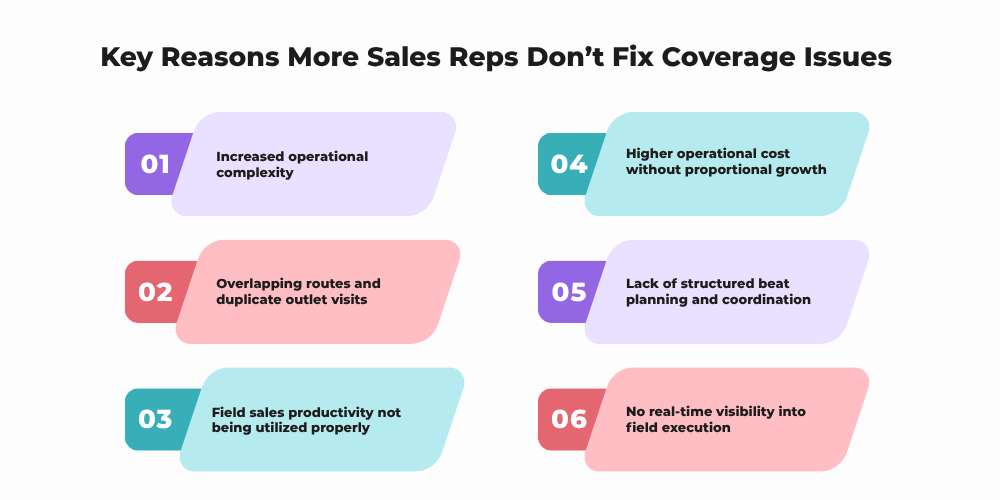
Key Reasons More Sales Reps Don’t Fix Coverage Issues
- Increased operational complexity
With the expansion of field sales teams in FMCG companies, the challenge of managing day-to-day operations increases manifold. Managers have to manage more territory, log more outlet visits and deal with more sales data. Without the right sales force automation solution in place, this complexity results in confusion, inconsistent reporting and less control over FMCG field execution. - Overlapping routes and duplicate outlet visits
Without sophisticated GPS-based beat planning and route optimization software, sales reps often find themselves visiting the same retail outlets again and again and missing out on others altogether. This leads to sub-optimal deployment of time and resources and leaves gaps in the actual retail distribution coverage across the market. - Field sales productivity not being utilized properly
Even when more reps are hired, a large portion of their working hours is spent on non-selling activities such as travel inefficiency, manual reporting, and unplanned visits. The lack of field sales automation tools means that the sales reps are not fully focused on core selling activities which reduces the overall rep productivity and diminishes FMCG sales performance. - Higher operational cost without proportional growth
Additional field sales staff mean additional salaries, travel, incentives and admin overheads. But if the basic FMCG distribution execution system is not improved, the growth of revenue cannot catch up with the growth of cost, leading to poor operational efficiency and low ROI.
- Lack of structured beat planning and coordination
In traditional FMCG setups, there is a lack of intelligent beat planning system and route optimization tools leading to unstructured field execution. This imbalance in the retail coverage strategy leads to some outlets being visited more often than others and a smaller brand presence in key markets. - No real-time visibility into field execution
Even with a larger team, managers typically rely on end-of-day reports or manual updates. Without a GPS-based field sales tracking system, there is no live visibility into outlet visits, route adherence, or sales performance, making it difficult to take timely decisions in fast-moving FMCG markets.
The Shift Towards Smart FMCG Distribution Models
With the ever-increasing competitiveness of the FMCG markets and the dynamism of consumer demand, companies are moving away from the traditional manpower-heavy distribution models. The attention is now moving towards smart FMCG distribution models supported by field sales automation, real-time tracking and digital execution systems.
Rather than just trying to add more field sales representatives, top brands are now optimizing how their existing field sales teams work. The shift is driven by the need for better retail coverage efficiency, faster execution and real-time visibility into sales operations.
Today’s FMCG distribution is not just about reaching the outlets, but systematically covering every outlet, tracking every visit and capturing every sales opportunity through a structured, technology-enabled approach.
How Top FMCG Brands Achieve 100% Retail Coverage
Today, the top FMCG brands are not betting on expanding their field sales force to get full retail coverage. Instead, they are focused on building a technology-driven, highly structured FMCG distribution system for systematic real-time coverage, monitoring and servicing of each outlet. The objective is not to visit more retailers, but to have consistent, measurable and optimized retail execution across all territories.
Key Strategies Used by Top FMCG Brands
- Smart beat planning and route optimization
FMCG companies have sophisticated beat planning tools and GPS based route optimization systems for creating structured daily routes for the sales representatives. This ensures that each retail outlet is assigned a suitable visit schedule based on priority and geography. It reduces travel time, eliminates repeat visits and substantially improves the efficiency of retail coverage and field sales productivity. - Field sales tracking in real-time
With real-time sales tracking systems, managers can monitor live field activities such as outlet visits, order booking, and route adherence. This enhances knowledge of FMCG field execution enabling companies to spot coverage gaps faster and to make sure that every planned outlet is served as planned. - Mobile-based order booking systems
FMCG distribution mobile sales apps allow field sales teams to take direct orders at retail outlets. No more manual paperwork and delays in order entry. Order data is synchronized with backend systems in real time for improved order accuracy, faster billing, and better ERP integration. - Robust secondary sales tracking
The biggest FMCG brands use real-time secondary sales data to get a sense of how their products are actually moving at the retail level. This results in improved demand forecasting, faster replenishment planning and better availability of fast-moving SKUs across all stores. - Automated field force accountability
Using GPS tracking, digital attendance systems, and activity logs, companies maintain complete visibility into field operations. Every outlet visit, working hour, and route movement is recorded, ensuring strict beat plan compliance and improved sales force discipline. - Data-driven retail coverage analytics
FMCG companies now rely on centralized dashboards to get insights into retail coverage percentage, outlet productivity, and territory performance, instead of manual reports. This empowers managers to make quicker, more accurate decisions using real-time field data.
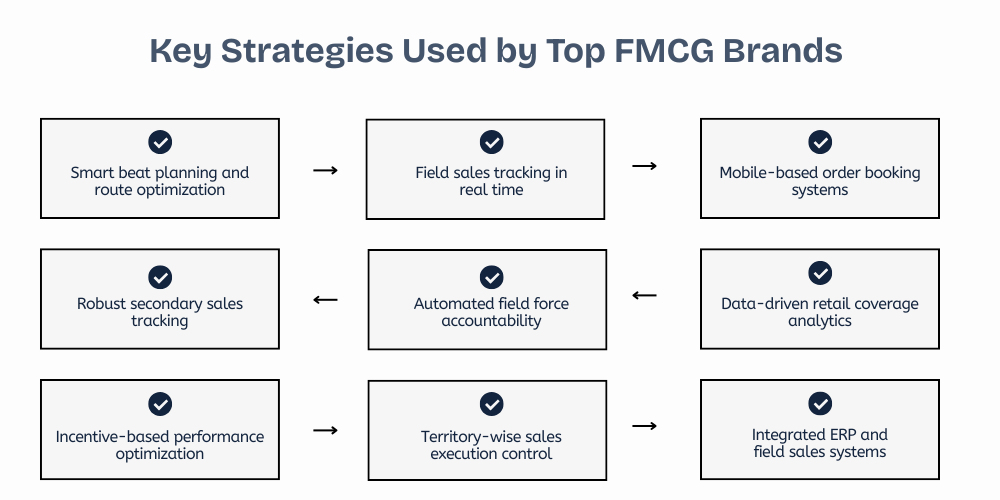
- Incentive-based performance optimization
FMCG brands often tie incentives to measurable KPIs such as outlet coverage, order value and beat completion rates. This motivates field teams to improve their performance, increases accountability, and ensures higher consistency in FMCG sales execution. - Territory-wise sales execution control
Markets are segmented into defined territories, and performance is measured at the territory level via field sales automation systems. This helps balance sales rep workload, reduce inefficiencies, and provide uniform retail distribution coverage across the regions. - Integrated ERP and field sales systems
The most effective approach is the pairing of ERP systems with field sales apps, ensuring real-time synchronization of payments, orders, and inventory data. This eliminates manual gaps, minimizes errors, and gives rise to a unified FMCG distribution management ecosystem where field execution and backend operations work together seamlessly.
Business Impact: Why This Model Works
The shift to smart FMCG distribution models, made possible by field sales automation, GPS tracking, and integrated ERP systems, is not just a technology upgrade; it delivers tangible business impact. This approach provides FMCG brands with the ability to achieve 100% retail coverage with the same or smaller field sales teams and simultaneously enhance efficiency, visibility, and profitability.
Rather than constant hiring, companies are improving performance through field sales execution, beat planning, and real-time sales tracking systems that directly impact distribution outcomes.

Key Business Impacts
- Higher retail coverage with same sales force
By using GPS-based beat planning and field sales automation tools, FMCG brands ensure that every outlet is systematically covered without increasing headcount. Optimized routes and structured visits allow sales reps to cover more retailers efficiently, improving overall retail distribution coverage.
- Reduced operational and manpower costs
Since companies no longer need to continuously hire additional sales reps, they reduce expenses related to salaries, travel allowances, and field operations. Automation in FMCG distribution management systems also reduces manual workload, lowering overall operational costs.
- Improved field sales productivity
Mobile sales apps and real-time order booking systems mean field reps can spend more time selling and less time on reporting or administrative tasks. This improves productivity per rep and overall field force performance.
- Faster decision-making with real-time data
With dashboards of sales performance, outlet coverage, and field activity at their fingertips, managers can make faster, more accurate business decisions instead of waiting for delayed reports.
- Increased retailer satisfaction and repeat orders
Retailers need faster order processing, accurate deliveries, and better product availability. This translates to more repeat orders and better long-term relationships on the retail level.
- Better inventory and demand alignment
Real-time secondary sales tracking & ERP integration ensures inventory levels are in line with actual market demand. This minimizes stockouts, avoids overstocking, and enhances the supply chain efficiency in FMCG operations.
- Stronger FMCG market competitiveness
Brands that effectively manage field sales and achieve complete retail coverage enjoy a distinct competitive advantage. Faster execution, better visibility and optimized distribution helps them to get stronger shelf presence and market shares.
How Delta Sales App Supports FMCG Retail Coverage
FMCG distribution today is not just about increasing the number of sales reps to achieve 100% retail coverage; it’s about the perfect coordination between field execution and back-end systems. Brands need total visibility into field sales activities, beat planning, order execution, and inventory flow to maximize coverage in its entirety. This is where a field sales automation solution like Delta Sales App can help.
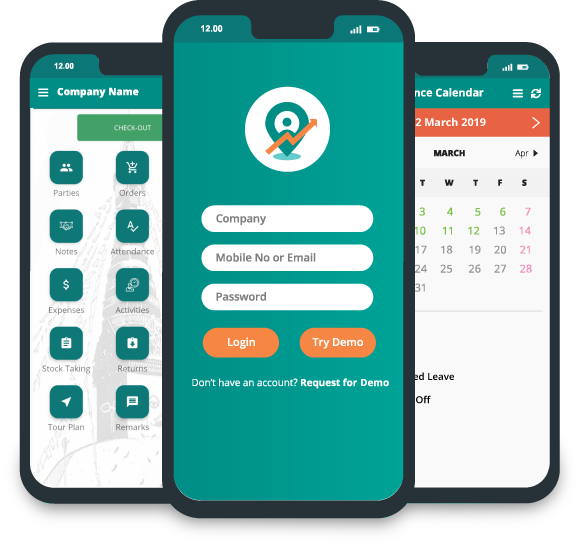
It integrates GPS tracking, structured beat planning, mobile order booking, offline functionality and ERP integration to enable FMCG companies to transform their fragmented field operations into a fully connected retail execution system.
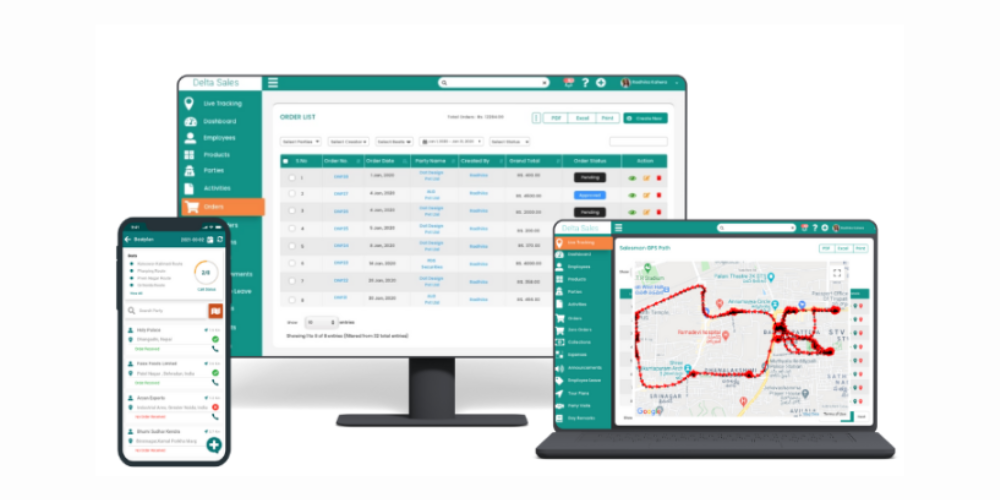
Key Features of Delta Sales App for retail coverage
- Smart beat planning and outlet allocation
Delta Sales App assists FMCG field sales team in planning their beats in an organized way by grouping outlets into a daily optimized route. This way, each retailer gets the correct visit frequency based on priority, demand and geography. Less missed outlets. No more random visits. Better consistency of retail coverage and efficiency of sales execution. - Field tracking and visit verification using GPS
It comes with inbuilt GPS tracking for field sales reps where managers can track the real time movement and can verify if an outlet visit actually happens. This improves transparency, reduces fake visits, and ensures stronger discipline in FMCG field execution and beat adherence. - Real-time order booking and execution
Sales reps can place orders at retail outlets instantly using a mobile interface. These orders are synchronized in real-time, enabling real-time FMCG order management and faster distribution cycles. This leads to quicker fulfillment, fewer delays, more accuracy, and happier retailers. - Secondary sales visibility and tracking
Every transaction recorded through the field app is reflected in dashboards, giving accurate insights into secondary sales performance at SKU and outlet level. This helps FMCG companies understand actual market demand, identify fast-moving products, and improve stock allocation strategies.

- Offline field sales functionality
One of the most powerful features is the offline capability. Sales reps can continue taking orders, updating visits and logging activities even in areas with poor or no connectivity. When the device reconnects, all data syncs automatically, without duplicating. This enables the smooth running of FMCG field sales even in rural and remote markets. - ERP integration for unified operations
The app integrates seamlessly with ERP systems so that all field data including orders, payments, and inventory updates flow real-time. This reduces manual entry and errors and creates a unified FMCG distribution management system that integrates the field and backend operations. - Automated reporting and performance monitoring
Instead of manual reporting, managers receive real-time dashboards on retail coverage, sales performance and field productivity metrics. This enables faster decision-making, better performance tracking, and more control over field sales operations and distribution efficiency.
Conclusion
It’s not about having more field sales reps to get 100% retail coverage in today’s competitive FMCG landscape; it’s about better execution with smarter systems. However, larger teams still struggle with overall sales performance due to inefficiencies inherent in traditional distribution models: missed outlets, poor beat planning, and a lack of real-time visibility.
FMCG modern brands are tackling these challenges with field sales automation, GPS-based tracking, mobile order management, and ERP integration, enabling real-time and seamless field execution. The change provides better retail coverage, higher productivity, and more control over distribution operations, a lesson that success is not about hiring more reps but building smarter, technology-driven systems.
Book a free demo today and achieve 100% retail coverage without increasing your sales force.