
Why Strategic Partnerships Matter for Growing SaaS Companies

Growing a SaaS company is not just about building a good product and waiting for customers to find it.
At some point, almost every growing SaaS business faces the same questions: How do we reach more customers? How do we enter new markets without spending heavily on sales? How do we build credibility faster? And how do we keep growing without increasing our internal team at the same pace?
One answer that is often overlooked is strategic partnerships. In fact, strategic partnerships are increasingly becoming an important growth channel for SaaS businesses looking to expand their reach, reduce acquisition costs, and build stronger market relationships. You can also explore how strategic partnerships driving SaaS growth are changing the way SaaS companies approach growth.
A good partner can put your software in front of the right audience, introduce you to customers who already trust them, help with implementation, or bring expertise that your internal team does not have.
Think about a software company that has developed a strong product for distributors but has limited connections within the distribution industry. Instead of hiring a large sales team and spending years building those relationships, the company could work with distribution consultants, technology providers, or industry specialists who already serve those customers.
The partner gets another valuable solution to offer. The SaaS company gets access to a relevant market. The customer gets a solution that better addresses its business needs.
That is the real power of a strategic partnership.
But partnerships should not be treated simply as another source of leads. The right partnerships can become an important part of a company's SaaS growth strategy, creating new acquisition channels, revenue opportunities, market access, and long-term competitive advantages.
Let's look at how they work and how growing SaaS companies can build partnerships that actually produce results.
What Are Strategic Partnerships in SaaS?
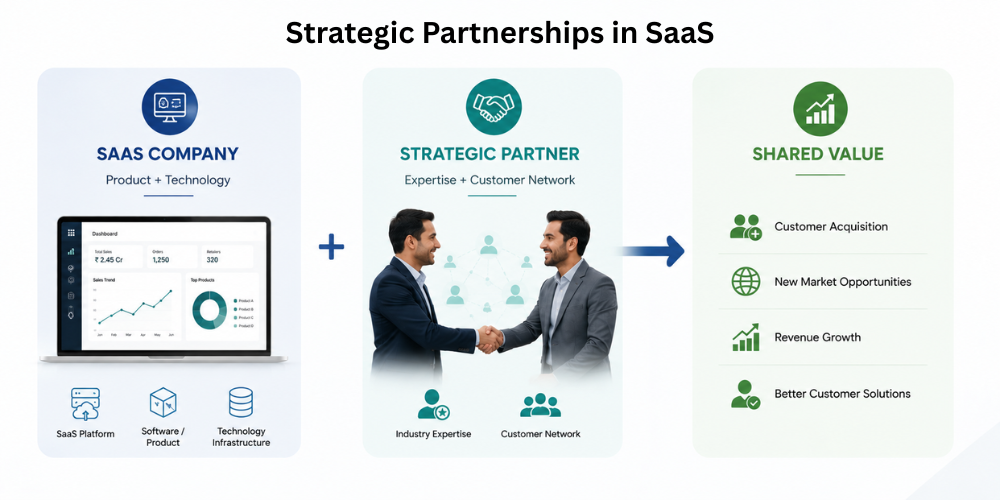
A strategic SaaS partnership is a business relationship where two companies work together because their products, services, expertise, or customer bases complement each other.
The important word here is complement.
A SaaS company does not necessarily need a partner that sells exactly the same thing. In fact, direct competitors usually aren't the ideal partners.
Instead, the best partners often solve a different part of the same customer's problem.
For example, one company may provide software while another provides consulting or implementation services. One may have the technology while the other has strong relationships with customers in a particular industry.
Depending on the arrangement, partners may help with:
-
Customer referrals
-
Software sales
-
Product implementation
-
Consulting
-
Integrations
-
Customer training
-
Marketing
-
Market expansion
The relationship can take different forms, but the principle remains the same: both businesses should have a clear reason to work together.
A partnership becomes strategic when it contributes to a meaningful business objective rather than simply creating another contact in your network.
The strongest partnerships are built around shared objectives, complementary strengths, and long-term value rather than one-time transactions. Businesses looking to establish these relationships can benefit from understanding the fundamentals of building strong strategic partnerships.
Why Strategic Partnerships Matter for Growing SaaS Companies
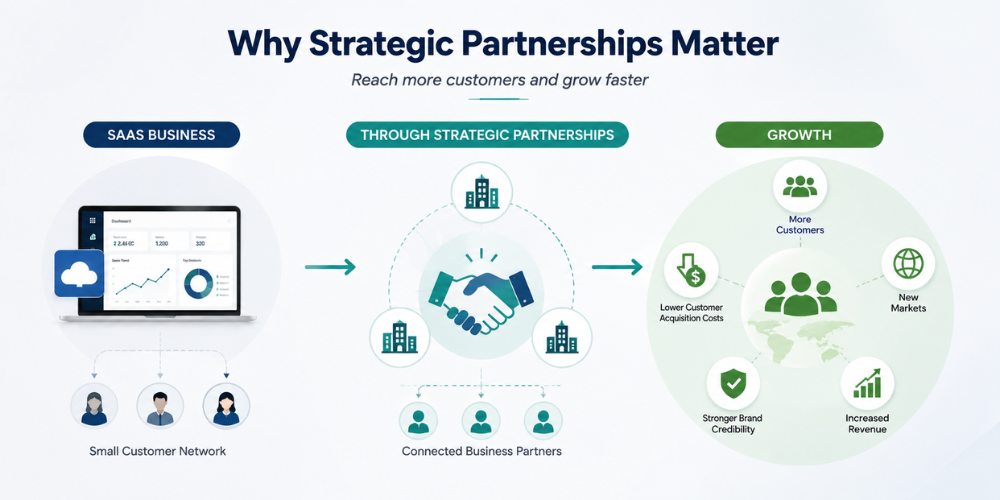
For a small or growing SaaS company, resources are limited. You cannot always hire a large sales team for every market, establish an office in every region, or build relationships with every potential customer segment.
Strategic partnerships can help bridge that gap.
1. Reach Customers You Could Not Easily Reach Alone
One of the biggest advantages of partnerships is access. Your potential partner may already have relationships with the exact businesses you are trying to reach.
For example, an ERP consultant may work with dozens of manufacturers and distributors. A field sales software company could partner with that consultant and gain access to businesses that would otherwise take months or years to reach through cold outreach.
This does not mean every partner will immediately generate hundreds of customers. But a well-connected partner can shorten the distance between your product and the right audience.
2. Enter New Markets With Less Friction
Expanding into a new industry or geography is rarely straightforward.
You need to understand the market, customer expectations, buying behavior, competitors, pricing, and local business practices. A local or industry-specific partner can already have much of that knowledge.
Instead of entering a market completely from scratch, a SaaS company can learn from someone who is already there.
This can make SaaS market expansion faster and less risky.
3. Build Trust Faster
Buying business software is different from buying a low-cost consumer product.
Customers want to know whether the software will actually solve their problem, whether the company will support them, and whether implementation will be smooth.
That is why trust matters.
A recommendation from a consultant or technology provider who already understands the customer's business can carry much more weight than a generic advertisement.
Strategic partnerships can therefore help growing SaaS companies build brand credibility much faster.
4. Reduce Customer Acquisition Costs
Customer acquisition can become expensive as a SaaS company scales.
Paid advertising, outbound sales, events, content marketing, and sales development all require continuous investment.
A strong partner channel gives companies another way to acquire customers. Instead of finding every prospect independently, a partner may introduce a business that already has a relevant need.
The result can be a shorter sales process, better-qualified opportunities, and lower acquisition costs. Partnerships are not automatically cheaper. Building and supporting a partner program requires investment too. The difference is that a successful program can become increasingly efficient as the partner network grows.
5. Create Additional Revenue Channels
A SaaS company does not have to depend entirely on its direct sales team.
Depending on the business model, partnerships can create additional revenue through:
-
Referral commissions
-
Reseller sales
-
Affiliate programs
-
Co-selling
-
Implementation services
-
Cross-selling
-
Integration partnerships
For example, a reseller may sell the software to its existing customers, while an implementation partner helps those customers deploy it.
The SaaS company generates software revenue, and the partner generates revenue from the relationship.
That creates a genuine win-win partnership.
Types of Strategic Partnerships for SaaS Companies
Not every partnership needs to look the same. The right model depends on your product, target customers, sales process, and what your potential partner can contribute.
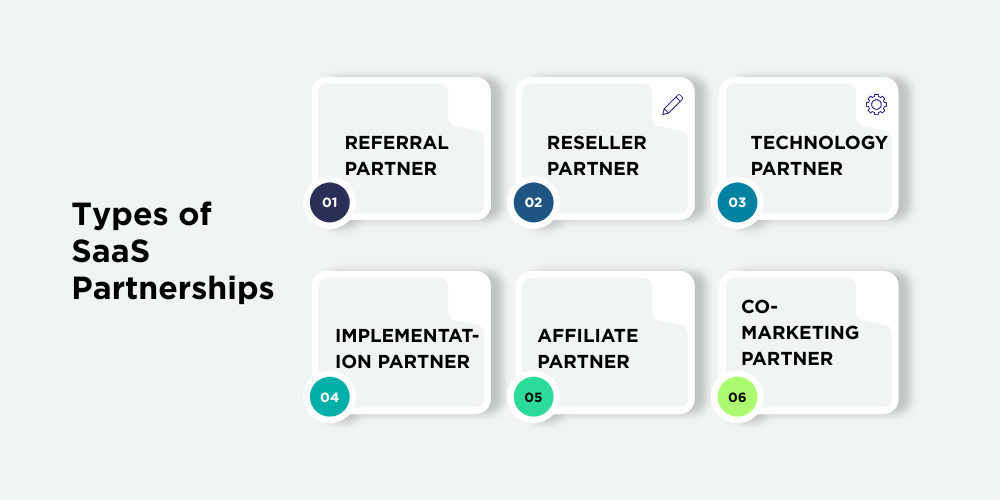
Referral Partnerships
Referral partnerships are one of the simplest ways to start.
A partner identifies a customer who could benefit from your product and introduces them to your sales team. The partner receives a commission or another agreed benefit when the referral converts.
This works particularly well with consultants, agencies, advisors, and professionals who regularly interact with your target customers.
Reseller Partnerships
A reseller goes one step further.
Instead of simply introducing the customer, the partner may actively sell the SaaS product as part of its own offering.
This can be useful when a SaaS company wants to expand into new regions or industries without building a large direct sales operation.
A reseller may also provide first-level customer support or implementation services.
Technology and Integration Partnerships
Sometimes the strongest partnership is between two software products.
Customers often use several applications to run their businesses. If two complementary platforms can exchange data or work together, the combined solution becomes more useful.
For example, a field sales platform could integrate with accounting, ERP, inventory, or business intelligence software.
These technology partnerships can improve customer experience while opening opportunities for both companies to reach each other's users.
Implementation and Service Partnerships
Selling software is only part of the customer journey. Some businesses need help with configuration, training, data migration, process design, or deployment.
Implementation partners can fill that gap. This model is particularly useful for SaaS products used by larger organizations or businesses with complex workflows.
The SaaS company focuses on the product while the partner handles the service layer.
Affiliate Partnerships
Affiliate partnerships are usually more marketing-focused. An affiliate promotes the SaaS product through a website, content, social media, email audience, or professional network and receives a commission for qualifying customers.
This can be an effective way to extend digital reach without hiring a large promotional team.
However, affiliate quality matters. A large number of low-quality affiliates is often less valuable than a smaller group of people who genuinely understand the product and its audience.
Co-Marketing Partnerships
Two companies can also collaborate on marketing without directly selling each other's products.
Examples include:
-
Joint webinars
-
Industry reports
-
Expert interviews
-
Podcasts
-
Events
-
Co-authored content
-
Case studies
The main advantage is shared reach.
Both businesses get an opportunity to introduce themselves to an audience they may not have reached independently.
Key Benefits of a SaaS Partnership Strategy
A well-managed partnership strategy can influence much more than lead generation.

Faster Customer Acquisition
When the partner already has a trusted relationship with the customer, that introduction can carry more weight than a completely cold sales approach. Choosing the right type of partner can also have a direct impact on sales outcomes, as discussed in this guide to how the right solution partner can improve sales performance.
Lower Cost of Market Expansion
Instead of building every market capability internally, a company can leverage the partner's existing relationships, knowledge, and infrastructure.
Better Customer Experience
A partner can provide services that complement your product, such as consulting, implementation, integration, or training.
The customer gets a more complete solution.
Stronger Brand Positioning
Being associated with respected businesses, consultants, and technology providers can increase trust in a growing SaaS brand.
New Revenue Opportunities
A mature partner ecosystem can create recurring revenue through referrals, resellers, affiliates, integrations, and other commercial models.
Better Market Intelligence
Partners spend time talking to customers too.
They can tell you what prospects are asking for, where competitors are gaining traction, what features customers expect, and what problems are becoming more important.
That feedback can influence your product roadmap and positioning.
How to Build a Successful SaaS Partnership Strategy
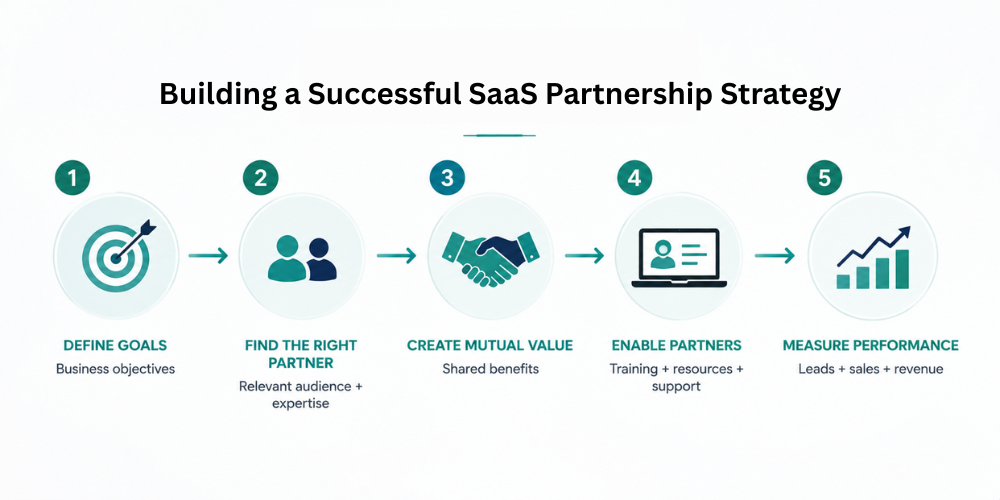
A common mistake is to launch a partner program simply because "partnerships are good for growth."
That is not enough.
A successful program starts with a clear reason for existing.
Start With the Business Goal
Ask what you actually want the partnership channel to accomplish.
Do you want to:
-
Enter a new market?
-
Generate more qualified leads?
-
Increase sales?
-
Improve implementation?
-
Expand your product ecosystem?
-
Build brand awareness?
The answer will determine the type of partner you need.
Find Partners With the Right Audience
Don't choose a partner simply because they have a large following or customer base.
Look for overlap between their audience and your ideal customer.
A partner with 500 highly relevant customers can be far more valuable than one with 50,000 unrelated contacts.
Make the Partnership Valuable for Both Sides
This is perhaps the most important rule.
Ask yourself:
"Why would this company want to promote our product?"
If the answer is only "because they can earn commission," the partnership may have limited long-term potential.
A stronger proposition might be:
-
The partner can offer a more complete solution.
-
The partner can solve an existing customer problem.
-
The partner can generate recurring revenue.
-
The partner can differentiate its services.
-
The partner can enter a new market.
The more value the partner sees, the more likely they are to invest in the relationship.

Make It Easy for Partners to Sell
Don't expect partners to learn everything themselves.
Give them the resources they need:
-
Product demonstrations
-
Training
-
Sales presentations
-
Brochures
-
Case studies
-
FAQs
-
Pricing information
-
Competitive positioning
-
Marketing templates
This is known as partner enablement, and it can make the difference between an inactive partner and a productive one.
Define Responsibilities Early
Before the partnership begins, agree on who handles what.
For example:
SaaS company
-
Product training
-
Technical support
-
Product demonstrations
-
Marketing resources
Partner
-
Customer introductions
-
Market development
-
Sales support
-
Implementation, where applicable
Clear expectations prevent misunderstandings later.
Keep the Commercial Model Simple
Nobody wants to spend hours trying to understand a commission structure.
Define the important details clearly:
-
What qualifies as a referral?
-
When is commission paid?
-
What happens if the customer cancels?
-
Are renewal commissions included?
-
Who owns the customer relationship?
Measure What Actually Matters
Don't measure a partner program only by the number of registered partners. A database containing 500 inactive partners is not a successful partner ecosystem.
Instead, track:
-
Active partners
-
Partner-sourced leads
-
Qualified opportunities
-
Conversion rates
-
Revenue generated
-
Customer retention
-
Partner engagement
-
Sales cycle length
These numbers tell you whether the channel is actually contributing to growth.
Common Challenges in SaaS Partnerships
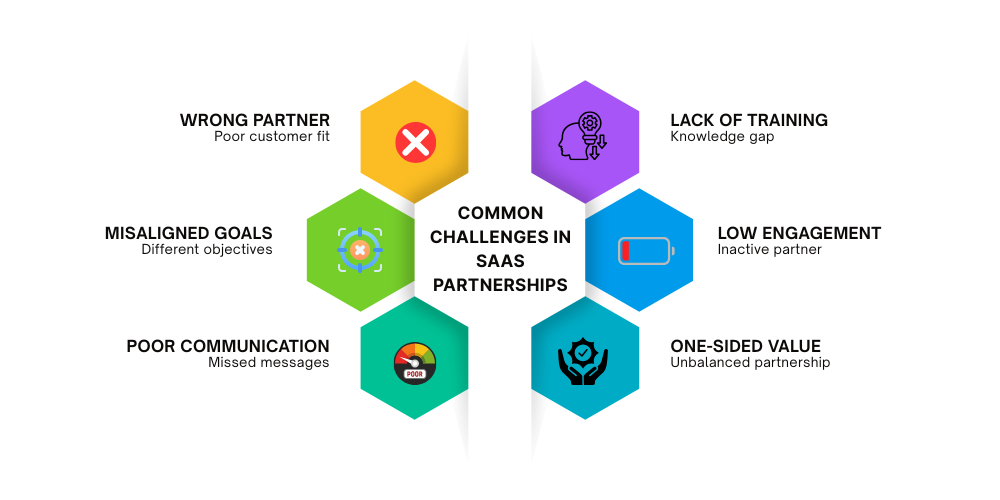
Choosing the Wrong Partner
A company may look impressive but have little overlap with your target market. Always evaluate customer fit, expertise, reputation, and willingness to participate.
Different Business Priorities
Your company may want immediate revenue while your partner is more interested in expanding its service portfolio. If expectations are not aligned, the relationship can lose momentum.
Poor Communication
A partner cannot effectively represent your product if they don't know about new features, pricing changes, positioning, or customer issues. Regular communication is essential.
Lack of Training
Partners who don't understand the product will rarely feel confident recommending it. Training should be part of the partnership from the beginning.
Partnerships That Become One-Sided
If one company continually sends leads while receiving little value in return, frustration eventually develops. Partnerships need to remain mutually beneficial.
How Delta Sales App Can Benefit From Strategic Partnerships
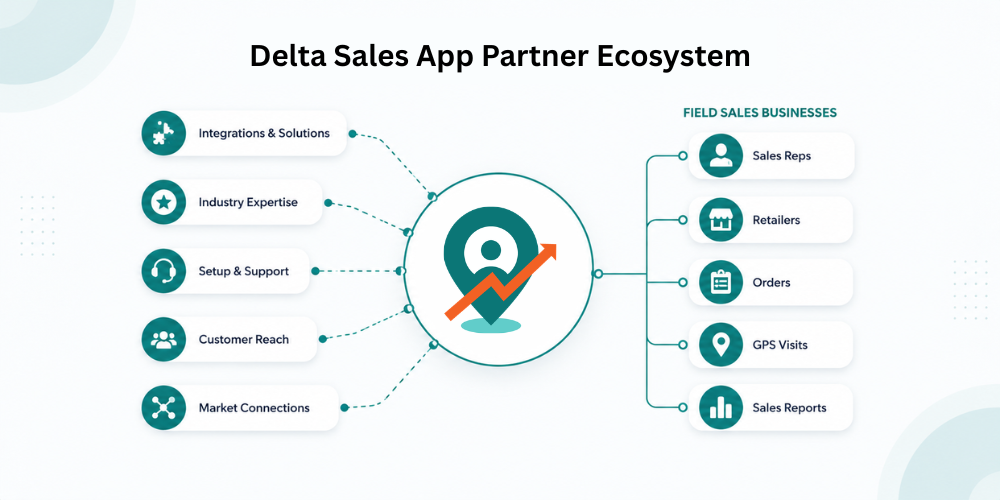
For Delta Sales App, partnerships are particularly relevant because businesses managing field sales operations often use several technologies and service providers at the same time.
A well-chosen partner can do more than generate referrals. The right collaboration can help strengthen positioning, improve customer value, and create a more effective partner business strategy around complementary products and services.
A company may already work with an ERP consultant, distributor management consultant, accounting software provider, system integrator, or business technology consultant.
These organizations may encounter customers facing challenges such as:
-
Limited visibility into field sales activities
-
Manual sales reporting
-
Poor outlet coverage
-
Difficulty tracking market visits
-
Inefficient route planning
-
Delayed order reporting
This creates a natural opportunity for collaboration.
A partner can introduce Delta Sales App when a customer needs a practical solution for managing field sales activities, while Delta Sales App provides the technology and product support.
Potential partnership categories include:
-
Technology consultants
-
ERP providers
-
System integrators
-
Business consultants
-
Distribution consultants
-
Industry specialists
-
Implementation partners
-
Affiliate partners
Delta Sales App also offers structured partner opportunities designed to help businesses understand the product, access sales and marketing resources, and create new commercial opportunities. For businesses considering a lower-barrier entry into the ecosystem, exploring the benefits of becoming a Delta Sales App partner can be a useful starting point.
The important point is that the partnership should create value on both sides.
The partner gets another useful solution to offer its customers. Delta Sales App gets access to relevant businesses. And the customer gets technology that addresses a real operational problem.
That is what makes a partnership sustainable.
Conclusion
Strategic partnerships can help growing SaaS companies expand their reach, enter new markets, acquire qualified customers, and create new revenue opportunities without relying entirely on internal sales and marketing teams.
The key is not to build the largest partner network, but to build the right partnerships with organizations that bring relevant customers, expertise, technology, or market access.
For Delta Sales App, partnerships with consultants, technology providers, implementation specialists, and organizations serving field sales businesses can create value for both partners and customers, helping businesses improve sales visibility, productivity, outlet coverage, and market execution.
Ready to Build a Partnership With Delta Sales App?
If you work with businesses that manage field sales teams, distributors, wholesalers, manufacturers, or retail networks, a partnership with Delta Sales App can create an additional solution for your customers while opening new commercial opportunities for your business.
Explore the Delta Sales App Partner Program and discover how we can grow together.
Want to See Delta Sales App in Action?
Book a free demo today and discover how Delta Sales App can help your customers improve field sales productivity and visibility.