
FMCG Sales Software vs General Sales Software: Key Differences Explained
In the fast-moving consumer goods (FMCG) business, meetings don't decide whether or not sales will be good; the market does.
How quickly and consistently your sales reps visit stores, how quickly your products get to stores, and how quickly orders are taken and filled all play a role. Every missed visit, late order, or out-of-stock item means lost sales. Even so, a lot of FMCG companies still use old-fashioned generic sales software, usually CRM systems, to run their sales. CRM tools are great for managing customer relationships, but they aren't made to handle the speed and complexity of FMCG distribution.
This is when knowing the difference between CRM and FMCG sales software becomes very important.
CRM helps you manage relationships, but FMCG sales software lets you automate field sales, manage orders in real time, see your distributors, and carry out retail tasks. These are the things that really drive growth in this industry.
What is Generic Sales Software?
Generic sales software refers to any tool businesses use to track, manage, or report sales. This can include spreadsheets, legacy order management systems, ERP modules, or even basic CRM platforms.
While these tools can help track sales numbers or maintain customer contact information, they are not purpose-built for the fast-paced, execution-heavy world of FMCG.
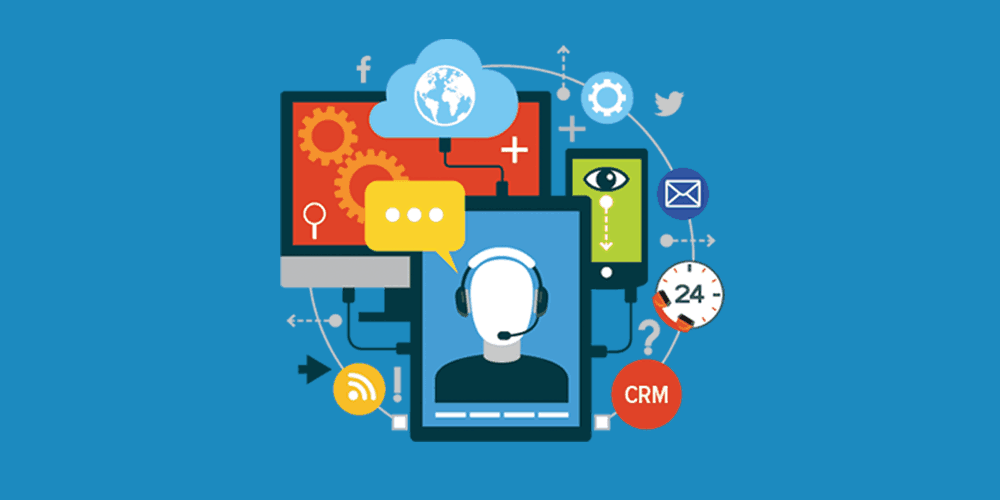
Common limitations of generic sales software include:
-
Lack of real-time visibility into field operations
-
No support for structured beat planning or route optimization
-
Minimal insights into distributor performance or secondary sales
-
Limited ability to track in-store execution or compliance
Many businesses use basic CRM tools as their main sales software, so generic sales software is often linked to CRMs. This helps people connect, but it's important to remember that not all generic sales software is CRM, and not all CRMs are good for FMCG businesses.
Some generic tools are actually CRMs or have CRM-like functionality, such as:
-
Maintaining customer contact details
-
Tracking sales opportunities or deals
-
Sending reminders for follow-ups
What is CRM (Customer Relationship Management)?
The goal of a CRM system is to help businesses keep track of, organize, and manage their interactions with customers. It is a central database that sales teams can use to keep track of customer information, communication history, and sales pipelines. This lets businesses nurture leads, follow up well, and over time raise their conversion rates.
CRM systems work best in fields where sales take a long time and are based on relationships. For instance, in B2B or SaaS businesses, it may take several meetings, emails, and negotiations to close a single deal. In these situations, having a well-organized pipeline and in-depth customer information is very helpful.
However, CRM systems are not built for environments where:
-
Sales happen daily across hundreds or thousands of retail outlets
-
Orders are frequent and transactional
-
Field reps are constantly moving between locations
-
Execution speed matters more than relationship tracking
Even when businesses try to use a field sales CRM, they often find limitations in areas like employee tracking, order automation, and retail visibility.
In short, CRM focuses on who you sell to and how you engage them, but not on how sales are executed on the ground.
What is FMCG Sales Software?
FMCG sales software is made to help with managing sales operations and distribution networks on the ground.
It is made for businesses where sales are made by field teams, distributors, and stores. It doesn't just look at customer data; it also looks at execution, speed, and visibility.
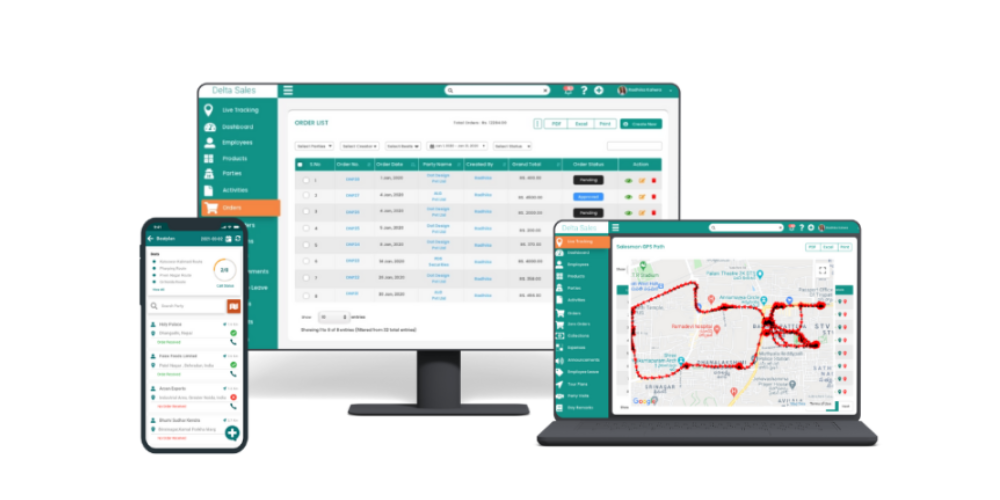
With a modern FMCG sales solution, businesses can:
-
Enable field sales automation to streamline daily activities
Field sales automation makes things like attendance, reporting, and task assignments easier by turning them into digital tasks. This lets salespeople spend less time on administrative tasks and more time on selling, which boosts productivity and efficiency overall.
-
Use a mobile order management system for instant order capture
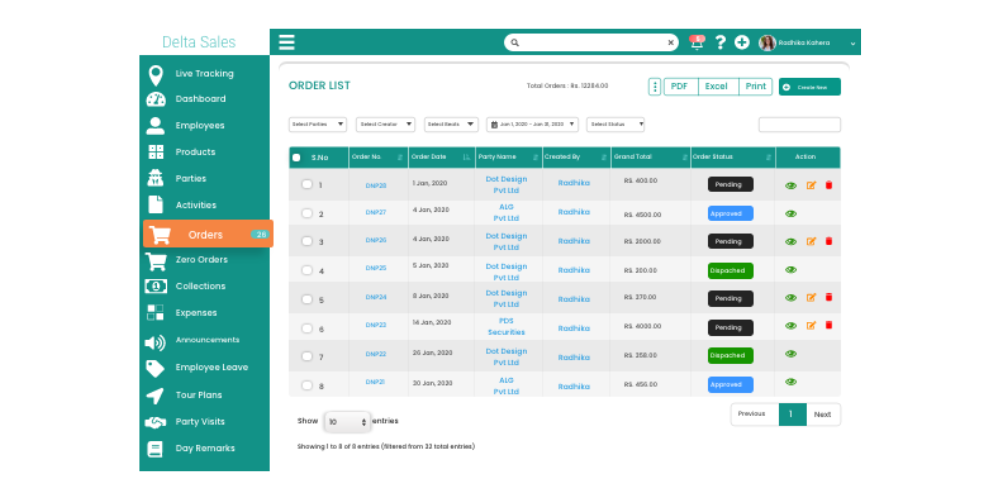
With a mobile order management system, salespeople can take orders directly from stores using their smartphones. Orders are processed right away, which cuts down on delays, mistakes, and the time it takes to complete the entire sales cycle.
-
Implement beat planning and route optimization for efficient coverage
Beat planning makes sure that sales reps go to every store by giving them specific routes and stops. Route optimization makes things even more efficient by cutting down on travel time and maximizing the number of productive visits each day.
-
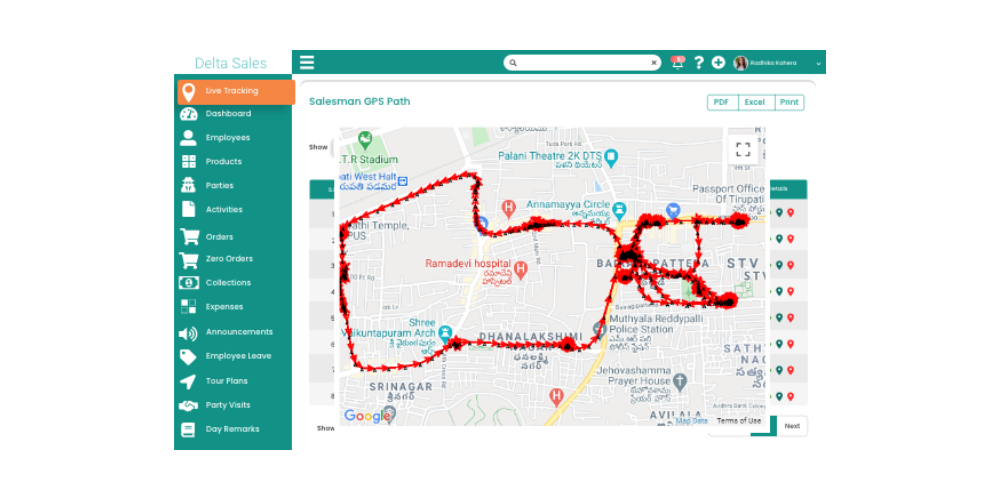
Track reps using real-time GPS employee tracking
Real-time GPS tracking gives managers full visibility into field activities. It helps verify store visits, monitor movement, and ensure that sales reps are following their assigned routes and schedules.
-
Manage distributors through a distributor management system (DMS)
A distributor management system helps keep track of orders, stock, and sales across all distribution channels. It makes sure that companies and distributors work together smoothly, which makes the supply chain more efficient and fills in gaps in stock.
-
Monitor stock with inventory visibility tools
Inventory visibility tools show you how much stock is on hand at warehouses and distributor points in real time. This helps companies avoid running out of stock, better plan when to restock, and make sure that products are always available in the market.
-
Ensure compliance using retail execution tracking
With a retail execution system, companies can keep an eye on things like product placement, promotions, and display compliance in stores with retail execution tracking. It makes sure that brand rules are followed and makes the shelf look better and work better overall.
This kind of software links all parts of the sales ecosystem, making sure that information flows smoothly between field reps, distributors, and management.
Key Differences Between FMCG Sales Software and Generic Sales Software
Before we talk about the differences, it's important to note that basic CRM systems are often used to show generic sales software. As their main sales tool, many businesses use CRMs to keep track of customer information, log deals, or manage pipelines.
CRMs are great for keeping track of relationships and organizing sales activities, but they don't have the specialized features that FMCG operations need, like high-frequency order capture, distributor management, real-time field tracking, and retail execution. In other words, CRMs are better for sales cycles that last a long time, while FMCG operations need speed, coverage, and execution in the field.
Here's how FMCG sales software works differently from regular sales software (like CRM):
1. Purpose and Focus
Generic sales software, often a CRM, focuses primarily on customer relationship management and opportunity tracking. It helps businesses manage engagement, leads, and pipelines efficiently, making it suitable for relationship-driven sales in B2B or SaaS environments.
FMCG sales software, however, is designed for execution-driven performance. It ensures that field reps cover all assigned outlets, capture orders accurately, and follow planned routes. With tools like field sales automation, task tracking, and beat planning, FMCG software transforms field operations into measurable revenue growth rather than just record-keeping.
2. Designed for High-Frequency Sales Environments
CRMs and generic sales software are built for structured, pipeline-driven sales where transaction frequency is relatively low. This setup struggles to handle multiple daily visits, numerous small orders, and repetitive transactions, which are typical in FMCG sales.
FMCG sales software is built for this fast-paced environment. Features like mobile order capture, offline access, and automated syncing allow reps to process orders instantly, even in low-connectivity areas. This ensures continuous field operations without errors or delays, keeping the supply chain and retail outlets well-serviced.
3. Field Force Management and Employee Tracking
Generic sales software often offers only basic activity logging, like noting meetings or tasks completed. It provides minimal visibility into real-time field operations, leaving managers to rely on self-reports or manual updates.
FMCG sales software provides GPS-enabled employee tracking, geo-tagged attendance, and customer visit verification. Managers can monitor where reps are, whether they’ve completed scheduled visits, and how much time is spent per outlet. This level of oversight improves accountability, optimizes daily coverage, and ensures every field activity aligns with business objectives.
4. Order Management and Automation
In basic CRMs or generic sales software, order capture is often not automated, and processing may depend on manual entries. This can cause mistakes, delays, and lost chances to make money, especially when there are a lot of orders every day.
Real-time order management, automated pricing, scheme application, and instant invoicing are all features of FMCG sales software. You can take orders on the go, have them automatically synced, and get them done faster. This cuts down on mistakes made by people, makes sure everything is correct, keeps retailers happy, and boosts cash flow.
5. Distributor Management and Secondary Sales Visibility
CRMs usually only keep track of direct customers and don't show how distributor networks work. Companies that use generic sales tools often don't know how much stock they have or how much they sell beyond the basic level. This makes planning and supply chain efficiency less effective.
FMCG sales software includes distributor management systems (DMS) and secondary sales tracking software, which lets businesses keep an eye on how stock moves through the channel. This helps with forecasting, optimizing inventory, avoiding stockouts, and keeping things running smoothly from the warehouse to the store shelf.
6. Retail Execution and In-Store Visibility
Generic sales software does not track what happens inside retail stores. Activities like product placement, promotion compliance, or merchandising audits are not captured, which reduces control over brand visibility.
FMCG sales software provides tools for retail execution tracking, merchandising audits, and in-store data capture, often supported by photos or reports submitted via mobile apps. This ensures products are displayed correctly, promotions are implemented, and competitors’ activities are monitored, helping brands maintain an edge at the point of sale.
7. Sales Analytics and Real-Time Reporting
Generic sales software and CRMs frequently depend on manual data updates, resulting in delayed or retrospective insights. It might be hard for managers to make quick decisions or react to sudden changes in the market.
FMCG sales software gives you real-time dashboards, automated reports, and analytics for the field. Managers can quickly see how sales are doing by outlet, product, or territory, keep an eye on how well their team is doing, and respond quickly to problems or trends. This data-driven method lets you make decisions ahead of time and makes operations run more smoothly and quickly.
FMCG Sales Software vs Generic Sales Software: Comparison Table
When comparing FMCG sales software with generic sales software (including CRM systems), the fundamental difference lies in their design philosophy and operational focus.
Generic sales software is primarily built to manage customer relationships. It helps businesses store customer data, track deals, and monitor sales pipelines. This makes it highly effective for organizations with long sales cycles, where success depends on nurturing relationships over time such as B2B companies or service-based industries. However, its capabilities in handling on-ground sales execution are limited. Features like field force tracking are often restricted to basic activity logging, with little real-time visibility into sales team movements or productivity.
In contrast, FMCG sales software is purpose-built for high-frequency, execution-driven sales environments. It is designed to handle the complexities of retail and distribution networks where speed, coverage, and efficiency are critical. These platforms offer advanced field force management capabilities, including GPS tracking, route optimization, and verified check-ins, ensuring complete visibility of on-ground operations.
Order management is another major differentiator. While generic systems rely on manual or semi-automated processes, FMCG sales software enables real-time order capture, faster invoicing, and seamless processing essential for businesses dealing with frequent daily orders. Additionally, FMCG solutions provide comprehensive distributor management, allowing businesses to track not just primary sales but also secondary sales across the distribution chain.
Retail execution is an area where generic software typically falls short. FMCG sales software, on the other hand, includes features such as merchandising audits, in-store execution tracking, and compliance monitoring to ensure brand visibility and consistency at the retail level.
Inventory visibility is also significantly stronger in FMCG systems, offering real-time stock tracking across warehouses, distributors, and retail outlets. This helps prevent stockouts and overstocking, which directly impacts sales performance.
From a data and reporting standpoint, generic tools often depend on delayed or manually updated information, whereas FMCG sales software provides real-time dashboards and analytics. This enables faster decision-making and more accurate performance tracking.
Ultimately, the impact on revenue differs between the two. Generic sales software contributes indirectly by improving relationship management, while FMCG sales software drives direct revenue growth through better execution, increased market coverage, and improved operational efficiency.
In summary, businesses focused on relationship-driven sales may benefit from generic systems, but companies operating in fast-moving consumer goods environments require specialized FMCG sales software to stay competitive and scale effectively.

Why Generic Sales Software Alone is Not Enough for FMCG Businesses
As FMCG companies get bigger, their sales operations get more complicated. When you have to manage a lot of field teams, several distributors, and hundreds or thousands of retail stores, you need more than just basic tools to keep track of customer information and sales pipelines.
A lot of businesses use generic sales software, like basic CRMs, as their main sales tool. These systems work well for managing relationships, keeping track of leads, or keeping an eye on sales opportunities, but they aren't made to handle the fast-paced, execution-driven needs of FMCG operations.
Relying solely on generic tools often results in several operational challenges:
-
Lack of visibility into field activities:
Managers have little insight into the day-to-day actions of their field teams. Without GPS tracking, geo-tagged check-ins, or verified store visit reports, it’s difficult to know whether sales reps are following assigned routes, completing tasks, or properly engaging with retailers. This can lead to missed opportunities and inefficient coverage.
-
Inefficient retail coverage:
Generic tools do not support structured beat planning or route optimization. Field reps may inadvertently miss key outlets, spend too much time in some areas, and fail to maintain consistent product availability across stores. This reduces market penetration and affects sales performance.
-
Delayed order processing:
Order capture and invoicing in generic sales software are often manual or semi-automated. High-frequency FMCG orders processed in this way are prone to errors, delays, and miscommunication. As a result, distributors and retailers may face stockouts or delayed deliveries, which can negatively impact brand reliability.
-
Poor coordination with distributors:
CRMs, or generic sales tools, are typically designed for direct customer management, not multi-level distribution networks. Without real-time visibility into distributor stock levels, secondary sales, or order fulfillment, companies face challenges in managing supply chains efficiently, which can lead to inventory imbalances or lost sales.
These problems happen because generic sales software is more focused on managing relationships or keeping track of basic sales than on the operational needs of FMCG businesses, which are more focused on getting things done. In an industry where daily field operations, retailer coverage, and order accuracy have a direct effect on revenue, these gaps can quickly lower productivity and limit growth.
To address these gaps, FMCG companies require purpose-built field sales automation software. Such solutions combine mobile order management, distributor management, field tracking, retail execution, and real-time analytics in a single platform, ensuring that every part of the sales process is optimized for speed, accuracy, and market coverage.
To explore this in more detail, read why FMCG businesses need purpose-built sales software.
When Should You Use Generic Sales Software (CRM) vs. FMCG Sales Software?
Not every business needs sales software made just for FMCG. In some cases, basic sales tools or CRMs are all you need. Companies can pick the right tool and avoid extra costs or complications by knowing the differences between use cases.
When Generic Sales Software or CRM is Enough
Generic sales software, including basic CRM systems, works well for:
-
Relationship-driven sales environments: Businesses that rely on long-term customer relationships, low-frequency transactions, or B2B sales cycles can manage pipelines effectively with CRMs.
-
Smaller sales teams or limited field operations: If your business has a small team visiting a few key accounts, tracking leads, follow-ups, and customer interactions may be enough without the need for complex execution tools.
-
Simple reporting and customer tracking: CRMs are ideal for generating reports, tracking engagement, and maintaining organized contact records when there is no heavy field execution or distributor management involved.
In these situations, generic sales software can help streamline operations and maintain organization without requiring a full-scale FMCG solution.
When FMCG Sales Software is Necessary
FMCG operations have unique requirements that generic tools or CRMs cannot meet. You should consider purpose-built FMCG sales software if your business faces:
-
High-frequency field operations: Your sales reps visit dozens of retail outlets every day and need real-time updates on coverage, check-ins, and order capture.
-
Distributor and supply chain complexity: You rely on distributors, secondary sales tracking, and multi-level inventory management to maintain product availability across markets.
-
Retail execution requirements: Monitoring merchandising, promotions, and in-store compliance is critical for your brand’s visibility and performance.
-
Need for real-time insights and analytics: You require dashboards, performance metrics, and actionable insights to make quick decisions and respond to market changes.
How Delta Sales App Drives Growth
You need more than just spreadsheets or generic CRM tools to grow an FMCG business. You need a solution that brings together all of your field sales, distributor management, and retail execution.
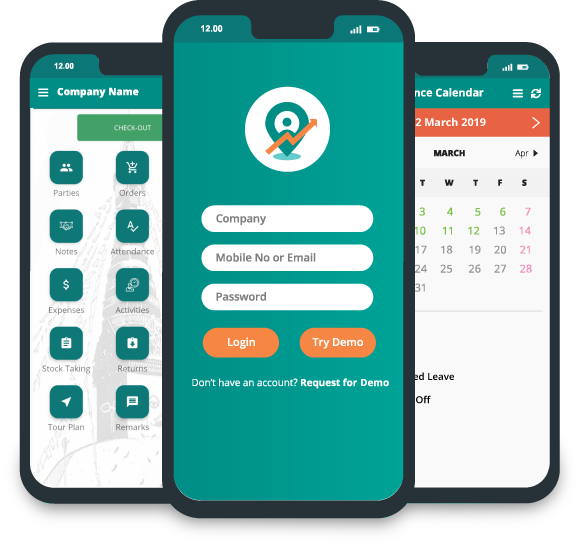
A purpose-built platform like Delta Sales App is designed specifically for FMCG companies, combining multiple capabilities into a single, easy-to-use system. This unified approach helps businesses eliminate inefficiencies, improve productivity, and scale operations with confidence.
-
Field Sales Automation Software for Daily Operations
The Delta Sales App makes daily sales tasks easier by automating things like attendance management, leave management, and task management that happen over and over again. Salespeople spend less time on paperwork and more time visiting stores, taking orders, and carrying out sales plans.
-
Employee Tracking Systems for Real-Time Visibility
With GPS-enabled employee tracking, managers can monitor the exact location and activity of field reps in real time. This ensures accountability, verifies store visits, and allows supervisors to make quick decisions if coverage gaps or inefficiencies arise.
-
Order Management Systems for Faster Transactions
The platform enables instant order capture directly from retail stores. With automated pricing, scheme application, and invoice generation, order processing becomes faster, more accurate, and fully integrated with distributor networks, improving fulfillment and reducing errors.
-
Distributor Management Tools for Channel Efficiency
Delta Sales App provides complete visibility into distributor operations. Businesses can monitor stock levels, track secondary sales, manage orders, and coordinate with distributors more effectively, ensuring smooth supply chain operations and reducing stockouts at the retail level.
-
Retail Execution Apps for In-Store Performance
It is also the retail execution app that allows sales teams to track in-store execution, such as merchandising compliance, product placement, promotions, and competitor activity. Managers can collect real-time data through photos and surveys, ensuring that brand standards are consistently maintained across outlets.
-
Sales Analytics Dashboards for Data-Driven Decisions
With real-time dashboards and performance analytics, Delta Sales App transforms raw field data into actionable insights. Businesses can track sales performance by territory, rep, or product, identify trends quickly, and make informed decisions that drive growth.
Conclusion
FMCG businesses can no longer choose not to use the right sales technology. Generic sales software systems can help you keep track of your relationships, but they can't handle the speed, complexity, and execution needs of field sales and retail distribution.
The Delta Sales App is a purpose-built solution that fills this gap by bringing together field sales automation, real-time employee tracking, order management, distributor management, retail execution, and analytics all in one place. This makes things run more smoothly, increases output, and keeps revenue growth steady. If you want to grow your FMCG business, get better coverage in stores, and boost sales, you need to use a specialized sales solution. This is the only way to stay competitive.
Are you ready to change how you do field sales? Schedule a free demo with Delta Sales App today to find out how your team can work more efficiently, cover more ground, and grow faster.