
The GPS Verification Trap: How Fake Locations and Laggy Geofencing Hurt Field Compliance
Your field sales rep visits a retailer, updates the visit, uploads a photo, and moves on to the next outlet. The manager’s dashboard appears normal. The visit is marked as done, attendance is recorded, and the daily report looks productive.
But what if that retailer was never actually there?
For companies that rely on field teams, it’s an increasingly hard problem. GPS-enabled apps have made it easier to track employees, but they've also revealed a new problem: Not every location update tells the whole story. Fake GPS apps, location spoofing, delayed geofencing, and inaccurate GPS signals can all create the illusion of work done when no work has been done.
For companies that manage sales reps, merchandisers, service techs, or delivery teams, these location verification gaps can be serious. The inability to verify if a field employee was at the assigned location is one basic problem that can result in lost customer visits, incorrect attendance records, fraudulent expense claims, and unreliable compliance reports.
And that is where a lot of businesses fall into what I call the GPS verification trap. They assume that simple monitoring of the location of the device is enough to ensure field compliance. And GPS tracking alone can’t prevent fake check-ins or guarantee that employees remain on their routes and visit the right customers.
For modern field operations, knowing where an employee’s phone is is no longer enough. They need real-time tracking, geofencing with intelligence, accurate location verification, and most importantly, proof that every customer visit actually happened.
In this blog, we will talk about why fake locations and laggy geofencing are becoming big challenges for field teams, how they affect business performance, and what features organizations should consider when looking for a reliable field sales solution to increase compliance and accountability.
What Is GPS Verification in Field Sales?
GPS verification is the process of confirming that a field employee is physically present at the assigned customer location before they can record attendance, check in to a visit, collect an order, or complete any field activity. Unlike basic GPS tracking, which only shows the current location of a device, GPS verification ensures that the reported location is genuine and matches the intended destination.
In field sales, every customer visit plays a crucial role in maintaining relationships, generating orders, and ensuring consistent market coverage. If sales representatives can mark visits without actually reaching the retailer, managers lose visibility into what's happening on the ground. This can lead to inaccurate reports, missed sales opportunities, and poor decision-making.
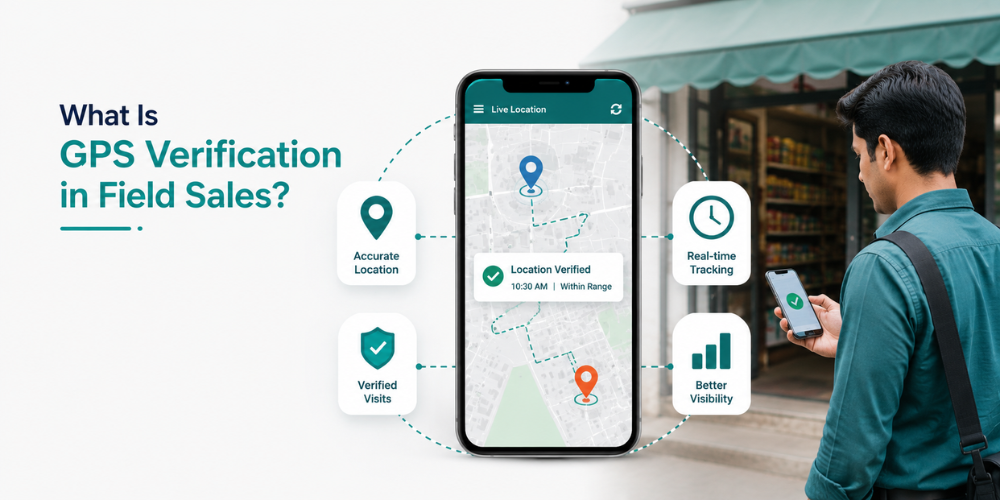
A reliable GPS verification system validates multiple aspects of a field visit, including:
- The employee's exact GPS coordinates
- The distance between the employee and the assigned customer location
- The date and time of check-in and check-out
- The duration of the visit
- Duration of the visit to the location
- Supporting evidence like visit pictures or activity logs
When these data points are combined, businesses can be confident a visit occurred at the right place, at the right time.
Today, most organizations automate this process with a field sales tracking app. Managers now have accurate, location-based records of every customer interaction, instead of relying on manual reporting or check-ins. GPS verification, combined with GPS employee tracking, geofencing, and beat planning software, can be a powerful tool to increase accountability, improve field compliance, and ensure sales teams remain on their assigned schedules.
In today’s competitive business environment, GPS verification is not only a tracking tool anymore. It has become integral to managing productive, transparent, and compliant field operations.
Why Fake Locations Are Becoming a Serious Problem
Field sales teams are supposed to visit retailers, distributors, and customers as per the schedule allotted to them. Location data is used by managers to verify these visits, measure output, and check compliance. But as GPS tracking apps become more widely available and flaws in traditional location tracking systems are exposed, fake check-ins are becoming an increasing problem for businesses across industries. However, when employees can falsify their location or take advantage of inaccurate GPS verification systems, the data collected becomes unreliable.” This impacts not only attendance records but also customer coverage, sales performance, expense reporting, and operational decision-making. As businesses increasingly rely on digital field reporting, it has become critical to ensure that each location update is real.
Here are some of the most common ways fake locations affect field operations.
-
Employees Can Check In Without Visiting the Customer
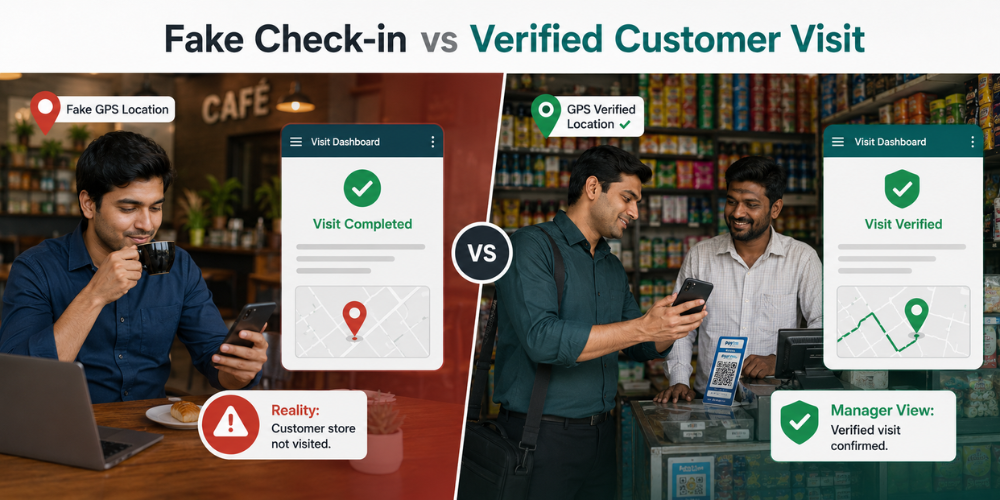
One of the toughest things about weak GPS verification is that employees can do attendance marking or customer visits without even reaching the assigned location. This can be achieved either through GPS tracking apps or by exploiting systems with weak location validation. If managers are working with inaccurate check-in information, they might believe retailers have been visited when no interaction has taken place. Field sales tracking apps with precise GPS verification also help to ensure check-ins are logged only when employees are physically at the assigned customer location.
-
Customer Visits Become Difficult to Verify
A completed visit report doesn't always mean a successful customer visit. If a business can’t know where a field executive was at the time of the visit, they have no way of knowing if the interaction actually happened. This presents challenges for businesses that rely on regular retailer visits for product demonstrations, merchandising, or order collection. Features like Customer Visit Tracking and GPS-based verification enable managers to be more confident that each visit reported is real.
-
Fake Data Leads to Poor Business Decisions
Decision-making by sales managers Sales managers use field activity reports for taking important decisions. They use visit data to measure productivity, identify the best territories, allocate funds, and forecast sales. When location data is not precise, these reports become confusing. Employees who don’t make their customer visits can look productive, and managers can miss areas where they need to provide more support. Reliable GPS verification can also improve the quality of field data, enabling businesses to make informed decisions based on genuine customer interactions rather than inaccurate reports.
-
Expense Fraud Becomes Easier
Many companies pay employees for their travel based on the number of miles they drive or the number of customer visits they make. Field visits cannot be verified, so employees can claim expenses for trips they never took. When you combine a GPS verification with an expense reporting system, it allows businesses to verify travel claims against actual visit records and GPS history. This helps to reduce fraudulent reimbursements and promotes transparency in expense reporting.
-
Routes and beat plans are not followed
Typically sales people are assigned daily routes to cover the entire market. Some employees may mark their beat plan as complete without proper verification, still skipping retailers. Beat planning software with GPS verification lets managers compare planned visits with actual movement. This helps to ensure that field teams stay on their routes and consistently cover customers.
-
Retail Execution Takes a Hit
For FMCG, consumer goods and distribution businesses, every store visit is an opportunity to check stock availability, monitor product displays, collect orders and build retailer relationships. no matter what the reports may say, skipping customer visits simply does not allow these activities to occur. A GPS-enabled Retail Execution App helps ensure that merchandising activities, store audits and promotional compliance are conducted at the right retail locations.
-
Trust in Field Reports Declines
The worst effect of fake locations is the loss of trust in field data. Managers don’t know where their employees are and that means that every attendance report, customer visit and sales report is doubted. By using a solid GPS-based employee location tracking solution combined with geofencing, real-time location updates and visit verification, managers can create a transparent system they can trust the data to evaluate performance and improve field operations.
The Hidden Cost of False Field Compliance
There is much more to false field compliance than fake check-ins and inaccurate attendance records. When businesses rely on bad location data, the entire business suffers. A few unverified field activities can have a big impact over time, from lost sales opportunities and increased operational costs to eroded customer relationships and unreliable performance reports. Managers assume that visit reports are accurate records of the work performed in the field. But if those reports are based on manipulated GPS data or weak verification systems, then important business decisions are made based on false information. This affects not only day-to-day operations; it also limits a company’s ability to improve sales performance and field productivity.
These are just some of the hidden costs a business incurs when it cannot accurately verify field compliance.
-
Missed Opportunities and Reduced Sales Coverage
When a customer visit is skipped and marked as completed, the retailers receive less attention than planned by field representatives. Missed visits often translate into missed orders, delayed follow-ups, and weaker customer relationships. Changing market coverage over time can erode customer satisfaction and provide openings for competitors to gain a foothold. Beat planning software and field sales tracking apps help businesses to ensure that all the assigned outlets are being visited as per schedule, providing better coverage of territory and improving sales performance.
-
Analysis of Poor Performance
Sales managers use field reports to measure employee productivity, client engagement, and territory performance. These reports no longer reflect actual field activities if location data is inaccurate. This can result in top performers not being recognized and those who routinely skip visits appearing equally productive. This makes it difficult to identify training needs, reward top performers, or improve overall team performance.
-
More Travel & Expense Fraud
Reimbursements for travel are an unfortunate part of managing field teams and can become a costly, unnecessary expense when employee locations cannot be verified. Without proper GPS verification, employees could file mileage claims or travel expenses for customer visits that did not happen. Even small mistakes accumulate over hundreds of field visits per month.
-
Bad Retail Execution
For FMCG, pharma, and consumer goods companies, a store visit is more than an order-taking exercise. Field representatives also perform inventory checks, product display audits, promotional material audits, and market intelligence gathering. And these activities are not fulfilled when visits are skipped, contrary to what reports may say. This leads to inconsistent brand visibility, stock problems, and poor in-store execution.
-
Business Reports You Can't Trust
Accurate field data is essential for sales forecasting, resource planning, territory management, and strategic planning, all critical business decisions that business leaders depend on. These reports cannot be trusted when field compliance is based on fabricated or partial location data. Bad information results in bad forecasting, poor territory planning and ineffective resource allocation.
-
Reduced Accountability in the Field Team
When employees see that fake check-ins and missed visits are typically not punished, accountability will gradually degrade. This can lead to inconsistent work habits over time and make it harder for managers to keep operational discipline.
-
Decreased Customer Satisfaction and Brand Trust
Customers expect regular visits, prompt collection of orders and consistent support from field representatives. If the field is falsely compliant, scheduled visits may be missed resulting in delays, unresolved issues, or a lack of client engagement.
Why Laggy Geofencing Creates Compliance Issues
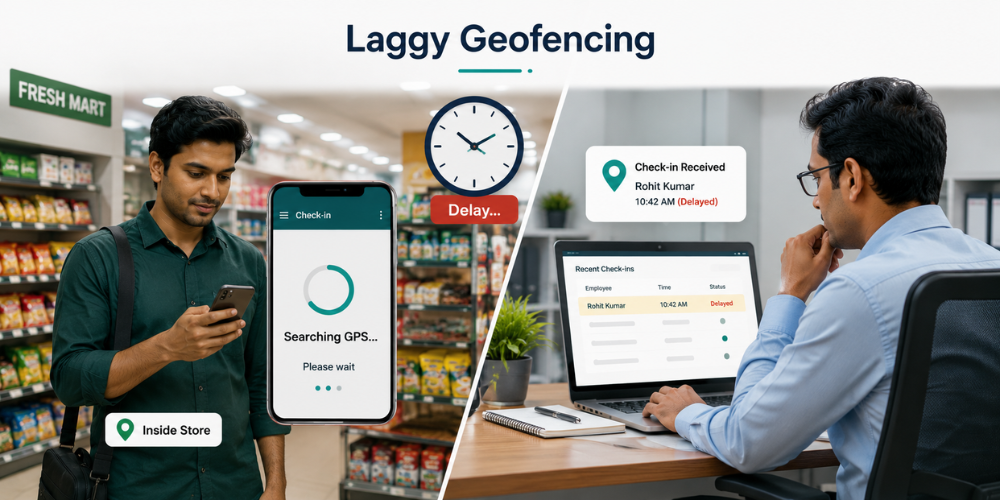
Geofencing is a must-have feature in today’s field sales automation software as it helps businesses to ensure that the employees are physically present at the assigned customer location before they mark their attendance or complete a visit. Geofencing establishes a virtual perimeter around a retailer, distributor, or client location, adding an extra layer of accountability to field operations.
Let's look at the most common compliance issues caused by laggy geofencing.
-
Delayed Check-Ins Reduce Field Productivity
Here are the most common compliance issues caused by laggy geofencing. ee is in the delayed check-ins impact field productivity. Away, field reps may have to wait a few minutes for the system to allow them to record their visits. A few minutes may not seem like much, but they can add up over the course of several customer visits in one day. Sales reps lose valuable selling time, customer appointments run late, and productivity suffers all around.
-
Big Geofence Radius Weakens Location Verification
Geofencing is used to verify that an employee has arrived at the customer’s location. But a virtual boundary that is too large may also mean employees check in from a street, parking lot, or neighboring shop close by, rather than at the retailer they’re working at. Field compliance is weakened because the managers can’t be sure the customer interactions actually occurred. The good news is that today’s field sales solutions use optimized geofence settings that balance GPS accuracy with the realities of the world, allowing businesses to improve the integrity of customer visit records.
-
Wrong Compliance Errors Due to Poor GPS Accuracy
GPS signals are not always perfect. Dense urban environments, indoor retail stores, warehouses, high-rise buildings, and poor satellite visibility can all affect location accuracy. As a result, employees who are physically present at the customer location may appear several meters outside the geofence. This can prevent legitimate check-ins and create unnecessary compliance issues for both employees and managers.
-
Weak Internet Connectivity Delays Location Updates
Mobile network coverage is often poor in locations where field employees travel. When internet connections are poor, GPS data might not sync with the server immediately, causing attendance records to be delayed or customer visits to be incomplete. The lack of offline capabilities may force employees to re-check in or manually report visits they have already made later, increasing administrative work and reducing reporting accuracy.
-
Planned Routes Prove Difficult to Confirm
Sales managers use geofencing to validate that customers have been visited and to ensure reps are staying on their assigned daily routes. If geofence detection is not reliable or is delayed, it can be hard to know if employees actually stopped at all of their scheduled stops. This impacts route planning, territory management, and overall field compliance.
-
Lower Compliance Leads to Unhappy Employees
The idea behind technology is to simplify field operations, not make them more difficult. If employees are consistently late checking in, their attendance is not logged or their location is identified incorrectly, they may become frustrated with the system. Over time, this frustration can reduce user adoption, encourage workarounds, and negatively impact compliance. A good geofencing solution should offer fast location detection, accurate GPS verification, and a smooth user experience so employees can focus on serving customers instead of troubleshooting technology.
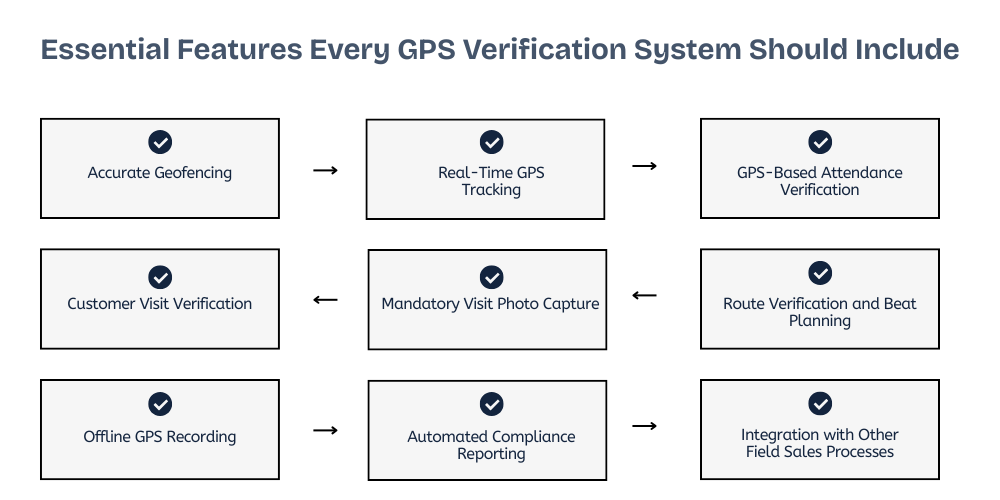
Essential Features Every GPS Verification System Should Include
Different GPS verification systems do not provide the same accuracy and reliability. Basic GPS tracking is available in many field sales applications, but this alone does not ensure genuine customer visits or field compliance. Businesses need a solution that can track employee locations and validate them through multiple layers of validation.
A good GPS verification system should enable managers to answer three key questions:
- Was the employee assigned to the customer site?
- Were they done with the visit on time?
- Is there sufficient evidence to prove the visit actually took place?
These features are crucial for building a transparent, accountable, and efficient field sales operation.
Accurate Geofencing
The first line of defense against fake check-ins is geofencing. The good system creates a virtual perimeter around each customer location and only permits employees to check in when they are within the approved range. But precision matters. If the geofence radius is set too large, employees may be able to check in without ever making it to the retailer. If it is too small, real visits can be ignored due to small GPS differences. The smart geofencing system finds the right balance, allowing businesses to improve field compliance and reduce false check-ins.
GPS tracking in real time
Knowing where your field team is during the day makes it easier for managers to keep track of progress, respond to unexpected delays, and ensure that planned routes are being followed. The advanced Live Location Tracking feature allows you to track the employee’s movement in real-time, which helps you to cross-check the visits of customers and any deviation in routes. Today’s managers can base decisions on real-time field activity, not end-of-day reports.
GPS-Based Attendance Verification
Attendance should be more than just tracking when an employee clocks in or out. A GPS verification system should be able to verify the physical presence of the employees at their assigned work location before marking attendance. GPS attendance with location verification helps to eliminate buddy punching, remote attendance, and false work-hour records while enhancing accountability of your workforce.
Customer Visit Verification
Each customer visit completed should have some proof that the employee actually visited the customer. Simply completing a visit is not enough. A complete customer visitation tracking system captures critical information such as:
-
GPS coordinates.
-
Check-in / Check-out times
-
Length of visit
-
Information about customers
-
Activity log
-
Visit status.
This information enables managers to confirm that every customer interaction took place as expected.
Mandatory Visit Photo Capture
Adding photo verification can reinforce your GPS-based compliance with visual proof that your employee was at the assigned location. For example, during each visit field representatives can take pictures of product displays, merchandising activities, store shelves, or customer premises. Mandatory visit photos, coupled with GPS coordinates and timestamps, make it much more difficult to send in false visit reports.
Route Verification and Beat Scheduling
GPS verification is even more valuable when integrated with sales route planning software. Businesses can assign daily routes and schedules for visiting customers and sales territories while tracking whether employees actually are following those plans. Managers can compare planned visits against actual travel history to identify missed retailers, unnecessary route deviations, or incomplete beat coverage. This enhances compliance and operational efficiency.
Offline GPS Recording
Field teams often operate in areas where internet connectivity is poor or intermittent. The GPS verification system should be able to collect location data when the device is not connected to the network. An offline field sales app allows employees to record attendance, customer visits, and GPS locations without any interruption. Once the internet connection is recovered, the system will automatically synchronize all the recorded data so that no field activity is lost.
Automated compliance reporting
The only way GPS data is useful is when you can translate it into useful information. A good GPS verification system should automatically output reports that show:
-
Compliance with attendance
-
Customer call complete
-
Missed/Skipped Appointments
-
Route changes
-
Time spent at each place
-
Field activity daily
-
Output of employees
Automation of reporting reduces the need for manual monitoring and helps managers quickly spot compliance problems before they have an impact on business performance.
Integration with Other Field Sales Processes
GPS verification should not be a feature of its own. It’s much more powerful when combined with other field sales processes like order management, expense management, retail execution, and sales team performance tracking. For example, managers can check that an order was placed after a verified customer visit or check travel expense claims against GPS records. This creates a connected workflow with the correct location data underpinning every field activity.
How Delta Sales App Solves the GPS Verification Problem
Effective GPS verification is more than just showing an employee’s location on a map. Businesses need a solution that can verify where the employees are, that the customer visits actually happened and give managers full visibility into field operations to build real field compliance.
Delta Sales App solves these issues with GPS verification and smart field sales automation features. Instead of depending on a single GPS signal, the platform uses geofencing, live location tracking, customer visit verification, beat planning and attendance management to deliver a more accurate and transparent field reporting system.
Here’s how Delta Sales App overcomes common challenges of GPS verification for businesses.
Smart Geofencing Stops Fake Check-Ins
False field compliance is often a result of being able to check in without actually making it to the designated customer site. The Delta Sales App employs smart geofencing to establish virtual boundaries around customer sites, enabling employees to log visits only when they’re actually in the area. This greatly reduces the number of fake check-ins and helps managers to make sure that field representatives have physically reached the retailer before they complete their activities.
GPS-Based Attendance Improves Workforce Accountability
Attendance records are often the first clues to field activity. With GPS location, Delta Sales App verifies employee attendance. This ensures that representatives mark their attendance from authorized locations and not from a remote or wrong location. This GPS based attendance system helps businesses to reduce attendance fraud, increase workforce accountability and keep accurate employee records without manual interventions.
Live Location Tracking Provides Real-Time Visibility
-1784522880.png)
It makes it easier for managers to manage a distributed field team if they can see where their employees are moving throughout the day. The live location tracking feature of the Delta Sales App lets supervisors see where their field reps are in real-time and track their progress in the territories they’ve been assigned. This visibility enables managers to quickly spot route deviations, delayed visits, or missed customer appointments and act before they impact business operations.
Customer Visit Tracking Confirms Every Visit
Simply showing up somewhere does not mean that meaningful work has been done. Delta Sales App enhances compliance with customer visit tracking, which records detailed information for each visit, including:
-
GPS coordinates.
-
check in and check-out time
-
Length of visit
-
Information about customers
-
History of Activity
-
Visit status.
This helps field reports to be more accurate and reliable, providing businesses with credible proof of customer interactions.
Beat Planning Ensures Complete Market Coverage
One of the most common challenges in field sales is to go past the scheduled retailers. The Delta Sales App’s Beat Planning Software provides managers with the ability to build structured daily routes and customer visit schedules and track if employees make every planned visit. By comparing planned routes with actual visit records, businesses can improve territory coverage, reduce missed visits, and ensure sales reps are working their assigned beats.
Mandatory Visit Images Add an Extra Layer of Verification
To drive further compliance in the field, the Delta Sales App now supports mandatory image capture when visiting customers. During their visits, employees can take pictures of the store displays, the product shelves, the merchandising activities, or the customer premises and upload them. This too, as well as GPS coordinates and time stamps, offers more proof that the visit did take place on the specified site.
Offline Functionality Keeps Field Operations Running
Field reps often work in areas with poor or spotty internet connections. Delta Sales App offline field sales app functionality allows employees to record attendance, customer visits, and orders without network access. When the connection is restored, all data is automatically synchronized with the system so no field activity is lost due to temporary network issues.

Automated Reports Help Managers Monitor Compliance
The only reason to collect location data is if you can translate it into useful information. The Delta Sales App will generate reports that will help managers to monitor:
- Employee attendance
- Customer call complete
- Employee attendances
- Route changes
- Time in customer locations
- Field productivity per day
These reports reduce manual tracking and help businesses quickly identify compliance issues and improve field performance.
Conclusion
GPS tracking alone no longer ensures field compliance. As businesses become more dependent on location-based reporting, problems like fake GPS locations, delayed geofencing, and inaccurate check-ins can compromise productivity, distort performance data, and harm customer relationships.
The answer is to farm the field more intelligently. With smart geofencing, live location tracking, customer visit tracking, and beat planning, businesses can verify every field activity with accuracy, improve workforce accountability, and make better decisions with accurate data.
The Delta Sales App integrates all these capabilities into one field sales automation app to help businesses eliminate fake check-ins, streamline field operations, and gain complete visibility into their sales teams. Whether you manage a small sales force or a large distributed workforce, the right technology can transform how you track, manage, and optimize field performance.
If you want a smarter way to verify customer visits, track field employees in real-time, and do away with fake location reporting, Delta Sales App can help.
Book a free demo today and see how our GPS-powered field sales automation solution can help your business improve field compliance, increase productivity, and build a more accountable sales team.