
5 Types of Sales Managers and Their Roles in a Field Sales Organization

Managing a field sales organization gets harder when the team grows. More representatives mean territories, more regions, more distributors, and more customer accounts. A sales manager who can coach ten reps in one territory might find it tough to do the same for a hundred reps spread across regions. The challenge isn’t size; it’s about keeping the same level of support and guidance no matter how big the team gets.
This is why field sales organizations often split up management duties among different sales manager roles. National sales managers take a view of the entire sales operation. Regional managers oversee performance across geographic areas. Area managers handle groups of territories. Territory managers work directly with field representatives. Key account managers focus on customers that are especially important to the business.
The exact titles can be different across companies. In some places, an area sales manager might handle duties that usually go to a territory manager. In some companies, key account management might not be part of the regular field sales structure. What really matters is not the title itself. The ownership, the decision-making power, and the level of responsibility for customers or territories. For FMCG companies, distributors, manufacturers, and wholesalers, these differences are especially important. Field performance isn't about closing sales. Managers must also track beat plans, secondary sales, primary sales, distributor stock levels, SKU coverage, outlet visits, collections, retail execution, and territory productivity.
This blog explains the five common types of sales managers in a field sales organization, what each role owns, the metrics they typically track, and how the roles work together as a sales team grows.
What a Sales Manager Does in a Field Sales Organization
A sales manager has to turn the company's sales goals into actual action on the ground. That means telling the team what's expected, dividing up the areas they'll cover, tracking how well they're doing, and stepping in with help and advice when it's needed. The manager also handles whatever operational problems come up and makes sure the team stays focused on the right customers and the tasks that actually matter.
In a field organization, the role goes well beyond reviewing a monthly sales report. Managers need real visibility into what's happening during customer visits and whether planned activities are actually getting completed.
A territory can show a sales decline, for instance, but the underlying issue could be poor route coverage, missed outlets, low SKU distribution, distributor stock shortages, weak collections, or inconsistent attendance from the rep. A manager needs enough operational visibility to find the actual problem before touching targets or just pushing the team to work harder. And the scope of that responsibility shifts depending on where a manager sits in the hierarchy.
How Field Sales Management Differs From Inside Sales Management
Inside sales teams generally operate through calls, emails, online meetings, and digital sales processes, and their managers can usually review call activity, conversation records, emails, and pipeline stages from one centralized system.
Field sales management carries an extra layer of complexity, since reps are physically scattered across markets. A field sales manager has to answer questions that look nothing like an inside sales review: which outlets got visited today, did reps actually follow the planned beat, how many productive calls happened, which SKUs got ordered, what was the secondary sales value, which customers still have outstanding collections, how much ground did reps actually cover, which areas have poor outlet coverage, did a rep really visit the customer they reported, and is distributor stock sufficient for current demand. That's exactly why location visibility, visit tracking, route planning, attendance, order reporting, and territory-level analytics matter so much in field sales management.
The 5 Types of Sales Managers in a Field Sales Organization
The types of sales managers typically differ by the size of the market, geographic area, customer responsibility, and level of field execution they oversee. While titles and reporting structures vary between organizations, each role has a distinct focus, from setting national sales strategy to managing territories and key customer accounts. Understanding these roles helps define clear ownership as a field sales organization grows.
1. National Sales Manager
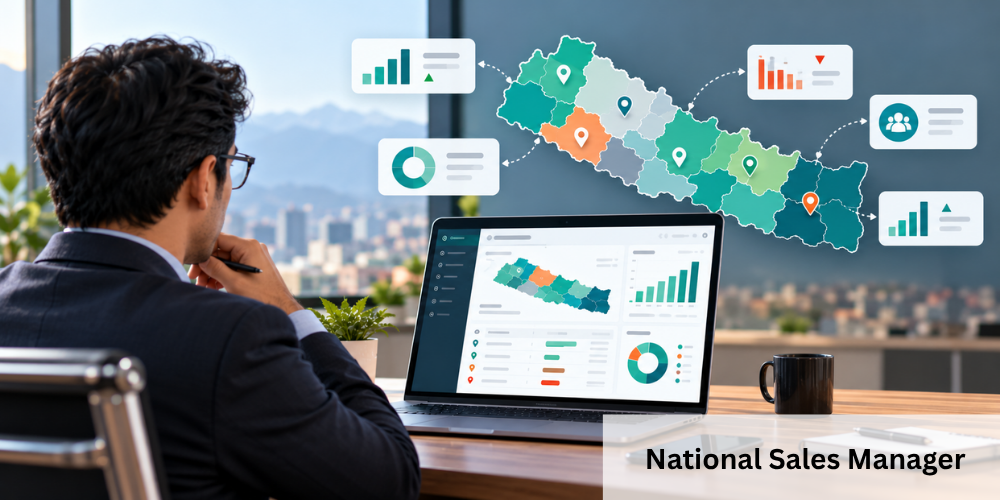
The national sales manager has the broadest sales responsibility. This role typically owns the organization's sales strategy and performance across the country or national market. In an FMCG organization, the national sales manager may oversee multiple regions, distribution networks, product categories, and sales teams. The role is generally focused on business-level performance rather than managing individual daily visits.
What the Role Owns
The national sales manager typically owns the overall sales target, national sales strategy, channel performance, distribution expansion, and high-level sales planning. Responsibilities may include:
-
Setting national sales targets
-
Defining channel and market strategies
-
Allocating targets across regions
-
Reviewing primary and secondary sales
-
Monitoring national distribution coverage
-
Evaluating regional performance
-
Planning sales force expansion
-
Coordinating with marketing, finance, supply chain, and senior leadership
-
Identifying underperforming markets
-
Reviewing distributor and channel performance
For FMCG businesses, national-level decisions can also involve product mix and SKU priorities. If one product category is growing strongly in one region but underperforming in another, the national sales manager needs enough data to determine whether the issue is demand, distribution, execution, pricing, or availability.
Metrics They Track: national sales revenue, target achievement, primary and secondary sales, sales growth, distribution coverage, market or channel performance, gross margin, SKU performance, distributor performance, collection performance, and region-wise productivity. A national manager generally needs summarized dashboards rather than individual visit records, though the ability to drill down into lower-level data becomes valuable the moment a market starts underperforming.
2. Regional Sales Manager
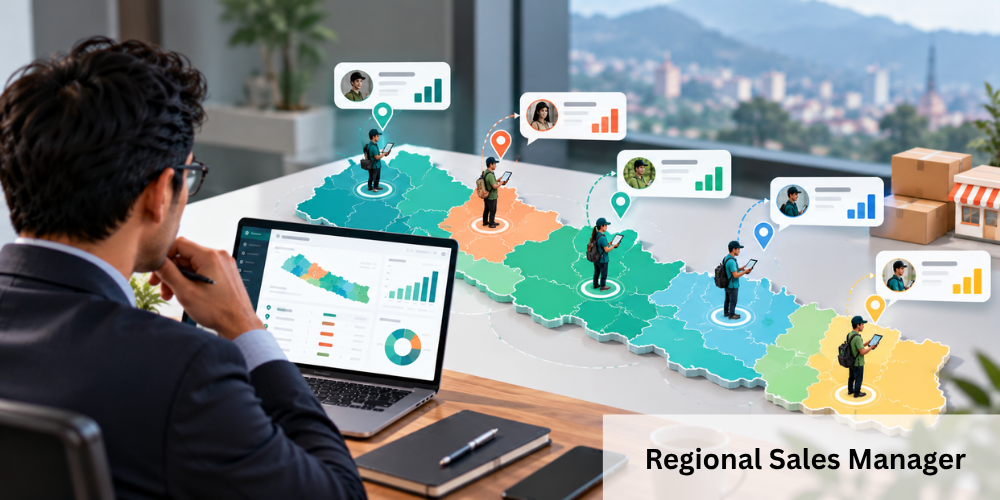
A regional sales manager manages sales performance across a defined geographical region. Depending on the organization, a region could cover several states, provinces, zones, or major markets. The regional manager converts national strategy into regional execution and manages the performance of area sales teams.
What the Role Owns
The role commonly owns regional targets, sales plans, distribution growth, regional team performance, and execution consistency. Responsibilities may include:
-
Breaking regional targets into area-level targets
-
Reviewing area sales performance
-
Monitoring distributor networks
-
Identifying territory gaps
-
Supporting major customer opportunities
-
Coaching area sales managers
-
Reviewing route and territory productivity
-
Managing regional sales forecasts
-
Coordinating inventory requirements
-
Escalating operational issues to national leadership
A regional manager should be able to identify patterns across multiple areas. If several territories are missing targets because of low outlet coverage, the problem may require a regional intervention rather than individual rep coaching.
Metrics they track: regional target achievement, sales growth by area, primary and secondary sales, active outlets, numeric distribution, SKU-wise performance, distributor productivity, collection efficiency, territory coverage, area manager performance, and sales force productivity. Regional managers benefit most from dashboards that let them move between high-level regional numbers and individual areas when they need to investigate a performance gap.
3. Area Sales Manager
The area sales manager sits closer to field execution. The role typically manages several territories and works directly with territory-level managers or sales representatives, depending on the company's structure. This is often one of the most operationally important management positions in an FMCG field sales organization.

What the Role Owns
An area sales manager commonly owns target achievement across an assigned area, distributor relationships, territory performance, field execution, and coaching. Responsibilities may include:
-
Assigning and reviewing territory targets
-
Monitoring beat coverage
-
Reviewing representative performance
-
Checking distributor stock
-
Improving outlet penetration
-
Coaching field representatives
-
Reviewing DSRs
-
Monitoring collections
-
Identifying low-performing territories
-
Supporting retail execution
-
Reviewing route efficiency
For example, if representatives are technically achieving visit counts but secondary sales remain weak, the area manager may need to examine productive calls, SKU-level ordering, outlet potential, and sales conversion rather than simply asking the team to make more visits.
Metrics they track: area sales achievement, daily sales, productive calls, outlet coverage, beat adherence, SKU distribution, order value, collection value, distributor stock, rep productivity, attendance, and route adherence. This level benefits the most from detailed field data, since area managers are the ones actually responsible for turning those numbers into specific action.
4. Territory Sales Manager
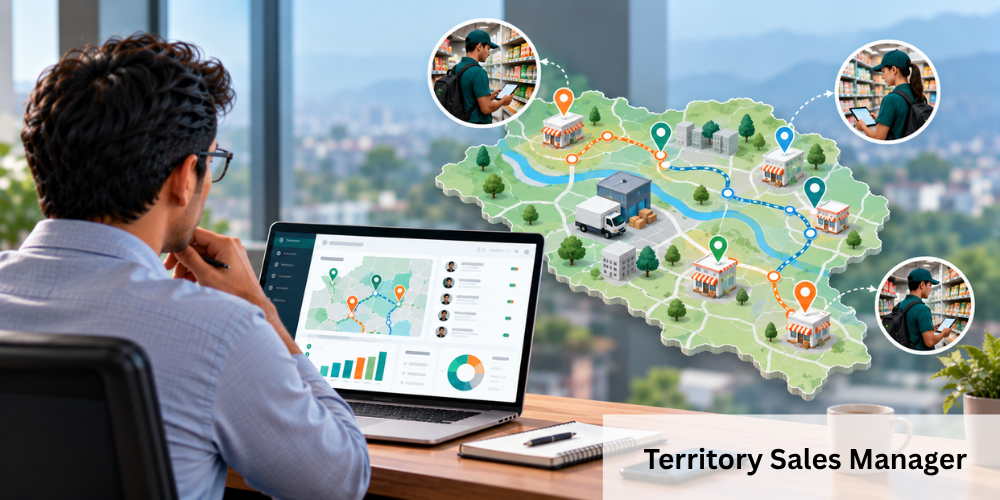
The territory sales manager is closest to day-to-day field execution. In some companies, this position may be called a territory manager, sales officer, or field sales manager. The role typically manages a smaller geographical territory and works directly with sales representatives, retailers, distributors, or customers.
What the Role Owns
The territory sales manager is generally responsible for making sure the assigned territory is properly covered and that representatives execute the planned sales activities. Responsibilities may include:
-
Managing daily territory performance
-
Reviewing beat plans
-
Monitoring customer visits
-
Coaching representatives
-
Tracking orders and collections
-
Managing retailer relationships
-
Checking retail execution
-
Identifying new outlets
-
Monitoring SKU availability
-
Following up on missed visits
-
Reviewing DSR submissions
The territory manager often has the clearest view of what is actually happening in the market. A dashboard may show declining sales, but the territory manager can connect that decline with specific outlets, distributors, routes, products, or representatives.
Metrics they track: daily sales, productive calls, planned versus completed visits, order value, collection value, outlet coverage, beat adherence, SKU-wise sales, new outlet additions, visit frequency, attendance, travel distance, and retail execution compliance. At this level, metrics need to translate directly into action. Knowing coverage dropped is useful. Knowing exactly which beat got missed and which outlets were affected is far more useful.
5. Key Account Manager
The key account manager focuses on strategically important customers rather than managing a broad geographical hierarchy. A key account may be a national retail chain, large distributor, supermarket group, institutional buyer, hotel group, or another customer that contributes significant revenue or has strategic importance.

What the Role Owns
The key account manager typically owns the commercial relationship and growth of assigned strategic accounts. Responsibilities may include:
-
Managing account relationships
-
Negotiating commercial terms
-
Developing account plans
-
Managing order cycles
-
Reviewing sales performance
-
Coordinating promotions and schemes
-
Monitoring product availability
-
Managing payment and collection issues
-
Identifying cross-selling opportunities
-
Coordinating internal teams for account requirements
Unlike a territory manager, the key account manager may spend less time thinking about total geographic coverage and more time understanding the individual account's purchasing behavior, sales history, SKU mix, profitability, and growth opportunities.
Metrics they track: account revenue, account growth, order frequency, average order value, SKU penetration, gross margin, collection cycle, outstanding payments, promotion performance, customer retention, and share of account. For key accounts, historical order and customer data matter especially, since decisions here tend to hinge on trends over time rather than a single day's field activity.
How the Five Roles Work Together
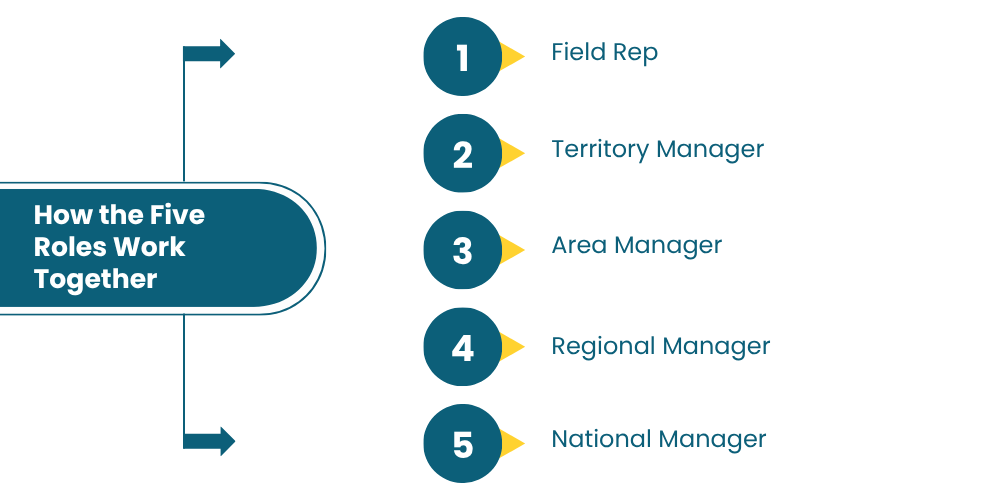
These five roles can't operate as separate sales islands and expect anything to work. Their effectiveness comes down to clear reporting lines, consistent data, and defined ownership across the chain. A national manager might spot a national sales gap. The regional manager figures out which region's driving it. The area manager narrows it down to the affected territories, and the territory manager pinpoints which beats, outlets, reps, or products are actually responsible. That whole chain only works when information actually moves reliably between each level of management.
-
Reporting Lines and Handoffs Between Levels
A typical reporting flow starts at field-level activity and moves upward from there. Sales reps record visits, orders, collections, attendance, and expenses. Territory managers review execution. Area managers compare territory performance. Regional managers evaluate the trends across areas, and the national manager looks at the business as a whole. That handoff shouldn't mean someone manually preparing a fresh report at every level. A field rep completing customer visits should generate the underlying activity data once, and territory and area managers should be working off that same information for their respective decisions, not a reconstructed version of it. That's what actually cuts the risk of different managers working from different versions of the same DSR or sales report.
-
Who Owns Targets, Territories, and Coaching
Clear ownership is what prevents management overlap. The national manager generally owns national targets and strategic direction. Regional managers break those targets down across regions. Area managers translate them further into area and territory expectations. Territory managers handle day-to-day execution and coaching. Key account managers own the commercial relationship and performance of their assigned strategic customers. Coaching should happen as close to the field as possible. A national manager might spot a regional productivity problem, but a territory manager is almost always better positioned to actually coach a rep on beat planning, outlet visits, order booking, or retail execution.
Which Sales Manager Roles Your Team Needs
Not every field sales organization needs all five types of managers. Adding management layers too early just increases overhead without actually improving field execution. The right structure depends on rep count, geographic spread, product complexity, channel structure, and how concentrated the customer base is.
1. Roles to Add at 10–25 Reps
A team with 10 to 25 field reps usually doesn't need a large management hierarchy. One sales manager can often oversee the whole team directly, especially when reps are working within a concentrated geography. If the team's already spread across several markets, an area-level manager starts to make sense. At this stage, the priority should be strong field visibility and clear accountability, not adding titles for the sake of it.
2. Roles to Add at 25–100 Reps
As the team approaches 25 to 100 reps, direct management starts getting genuinely hard. A common move at this stage is introducing area- or territory-level managers who take responsibility for smaller groups of reps. A regional manager starts to make sense once the organization's operating across several major markets. This is also the point where management systems become increasingly important, since spreadsheets and manually consolidated DSRs stop being something anyone can keep consistent at this scale.
3. Roles to Add Across Multiple Regions or Countries
Organizations operating across multiple regions or countries generally need regional or national-level management at that point. Geographical complexity brings different sales conditions, distributor structures, customer preferences, product mixes, and regulatory considerations with it. Regional managers are what let national strategy actually adapt to local markets while keeping overall targets aligned.
4. Hunter and Farmer Profiles: Which Fits Each Role
Sales managers also differ by selling orientation. A hunter focuses on new opportunities, new distributors, new outlets, and market expansion, which is valuable in territory expansion or new-market roles. A farmer focuses on existing relationships, account growth, retention, collections, and deeper SKU penetration, and key account managers usually need strong farmer instincts. Plenty of field management roles need a mix of both. What actually matters is matching the person's natural strengths to the commercial responsibility the position demands, not forcing one type into the wrong role.
How Field Sales Software Supports Each Manager
The right field sales management software doesn't replace sales management. It gives managers the operational visibility they need to make better decisions, instead of relying entirely on phone calls, spreadsheets, or end-of-day updates. For a field organization, the real value comes from connecting activity data: visits, orders, collections, attendance, routes, expenses, and customer information into one picture instead of five disconnected ones.

-
Live Rep Visibility for National and Regional Managers
National and regional managers usually don't need to monitor every rep continuously. What they need is a reliable way to spot the exceptions. GPS-based employee location tracking and real-time dashboards let managers see where teams are operating, review territory activity, and catch unusual gaps in field coverage. Instead of chasing multiple managers for updates, leadership can drill straight from national performance into regional and area-level results the moment a problem shows up.
-
Beat Plans and Visit Tracking for Area and Territory Managers
Area and territory managers need more granular information than that. Beat planning organizes which outlets reps should visit and when, and visit tracking shows whether those planned customer calls actually got completed. That's what makes it possible to catch missed outlets, inefficient routes, low-coverage beats, and productivity gaps before they drag on for weeks. For field teams working in areas with inconsistent connectivity, offline-first functionality matters a lot here too. Reps can keep recording orders and field activity and sync it all once the connection comes back, instead of losing the day's work to a dead zone.
-
Account History and Order Data for Key Account Managers
Key account managers need a different view of field data entirely. Customer history, previous orders, SKU-level purchases, collection information, and account performance together are what reveal shifts in purchasing behavior and real opportunities for account growth. Instead of looking at orders in isolation, the manager can see account-level patterns: which products are growing, which are declining, and which have quietly dropped out of the customer's usual order mix.
-
Expense and Reimbursement Tracking for Field Teams
Field sales also generates real operational expenses: travel, customer visits, fuel, and other approved activity. Expense reporting within a field sales platform lets managers check submitted expenses against actual field activity while giving finance teams a far more structured record for reimbursement. That becomes especially valuable as teams expand across multiple territories, where manually collecting and verifying expense reports can eat up a surprising amount of management time on its own.
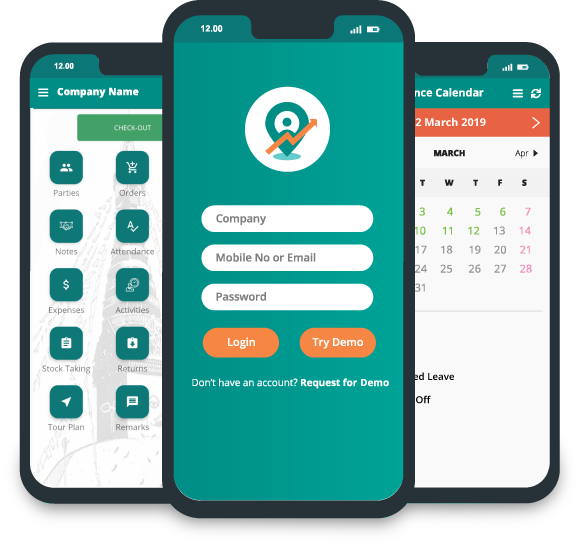
For organizations managing field representatives, distributors, and retail execution, Delta Sales App brings these activities into one field sales environment, including GPS-based employee tracking, beat planning, order and collection reporting, attendance, expenses, distributor management, retail execution, and sales dashboards.
Conclusion
A growing field sales organization doesn't need more managers just because the team is bigger. It needs clear ownership at every level. National, regional, area, territory, and key account managers each see sales performance from a different angle, but all of them depend on reliable field data and clean reporting lines to actually do the job.
As the organization expands, managing beat coverage, rep activity, orders, collections, distributor performance, expenses, and customer accounts through disconnected spreadsheets gets harder to sustain by the week. Field sales software gives each manager the level of visibility their role actually needs, from national sales trends all the way down to individual customer visits.
Delta Sales App brings field activities, sales reporting, employee tracking, beat planning, distributor management, attendance, expenses, and real-time dashboards into one platform, so managers spend less time chasing updates and more time acting on what the field data's actually telling them.
Book a free demo of Delta Sales App to see how field sales management can be organized across territories, teams, and customer accounts.