
The Complete Guide to Running a High-Performance Field Sales Team

Field sales remains one of the most powerful revenue engines for organizations that rely on direct customer engagement. Unlike inside sales, field sales operates in real-world environments where trust, relationships, and face-to-face interactions play a decisive role in conversions.
Modern organizations require structured systems to manage distributed field teams effectively. This discipline is commonly referred to as Outside Sales Management.
Without structured management, field sales becomes inconsistent, difficult to measure, and highly dependent on individual performance rather than system-driven outcomes.
What Defines a High-Performance Field Sales Team?
A high-performance field sales team is defined by consistency, efficiency, and conversion effectiveness, not just activity levels. It is built on disciplined execution, structured processes, and measurable outcomes that ensure every field effort contributes directly to revenue growth and market expansion.
Key characteristics include:
- High Daily Productive Visits: A strong field sales team consistently maximizes meaningful customer interactions each day through optimized planning, efficient routing, and prioritized visit scheduling.
- Strong Conversion Ratios: High-performing teams focus on quality engagement, ensuring every interaction is well-prepared, value-driven, and strategically aligned to close more deals.
- Efficient Territory Utilization: Effective teams divide regions intelligently, ensuring balanced workload distribution, reduced travel time, and maximum coverage of potential customers.
- Accurate and Timely Reporting: Reliable reporting systems ensure real-time visibility into field activities, enabling faster decisions, better forecasting, and improved sales control.
- Strong Accountability Across Team Members: Each team member takes ownership of targets, activities, and outcomes, ensuring transparency, discipline, and consistent performance tracking across all levels.
Such teams operate with clarity, every action has a defined purpose, and every customer interaction contributes to measurable business outcomes. They also rely on structured systems rather than improvisation, ensuring predictable performance across different geographies.
Core Challenges in Outside Sales Management
Despite its importance, field sales execution faces several operational challenges that directly impact productivity, visibility, and revenue consistency. These issues often arise due to lack of structured processes, weak system integration, and dependence on manual workflows within Outside Sales Management environments.
Lack of Real-Time Visibility
Managers often cannot track what field reps are doing during working hours, leading to poor decision-making, delayed interventions, and reduced control over field operations and daily sales activities.
Inefficient Territory Management
Unequal distribution of workload leads to burnout in some regions and underperformance in others, affecting overall sales coverage, customer engagement, and balanced revenue generation across territories.
Manual Reporting Systems
Delayed or inaccurate reporting reduces decision-making speed and accuracy, creating gaps between actual field performance and management visibility, which impacts forecasting and planning efficiency.
Limited Accountability
Without structured tracking systems, performance evaluation becomes subjective, making it difficult to measure individual contributions, enforce discipline, or maintain consistent sales execution standards.
Communication Gaps
Field teams and headquarters often operate in silos, reducing coordination efficiency, slowing down information flow, and impacting alignment between strategy and on-ground execution.
Key Pillars of Effective Outside Sales Management
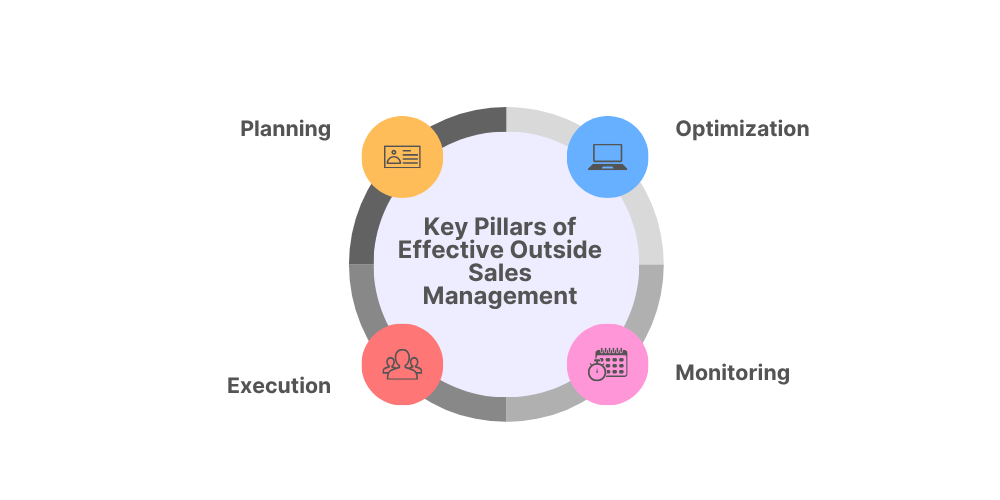
Effective field sales operations are built on four core pillars that ensure structure, consistency, and scalable performance across teams.
1. Planning
Planning defines territories, sales targets, daily routes, and execution strategies, ensuring field teams operate with clarity, direction, and measurable objectives.
2. Execution
Execution ensures disciplined field activity where sales representatives follow planned visits, engage customers effectively, and consistently drive revenue generating interactions daily.
3. Monitoring
Monitoring provides real-time visibility into field activities, helping managers track performance, improve accountability, and ensure alignment with planned sales operations.
4. Optimization
Optimization uses performance insights to refine strategies, improve efficiency, enhance routing, and continuously boost overall field sales productivity and effectiveness.
When these pillars are aligned, organizations achieve predictable and scalable sales performance with better control, visibility, and consistent revenue growth.
Sales Performance Measurement and Key KPIs in Field Sales
Sales performance measurement is the backbone of any scalable field sales operation. Without clear metrics, field activity becomes difficult to evaluate, and managers are forced to rely on assumptions rather than evidence. In structured field environments, performance is not measured by effort alone but by outcomes, efficiency, and consistency across defined key performance indicators (KPIs).
A well-designed performance measurement system helps organizations understand whether field teams are truly contributing to revenue growth or simply staying busy with low-impact activities. It also ensures alignment between strategic goals and on-ground execution, making field operations predictable and controllable.
Why KPIs Matter
KPIs transform field sales from an activity-driven function into a results-driven system. They provide visibility into what is working, what is not, and where corrective actions are required. More importantly, they create accountability at both individual and team levels.
In a structured sales environment, KPIs help managers:
- Track productivity across field representatives
- Identify high and low performers objectively
- Improve territory-wise performance visibility
- Optimize resource allocation and field coverage
- Align daily execution with revenue goals
Without KPIs, field sales teams often lack direction and operate without measurable benchmarks, making improvement inconsistent.
Key Field Sales KPIs
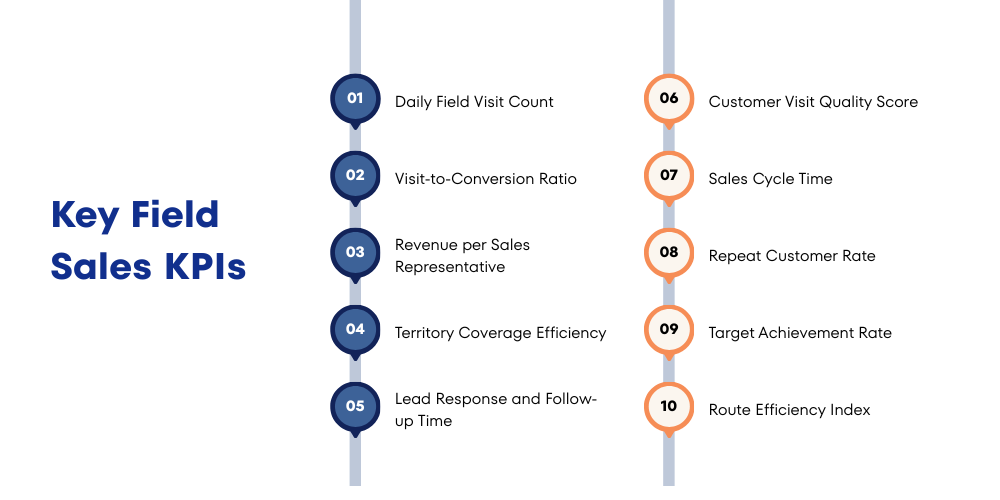
Below are the most critical KPIs used to evaluate and optimize field sales effectiveness:
1. Daily Field Visit Count
This KPI measures the number of customer visits completed by a sales representative each day. It reflects activity levels and field engagement intensity. However, it must be balanced with quality to avoid activity without impact.
2. Visit-to-Conversion Ratio
This metric evaluates how many visits successfully convert into orders or deals. It is one of the strongest indicators of sales effectiveness, highlighting the quality of customer interactions and selling capability.
3. Revenue per Sales Representative
This KPI tracks the total revenue generated by each field executive. It helps identify high-performing individuals and ensures fair comparison across team members working in similar territories.
4. Territory Coverage Efficiency
This measures how effectively a sales representative covers assigned geography and customer base. It ensures that no potential market is left under-served or ignored due to poor planning.
5. Lead Response and Follow-up Time
This KPI tracks how quickly field teams respond to assigned leads and follow up with prospects. Faster response times significantly increase conversion probability and improve customer experience.
6. Customer Visit Quality Score
Beyond counting visits, this metric evaluates the effectiveness of each interaction. It considers preparation, engagement depth, and outcome quality, ensuring that visits are meaningful and not just routine.
7. Sales Cycle Time
This measures the average time taken to convert a lead into a final sale. Shorter sales cycles indicate higher efficiency, better persuasion skills, and improved process alignment.
8. Repeat Customer Rate
This KPI reflects customer retention strength in field sales operations. High repeat rates indicate strong relationship management and consistent service quality delivered by the field team.
9. Target Achievement Rate
This measures the percentage of assigned sales targets achieved within a defined period. It is a direct indicator of overall performance alignment with business objectives.
10. Route Efficiency Index
This evaluates how effectively daily travel routes are planned and executed. Optimized route planning reduces travel time and increases productive selling hours in the field.
Territory Optimization for Sales Efficiency
Territory planning is the backbone of field sales efficiency and directly impacts productivity, coverage, and revenue outcomes. A well-structured approach to territory design ensures that field teams operate with clarity, balance, and maximum effectiveness across regions.
A well-designed territory structure ensures:
- Balanced workload distribution across sales representatives
Ensures fair allocation of customers and tasks among representatives, preventing burnout and improving overall team efficiency consistently. - Maximum market coverage without overlaps or gaps
Helps sales teams reach every potential customer area effectively while avoiding duplication of effort and missed opportunities in territories. - Reduced travel time leading to better efficiency and lower costs
Optimized routes minimize unnecessary travel, saving time, reducing operational costs, and increasing productive selling hours significantly every day. - Higher productivity per representative through optimized routing
Efficient route planning allows sales reps to visit more clients daily, improving output and boosting overall sales performance significantly.
Territories are typically segmented based on geography, customer density, and revenue potential to ensure equitable opportunity distribution. When done correctly, it strengthens sales territory management and improves overall execution consistency.
Poor planning, however, leads to inefficiencies such as missed opportunities, uneven performance distribution, increased travel effort, and lower sales productivity optimization, ultimately affecting revenue growth and field execution quality.
Building a Structured High-Performance Sales Team
A high-performing sales team requires structure, not just talent. Without a defined system, even skilled representatives struggle with consistency, accountability, and scalable execution in field sales operations.
Key elements include:
Defined Roles and Responsibilities
Clear role definitions ensure every team member understands their targets, ownership areas, customer segments, and execution expectations for improved sales productivity optimization.
Clear Reporting Hierarchy
A structured reporting system ensures smooth communication flow between field teams and managers, enabling better decision-making and stronger sales performance management.
Standard Operating Procedures (SOPs)
SOPs create consistency in daily activities, guiding field representatives on visit planning, customer engagement, and execution standards across all territories.
Performance Accountability Frameworks
Accountability systems ensure measurable outcomes, tracking individual performance, improving discipline, and strengthening overall sales accountability framework across teams.
Structure ensures consistency and allows organizations to scale operations across multiple regions without losing control, improving efficiency and supporting long-term sales growth strategy.
Training & Continuous Skill Development
Strong onboarding reduces ramp-up time and improves consistency in field sales execution across teams and territories.
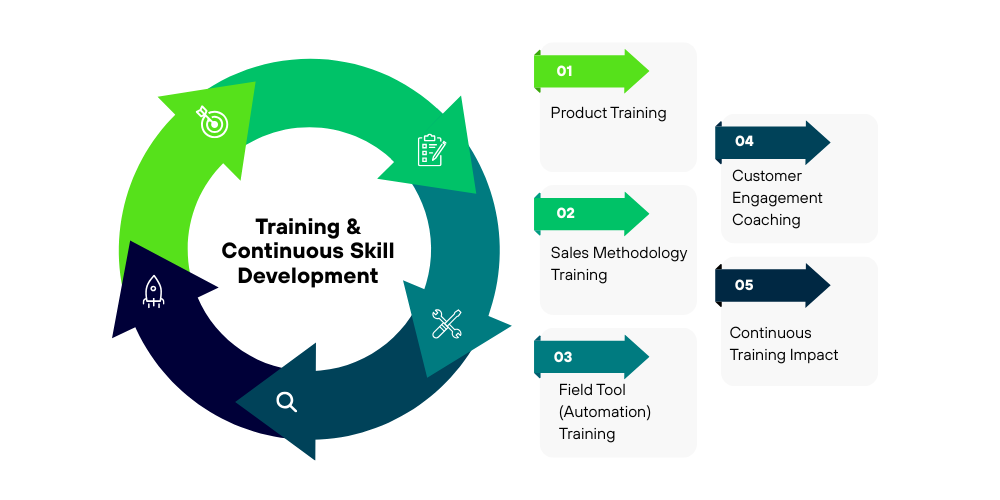
It includes:
Product Training
Ensures deep understanding of product features, benefits, positioning, and use cases, enabling confident communication and stronger customer trust during sales interactions.
Sales Methodology Training
Focuses on structured selling approaches, negotiation techniques, objection handling, and conversion strategies to improve overall deal closure rates and consistency.
Field Tool (Automation) Training
Trains teams on CRM and automation tools for reporting, tracking visits, managing leads, and ensuring real-time accurate field data updates.
Customer Engagement Coaching
Develops communication skills, relationship-building techniques, and consultative selling approaches to improve customer experience and long-term retention in field sales.
Continuous Training Impact
Continuous training ensures adaptability in changing market conditions, improves execution discipline, and enhances long-term conversion performance across all field sales teams.
Daily Operations in Outside Sales Management
Daily operations form the foundation of field execution and directly impact productivity, consistency, and overall sales performance management.
They include:
Planning Daily Schedules
Planning daily schedules ensures optimized route planning, better time management, and structured execution for improved field productivity and efficiency.
Assigning Customer Visits
Assigning customer visits helps prioritize high-value prospects, balance workload, and ensure effective coverage for maximum sales conversion opportunities daily.
Monitoring Execution
Monitoring execution provides real-time visibility into field activities, ensuring adherence to plans, improving accountability, and enhancing operational control significantly.
Collecting Field Feedback
Collecting field feedback captures customer insights, market trends, and ground realities, helping improve strategies and strengthen decision-making for better results.
Consistency in daily operations ensures predictable output and reduces performance variability across teams, improving overall sales productivity optimization and execution discipline.
Role of Technology in Scaling Field Sales Performance
Technology has fundamentally transformed field sales from a manual, fragmented process into a highly structured, data-driven ecosystem. Traditional methods relied heavily on spreadsheets, phone calls, and delayed reporting, which limited visibility and slowed decision-making. Modern digital systems now enable organizations to run field operations with precision, speed, and measurable accountability. In many organizations, this shift is also influenced by how teams are structured across inside sales vs outside sales, ensuring the right balance between remote efficiency and on-ground relationship-driven execution.
Today, scalable field sales performance is no longer dependent only on human effort, it is driven by integrated platforms that enhance execution, monitoring, and optimization across every stage of the sales cycle.
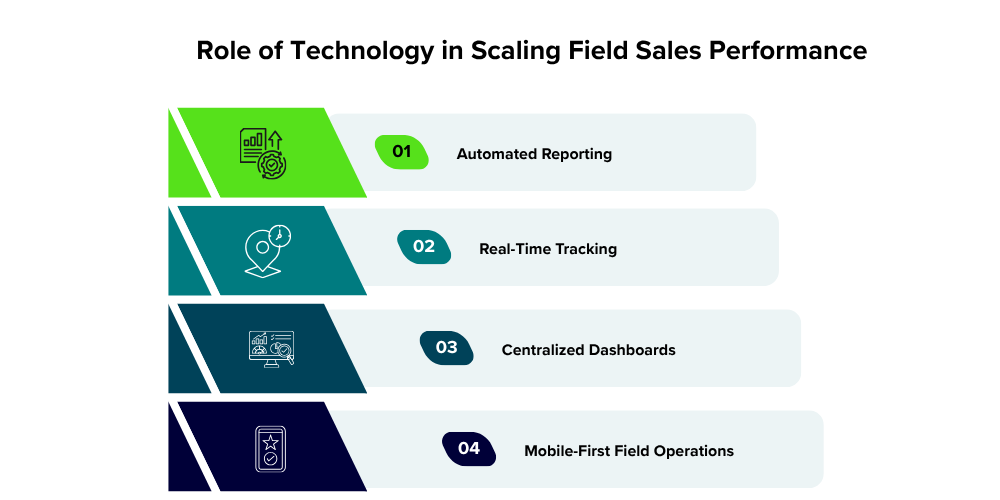
Modern systems enable:
Automated Reporting
Automated reporting eliminates manual entry errors and delays by capturing field activity in real time. This ensures accurate sales data, faster reporting cycles, and improved decision-making for managers who need instant visibility into performance metrics.
Real-Time Tracking
Real-time tracking allows organizations to monitor field representatives as they work, ensuring transparency, better route adherence, and improved productivity. It enhances accountability while helping managers respond quickly to deviations or opportunities.
Centralized Dashboards
Centralized dashboards consolidate all field sales data into a single interface, making it easier to analyze performance, track KPIs, and identify trends. This improves strategic planning and supports better forecasting and resource allocation.
Mobile-First Field Operations
Mobile-first systems empower sales teams to update visits, capture customer data, and log activities directly from the field. This increases efficiency, reduces paperwork, and ensures that data is always current and accessible.
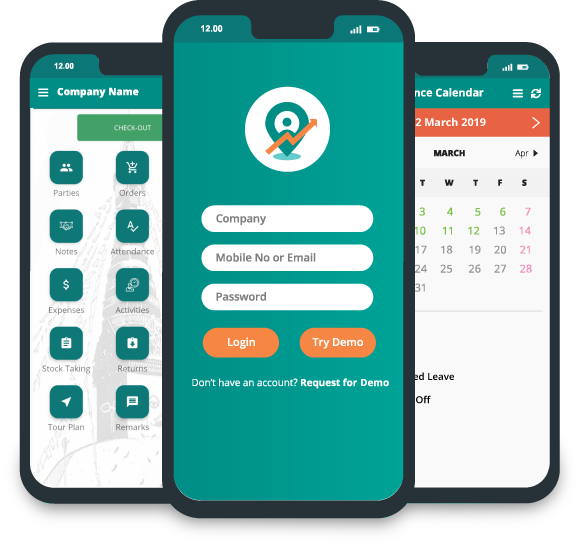
Platforms like Delta Sales App help organizations streamline operations, improve visibility, and enhance productivity through automation, analytics, and intelligent workflow management.
Key Benefits of Delta Sales App
- GPS-Based Tracking: Enables real-time GPS tracking of field executives, improving transparency, accountability, and ensuring accurate monitoring of daily field movement activities.
- Visit Verification: Digitally verifies customer visits through check-ins and location proof, preventing fake reporting and strengthening trust in field sales operations.
- Order Management: Streamlines order capture directly from the field, reducing manual entry errors, accelerating processing, and improving overall sales efficiency significantly.
- Live Dashboards: Provides real-time dashboards showing sales performance, visit status, and KPIs, enabling faster decisions and improved operational visibility for managers.
- Stronger Execution Discipline: Ensures structured workflows for field teams, reducing inconsistencies, improving discipline, and driving consistent execution of daily sales activities effectively.
- Reduced Manual Reporting: Eliminates dependency on spreadsheets and manual updates, reducing errors, saving time, and improving overall accuracy of field reporting systems.
- Better Team Coordination: Improves communication between managers and field executives through centralized data sharing, ensuring alignment, clarity, and faster response to field issues.
- Actionable Data Capture: Collects structured field data in consistent formats, enabling meaningful analysis, better insights, and improved strategic decision-making across sales operations.
By integrating such systems, businesses ensure that field sales becomes fully data-driven rather than intuition-based. This shift enables better forecasting accuracy, improved sales execution, and stronger alignment between field teams and organizational goals, ultimately scaling overall sales performance more effectively.
Improving Productivity Through Data-Driven Decisions
Data-driven decision-making significantly improves operational efficiency by replacing assumptions with measurable insights, enabling organizations to optimize field performance and enhance overall sales productivity optimization. In modern field sales environments, decisions based on data ensure accuracy, consistency, and scalable growth.
Organizations use data to:
Optimize Territories
Organizations use performance data, customer density, and revenue potential insights to design balanced territories that improve coverage and reduce inefficiencies.
Improve Routing Efficiency
Data helps in planning optimized travel routes, reducing travel time, increasing daily visits, and enhancing overall field productivity significantly.
Identify Underperforming Regions
Analytics highlight low-performing areas, enabling managers to take corrective actions, allocate resources better, and improve regional sales outcomes.
Refine Sales Strategies
Data insights help refine sales approaches, improve targeting accuracy, and enhance engagement methods to increase conversion rates and revenue growth.
Common Mistakes That Reduce Field Sales Efficiency
Field sales efficiency often declines not because of lack of effort, but due to avoidable structural and operational mistakes. These issues directly impact productivity, visibility, and revenue outcomes, especially in distributed field environments where coordination and discipline are critical.
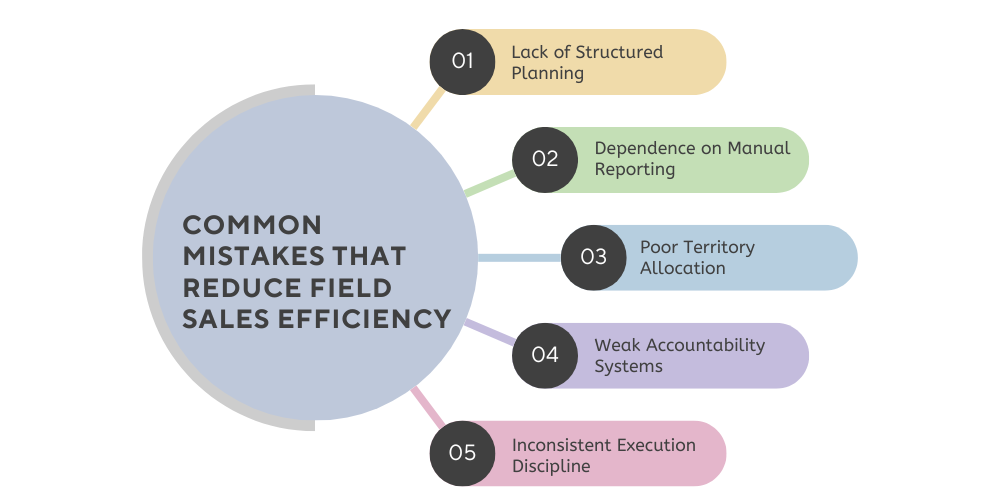
Common mistakes include:
Lack of Structured Planning
When teams operate without clear planning, daily activities become reactive instead of strategic. This leads to wasted time, missed opportunities, and inconsistent sales performance across regions.
Dependence on Manual Reporting
Manual reporting creates delays, inaccuracies, and data gaps. It reduces real-time visibility for managers and slows down decision-making, making it difficult to track actual field performance effectively.
Poor Territory Allocation
Improper territory distribution results in workload imbalance. Some representatives become overloaded while others remain underutilized, leading to inefficiencies and uneven revenue generation across areas.
Weak Accountability Systems
Without clear accountability frameworks, it becomes difficult to measure individual performance objectively. This often leads to reduced ownership, inconsistent results, and lower overall productivity.
Inconsistent Execution Discipline
When field teams do not follow standardized processes, execution quality varies widely. This inconsistency affects customer experience, conversion rates, and long-term sales reliability.
These mistakes significantly reduce productivity and should be addressed systematically through structured processes, better planning, and improved operational frameworks that ensure consistency, visibility, and control in field sales operations.

Best Practices to Optimize Outside Sales Management
Optimizing field operations requires a structured and disciplined approach that improves visibility, efficiency, and consistency across teams. These best practices help organizations strengthen execution, reduce inefficiencies, and improve overall sales performance in Outside Sales Management environments.
Best practices include:
- Standardizing Field Processes: Standardizing field workflows ensures every sales representative follows consistent procedures for visits, reporting, and customer engagement, improving operational clarity and execution quality.
- Using Automation Tools: Automation tools eliminate manual work, streamline reporting, and improve data accuracy, enabling faster decision-making and better coordination between field teams and managers.
- Monitoring Performance in Real Time: Real-time monitoring provides instant visibility into field activities, helping managers track productivity, ensure accountability, and quickly address performance gaps.
- Continuous Training and Coaching: Ongoing training improves sales skills, adaptability, and customer interaction quality, ensuring teams stay aligned with evolving market conditions and business goals.
- Data-Driven Execution Strategies: Using data insights allows organizations to optimize territories, improve planning, and refine execution strategies for better efficiency and higher conversion rates.
Organizations that adopt these practices achieve higher efficiency, improved field productivity, and stronger market penetration, leading to more predictable and scalable sales growth.
Conclusion:
A high-performing field sales organization is built on structure, discipline, and continuous improvement. Long-term success depends on how effectively teams are planned, executed, monitored, and optimized using the right operational framework.
When supported by strong systems, field sales moves beyond manual effort and transforms into a scalable, data-driven revenue engine. This shift enables organizations to improve control, enhance visibility, and consistently drive better outcomes across territories and teams.
If you are looking to streamline your field operations, improve sales productivity, and gain real-time visibility into your sales team, you can explore how a modern field sales automation platform can help.
Book a demo with Delta Sales App today and transform your field sales operations into a high-performance growth engine.