
Inside Sales vs Outside Sales: Key Differences and Which Model Fits Your Business in 2026
Sales organizations are now operating under increasing pressure to improve efficiency while managing limited resources. With rising customer expectations and stronger competition, companies are rethinking how their sales teams are structured and how deals are executed.
In 2026, buyer behavior has also shifted significantly. Most customers complete a large part of their research online before engaging with a sales representative, reducing dependency on traditional relationship-based selling. This makes timely, data-driven engagement more important than ever.
At the same time, sales technology such as CRM systems, AI-driven lead scoring, and automation tools has become essential for driving productivity and improving conversion rates. As a result, the line between inside sales and outside sales is becoming increasingly blended, with many businesses adopting hybrid models to balance efficiency and personal engagement.
What is Inside Sales?
Inside sales refers to a sales approach where representatives sell products or services remotely without meeting customers in person. Communication happens via phone calls, emails, video conferencing, CRM tools, and digital platforms.
This model is highly dependent on sales automation tools and data-driven decision-making.
Key Characteristics:
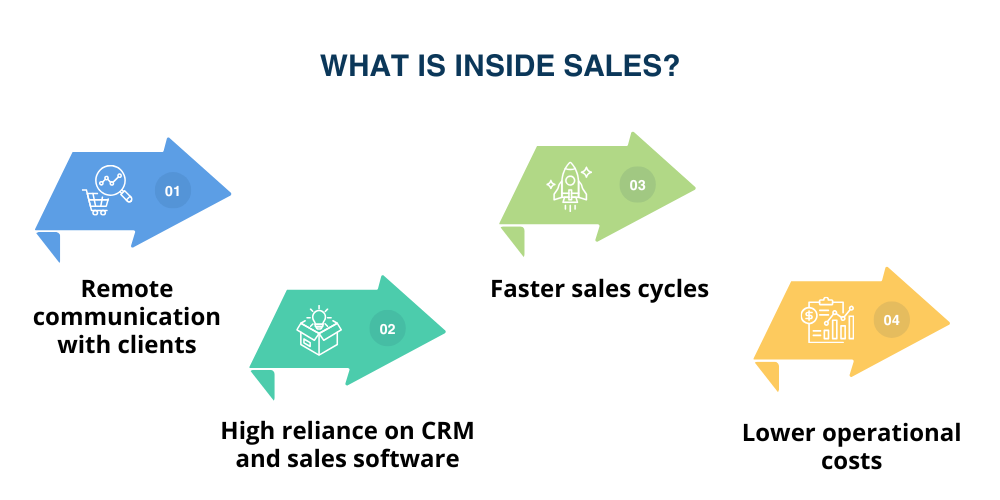
Remote communication with clients
Inside sales teams engage with customers entirely through digital channels such as calls, emails, and video meetings, eliminating the need for physical face-to-face interactions.
High reliance on CRM and sales software
This model depends on CRM platforms and sales tools to manage leads, track customer interactions, automate workflows, and improve overall sales performance and visibility.
Faster sales cycles
Inside sales enables quicker deal closures as communication is instant, follow-ups are automated, and decisions are made faster through streamlined digital engagement processes.
Lower operational costs
Companies save significantly on travel, accommodation, and field expenses, making inside sales a cost-efficient model that supports scalable and predictable revenue growth.
What is Outside Sales?
Outside sales, also known as field sales, involves direct, in-person interaction between sales representatives and customers. Sales reps travel to meet clients, conduct presentations, and close deals face-to-face.
This traditional approach is still widely used in industries where relationship-building and physical demonstrations are critical.
Key Characteristics:
In-person meetings and field visits
Outside sales representatives meet customers physically at their offices, stores, or sites to present products, build trust, and strengthen business relationships effectively.
Strong relationship-based selling
This model focuses on personal connections, where trust, rapport, and long-term relationships play a key role in influencing purchase decisions and closing deals successfully.
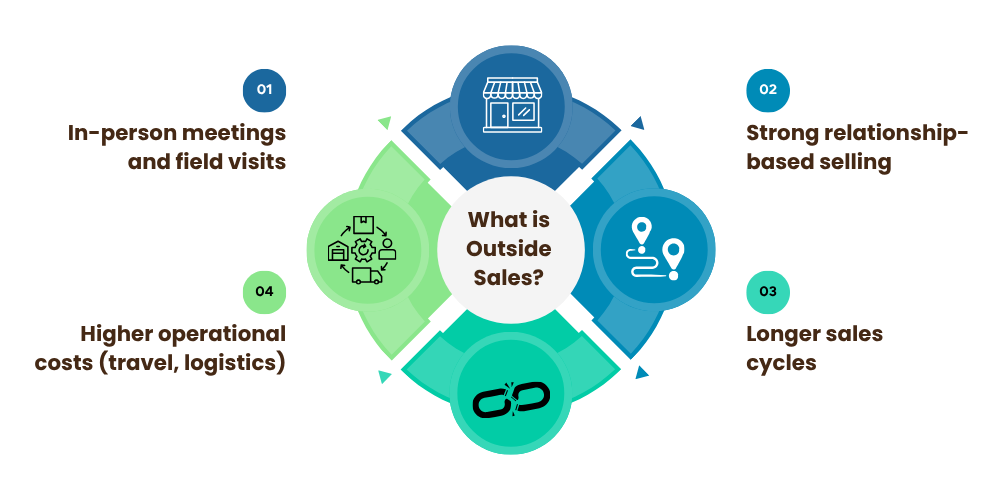
Longer sales cycles
Sales processes take more time due to scheduling meetings, travel requirements, and multiple in-person discussions before finalizing agreements or converting prospects into customers.
Higher operational costs (travel, logistics)
Outside sales involves significant expenses such as travel, accommodation, and logistics, making it a cost-intensive model compared to digital or remote sales approaches.
Key Differences Between Inside Sales and Outside Sales
Understanding the differences between these two models helps businesses choose the right approach. While both aim to generate revenue, their execution style, cost structure, and operational dependency differ significantly.
Work Environment
- Inside Sales: Remote or office-based environment
- Outside Sales: Field-based, travel-heavy environment
Inside sales teams operate from centralized locations, allowing better coordination, monitoring, and scalability. Outside sales teams, on the other hand, work in dynamic field conditions, spending significant time traveling to meet clients across locations.
This difference directly impacts productivity tracking and operational planning for sales managers.
Customer Interaction Style
- Inside Sales: Digital communication (calls, emails, Zoom)
- Outside Sales: Face-to-face meetings and physical presentations
Inside sales relies on structured, technology-enabled communication that allows quick follow-ups and high-volume engagement. Outside sales focuses on personal interaction, where trust-building and persuasion often depend on in-person engagement and relationship depth.
This makes inside sales more scalable, while outside sales more personalized.
Cost Structure
- Inside Sales: Lower cost (no travel or accommodation expenses)
- Outside Sales: Higher cost due to travel, logistics, and time investment
Inside sales reduces operational expenses significantly by eliminating field travel and associated costs. Outside sales requires continuous investment in logistics, travel allowances, and time allocation per client, making it more expensive per deal closed.
Because of this, many businesses use inside sales for efficiency and outside sales for high-value accounts.
Sales Cycle Length
- Inside Sales: Shorter sales cycles due to faster communication
- Outside Sales: Longer cycles due to scheduling and travel requirements
Inside sales benefits from instant communication and rapid decision-making, which shortens the overall sales process. Outside sales involves physical meetings, coordination delays, and multiple touchpoints, which naturally extend the sales cycle.
However, outside sales can be more effective for complex or enterprise-level deals requiring deeper evaluation.
Tools and Technology Usage
- Inside Sales: CRM systems, automation tools, AI-driven analytics
- Outside Sales: Mobile CRM apps, GPS tracking, field force management tools
Inside sales is heavily powered by digital ecosystems that streamline lead management, communication, and performance tracking. Outside sales increasingly depends on mobile-first solutions to maintain visibility and control over field activities.
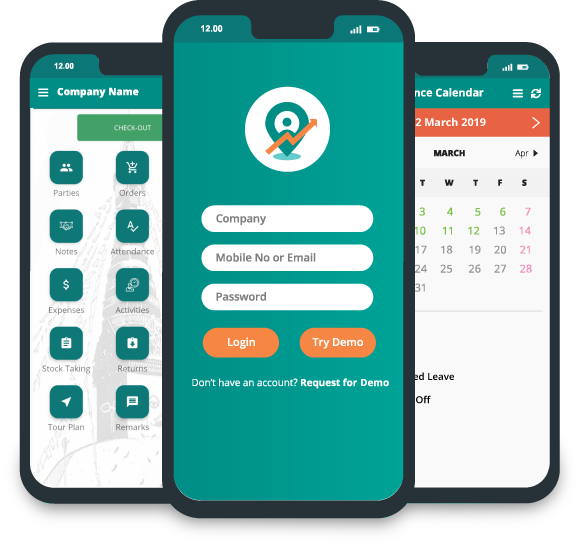
Modern outside sales teams now rely on sales force automation platforms like Delta Sales App to track visits, monitor productivity, and ensure real-time reporting, bridging the gap between field operations and management visibility.
Pros and Cons of Inside Sales
Inside sales has become a core growth engine for modern businesses, especially in digital-first industries. However, like any sales model, it comes with both advantages and limitations.
Pros:
Cost-effective
Inside sales significantly reduces operational expenses by eliminating travel, lodging, and field costs, making it highly efficient for businesses focused on profitability and scalability.
Scalable for large teams
Since operations are remote and centralized, companies can quickly scale inside sales teams without major infrastructure changes, enabling faster expansion into new markets.
Faster lead response time
Sales reps can instantly respond to inquiries through calls, emails, or chat, improving lead conversion rates and reducing the chances of losing prospects due to delays.
Easy to track and measure performance
With CRM systems and analytics tools, managers can monitor calls, follow-ups, conversions, and productivity in real time, ensuring better visibility and control.
Cons:
Limited personal interaction
Lack of face-to-face communication can make it harder to build deep trust and emotional connection, especially for customers who prefer in-person engagement.
Less effective for high-value enterprise deals
Complex or high-ticket sales often require detailed discussions and relationship-building, which may be less effective in a purely remote setup.
Heavily dependent on digital tools
Inside sales performance relies strongly on technology such as CRM, internet connectivity, and automation tools, making it vulnerable to system or process gaps if not managed properly.
Pros and Cons of Outside Sales
Outside sales remains a powerful model in industries where trust, personal interaction, and complex decision-making play a critical role. However, it also comes with operational challenges that businesses must carefully consider.
Pros:
Strong customer relationships
Outside sales enables direct face-to-face interaction, helping sales representatives build deeper trust, stronger rapport, and long-term customers relationships management.
Better for complex or high-ticket sales
This model is highly effective for products or services that require detailed explanation, demonstrations, or multi-level decision-making before purchase.
Higher trust and personalization
In-person engagement creates a stronger sense of credibility and confidence, allowing sales reps to tailor their pitch based on real-time customer reactions and needs.
Cons:
Expensive operations
Outside sales involves significant costs such as travel, accommodation, field allowances, and time investment per client, making it resource-intensive.
Slower sales cycles
Since meetings need to be scheduled and conducted physically, the overall sales process takes longer compared to digital or inside sales models.
Difficult to scale quickly
Scaling outside sales requires hiring more field reps, expanding logistics, and increasing operational support, which makes rapid expansion more challenging.
Which Sales Model is More Effective in 2026?
In 2026, inside sales is becoming the dominant model due to digital transformation, automation, and the rise of remote and hybrid work. Businesses prefer it for its speed, scalability, and cost efficiency.
With CRM systems, AI insights, and automation tools, inside sales teams can handle more leads efficiently and improve pipeline visibility, making it ideal for modern B2B and digital-first companies.
However, outside sales remain important in industries like FMCG, pharmaceuticals, construction, manufacturing, and enterprise solutions where in-person interaction, trust-building, and product demonstrations are essential.
It is especially valuable for complex and high-ticket deals that require deeper engagement.
The most effective approach in 2026 is not choosing one model, but combining both based on industry, customer journey, and deal complexity.
Key Factors Defining the Best Sales Model in 2026
1. Industry Type Matters
Different industries require different approaches. Tech and SaaS companies lean toward inside sales, while FMCG and industrial sectors still depend heavily on outside sales.
2. Buyer Behavior is Digital-First
Most buyers research online before engaging with a sales representative, making digital engagement essential regardless of the sales model.
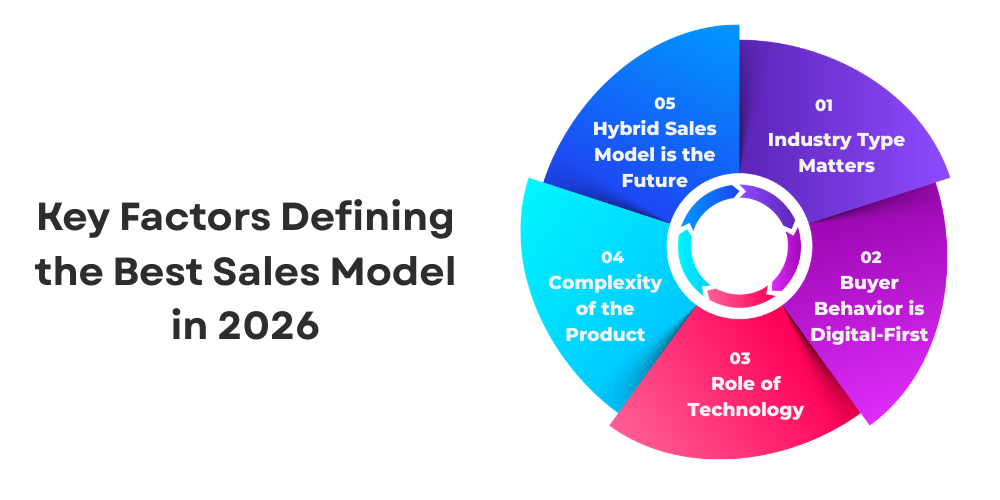
3. Role of Technology
AI, CRM systems, and sales automation tools are now central to both inside and outside sales, improving efficiency, tracking, and decision-making.
4. Complexity of the Product
Simple and standardized products perform better with inside sales, while complex solutions require outside sales involvement for better explanation and trust-building.
5. Hybrid Sales Model is the Future
The most effective organizations are combining both approaches, inside sales for lead generation and nurturing, and outside sales for high-value closures.
When to Choose Inside Sales for Your Business
Inside sales is ideal when:
-
You have a digital-first product or service: Inside sales works best for digital products that can be demonstrated and sold remotely. It eliminates the need for physical visits and allows faster adoption through online demos and virtual communication channels.
-
Your target market is geographically wide: If your customers are spread across different cities, countries, or regions, inside sales helps you reach them efficiently without travel constraints, enabling faster and more consistent engagement at scale.
-
You want fast scaling and low operational cost: Inside sales enables rapid team expansion without heavy infrastructure investment. It reduces travel expenses, field costs, and operational overhead, making it highly cost-efficient for growing businesses.
-
Your sales process is standardized: When your sales cycle follows a structured and repeatable process, inside sales becomes more effective. It ensures consistency in messaging, quicker onboarding, and predictable conversion outcomes across the team.
SaaS companies, IT firms, and startups benefit most from this model.
When to Choose Outside Sales for Your Business
Outside sales works best when:
Product requires physical demonstration
Outside sales is ideal when customers need to physically see, test, or experience the product in real time to fully understand its features, quality, and performance.
High-value enterprise deals are involved
This model works best for large, complex deals where multiple stakeholders are involved and detailed discussions are needed before final purchase decisions are made.
Relationship-building is crucial
Outside sales helps build strong trust and long-term relationships through face-to-face interaction, which is essential for retaining clients and closing repeat or strategic deals.
Customers prefer in-person engagement
Some customers value direct human interaction over digital communication, making in-person meetings more effective for understanding needs and influencing buying decisions.
Industries like FMCG, manufacturing, and real estate still depend heavily on this model.
Impact of Digital Transformation on Sales Models
Digital transformation is fundamentally reshaping how both inside sales and outside sales operate. Traditional sales processes are being replaced by data-driven, automated, and highly connected systems that improve efficiency, visibility, and customer engagement across the entire sales cycle.
Modern businesses are no longer relying on manual tracking or intuition-based decisions. Instead, they are adopting intelligent tools that help sales teams work faster, smarter, and with greater accuracy. This transformation is also enabling better alignment between marketing, sales, and customer success teams.
Overall, digital transformation is making sales models more efficient, measurable, and customer-centric, regardless of whether the approach is inside or outside sales.
CRM systems automate lead tracking
CRM systems automatically capture, organize, and track leads across the sales funnel, ensuring no opportunity is missed. They provide real-time visibility into customer interactions and improve sales pipeline management.
AI helps in predicting customer behavior
AI analyzes historical data, engagement patterns, and buying signals to predict customer intent. This helps sales teams prioritize high-quality leads and improve conversion rates through smarter targeting.
Mobile apps improve field sales productivity
Mobile sales applications enable field representatives to log visits, update orders, and access customer data instantly. This reduces manual work and improves on-ground execution efficiency significantly.
Data analytics improves decision-making
Sales analytics tools provide actionable insights into performance, customer behavior, and pipeline health. Managers can make faster, data-backed decisions to optimize sales strategies and improve outcomes.
Businesses that adopt sales automation tools gain a clear competitive advantage
Organizations using automation tools achieve higher efficiency, better lead management, and improved forecasting accuracy, giving them a strong advantage over competitors still using manual sales processes.

How to Decide the Right Sales Model for Your Business
Choosing the right sales model depends on your product type, customer behavior, and business goals. There is no single best approach, only the most suitable one for your context.
1. Understand your customer buying journey
If customers research and buy digitally, inside sales works better. If they need personal interaction and trust-building, outside sales are more effective.
2. Evaluate product complexity and pricing
Simple, low-cost products fit inside sales. Complex, high-value, or customized solutions usually require outside sales support.
3. Consider your cost and scaling goals
Inside sales is cost-efficient and scalable. Outside sales requires higher investment but delivers stronger relationship depth.
4. Analyze sales cycle and deal volume
High-volume, fast deals suit inside sales. Longer, strategic, and relationship-driven deals are better handled by outside sales teams.
5. Adopt a hybrid approach when needed
Many businesses combine both models, inside sales for lead generation and outside sales for closures, to balance efficiency and personal engagement.
Final Thoughts
The debate between inside sales vs outside sales is no longer about which is better, it is about which model fits your business context and customer journey.
In 2026, the most successful companies are those that strategically combine both inside and outside sales, using each where it delivers the highest impact. Technology plays a key role in this shift, enabling better coordination, faster execution, and improved visibility across the entire sales process.
A well-structured sales model supported by automation, CRM systems, and analytics can significantly enhance revenue performance, improve sales efficiency, and deliver a better customer experience.
Book a free demo of Delta Sales App today and transform the way your sales team performs in the field and beyond.