
How Can Field Sales Teams Improve New Product Distribution?

A new product can have everything going for it: strong packaging, competitive pricing, retailer promotions, and a well-planned marketing campaign, but it still struggles to sell if it never reaches enough stores.
For field sales teams, the challenge isn't just getting retailers to place that first order. They also need to identify the right outlets, keep the product actually available, cover priority territories, watch shelf presence, and follow up to see whether the product is actually moving off the shelf. When all of that runs through disconnected processes, distribution gaps stay invisible right up until they start hurting sales.
Improving new product distribution takes more than sending reps to more stores. It needs a structured approach connecting outlet targeting, retailer engagement, route planning, distribution tracking, and field feedback.
This blog covers what new product distribution actually involves, why field teams often struggle with it, seven practical ways to improve launch coverage, and how sales force automation software makes distribution more measurable and efficient.
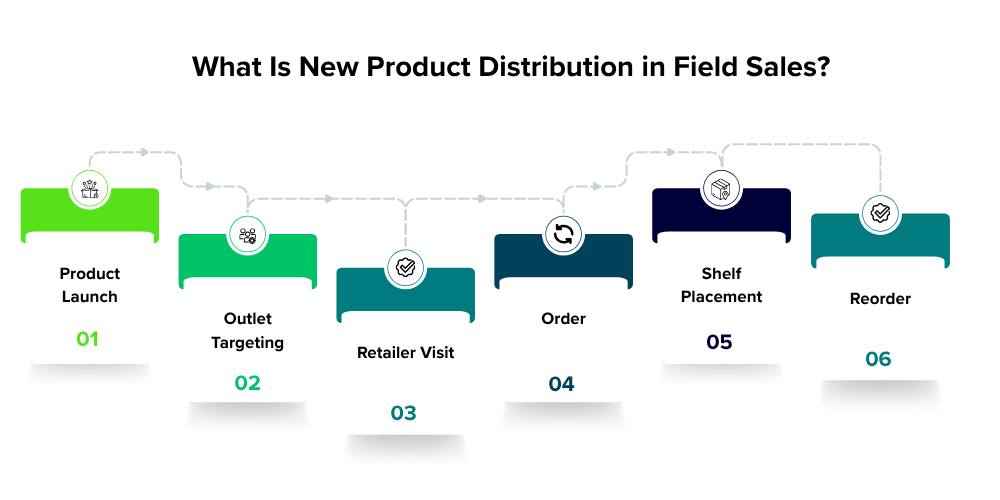
What Is New Product Distribution in Field Sales?
New product distribution is the process of making a newly launched product available across the retail outlets that are relevant to its target market. For field sales teams, this includes identifying suitable stores, introducing the product to retailers, securing orders, checking availability, monitoring placement, and encouraging repeat purchases.
The objective is not simply to increase the number of stores that receive the product. A successful distribution strategy should ensure that the product reaches outlets with genuine sales potential and remains available after the initial placement.
For FMCG and CPG businesses, this process is especially important because retail availability directly influences whether consumers can find and purchase a new product.
How It Differs from Regular Sales Execution
Regular sales execution usually focuses on maintaining existing distribution: repeat orders, retailer relationships, and keeping established products available. A new product launch demands something else entirely. Reps have to introduce something unfamiliar, explain its benefits, handle retailer pushback, communicate whatever schemes apply, and convince a store to hand over shelf space to a brand-new SKU.
That's why the success of a launch isn't just about whether a rep completed the visit. The real questions are whether the right outlet even got approached, whether the product was accepted, whether it actually made it onto the shelf, and whether the retailer reordered it afterward.
Key Metrics: Numeric vs. Weighted Distribution
Numeric distribution measures the percentage of relevant retail outlets carrying a particular product. If a new SKU sits in 300 out of 1,000 relevant outlets, that's 30% numeric distribution.
Weighted distribution comes at it differently, factoring in the sales importance of the outlets actually carrying the product. A product could have broad numeric distribution and still have limited commercial reach if most of those outlets barely sell anything in that category to begin with.
Using both measures together tells a sales manager whether a new product is reaching a lot of stores, the strategically important stores, or genuinely both.
Why Field Sales Teams Struggle to Distribute New Products
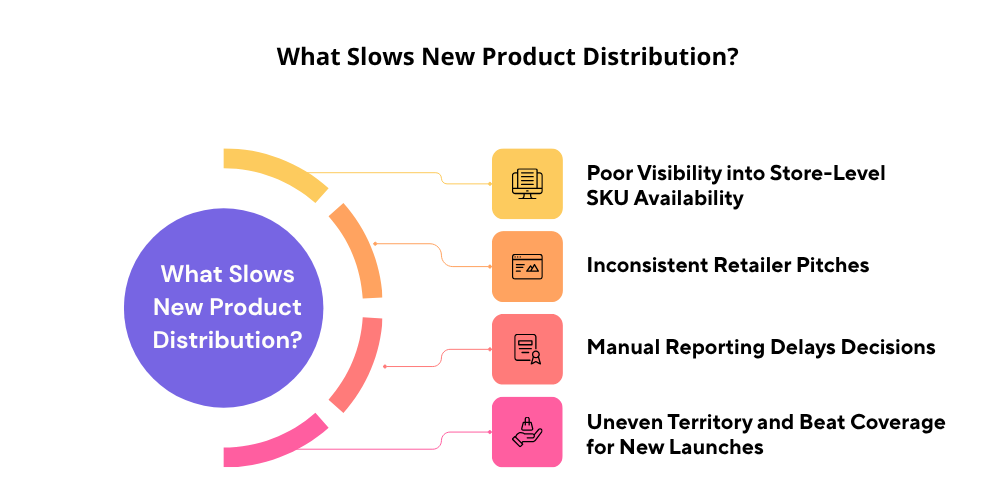
New product distribution can become difficult when sales teams operate across large territories, diverse outlet types, and multiple distributor networks. The challenge becomes even greater when managers do not have timely information about what is happening at individual stores. Several common problems can slow down distribution expansion.
-
Poor Visibility into Store-Level SKU Availability
A manager might know how many orders came in without knowing whether the product's actually available at any individual outlet. A retailer might place an initial order, sell through the stock fast, and never get a replenishment. Another store might have the product but give it poor shelf visibility. If none of that gets captured during a field visit, managers end up assuming distribution's healthy when real gaps already exist. Store-level visibility is what separates an outlet that's been approached from one that's actually ordered the product, from one where the product is genuinely sitting on the shelf right now.
-
Inconsistent Retailer Pitches
A new product needs a clear explanation of its benefits, target consumers, pricing, retailer value, and promotional support. When every rep pitches it a little differently, retailers end up with inconsistent information about the same product. A standardized pitch gives the team a common foundation while still leaving room for reps to adapt the conversation to whoever they're talking to. It also makes it much easier for managers to spot recurring objections and adjust the launch strategy based on what the field is actually hearing.
-
Manual Reporting Delays Decisions
Manual reporting creates a real gap between field activity and the decisions management is trying to make. When reps submit information through spreadsheets, paper forms, or a delayed end-of-day update, managers might not see a distribution problem until it's several days old. That's especially damaging during a launch, since early distribution gaps can spread across a whole territory fast. Timely reporting gives managers the chance to catch weak coverage, adjust priorities, and fix problems while the launch still has momentum, not after it's already lost.
-
Uneven Territory and Beat Coverage for New Launches
A new product might need extra outlet coverage, but reps often keep following established routes that were built around existing products. That means high-potential stores get skipped while lower-priority outlets keep getting the repeat visits they've always gotten. Structured beat planning fixes that by pointing managers to exactly where launch-focused coverage is actually needed, giving more attention to stores with stronger category potential or strategic importance instead of treating every outlet like it deserves equal time.
How Can Field Sales Teams Improve New Product Distribution?
Improving distribution takes better planning, consistent execution, timely reporting, and continuous follow-up, all working together. Here are seven steps that actually help field teams build stronger launch coverage.
1. Prioritize High-Potential Outlets with Data-Driven Targeting
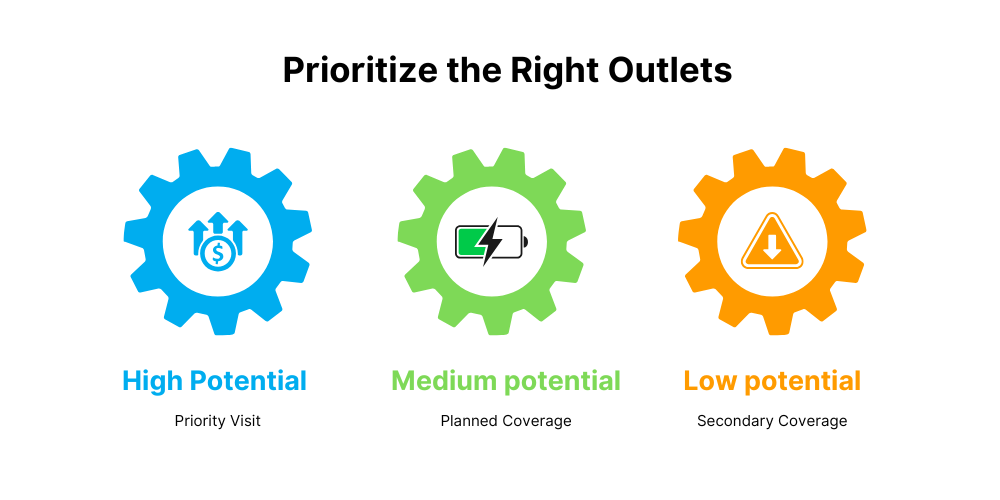
A new product doesn't need to hit every possible outlet on day one. Sales teams can start by identifying stores more likely to generate real demand, based on historical sales, category performance, outlet type, location, customer profile, and past purchasing behavior. That focuses a rep's time on outlets where the product has a genuine shot at succeeding. A premium product, for instance, probably fits better in modern trade stores and higher-income neighborhoods, while an affordable daily-use product needs broader coverage across general trade. Data-driven outlet targeting builds distribution around real opportunity instead of just chasing a store count.
2. Standardize the New Product Pitch Across the Team
Reps need a clear framework for introducing a new product to retailers: why it's relevant, who's likely to buy it, what makes it different, and why the retailer should give it shelf space. The team also needs the commercial specifics down cold: recommended opening quantities, retailer margins, promotional schemes, and display expectations. A consistent pitch means retailers get the same core information no matter which rep walks in, while reps still have room to adapt the conversation to whatever objections or needs come up in that specific store.
3. Optimize Beats and Routes for Faster Launch Coverage
Speed matters a lot during a launch. If priority outlets don't get approached early, competitors grab the available shelf space or retailers lose interest before the product ever gets traction. Sales teams can improve coverage by working priority outlets into existing routes or building dedicated coverage plans for important clusters. A sales route planning app helps reps organize visits efficiently while making sure high-priority outlets never get skipped and lets managers check whether planned visits are actually happening or whether more coverage is needed. The goal isn't more visits for their own sake. It's routes that actually align with what the launch is trying to accomplish.
4. Track Distribution KPIs in Real Time
New product distribution should get tracked through clear performance indicators, not just total sales. Worth watching: new outlet additions, product availability, outlet conversion, order volume, repeat purchases, stockouts, and priority outlet coverage. Real-time visibility lets managers compare performance across territories and catch where distribution is dragging. If one territory shows strong initial orders but almost no repeat purchases, that's probably not a distribution-reach problem. It's more likely weak product movement, missed follow-up, poor shelf placement, or retailer pushback that's never been addressed.
5. Incentivize Reps for New SKU Placement
If distributing a new product is genuinely a priority, reps need measurable goals tied directly to that launch. Instead of judging performance purely off overall sales, companies can set targets around new SKU placement, priority outlet additions, repeat orders, or covering selected stores successfully. But the incentives need to reward meaningful distribution, not encourage reps to pad a target with low-potential outlets that never really move the product. One placement in a strategically important store can do more for long-term growth than a handful of placements in outlets with almost no category demand.
6. Verify Shelf Placement with Image Recognition

Getting the order placed doesn't automatically mean the product is visible to consumers. Reps can capture shelf images during visits to document product presence, display quality, promotional execution, and stock gaps. Where image recognition technology is available, those images can even be analyzed for specific products or execution conditions. That gives a far more reliable view of what's actually happening inside the store. Instead of taking a verbal report at face value, managers get visual evidence of whether the new product actually made it to the shelf and is being presented the way it's supposed to be.
7. Close the Feedback Loop with Trade Marketing
Field reps are usually the first to hear retailer objections and market feedback. That's incredibly valuable during a launch. A retailer might mention the pack size isn't right, the price is hard to position, a competitor's offering stronger incentives, or consumers are asking for a different variant entirely. If that feedback stays trapped with individual reps, the wider organization misses real patterns it needs to see. A structured feedback process gets those observations to trade marketing and product teams, so the business can actually adjust promotional strategy, retailer messaging, positioning, or distribution priorities based on what the market's actually saying.
How Sales Force Automation Tools Accelerate Distribution
Sales force automation software can seamlessly integrate field activities, outlet insights, orders, visits, and performance reporting into a cohesive workflow. During new product launches, this technology empowers managers with enhanced visibility, allowing them to see if distribution plans are truly being implemented in the market.
-
Real-Time Dashboards for Distribution Tracking
Real-time dashboards let managers monitor the important launch indicators without waiting on a manually consolidated report. Outlet coverage, new product orders, completed visits, and territory performance, all of it visible from one centralized system. That makes it much easier to catch the areas falling behind and act before a small distribution gap turns into a much bigger problem.
-
Geo-Tagged Visit Verification
Geo-tagged visits let managers verify that reps are actually visiting the assigned outlets and spending time in the territories where launch coverage is needed. Combined with customer visit tracking, which gives real visibility into field activity, managers can see whether priority outlets are getting covered according to the actual launch plan, instead of taking self-reported activity on faith.
-
Outlet and Product-Level Visibility
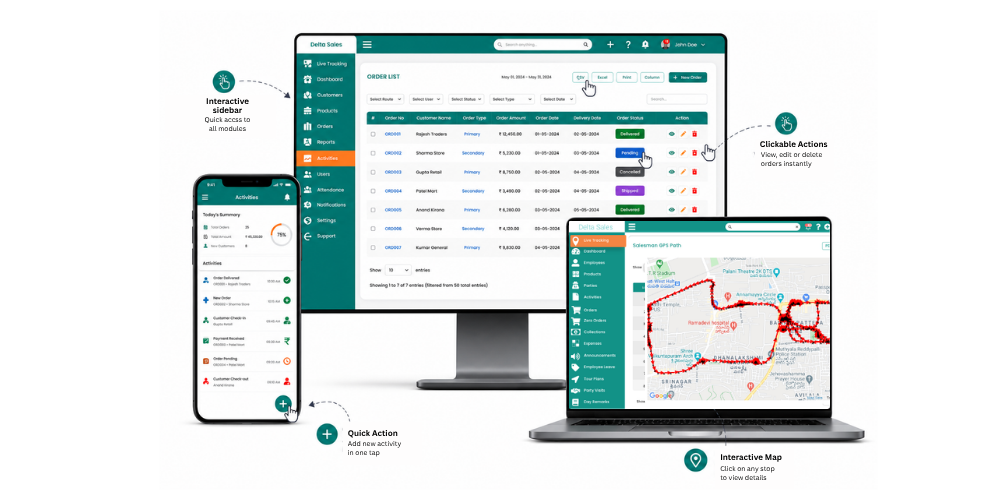
New product distribution requires more than knowing how many stores a representative visited. Teams also need visibility into what happened at those outlets. An SFA platform can help representatives record relevant information during each visit, such as whether the new SKU was introduced, whether an order was placed, whether the product was available, and what feedback the retailer provided. This outlet-level information helps managers understand where the product is gaining traction and where additional follow-up may be necessary. It also creates a more structured record of launch execution that can be reviewed by territory, representative, outlet, or product.
-
Automated Order and Stock Tracking
Keeping track of new product orders by hand across hundreds of outlets makes it easy to miss stockouts or delayed replenishments. A stock-taking system can capture order and inventory data directly at the point of visit, giving managers a running view of what's been ordered, what's been delivered, and where stock is running low. That visibility helps prevent a common launch problem: a retailer accepts the product once, runs out, and never gets a follow-up reorder.
-
Retailer Feedback Capture at Scale
Rather than relying on reps to remember or informally pass along what retailers say, feedback can be logged directly during the visit itself, whether it's about pricing, pack size, competitor activity, or consumer demand. Capturing this consistently across the whole team gives trade marketing and product teams a much clearer, aggregated picture of how the market's actually responding to the launch.
-
Performance Benchmarking Across Territories
Comparing distribution performance across regions, teams, or individual reps side by side becomes possible once that data lives in one place. Managers can see which territories are hitting outlet targets and which ones are falling behind, then reallocate resources or adjust coverage plans accordingly. That kind of benchmarking turns scattered, anecdotal progress updates into a clear, comparative view of launch performance.
-
Automated Alerts for Distribution Gaps
Rather than waiting for a scheduled report to surface a problem, automated alerts can flag issues as they happen, like a priority outlet that hasn't been visited, a stockout that hasn't been addressed, or a territory falling behind on new SKU placement. That lets managers step in quickly, while there's still time to correct course during the launch window.
How to Measure Success in New Product Distribution
Successful distribution goes beyond just counting the number of stores that first receive a product. Companies should consider if the product is making its way to valuable outlets, becoming available in a timely manner, and fostering lasting demand among consumers.
1. Retail Execution Quality
Distribution numbers alone don't confirm whether the product is actually visible and well-positioned once it reaches a store. Retail execution quality looks at whether the product got proper shelf placement, correct pricing, promotional visibility, and planogram compliance. A product can technically be "in distribution" and still perform poorly if execution at the shelf level is weak. A retail execution app can help track these details consistently across outlets, capturing shelf images, pricing checks, and display compliance during each visit instead of relying on a rep's verbal report. Tracking execution quality alongside distribution numbers, backed by this kind of visibility, gives a fuller picture of whether the launch is actually working at the point of sale.
2. Numeric vs. Weighted Distribution
Numeric distribution addresses the question, “How many relevant outlets are offering the product?” On the other hand, weighted distribution focuses on a different aspect: “How significant are the outlets that carry the product?” Both of these metrics are valuable. For instance, a company might achieve impressive numeric distribution by placing a new product in numerous small shops, yet still have a minimal presence in larger, high-traffic outlets. By examining weighted distribution in conjunction with numeric distribution, one can uncover this distinction.

3. Time-to-Shelf Benchmarks
Time-to-shelf measures how fast a product goes from launch-ready to actually sitting in a store. A longer time-to-shelf can point to problems with distributor inventory, order processing, retailer onboarding, sales coverage, or delivery. Tracking that metric across territories shows managers exactly where the launch process is dragging and which part of the distribution chain needs actual attention.
4. Sell-Through and Repeat Purchase Rate
Initial placement is only the first stage of distribution success. A retailer might accept a new product once and never reorder it, either because consumer demand's weak or the product never got enough visibility on the shelf. That's why companies need to watch sell-through and repeat purchase behavior after that first placement. Strong repeat ordering is the real sign the product's moving past initial distribution and starting to build sustainable demand.
Common Mistakes That Slow Down Distribution Expansion
Expanding distribution for a new product isn't just about reaching more outlets. Poor targeting, weak follow-up, and limited visibility can burn a lot of field time without ever creating sustainable product availability. Knowing the common mistakes here helps managers catch gaps before they hurt the wider launch.
One common mistake is trying to reach every outlet at once. Treating every store as equally important spreads the sales team's effort too thin. It's better to identify outlets with real category potential first and prioritize by location, sales history, outlet type, and customer profile.
Another problem is measuring distribution only by initial orders. An opening order confirms the retailer accepted the product, nothing more. It doesn't mean the product is actually selling or will stay on the shelf. Teams need to keep watching stock availability, sell-through, and repeat orders to see whether that initial placement is turning into something sustainable.
Inconsistent retailer communication slows expansion too. If reps explain the product differently or can't clearly walk through its benefits, pricing, margins, or promotional support, retailers get less willing to hand over shelf space. A consistent pitch across the team is what keeps the launch experience reliable no matter which territory it's happening in.
Following existing routes without adjusting for the launch is another common issue. A beat that works fine for regular products might not give priority outlets the coverage they need during a new introduction. Sales managers need to review coverage plans and adjust routes wherever the launch demands extra attention.
And delayed field reporting stops managers from reacting fast to distribution gaps. If retailer objections, availability problems, or missed visits only reach managers days later, the chance to fix them is often already gone. Timely field data is what gives managers a real view of launch progress and lets them actually move fast.
Avoid these mistakes, and a field sales team spends less energy just chasing outlet numbers and more building distribution that's actually valuable, measurable, and built to last.
Conclusion
New product distribution comes down to how well a company connects its launch strategy to what's actually happening at the retail level. Field sales teams improve distribution by prioritizing high-potential outlets, standardizing retailer communication, optimizing routes, tracking the right launch KPIs, rewarding placements that actually mean something, verifying shelf execution, and feeding market feedback back to trade marketing. Technology strengthens all of that by giving managers real visibility into outlet coverage, rep activity, product availability, and territory performance.
The goal was never just getting a new product into more stores. It's getting the right product into the right outlets at the right time and keeping it there long enough to build real repeat demand.
If you want better field visibility, outlet coverage, and new product execution through a connected sales workflow, book a free demo with Delta Sales App and see how technology can support your field sales operations.
FAQs
1. How long does it take to achieve full distribution for a new product?
There's no fixed timeline for hitting full distribution, since that depends on the product category, target market, outlet universe, distributor network, supply availability, and how big the field sales team actually is. Companies usually get better results by prioritizing high-potential outlets first and expanding coverage based on how the market actually responds.
2. What's the difference between numeric and weighted distribution?
Numeric distribution measures the percentage of relevant retail outlets carrying a product, while weighted distribution considers the commercial importance of those outlets. Numeric distribution shows the breadth of market coverage, whereas weighted distribution provides greater insight into whether the product has reached high-value stores.
3. How does an SFA app help with new product launches?
An SFA app such as Delta Sales App can help representatives plan visits, prioritize outlets, record orders, track product availability, capture field information, and report activities. Managers can use the collected information to monitor launch execution and identify distribution gaps more quickly.
4. What is a field sales team's role in a new product launch?
A field sales team's role is to turn the product launch strategy into retail execution. Representatives identify suitable outlets, introduce the product to retailers, secure initial orders, monitor availability and placement, collect retailer feedback, and follow up to encourage repeat purchases.