
How Inefficient Field Sales Quietly Drain Your Revenue
Field sales are often seen as the backbone of revenue growth. Your sales representatives are on the ground, meeting retailers, distributors, and partners, taking orders, building relationships, and representing your brand. But what happens when a field sales management app is missing or ineffective?
The problem is, inefficient field sales rarely fail loudly. There are no dramatic alarms or sudden collapses. Instead, revenue leaks slowly and quietly day by day, visit by visit, order by order. Many businesses don’t even realize how much money they’re losing until the damage is already done.
In this blog, we’ll uncover how inefficient field sales silently drain revenue, the hidden signs to watch for, and why fixing these issues is critical for sustainable growth.
The Invisible Cost of Inefficient Field Sales
Inefficiency in field sales doesn’t usually look like failure. Sales are still happening. Orders are still being placed. Teams are still busy. That’s what makes it dangerous.
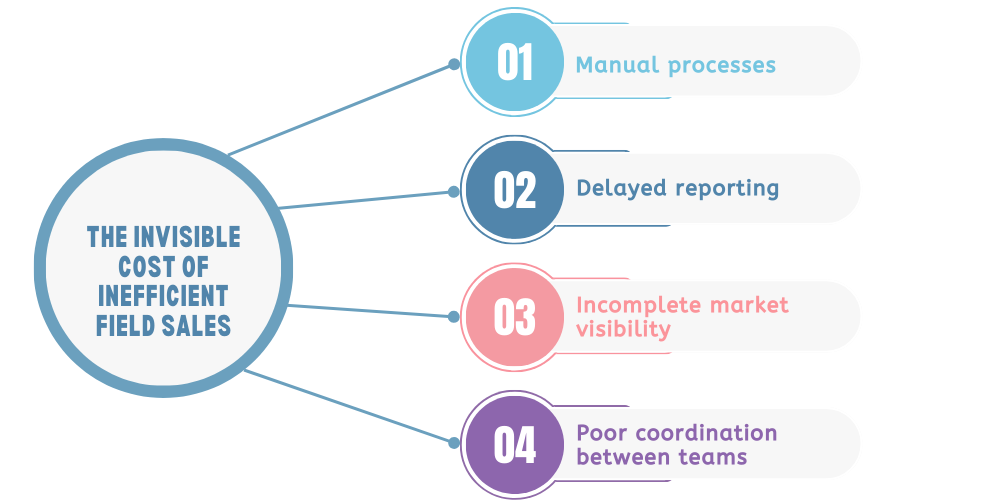
Revenue leakage often hides behind:
-
Manual processes: Relying on paper or spreadsheets causes errors, delays, and missed orders, reducing selling time and quietly lowering overall sales efficiency and revenue. This is why many companies benefit from sales force automation to streamline order taking and reduce errors.
-
Delayed reporting: Late sales data prevents quick decisions, allowing problems like stock-outs or low performance to continue unchecked, resulting in lost sales opportunities. Real-time data provided by real-time sales tracking can help prevent this.
-
Incomplete market visibility: Without real-time insights into field activities, managers can’t track execution, missed visits, or demand patterns, leading to poor planning and revenue gaps. A good mobile sales tool can improve this visibility immensely.
-
Poor coordination between teams: Lack of alignment between sales, managers, and marketing creates confusion, inconsistent messaging, and weak execution, reducing the overall impact of sales efforts.
When these issues combine, they create a system where effort does not equal results. Your sales team may be working hard, but your revenue does not reflect their true potential.
Missed Visits and Poor Route Planning
One of the biggest silent revenue killers is poor route planning.
When field sales reps:
-
Visit outlets randomly: Unplanned store visits reduce coverage of priority accounts, resulting in inconsistent order volumes, missed sales opportunities, and inefficient use of field sales time. Using field sales management software can optimize routes for maximum coverage and efficiency.
-
Skip high-potential stores: When high-revenue outlets are neglected, competitors gain shelf space, order frequency drops, and long-term sales growth in key territories is negatively impacted.
-
Spend excessive time traveling: Poor route planning increases travel time, leaving fewer hours for selling activities, reducing daily productive visits and directly limiting order generation.
-
Miss planned calls: Missing scheduled visits weakens retailer relationships, delays replenishment orders, and leads to lost sales opportunities that competitors quickly capture.
The impact is immediate and measurable. Fewer productive visits mean fewer orders. Over time, this leads to declining sales in key territories. Without a structured visit plan, reps often prioritize convenience over opportunity. High-revenue outlets may not get enough attention, while low-value visits consume time and resources.

Manual Order Taking Leads to Lost Sales
Many field sales teams still rely on notebooks, spreadsheets, or memory to capture orders. This might seem manageable at first, but it creates serious problems:
-
Incorrect quantities: Manual entry often leads to wrong order quantities, causing overstock or stock-outs, dissatisfied retailers, and lost sales due to inaccurate demand fulfillment.
-
Missed SKUs: Sales reps may forget to include certain products in manual orders, reducing basket size, limiting cross-selling opportunities, and lowering total order value.
-
Pricing errors: Incorrect pricing or discounts create billing disputes, margin loss, and retailer mistrust, directly impacting profitability and long-term business relationships.
-
Forgotten orders: Orders noted manually can be misplaced or forgotten, leading to missed deliveries, unhappy retailers, and complete loss of expected sales revenue.
-
Delayed order submission: Late order submission slows fulfillment, misses delivery schedules, and results in canceled or postponed orders, giving competitors an advantage.
Each small mistake directly affects revenue. An order written incorrectly is revenue partially lost. An order submitted late may miss delivery cycles entirely. Manual order taking also reduces confidence. Retailers lose trust when deliveries don’t match what was promised. Automating orders via a mobile sales app or field sales force automation platform eliminates many of these risks.
Delayed Reporting Equals Delayed Decisions
In an inefficient field sales setup, data flows slowly. Sales reports often arrive: at the end of the day, at the end of the week, or sometimes, not at all. By the time managers see the numbers, the opportunity is already gone.
Without real-time sales tracking:
-
Stock-outs go unnoticed: Without timely sales data, inventory shortages aren’t detected early, causing missed replenishment, empty shelves, frustrated retailers, and immediate loss of potential sales.
-
Underperforming reps aren’t identified early: Delayed reporting prevents managers from spotting low performance quickly, reducing coaching effectiveness and allowing revenue gaps to widen over time.
-
High-demand products aren’t pushed aggressively: Lack of real-time insights hides fast-moving products, stopping sales teams from prioritizing them and missing opportunities to maximize revenue.
-
Promotions fail without corrective action: When promotion performance isn’t tracked promptly, poor execution continues unchecked, wasting marketing spend and reducing expected sales impact.
Delayed reporting turns decision-making into guesswork and guesswork is expensive.
Poor Visibility into Market Execution
Are your promotions being executed properly in the market? Without visibility, you don’t really know.
Common issues include:
-
Displays not set up as planned: When displays are poorly executed or missing, products lose visibility in stores, reducing shopper attention, impulse purchases, and overall promotional effectiveness.
-
Discounts not communicated correctly: Incorrect or unclear discount communication confuses retailers, leads to wrong pricing at shelves, and reduces customer trust and promotional sales impact.
-
Schemes ignored by retailers: Without proper follow-up, retailers may skip schemes entirely, resulting in low participation, wasted promotional budgets, and missed sales growth opportunities.
-
New product launches poorly explained: Inadequate product explanation causes retailer hesitation, low stocking, and weak recommendations to customers, limiting the success of new launches.
When execution fails at the last mile, marketing spend goes to waste. You may invest heavily in campaigns, but inefficient field sales prevent those campaigns from delivering results. This is where field sales management software helps track and ensure proper execution in the field.
Inconsistent Pricing and Discounting
Another silent drain on revenue is inconsistent pricing.
When field reps:
-
Apply different prices to different retailers: Inconsistent pricing creates confusion and resentment among retailers, damages trust, and leads to disputes that negatively affect repeat orders and long-term revenue.
-
Offer unauthorized discounts: Unauthorized discounts reduce margins, set wrong price expectations, and make it difficult for management to maintain a consistent and profitable pricing strategy.
-
Miscommunicate schemes: Incorrect scheme communication causes retailers to expect unavailable benefits, leading to dissatisfaction, order cancellations, and reduced participation in future promotions.
…it creates chaos in the channel.
Retailers become confused or frustrated. Margins erode. Brand credibility suffers. Worst of all, management loses control over pricing strategy.
Even small pricing inconsistencies across hundreds of outlets can result in significant revenue loss over time.
Low Sales Productivity
Inefficient field sales often mean low productivity, even if reps are busy all day.
Time is wasted on:
-
Manual data entry: Reps spend excessive time entering information manually, reducing selling hours, increasing errors, and lowering the number of productive customer interactions each day.
-
Calling managers for approvals: Frequent approval calls slow down sales conversations, delay order closures, and reduce reps’ ability to move quickly between outlets.
-
Searching for product information: When product details aren’t easily accessible, reps lose valuable time during visits, weakening sales pitches and reducing customer confidence.
-
Clarifying pricing and schemes: Unclear pricing or schemes force reps to seek clarification mid-visit, interrupting sales flow and limiting their ability to close orders efficiently.
-
Fixing avoidable errors: Correcting mistakes from manual processes consumes time and effort, lowering productivity and increasing the overall cost of completing each sale.
Instead of selling, reps spend hours on non-selling activities.
Low productivity doesn’t just reduce sales it increases cost per sale, directly impacting profitability.
Poor Follow-Ups and Missed Opportunities
Field sales success depends heavily on follow-ups:
-
Replenishment orders: Without a sales order management app, missed or delayed follow-ups on replenishment orders can result in empty shelves, lost repeat sales, and retailers turning to competitors for faster stock availability.
-
Pending payments: Poor follow-up on outstanding payments delays cash flow, strains retailer relationships, and limits the business’s ability to reinvest in growth activities.
-
Retailer complaints: Unresolved complaints reduce retailer trust, damage long-term relationships, and increase the risk of losing loyal customers to competing brands.
-
New product discussions: Lack of timely follow-up on new product conversations results in low adoption, missed launch opportunities, and slower revenue growth from innovations.
When follow-ups are tracked manually or not at all, opportunities fall through the cracks.
A missed follow-up today can mean:
-
A competitor wins the shelf tomorrow: Missing timely follow-ups allows competitors to step in quickly, secure shelf space, and capture sales opportunities that could have been retained.
-
A retailer switches brands next month: Lack of consistent engagement weakens relationships, prompting retailers to replace your brand with competitors offering better support and responsiveness.
-
Long-term revenue is lost permanently: Once trust and shelf presence are lost, recovering the account becomes difficult, leading to sustained revenue loss over time rather than short-term impact.
Weak Coordination Between Sales and Management
In inefficient systems, sales teams and managers operate in silos.
Managers struggle to:
-
Track rep activities: Without activity tracking, managers can’t accurately monitor what reps do daily, leading to blind spots in sales operations and missed improvement opportunities.
-
Verify visits: Lack of visit verification causes doubts about rep efforts, reducing trust and making it hard to ensure market coverage.
-
Monitor performance fairly: Incomplete data prevents fair evaluation, causing frustration among reps and hindering targeted coaching.
-
Coach teams effectively: Without insights, managers struggle to identify training needs, weakening skill development and sales results.
This leads to:
-
Micromanagement: Poor coordination leads managers to micromanage, which lowers rep autonomy and motivation.
-
Low morale: Feeling unsupported and unfairly judged, reps become disengaged, reducing productivity.
-
Lack of accountability: Silos reduce responsibility, causing tasks to be neglected and performance to suffer.
-
High attrition: Frustration and poor management increase turnover, leading to costly hiring and training cycles.
-
Overall impact: Weak coordination lowers sales effectiveness, directly reducing revenue and growth potential.
When teams don’t feel supported or guided, performance drops and so does revenue.
Lack of Accurate Performance Measurement
If you can’t measure performance accurately, you can’t improve it.
Inefficient field sales setups often rely on:
-
Self-reported numbers: Relying on reps’ self-reports risks biased or inaccurate data, hiding true performance and preventing effective management decisions.
-
Incomplete data: Missing or partial information obscures the full sales picture, making it hard to identify problems or opportunities.
-
Delayed summaries: Late reports slow response times, causing missed chances to correct course or capitalize on trends.
This makes it difficult to identify:
-
Top performers: Without accurate metrics, it’s difficult to recognize and reward high achievers, weakening motivation.
-
Training gaps: Unclear performance data hides skill weaknesses, limiting targeted coaching and improvement.
-
Territory issues: Poor measurement fails to reveal underperforming or oversaturated regions, hurting resource allocation.
-
Product-level trends: Lack of detailed insights prevents timely adjustments in product focus and inventory.
As a result, decisions are based on assumptions instead of facts leading to poor strategy execution and lost revenue.
The Compounding Effect of Small Inefficiencies
Each inefficiency on its own may seem manageable. But together, they create a compounding effect:
-
One missed visit → one missed order: Each skipped visit directly results in lost sales, and repeated missed visits across reps cause significant revenue decline.
-
One delayed report → one missed decision: Late data delays critical actions, allowing problems to grow and opportunities to slip away unnoticed.
-
One pricing error → one unhappy retailer: Pricing mistakes damage trust, frustrate retailers, and reduce repeat business, harming long-term relationships.
Multiply this across hundreds of reps and thousands of outlets, and the revenue loss becomes massive.
The most dangerous part? It happens quietly.
Why Many Businesses Ignore the Problem
Many organizations accept inefficiency as “the cost of doing business.”
They assume:
-
Field sales are hard to control: Many believe managing field sales complexity is impossible, accepting inefficiencies instead of seeking better solutions.
-
Data delays are normal: Delayed reporting is often seen as inevitable, preventing timely improvements and decision-making.
-
Errors are unavoidable: Mistakes in sales processes are accepted as routine rather than signs of outdated systems needing change.
But in reality, these are symptoms of outdated processes, not unavoidable challenges.
Businesses that continue to ignore inefficiencies eventually lose market share to competitors who operate smarter and faster.

Conclusion
Inefficient field sales don’t just reduce revenue they limit growth, weaken market presence, and damage retailer relationships. The longer these inefficiencies persist, the harder they become to fix.
Modern businesses are now rethinking how they manage field sales by focusing on visibility, productivity, accuracy, and accountability.
This is where intelligent field sales solutions make a real difference. Platforms like Delta Sales App, field sales management software, sales force automation, real-time sales tracking, and mobile sales apps help businesses eliminate inefficiencies, improve execution, and unlock hidden revenue potential. By addressing the silent leaks in field sales, companies can turn everyday sales activities into a powerful engine for sustainable growth.
Don’t let missed replenishment opportunities cost you sales - streamline your follow-ups with a powerful sales management app, Book your demo today!