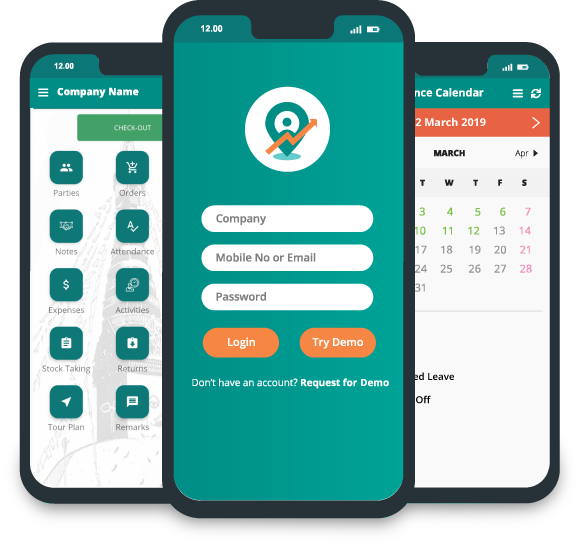

Why WhatsApp Voice Notes Are Not a Sales Report

WhatsApp has become one of the most commonly used communication platforms in field sales operations across FMCG, pharma, and distribution industries. Sales representatives use WhatsApp for sharing updates, communicating with managers, sending order details, and discussing retailer feedback during daily field activities.
Voice notes became especially popular because they allow salespeople to quickly share information while traveling between outlets without spending time typing long reports. Many organizations initially considered this method fast, flexible, and convenient for communication between field teams and management.
However, as businesses grow and sales operations become more complex, companies begin facing serious challenges when WhatsApp voice notes are treated as formal sales reports. Communication tools are useful for conversations, but business reporting requires structured, measurable, searchable, and standardized data supported by sales force automation systems.
This is where many organizations fail to differentiate between communication and reporting. A voice note may explain a situation, but it cannot replace organized reporting systems designed for business analysis and decision-making.
Why Voice Notes Became Popular Among Sales Teams
Field sales teams operate in high-pressure environments where representatives travel long distances, visit multiple retailers daily, manage order collection, handle complaints, track product availability, and coordinate with distributors. In such fast-moving conditions, preparing detailed written reports after every outlet visit often feels time-consuming and impractical.
Voice notes gained popularity because they solve immediate communication challenges and offer several operational advantages:
- Faster updates while moving between outlets and territories
- Easier sharing of real-time market conditions and retailer conversations
- Reduced manual effort compared to typing detailed reports
- Quick escalation of issues during working hours
- Convenient communication in local and regional languages
For managers, voice notes initially seem effective as they provide instant visibility into field activities without formal reporting delays. However, they are not integrated with field sales reporting software, which is essential for structured tracking, analysis, and accountability.
While voice notes improve short-term communication efficiency, they create long-term operational challenges as organizations scale, leading to inconsistent reporting, reduced data reliability, and limited visibility for decision-making.
The Difference Between Communication and Reporting
Many businesses mistakenly treat communication and reporting as the same function, but in sales operations they serve entirely different purposes and outcomes.
Communication
Communication is primarily about coordination. It helps field teams stay connected, share updates quickly, and respond to on-ground situations in real time. It is informal, conversational, and often temporary in nature, making it suitable for urgency-driven interactions rather than structured analysis.
Reporting
Reporting, on the other hand, is a structured business process focused on collecting measurable, standardized, and verifiable operational data through field force management software. It is designed for performance tracking, accountability, and strategic decision-making.
Professional sales reporting typically includes:
- Outlet coverage and visit tracking
- Exact order values and SKU-level details
- Product availability and stock status
- GPS-based visit verification
- Attendance and working hours tracking
- Retailer feedback and market intelligence
- Territory-wise performance analysis
Without structured systems like a sales analytics dashboard, organizations cannot convert raw field activity into actionable insights, making it difficult to evaluate performance, optimize territories, or improve forecasting accuracy.
The Major Limitations of Voice-Note Reporting
Voice-note-based reporting may appear convenient for field sales teams, but it introduces several structural and operational challenges that directly impact data quality, visibility, and decision-making.
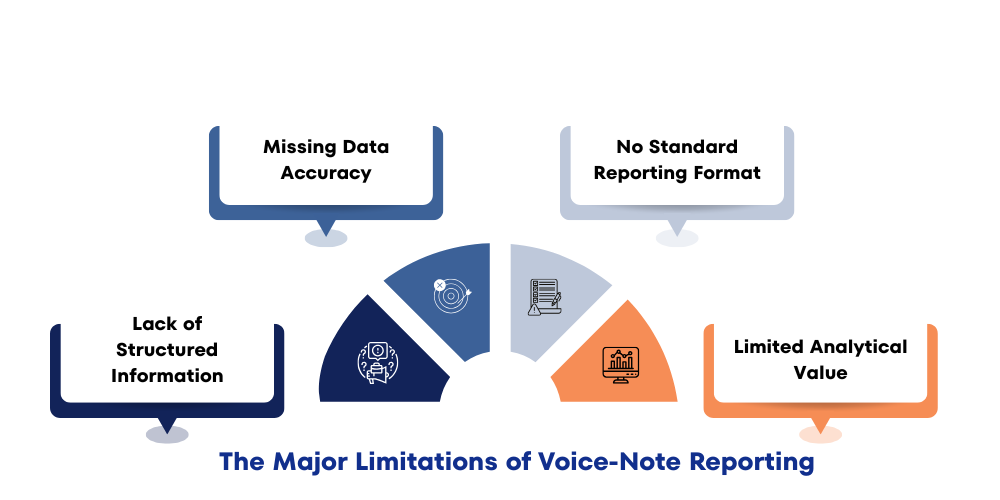
Lack of Structured Information
Voice notes are inherently unstructured and narrative-driven, which prevents seamless integration with FMCG sales tracking systems. Since data is not captured in predefined fields, it becomes difficult to standardize, compare, or analyze across territories and teams.
Missing Data Accuracy
Because updates are often based on recall rather than real-time entry, organizations lose precision in real-time sales data capture. Critical details such as SKU-level demand, exact order quantities, or competitor activity are frequently missed or inconsistently reported.
No Standard Reporting Format
In the absence of sales reporting software, there is no uniform reporting structure across field teams. Each salesperson communicates information differently, leading to inconsistent data formats, reduced comparability, and weak historical analysis capability.
Limited Analytical Value
Unstructured voice inputs cannot be easily transformed into dashboards or performance metrics, limiting their usability in sales analytics dashboard systems and reducing visibility into territory performance and execution efficiency.
Why Managers Cannot Rely on Verbal Updates Alone
Managers require structured, real-time visibility into field operations to effectively monitor performance, and this is only possible through mobile sales app systems designed for data-driven execution tracking.
With voice-note-based reporting, several operational limitations emerge:
- Managers are forced to listen to hundreds of messages daily, making it time-consuming and inefficient to extract actionable insights
- Important updates often get buried or missed within continuous communication threads
- Historical information cannot be searched, filtered, or analyzed for trends or performance reviews
- Decision-making slows down due to the absence of structured, real-time dashboards and consolidated reporting
Additionally, without a GPS tracking sales mechanism, field activity verification becomes subjective and unreliable. Managers cannot accurately confirm outlet visits, route adherence, or on-ground execution, which weakens accountability and reduces overall control over field operations.
Important Sales Insights Voice Notes Fail to Capture
Voice-note-based reporting may capture general field updates, but it consistently fails to generate structured, measurable data required for effective sales operations and performance analysis.
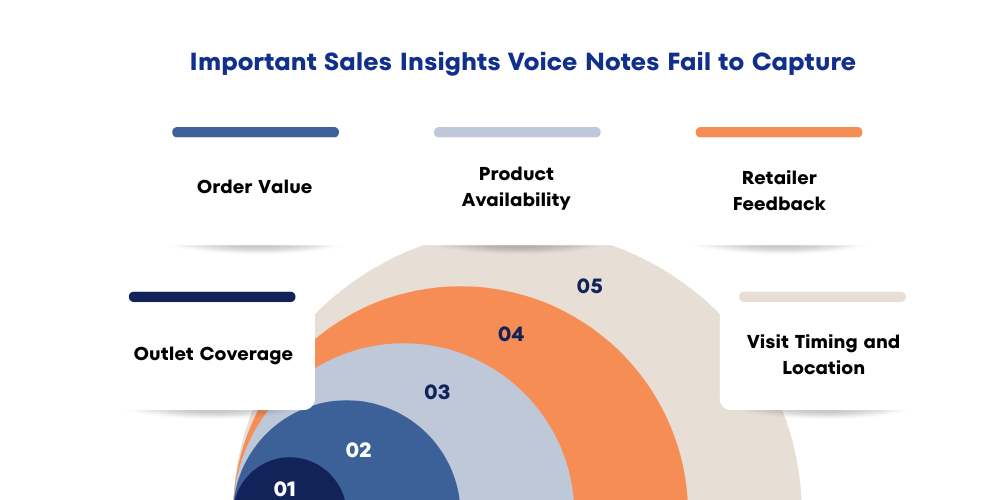
Outlet Coverage
Without outlet coverage tracking, businesses cannot accurately measure field efficiency, visit completion rates, or territory penetration. This results in blind spots in identifying underperforming regions and missed sales opportunities.
Order Value
Voice notes do not provide structured inputs required for order management system analytics. As a result, businesses lose visibility into order size, SKU-level demand, and revenue contribution at a granular level.
Product Availability
Accurate inventory visibility depends on integration with distributor management software workflows. Voice notes may mention stock issues, but they cannot systematically capture or analyze availability trends across SKUs and locations.
Retailer Feedback
Unstructured verbal communication limits the ability to convert feedback into actionable insights for retail execution improvements. Critical market intelligence often remains unorganized and underutilized.
Visit Timing and Location
Without structured tools, sales performance tracking becomes inconsistent and incomplete. Lack of verified visit timing and location data reduces field transparency, making it difficult to assess productivity and operational discipline.
The Operational Problems Created by WhatsApp Reporting
When WhatsApp becomes the primary reporting channel, organizations gradually lose control over structured execution systems and the effectiveness of field force management software declines significantly.
This shift introduces several critical operational challenges:
- No centralized reporting database, leading to fragmented and scattered field data across chats and groups
- Missing historical sales records, making it difficult to track trends, performance patterns, and past decisions
- Weak accountability systems, as field activities cannot be consistently verified or audited
- Delayed business decisions due to lack of real-time consolidated insights and dashboards
- Poor visibility in territory management software, resulting in unclear performance tracking across regions and sales teams
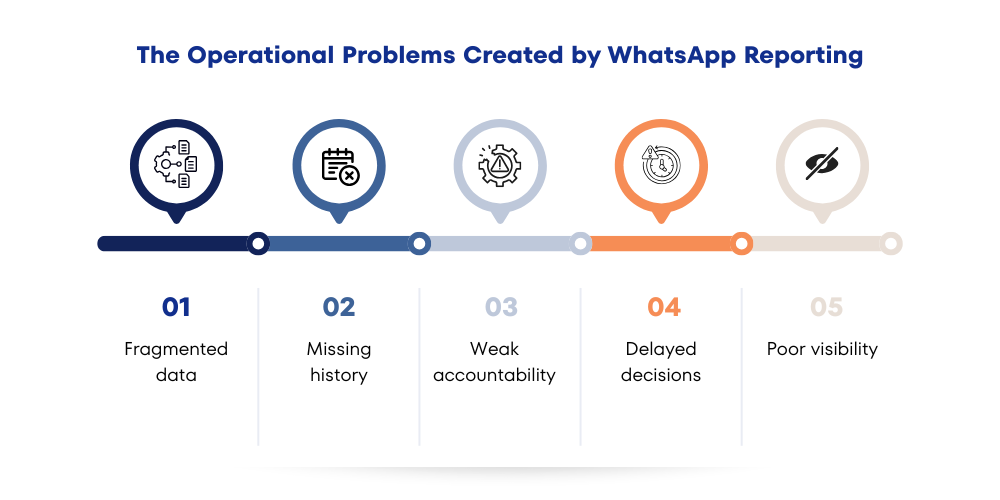
Over time, these inefficiencies reduce operational control, weaken sales governance, and limit the organization’s ability to scale structured field operations effectively.
Why Unstructured Data Leads to Poor Decision-Making
Without structured systems like real-time sales data, organizations are forced to rely on assumptions instead of actionable insights, which significantly weakens operational accuracy and strategic planning.
This results in several critical business challenges:
- Inaccurate forecasting, as sales trends cannot be reliably analyzed without consistent, structured inputs
- Weak inventory planning, due to lack of SKU-level visibility and demand intelligence across territories
- Missed market opportunities, where emerging demand signals remain hidden in unstructured communication
- Poor territory analysis, making it difficult to compare performance, identify gaps, or optimize field execution strategies
Over time, the absence of structured data creates a reactive decision-making environment, where businesses respond to problems after they occur rather than preventing them through predictive, data-driven insights.
How Voice Notes Reduce Accountability in Field Teams
Without sales force automation, enforcing accountability in field operations becomes inconsistent because activity data is informal, unstructured, and difficult to verify.
This leads to several operational gaps:
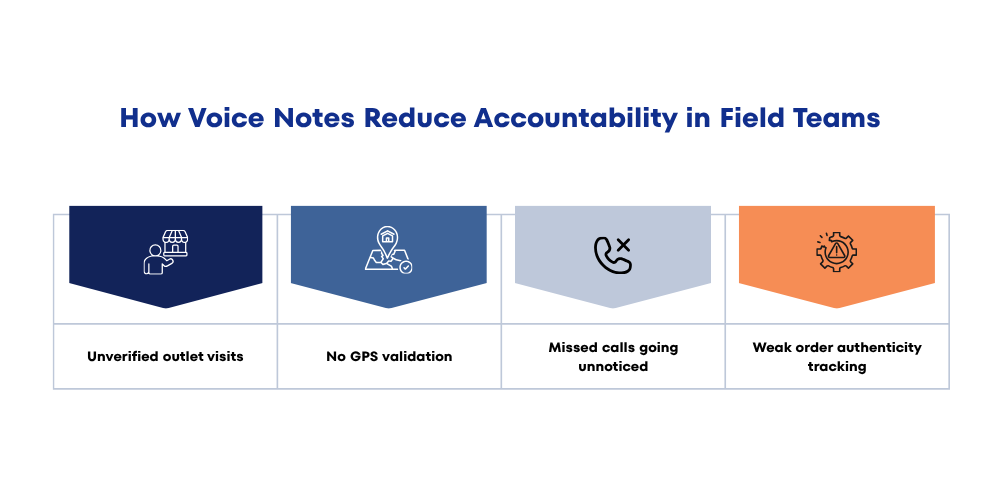
- Unverified outlet visits, as there is no structured proof of visit completion or outlet-level tracking
- No GPS validation, making it impossible to confirm whether the salesperson actually visited the assigned location
- Missed calls going unnoticed, since informal updates do not provide systematic attendance or activity logs
- Weak order authenticity tracking, where orders shared through voice notes cannot be reliably validated or linked to verified field activity
As a result, managers lose operational control, and field performance becomes dependent on self-reported information rather than measurable, auditable data.
The Need for Real-Time and Searchable Sales Data
Modern organizations rely on automated reports and analytics dashboard platforms to gain real-time visibility and make informed decisions based on structured field data rather than informal communication.
These systems enable access to critical business insights, including:
- Live order data for instant sales tracking and revenue visibility
- Attendance records to monitor field force discipline and working patterns
- Territory productivity metrics to evaluate performance across regions
- Retailer feedback for capturing structured market intelligence
- Product movement insights to understand demand trends and inventory flow
Without these capabilities, organizations struggle to scale efficiently, as decision-making becomes reactive rather than data-driven, limiting overall operational control and business growth potential.
How Sales Automation Solves Reporting Challenges
A mobile sales tool eliminates the limitations of voice-based reporting by replacing unstructured communication with standardized, real-time data capture across all field activities. Instead of relying on subjective updates, every interaction is recorded in a measurable and verifiable format, ensuring complete operational transparency.
It enables accurate and consistent data capture for:
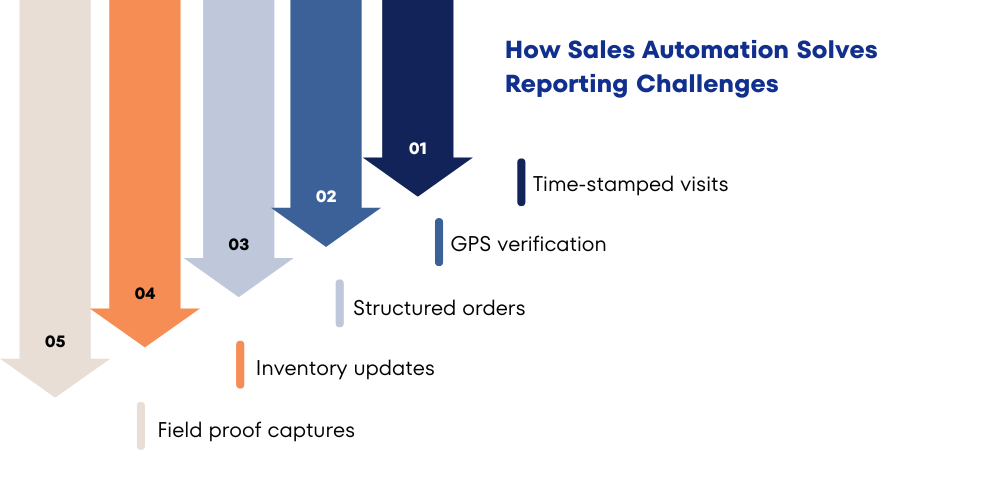
- Outlet visits with time-stamped entries, ensuring every call is recorded with exact visit timing and duration
- GPS verification to confirm on-ground presence, route compliance, and eliminate fake or missed visit reporting
- Orders captured in structured formats with SKU-level detail, pricing accuracy, and instant syncing to backend systems
- Product availability updates linked directly to distributor and inventory systems for real-time stock visibility
- Field images and proof of execution, providing visual validation for merchandising, promotions, and shelf placement
Beyond basic data capture, sales automation also introduces workflow intelligence into field operations. Managers can track live dashboards, identify bottlenecks instantly, and monitor team performance without waiting for manual updates or WhatsApp messages.
These capabilities collectively form a powerful field force management software ecosystem that enhances visibility, improves accountability, reduces reporting delays, and enables faster, more accurate decision-making across all sales territories.
Building a Smarter and More Transparent Sales Process
Organizations adopting FMCG sales tracking systems move away from fragmented communication-based reporting toward a fully structured, data-driven execution model that improves control and visibility across all field operations.
This transformation delivers measurable business benefits, including:
- Better transparency, as every outlet visit, order, and field activity is captured in real time and visible to management dashboards
- Faster decisions, enabled by instant access to structured sales data instead of delayed or unorganized WhatsApp updates
- Improved accuracy, since data is recorded at the source through standardized mobile workflows rather than memory-based reporting
- Stronger forecasting, powered by consistent historical data on sales trends, SKU movement, and territory performance
- Scalable operations, allowing organizations to efficiently manage growing field teams without increasing manual reporting complexity

In addition to these advantages, structured sales force automation systems also strengthen accountability, improve field discipline, and ensure that every sales activity contributes to a unified and measurable business performance framework.
Conclusion:
WhatsApp voice notes may provide speed and convenience, but they are not a replacement for structured sales reporting software designed to deliver accurate tracking, consistent data capture, and reliable decision-making. As sales operations grow in scale and complexity, dependence on informal communication creates significant gaps in visibility, accountability, and performance evaluation.
High-performing organizations address these challenges by moving beyond communication-based updates and adopting structured systems that enable measurable business intelligence rather than unstructured conversations.
Take the next step toward smarter sales execution
Book a free demo of Delta Sales App today and see how structured field force automation can transform your sales reporting, improve team visibility, and accelerate business growth.