
Managing a Team of 5 vs. 50: How Your Process Must Change
Managing people is not just about increasing team size; it fundamentally changes how work is executed, monitored, and optimized within an organization. A management approach that works effectively for a small team often becomes inefficient and unscalable as the team grows beyond its initial structure.
As organizations expand, the need for scalable team management becomes essential to maintain consistency, control, and performance across all operations. Without evolving processes, managers struggle with reduced visibility into daily activities, weak accountability systems, and inconsistent execution across team members.
This makes it critical for leaders to shift from informal, people-dependent management to structured, system-driven processes powered by performance tracking software, enabling sustainable growth, better decision-making, and operational efficiency at scale.
The Fundamental Shift in Management Thinking
This makes it critical for leaders to shift from informal, people-dependent management to structured, system-driven processes powered by performance tracking software, enabling sustainable growth, better decision-making, and operational efficiency at scale.
Such systems fundamentally change how managers operate by bringing clarity and control into day-to-day execution. Instead of relying on verbal updates or fragmented communication, organizations move toward structured visibility and measurable outcomes.
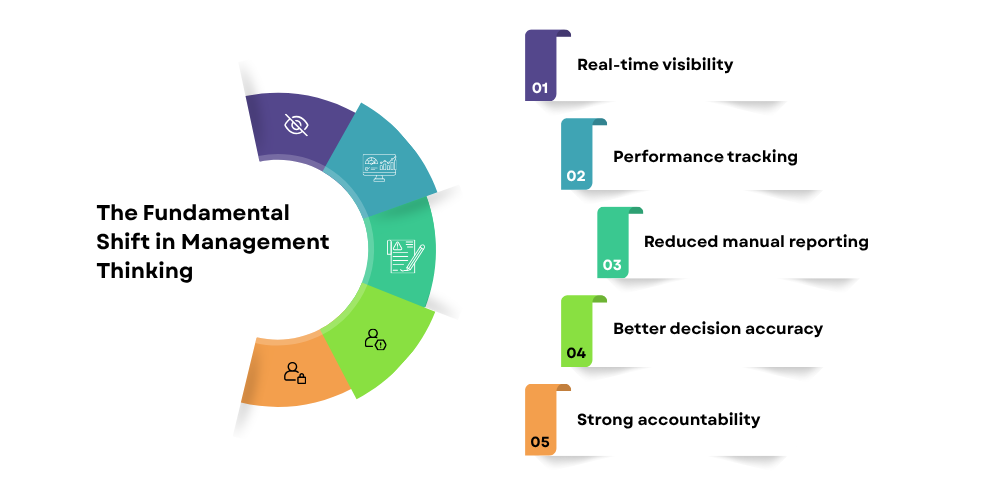
Key benefits of this shift include:
- Real-time visibility into team performance and field activities
- Early identification of performance gaps and operational delays
- Reduced dependency on manual reporting and follow-ups
- Improved accuracy in decision-making through centralized data
- Better accountability across all levels of the organization
Over time, this transition not only improves operational discipline but also strengthens long-term planning, forecasting, and resource allocation. It enables businesses to move from reactive management to proactive, data-driven execution, where every decision is backed by structured insights rather than assumptions.
Managing a Team of 5: Direct Control Model
In a team of five, management operates in a highly direct and hands-on manner. The manager is closely embedded in daily activities, often acting as both decision-maker and execution guide. Because of the small size, coordination is simple, and issues are typically resolved in real time without requiring formal escalation or documentation.
High Visibility and Informal Tracking
In small teams, every activity is naturally visible through small team management software is rarely required. Managers can easily track progress through direct communication, quick check-ins, and personal observation. This reduces the need for structured systems, as awareness is maintained through constant interaction.
Fast Decision-Making Without Systems
Decision-making in small teams is highly responsive and supported by real-time team tracking tools in a lightweight form. Since feedback loops are immediate, managers can quickly adjust priorities, resolve issues, and reassign tasks without waiting for reports or dashboards. This agility allows teams to operate with speed, even in dynamic environments.
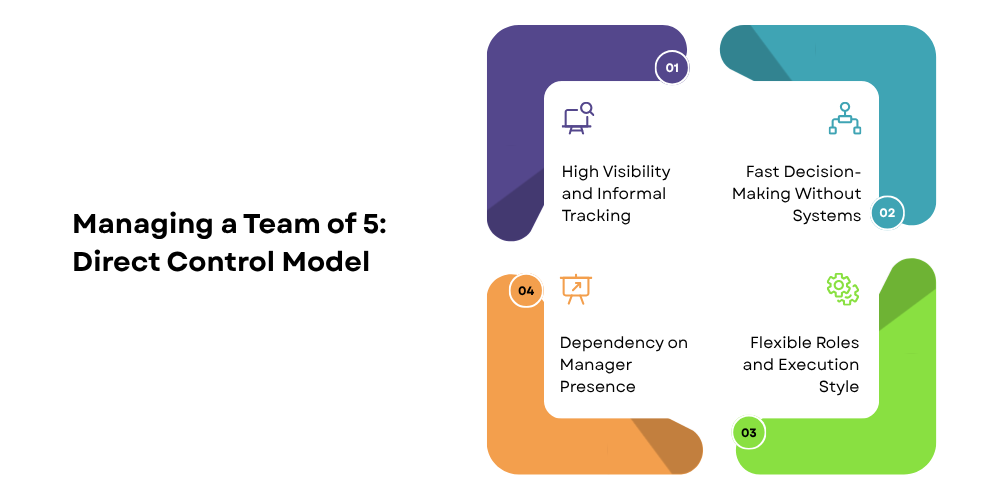
Flexible Roles and Execution Style
Team members often handle multiple responsibilities, shifting between tasks as needed, which is common in startup team management practices. This flexibility improves responsiveness but also limits process standardization, as roles are not strictly defined or system-driven.
Dependency on Manager Presence
One of the key characteristics of this model is its reliance on the manager’s constant involvement, often seen in direct sales team supervision models. The team’s performance, direction, and efficiency largely depend on the manager being actively present, making scalability difficult without structural changes.
Managing a Team of 50: Systems-Driven Model
When a team scales to 50 members, management shifts from individual oversight to structured system-based control. At this level, informal tracking and direct supervision are no longer effective. Instead, organizations must rely on standardized processes, clear hierarchies, and data-driven systems to maintain consistency, visibility, and performance across the entire team.
Need for Standardized Processes (SOPs)
At scale, organizations require standard operating procedures (SOPs) for sales teams to ensure consistency in execution across all employees. SOPs define how tasks should be performed, reducing dependency on individual interpretation and ensuring uniform output across different locations and team members.
Role of Layered Management Structure
Hierarchy becomes necessary to distribute responsibility and maintain control over large teams. A layered sales team structure helps break down reporting lines into manageable units, enabling team leaders to supervise smaller groups while senior managers focus on overall performance and strategy.
Shift from Supervision to Monitoring
As teams grow, managers can no longer supervise every activity directly. Instead, they shift toward monitoring outcomes through structured systems like field sales monitoring software, where performance is tracked through dashboards, KPIs, and automated reports rather than manual follow-ups.
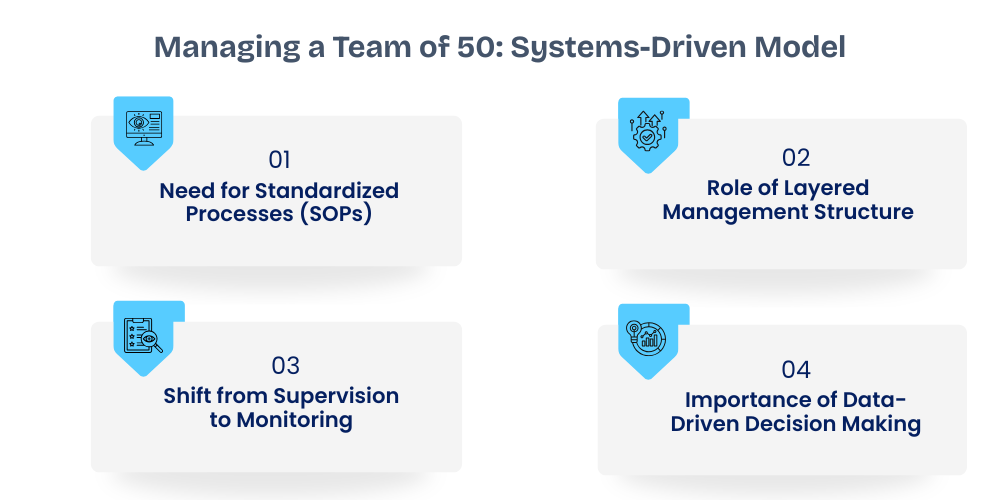
Importance of Data-Driven Decision Making
Decision-making is no longer based on observation or verbal updates. Instead, it relies on structured insights from a business intelligence dashboard for sales, which consolidates real-time data into actionable metrics, enabling faster, more accurate, and objective business decisions.
The Core Transition: From Control to Systems Thinking
As organizations scale, the fundamental approach to management shifts from direct control of individuals to designing systems that drive consistent outcomes. This transition is essential for maintaining performance, visibility, and accountability in larger teams where manual oversight is no longer feasible.
People Management vs Process Management
Small teams depend on managing people directly, where the manager is involved in every decision and execution detail. In contrast, large teams depend on process-driven management in sales organizations, where standardized workflows and systems ensure consistency regardless of individual differences.
From Intuition to Data-Based Decisions
Gut feeling and experience-based judgment gradually get replaced by structured analytics, performance metrics, and tools like sales performance tracking software. Decisions are no longer subjective; they are based on measurable data such as productivity, conversion rates, and territory performance.
From Manual Tracking to Automated Visibility
Manual follow-ups, verbal updates, and informal check-ins are replaced by automated sales tracking systems that provide real-time visibility across teams. This enables managers to monitor performance instantly, identify issues early, and maintain control without constant direct involvement.
Communication vs Reporting in Small vs Large Teams
As team size increases, the role of communication evolves significantly. What works in a small, closely connected team becomes insufficient when applied to larger, distributed structures. The distinction between informal communication and structured reporting becomes critical for maintaining control and visibility.
Informal Communication in Small Teams
Communication is enough when teams are small because managers are always close to execution and can directly observe progress. Most updates happen through quick conversations, calls, or messages, making formal systems unnecessary. This form of informal team communication in small sales teams works effectively due to high visibility and low complexity.
Structured Reporting in Scaled Teams
Large teams require structured reporting systems such as enterprise reporting system platforms for sales operations. These systems ensure that data is captured in a consistent, measurable, and searchable format, enabling managers to track performance across multiple regions and team members without relying on verbal updates.
Why Communication Alone Fails at Scale
As teams grow, informal communication creates gaps in tracking, consistency, and accountability. Important updates get lost in conversations, data becomes fragmented, and decision-making slows down. Without structured sales reporting systems, organizations lose visibility and struggle to maintain operational control across large teams.
Operational Challenges When Scaling from 5 to 50
As organizations grow from small teams to larger structures, operational complexity increases significantly. Processes that were once easy to monitor manually become difficult to track, measure, and control without structured systems. This is where scalability challenges begin to surface across execution, reporting, and accountability.
Loss of Visibility
Managers can no longer personally monitor every activity, leading to operational blind spots. Without field team visibility software, it becomes difficult to understand what is happening on the ground in real time.
Inconsistent Execution
Without standardization, execution quality varies across team members and regions. A lack of sales execution standardization tools results in uneven performance and reduced process reliability.
Delayed Reporting Cycles
Information flow slows down due to dependency on manual updates and informal communication. This creates delays in decision-making and reduces the effectiveness of real-time sales reporting systems.
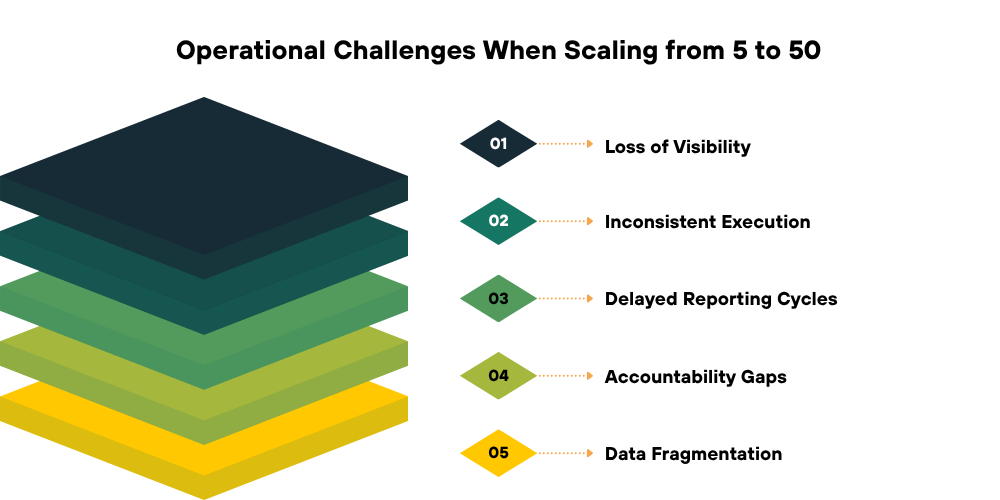
Accountability Gaps
It becomes difficult to verify who completed which task and when. Without sales team accountability tracking systems, organizations struggle to enforce discipline and performance ownership.
Data Fragmentation
Information gets scattered across chats, calls, and manual notes, reducing clarity and control. This fragmentation weakens the effectiveness of centralized sales data management systems.
This is where field sales tracking app becomes critical, as it consolidates execution data into a single system, restoring visibility, accountability, and operational control at scale.
The Role of Technology in Scaling Teams
As teams grow beyond small operational units, manual coordination and informal tracking become insufficient. Technology becomes the backbone of scalable management by introducing structure, consistency, and real-time visibility into daily operations.
Field Force Management Software
Field force management software for sales teams enables structured tracking of field operations and improves execution transparency. It helps organizations monitor visits, productivity, and territory coverage in a standardized format, reducing dependency on manual updates.
Sales Force Automation Systems
Sales force automation tools for FMCG companies automate reporting, order management, and performance tracking processes. This reduces manual effort, minimizes errors, and ensures that all field data is captured consistently at the source.
Mobile Sales Apps for Real-Time Tracking
Mobile sales tracker apps provide instant visibility into field activities and team performance. Managers can track orders, visits, and execution status in real time, enabling faster decision-making and improved operational control.
Dashboards and Analytics for Managers
Automated reports and analytics dashboards help convert raw field data into actionable insights. These real-time analytics platforms allow managers to monitor KPIs, identify performance gaps, and make data-driven decisions that improve overall efficiency and scalability.

Building a Scalable Management System
As organizations expand, sustainability depends on how effectively management systems are designed to handle growth. A scalable management system ensures that performance, visibility, and accountability remain consistent even as team size increases.
Designing Repeatable Processes
To achieve scalability, organizations must build standardized business processes for sales teams that can be repeated across locations and team members without variation. Repeatable processes reduce dependency on individuals and ensure consistent execution quality across the entire organization.
Defining KPIs and Performance Metrics
Clear performance indicators are essential for measuring success objectively. Using sales KPI management frameworks, organizations can track productivity, efficiency, and outcomes in a structured way, ensuring that every team member is evaluated on the same measurable standards.
Establishing Reporting Structures
A well-defined reporting system ensures that data flows accurately and consistently across all levels of the organization. Structured sales reporting frameworks help eliminate confusion, reduce delays, and provide managers with reliable insights for decision-making.
Automating Field Operations
Automation plays a critical role in scaling operations efficiently. By implementing field sales automation systems, organizations can reduce manual workload, eliminate reporting errors, and improve overall operational speed and accuracy. This enables teams to focus more on execution and less on administrative tasks.
How Leadership Style Must Evolve With Team Size
As organizations scale, leadership is no longer about direct involvement in every task. The effectiveness of a manager increasingly depends on how well they can design systems, interpret data, and guide teams through structured processes rather than hands-on execution.
From Executor to System Designer
Managers move from doing work themselves to building scalable leadership systems for sales organizations that others can follow. Instead of focusing on individual tasks, their role shifts toward designing workflows, processes, and frameworks that ensure consistent execution across the entire team.
From Reactive to Proactive Management
In small setups, leaders often react to issues as they arise. However, at scale, effective leaders adopt a proactive sales management approach, where they anticipate challenges using data insights, identify potential bottlenecks early, and implement preventive measures before problems impact performance.
From Micro-Management to Macro Oversight
As teams grow, attention must shift away from individual task monitoring toward overall performance trends. Through sales performance monitoring systems, leaders focus on KPIs, territory performance, and strategic outcomes rather than day-to-day micro-level supervision, enabling better scalability and control.
Common Mistakes Managers Make While Scaling Teams
As teams grow, many managers continue using small-team management habits that do not scale. These mistakes gradually reduce visibility, weaken execution quality, and create operational inefficiencies across the organization.
Over-Reliance on Informal Communication
Relying heavily on calls, messages, or verbal updates often leads to missed information and unclear execution status. Without structured team communication systems, accountability becomes inconsistent and critical updates fail to reach decision-making levels on time.
Ignoring Standardization
When processes are not standardized, each team member executes tasks differently. This creates inconsistency in output, reduced quality control, and poor scalability. A lack of sales process standardization tools makes it difficult to maintain uniform performance across teams.
Lack of Data Visibility
Without operational analytics tools for sales teams, managers are forced to depend on assumptions rather than real-time insights. This weakens decision-making accuracy and prevents timely identification of performance gaps or market issues.
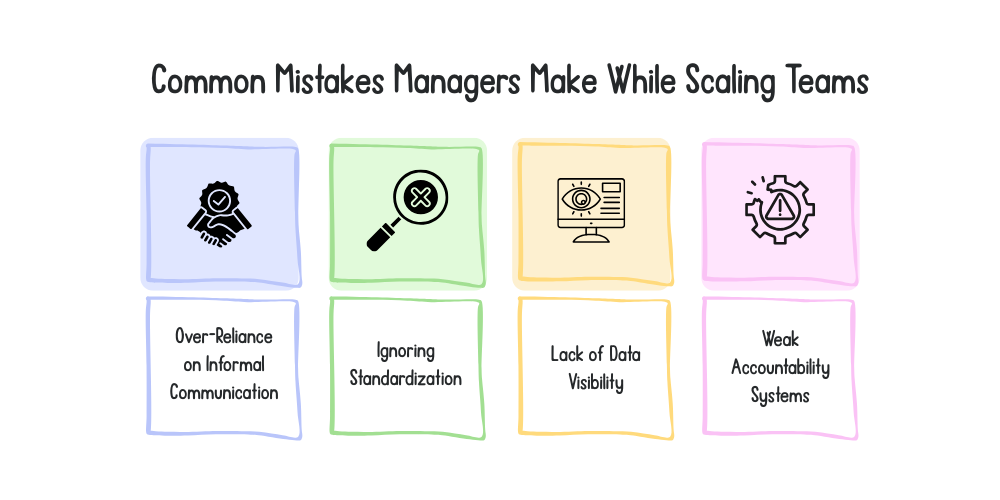
Weak Accountability Systems
When accountability is not clearly defined or tracked, it becomes difficult to measure individual contribution. Without sales accountability tracking systems, performance evaluation becomes subjective, leading to reduced discipline and lower overall efficiency.
Why Most Teams Fail During Scaling Transitions
Scaling a team is not just about increasing headcount; it is about ensuring that processes, communication, and performance systems can handle the added complexity. Many teams fail during this transition because foundational systems are not designed for scale.
Process Breakdown
Without a scalable workflow management app, processes that worked for small teams begin to collapse under increased workload. Tasks become inconsistent, dependencies increase, and execution quality starts to decline due to lack of structured workflows.
Communication Overload
As team size grows, communication channels become overloaded with messages, updates, and informal discussions. Without structured team communication systems, this leads to confusion, missed priorities, and reduced operational efficiency.
Lack of Reporting Discipline
Inconsistent reporting practices reduce the reliability of data used for decision-making. Without sales reporting discipline frameworks, organizations struggle to maintain accurate performance tracking and historical visibility across teams.
Absence of Scalable Systems
When organizations fail to adopt team performance management software, growth becomes unsustainable. Manual tracking and informal processes cannot support larger teams, resulting in inefficiency, poor control, and declining performance during scaling transitions.
Conclusion:
Managing a team of 5 is fundamentally different from managing a team of 50. The shift is not just about increasing headcount, it is about evolving structure, implementing systems, and building true scalability into operations.
Organizations that scale successfully adopt structured processes, automation, and data-driven tools such as organizational efficiency systems, enabling them to move from reactive management to controlled, predictable, and performance-driven growth.
Ultimately, success at scale is not defined by how many people you manage, but by how effectively you build systems that manage people, processes, and performance for you.
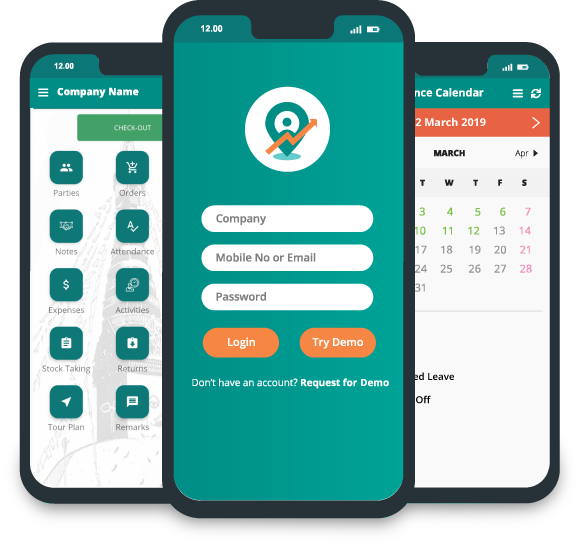
Book a free demo of Delta Sales App today and see how sales force automation can help you improve visibility, strengthen accountability, and scale your team with confidence.