
Modern Trade vs General Trade: Which Channel Delivers Better ROI for FMCG Brands
-1782971718.png)
The FMCG industry is one of the most competitive sectors, where success depends on reaching customers through the right sales channels. Whether selling food, beverages, personal care, or household products, a brand’s distribution strategy directly impacts revenue, profitability, and long-term growth.
Today, FMCG brands mainly rely on two key retail channels, Modern Trade and General Trade. Modern Trade includes organized retail formats like supermarkets and hypermarkets with centralized procurement and structured systems, while General Trade consists of traditional outlets such as kirana stores, wholesalers, and independent retailers that dominate local markets.
Both channels play a major role in FMCG distribution, but they differ in infrastructure, customer reach, costs, and ROI. With the help of sales force automation, field sales management, FMCG distribution systems, and sales analytics, businesses can efficiently manage both channels and improve overall performance.
In this blog, we compare Modern Trade and General Trade in detail and explore which channel delivers better ROI for FMCG brands.
What Is Modern Trade?
Modern Trade refers to organized retail businesses that operate through structured supply chains, centralized purchasing systems, standardized store layouts, and advanced retail technologies. These outlets offer customers a consistent shopping experience while enabling brands to showcase products professionally and efficiently.
Unlike traditional retail stores, Modern Trade retailers purchase products in bulk through centralized procurement systems and use technology to manage inventory, billing, promotions, and customer engagement. This organized approach allows brands to launch products quickly, execute promotional campaigns efficiently, and monitor sales performance with greater accuracy.
Today, Modern Trade has become an essential distribution channel for many FMCG companies because it offers access to urban consumers, premium shelf space, and valuable consumer purchasing insights.
Key Characteristics of Modern Trade
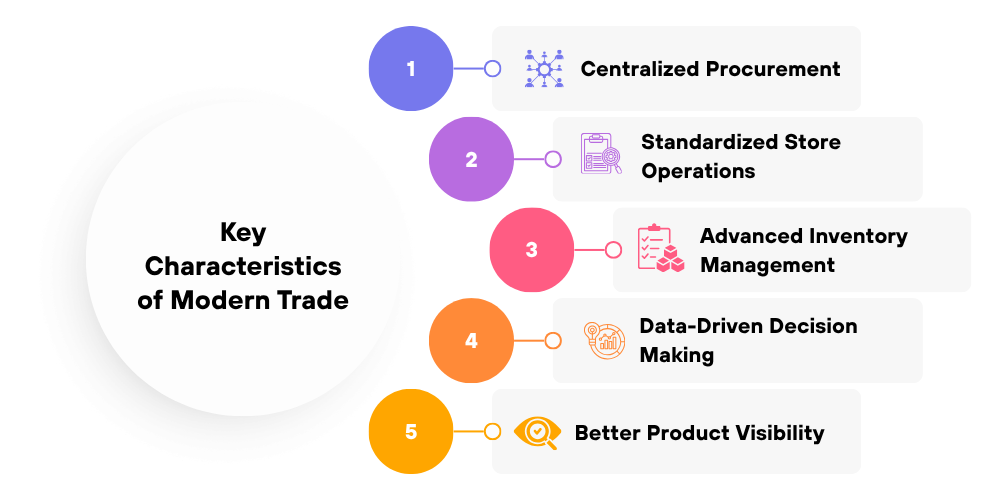
Centralized Procurement
Modern retailers purchase products through centralized buying teams rather than individual store owners. This simplifies distributor management, enables bulk purchasing, and helps brands forecast demand more accurately.
Standardized Store Operations
Every outlet follows consistent merchandising standards, pricing policies, promotional campaigns, and product placement strategies. This improves retail execution while creating a uniform shopping experience.
Advanced Inventory Management
Most organized retailers use sophisticated inventory management systems that automatically monitor stock levels, trigger replenishment orders, and reduce stock shortages.
Data-Driven Decision Making
Modern Trade generates valuable customer purchasing data, enabling brands to leverage sales analytics for pricing decisions, promotional planning, and product assortment optimization.
Better Product Visibility
Products are displayed using planned shelf layouts, promotional displays, and category management practices that increase visibility and encourage impulse purchases.
Benefits of Modern Trade for FMCG Brands
Modern Trade offers several advantages for businesses looking to expand their market presence:
- Access to high-volume urban customers.
- Stronger brand visibility through premium shelf placement.
- Faster rollout of promotional campaigns.
- Better inventory control and demand forecasting.
- Detailed sales reporting and customer insights.
- Simplified order processing through centralized purchasing.
- Higher opportunities for premium product positioning.
Because of these benefits, many FMCG brands allocate a significant portion of their marketing budgets to Modern Trade channels, especially for product launches and brand-building initiatives.
However, Modern Trade also comes with higher listing fees, stricter compliance requirements, promotional expenses, and tougher pricing negotiations. These factors can reduce profit margins despite generating high sales volumes, making ROI analysis essential before increasing investments.
What Is General Trade?
General Trade refers to the traditional retail distribution network consisting of independent retailers, neighborhood grocery stores, kirana shops, wholesalers, distributors, and local markets. Despite the rapid growth of organized retail, General Trade continues to account for a significant share of FMCG sales in many countries because of its extensive geographic reach and deep customer relationships.
Unlike Modern Trade, General Trade operates through decentralized purchasing, where retailers procure products from distributors or wholesalers based on local demand. These stores are often family-owned businesses that have built long-term trust with customers and understand the purchasing behavior of their communities.
For FMCG brands, General Trade plays a crucial role in expanding market penetration, especially in semi-urban and rural regions where organized retail presence remains limited.
Key Characteristics of General Trade
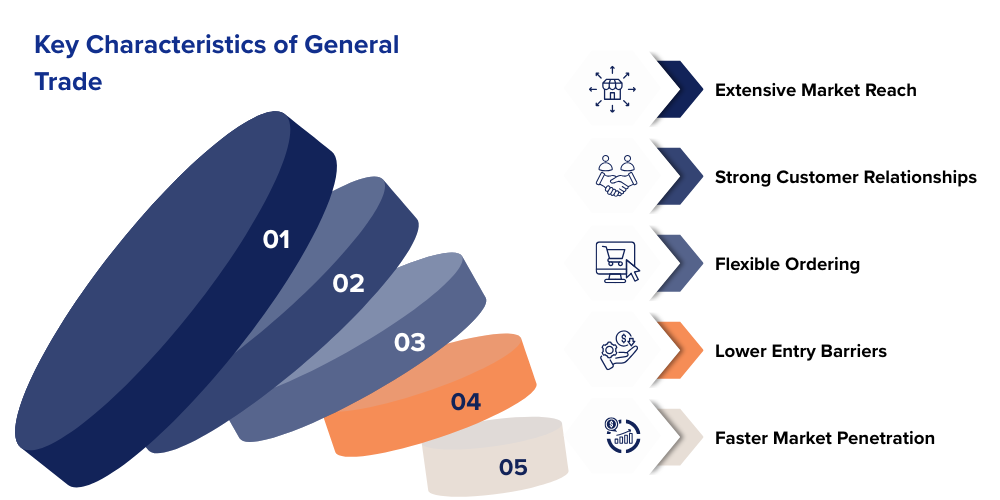
Extensive Market Reach
General Trade provides access to thousands of independent retailers across urban, semi-urban, and rural markets, helping businesses strengthen retail distribution and improve product availability.
Strong Customer Relationships
Local retailers often maintain long-term relationships with customers, leading to repeat purchases, personalized service, and higher customer loyalty.
Flexible Ordering
Retailers can order products based on immediate demand rather than centralized purchasing schedules. This flexibility improves inventory turnover and supports efficient order management.
Lower Entry Barriers
Unlike organized retail, General Trade generally doesn't require expensive listing fees or large promotional investments, making it easier for brands to expand into new markets.
Faster Market Penetration
With the support of distributors and field sales representatives, businesses can quickly introduce products into multiple retail outlets, strengthening territory management and increasing product availability.
Benefits of General Trade for FMCG Brands
General Trade continues to be the backbone of FMCG distribution because it offers several strategic advantages:
- Wider market coverage across diverse geographic regions.
- Strong retailer relationships that encourage repeat business.
- Lower operational and onboarding costs.
- Faster product availability in local markets.
- Greater flexibility in pricing and promotions.
- Better opportunities for rural market expansion.
- Higher frequency of customer interactions.
Managing General Trade effectively, however, requires a robust field sales operation. Businesses must coordinate distributor visits, retailer servicing, order collection, merchandising, payment follow-ups, and stock replenishment across hundreds or even thousands of outlets.
Without digital tools such as field force automation, customer visit tracking, route optimization, and secondary sales monitoring, managing General Trade can become time-consuming and operationally challenging.
While Modern Trade offers scale and structured operations, General Trade delivers unmatched market reach and customer accessibility. The choice between these channels ultimately depends on a brand's product portfolio, target audience, distribution strategy, and long-term business objectives.
Modern Trade vs General Trade: Which Channel Delivers Better ROI for FMCG Brands
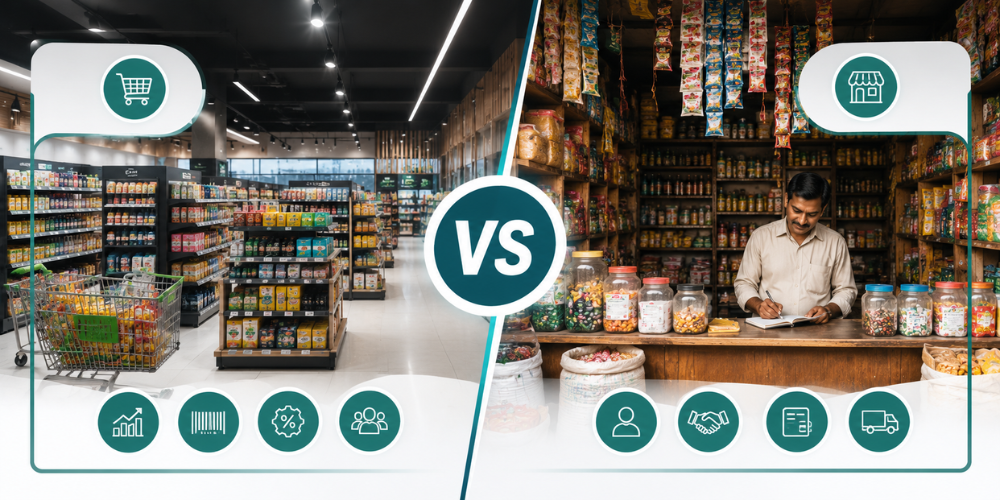
Key Differences of Modern Trade vs General Trade
Although both Modern Trade and General Trade play vital roles in the FMCG ecosystem, they operate using very different business models. Understanding these differences helps FMCG brands develop effective distribution strategies, allocate resources wisely, and maximize return on investment (ROI).
Modern Trade focuses on organized retail with centralized operations, whereas General Trade relies on a vast network of independent retailers and distributors. Each channel offers unique advantages depending on the product category, target audience, and market objectives.
Below is a detailed comparison of the two sales channels.
Customer Reach
Modern Trade primarily serves urban and metro customers through supermarkets, hypermarkets, and retail chains. These stores attract consumers looking for convenience, variety, premium shopping experiences, and promotional offers.
General Trade, on the other hand, has a much broader reach. Millions of neighborhood grocery stores, kirana shops, wholesalers, and independent retailers serve customers across urban, semi-urban, and rural markets. This extensive retail distribution network enables FMCG brands to reach even the most remote locations.
Purchasing Behavior
Customers visiting Modern Trade outlets usually purchase multiple products in a single visit and are influenced by promotions, discounts, product displays, and organized merchandising.
General Trade customers often make smaller but more frequent purchases. Buying decisions are strongly influenced by retailer recommendations, product availability, and long-standing customer relationships.
Understanding customer purchasing patterns helps businesses optimize sales analytics and improve product availability across both channels.
Order Management Process
Modern Trade follows centralized procurement systems where purchasing decisions are made by head offices or regional buying teams. Orders are generally placed in bulk and follow scheduled replenishment cycles.
General Trade operates through distributors and wholesalers, with retailers placing orders based on immediate demand. Efficient order management becomes critical to ensure timely deliveries and prevent stock shortages.
Pricing Strategy
Pricing in Modern Trade is highly competitive due to promotional campaigns, discounts, loyalty programs, and large-volume negotiations. Brands often invest heavily in visibility programs and in-store promotions.
General Trade offers greater flexibility in pricing. Retailers can adjust margins according to local competition and customer demand, making pricing strategies more adaptable to regional markets.
Inventory Control
Modern Trade relies on sophisticated inventory management systems that monitor stock levels, forecast demand, and automate replenishment.
General Trade inventory management is largely dependent on distributors and retailer ordering patterns. Businesses often require strong distributor management processes to ensure products remain consistently available.
Relationship Management
Modern Trade relationships are generally managed through corporate agreements, annual contracts, and centralized negotiations.
General Trade emphasizes personal relationships between sales representatives, distributors, and retailers. Regular visits supported by customer visit tracking help strengthen these relationships and improve retailer loyalty.
Sales Execution
Modern Trade requires strict compliance with merchandising standards, promotional execution, shelf placement, and category management.
General Trade focuses more on product availability, retailer servicing, relationship building, and frequent market visits supported by field sales management practices.
Technology Adoption
Most Modern Trade retailers already use advanced technologies such as automated billing, inventory software, electronic data interchange (EDI), and centralized reporting.
General Trade is rapidly adopting digital solutions such as field force automation, mobile ordering, GPS tracking, and retailer management applications to improve operational efficiency.
Operational Complexity
Managing Modern Trade involves handling negotiations, promotional investments, listing fees, and compliance requirements.
Managing General Trade requires coordinating thousands of retailers, distributors, field representatives, and delivery routes across multiple territories.
This complexity highlights the importance of territory management and digital sales solutions that simplify daily operations.
Comparing ROI Across Both Sales Channels
Every FMCG company ultimately asks one important question:
Which sales channel generates the highest Return on Investment (ROI)?
The answer isn't always straightforward.
ROI depends on multiple business factors including operating costs, customer acquisition expenses, product margins, sales volume, distribution efficiency, and long-term customer value. While Modern Trade often generates larger order values, General Trade usually delivers wider market penetration and stronger product availability.
Instead of viewing these channels as competitors, successful FMCG brands evaluate ROI based on their overall business objectives.
Revenue Generation
Modern Trade stores typically generate high sales volumes because customers purchase multiple products during each shopping visit. Large retail chains also enable nationwide product launches, increasing brand exposure.
General Trade generates revenue through high transaction frequency across thousands of retail outlets. Although individual order values may be smaller, cumulative sales often exceed those from organized retail because of extensive market coverage.
Businesses using sales force automation gain better visibility into revenue trends across both channels.
Cost of Distribution
Modern Trade often involves significant investments such as:
- Listing fees
- Promotional allowances
- Shelf rental
- Display charges
- Marketing campaigns
- Retail compliance costs
These expenses can reduce overall profitability despite higher sales volumes.
General Trade usually requires lower entry costs but higher investments in field sales teams, distributor networks, transportation, and retailer servicing.
Optimizing route optimization strategies can significantly reduce distribution costs in General Trade.
Profit Margins
Modern Trade generally operates with tighter profit margins due to aggressive price competition and retailer negotiations.
General Trade often allows businesses to maintain healthier margins because pricing is more flexible and promotional expenses are comparatively lower.
However, margin performance ultimately depends on product categories, distributor agreements, and retailer incentives.
Market Penetration
General Trade clearly leads in market penetration.
Its widespread retailer network enables FMCG brands to establish product availability across cities, towns, villages, and rural markets.
For products requiring frequent replenishment and daily consumption, General Trade remains an indispensable distribution channel.
Brand Visibility
Modern Trade offers exceptional opportunities for branding through:
- End-cap displays
- Product sampling
- Promotional campaigns
- Digital signage
- Premium shelf positioning
These activities increase consumer awareness and encourage impulse purchases.
General Trade builds brand recognition differently through retailer recommendations, consistent product availability, and repeated customer interactions.
Operational Efficiency
Modern Trade benefits from standardized systems and centralized operations.
General Trade becomes highly efficient when supported by mobile sales apps, secondary sales tracking, digital order booking, and automated reporting systems.
Technology significantly improves productivity across both channels.
Customer Loyalty
Modern Trade attracts shoppers through convenience, discounts, and loyalty programs.
General Trade builds loyalty through personal relationships, trust, credit facilities, and retailer familiarity.
This relationship-driven approach often results in repeat purchases and long-term customer retention.
Which Delivers Better ROI?
There is no universal winner.
If your goal is premium branding, organized merchandising, and high-volume urban sales, Modern Trade can deliver excellent returns despite higher operational costs.
If your priority is wider distribution, deeper market penetration, stronger retailer relationships, and sustainable long-term sales growth, General Trade often delivers superior ROI.
The highest-performing FMCG companies don't choose one channel over the other, they create a balanced omnichannel distribution strategy that combines the strengths of both.
With the help of sales analytics, field force automation, distributor management, and real-time reporting, businesses can continuously evaluate channel performance, optimize investments, and maximize ROI across both Modern Trade and General Trade.
Advantages of Modern Trade for FMCG Brands
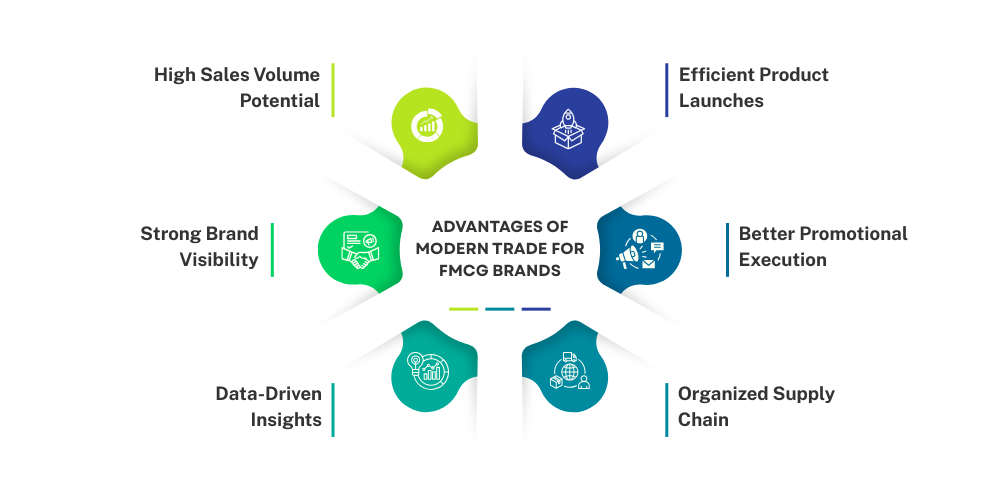
Modern Trade has become a critical growth driver for FMCG companies looking to build strong urban presence and premium brand positioning. With organized retail formats and structured buying systems, it offers several strategic advantages that directly impact revenue visibility and sales analytics performance.
High Sales Volume Potential
Modern trade outlets such as supermarkets and hypermarkets generate large basket sizes per customer visit. This leads to higher average transaction values and improved revenue consistency for FMCG brands.
Strong Brand Visibility
Products placed in Modern Trade benefit from premium shelf space, end-cap displays, and promotional zones. This enhances brand recall and improves retail execution across urban markets.
Data-Driven Insights
Modern retailers use advanced systems for billing and inventory, allowing brands to access detailed sales data. This supports better inventory management and demand forecasting for FMCG companies.
Efficient Product Launches
New product introductions are faster and more structured in Modern Trade due to centralized procurement and standardized listing processes.
Better Promotional Execution
Brands can run targeted campaigns, discounts, and in-store promotions that directly influence customer purchase behavior and improve ROI tracking.
Organized Supply Chain
Modern Trade ensures systematic replenishment cycles, reducing stockouts and improving overall distribution efficiency.
Advantages of General Trade for FMCG Brands
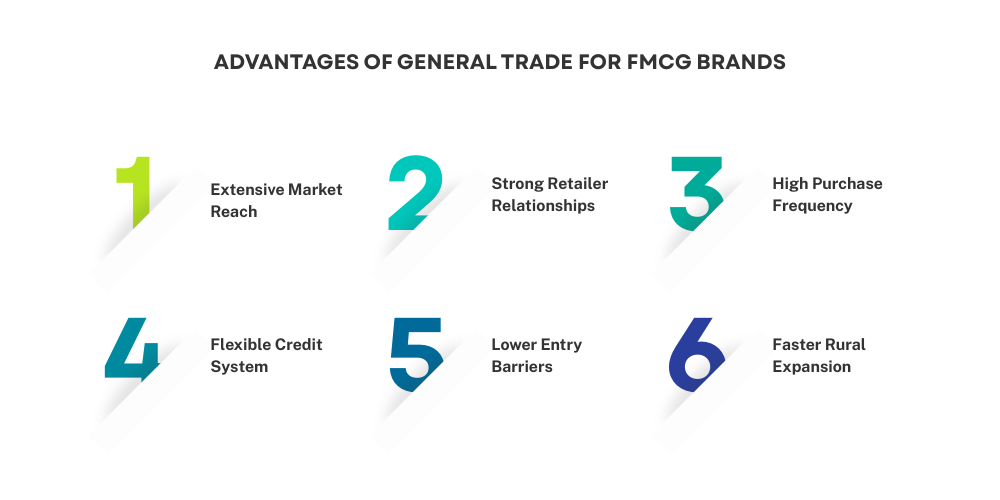
General Trade remains the backbone of FMCG distribution, especially in emerging markets. Its unmatched reach and strong retailer relationships make it essential for long-term market penetration and retail distribution success.
Extensive Market Reach
General Trade covers millions of kirana stores, wholesalers, and local retailers across urban, semi-urban, and rural markets, ensuring deep product penetration.
Strong Retailer Relationships
Personal relationships between sales representatives and retailers drive repeat orders and strengthen customer visit tracking effectiveness.
High Purchase Frequency
Consumers in General Trade buy smaller quantities more frequently, resulting in steady product movement and consistent demand generation.
Flexible Credit System
Retailers often operate on informal credit terms, increasing product accessibility and boosting sales conversion rates in local markets.
Lower Entry Barriers
Unlike Modern Trade, General Trade does not require listing fees or heavy promotional investments, making it easier for FMCG brands to scale quickly.
Faster Rural Expansion
General Trade plays a key role in rural market penetration where organized retail presence is limited or absent.
Challenges of Managing Modern and General Trade
Managing both Modern Trade and General Trade is complex because FMCG brands operate across two very different distribution ecosystems with varying processes and execution styles.
A major challenge is distribution complexity, as Modern Trade runs on centralized procurement while General Trade depends on fragmented distributor and retailer networks, making coordination difficult. Alongside this, lack of real-time visibility without sales force automation limits tracking of secondary sales, stock movement, and field performance.
Inventory mismatches also occur frequently due to weak inventory management, leading to stockouts in kirana stores and overstocking in organized retail. Another key issue is higher operational cost, where Modern Trade requires promotions and listings, while General Trade needs extensive field coverage through field sales management teams.
Finally, fragmented data systems reduce the accuracy of sales analytics, making it harder for businesses to take timely, informed decisions across both channels.
Which Channel Is Better for Different FMCG Businesses?
There is no universal winner between Modern Trade and General Trade. The effectiveness of each channel depends on the product category, target audience, pricing strategy, and overall business objectives. FMCG brands must evaluate their distribution strategy based on market maturity, consumption patterns, and long-term growth goals supported by sales analytics and FMCG distribution insights.
Premium and Urban-Focused Brands
Modern Trade is ideal for FMCG brands targeting urban consumers with premium or lifestyle-oriented products. Categories like packaged foods, beverages, personal care, and health products perform well in organized retail due to better visibility and structured merchandising.
These brands benefit from strong retail execution, promotional campaigns, and shelf space visibility, which directly influence purchasing decisions in supermarkets and hypermarkets.
Mass-Market and High-Frequency Products
General Trade is more effective for fast-moving daily essentials such as staples, snacks, beverages, and household goods. These products rely heavily on availability, repeat purchases, and strong retailer relationships supported by retail distribution networks.
Since General Trade covers both urban and rural markets, it ensures deeper penetration and consistent demand generation.
Rural and Semi-Urban Markets
For rural expansion strategies, General Trade remains the dominant channel. Its extensive reach through kirana stores and local distributors ensures product availability even in areas where Modern Trade presence is minimal.
New Product Launches
Modern Trade is highly effective for launching new products due to centralized procurement systems and better visibility. However, long-term success depends on scaling into General Trade to achieve mass adoption.
High-Volume FMCG Players
Large FMCG companies often adopt a hybrid model, using Modern Trade for brand building and General Trade for market penetration. This combination improves ROI balance across both channels.
How Technology Helps Maximize ROI Across Both Sales Channels
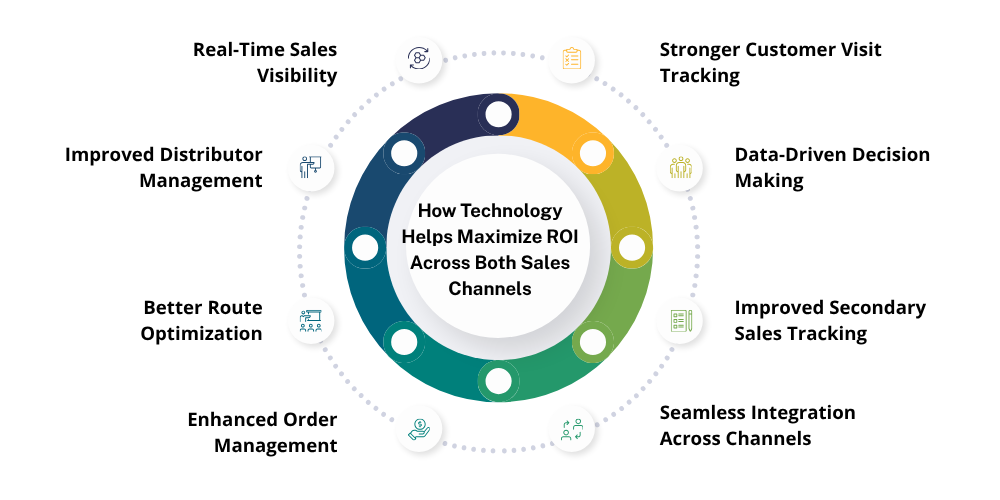
Technology plays a critical role in bridging the gap between Modern Trade and General Trade. With increasing competition and complex distribution networks, FMCG companies are turning to sales force automation, field sales management, and mobile workforce management tools to optimize performance and improve ROI.
Real-Time Sales Visibility
Modern field force automation systems provide real-time updates on sales performance, order booking, and retailer activity. This helps businesses make faster and more accurate decisions across both trade channels.
Improved Distributor Management
Efficient distributor management software ensures smooth product flow from warehouses to retail outlets. It reduces stock discrepancies and improves availability across both Modern and General Trade networks.
Better Route Optimization
Advanced route optimization tools help sales representatives plan efficient store visits, reduce travel time, and increase daily customer coverage, especially in General Trade-heavy regions.
Enhanced Order Management
Digital order management systems enable retailers to place orders instantly, reducing delays and improving supply chain responsiveness across all channels.
Stronger Customer Visit Tracking
With customer visit tracking, businesses can monitor field activity, ensure compliance, and improve retailer engagement through structured sales visits.
Data-Driven Decision Making
Unified dashboards powered by sales analytics help FMCG brands compare channel performance, analyze ROI, and identify high-performing territories.
Improved Secondary Sales Tracking
Tracking secondary sales helps businesses understand actual product movement at the retailer level, ensuring better forecasting and inventory planning.
Seamless Integration Across Channels
Integration of Modern and General Trade data allows FMCG companies to build a unified omnichannel distribution strategy, reducing inefficiencies and improving profitability.
By combining technology with a balanced channel strategy, FMCG brands can optimize investments, improve execution efficiency, and maximize ROI across both Modern Trade and General Trade.
How Delta Sales App Supports Modern & General Trade Sales
Managing both Modern Trade and General Trade efficiently requires more than traditional reporting systems. FMCG companies need a unified platform that delivers visibility, control, and automation across every level of the distribution network. The Delta Sales App is designed exactly for this purpose, helping brands streamline FMCG distribution, improve execution, and maximize ROI across both channels.
It brings together sales force automation, field sales management, and real-time analytics into one integrated system, enabling businesses to manage complex retail ecosystems with ease.
Unified Sales Tracking Across Channels
Delta Sales App provides centralized visibility into both Modern Trade and General Trade operations. Sales teams can track orders, visits, and secondary sales in real time, ensuring accurate sales analytics and better decision-making.
Efficient Distributor Management
The platform simplifies distributor management by tracking stock movement, order fulfillment, and retailer servicing. This reduces gaps in supply chain execution and improves product availability across all retail formats.
Real-Time Customer Visit Tracking
With advanced customer visit tracking, field representatives can log visits, capture retailer feedback, and ensure consistent engagement across thousands of outlets in General Trade and key accounts in Modern Trade.
Smart Route Optimization
The app uses route optimization to help sales teams plan daily beats efficiently, reducing travel time and increasing the number of outlets covered per day, especially in General Trade-heavy regions.
Automated Order Management
The built-in order management system enables quick and accurate order booking from retailers, distributors, and Modern Trade outlets. This minimizes errors and speeds up fulfillment cycles.

Secondary Sales Visibility
Delta Sales App provides deep insights into secondary sales performance, helping FMCG brands understand actual product movement at the retail level and improve forecasting accuracy.
Advanced Sales Analytics Dashboard
Interactive dashboards offer real-time insights into territory performance, product movement, and sales trends. This empowers managers to make data-driven decisions using automated reports and analytics and performance metrics.
Improved Field Force Productivity
By automating repetitive tasks like reporting, attendance, and expense tracking, the app enhances field sales management efficiency and allows teams to focus on revenue-generating activities.
Final Thoughts
Modern Trade and General Trade are not competing channels, they are complementary pillars of FMCG growth. Modern Trade drives brand visibility, structured retail execution, and premium positioning, while General Trade ensures deep market penetration, strong retailer relationships, and consistent product availability.
The real challenge for FMCG brands is not choosing between the two, but managing both efficiently to maximize ROI. Without proper systems, businesses risk inefficiencies in retail distribution, inaccurate inventory management, and fragmented sales analytics.
With the rise of digital transformation, companies that adopt sales force automation, field force automation, and intelligent distribution tools gain a significant competitive advantage in speed, visibility, and decision-making.
To succeed in today’s FMCG landscape, brands must move beyond manual processes and embrace technology-driven execution.
Book a demo with Delta Sales App today and discover how you can optimize Modern Trade and General Trade operations, improve field productivity, and maximize ROI across your entire sales network.