
Reducing Order Errors in Field Sales: Causes, Impact, and Solutions

Order accuracy is one of the most critical yet underestimated aspects of field sales operations. While organizations focus on increasing revenue, expanding distribution, and improving sales coverage, they often overlook the operational inefficiencies caused by inaccurate order capture.
In reality, even small order errors can trigger a chain reaction, affecting inventory tracking, delaying deliveries, and weakening customer trust. Because field sales teams operate in dynamic, on-ground environments, they are more prone to inconsistencies, especially when processes are manual or poorly integrated.
Without proper systems and controls, these hidden inefficiencies accumulate over time, leading to measurable losses in both productivity and profitability.
What Causes Order Errors in Daily Sales Operations?
Order errors are rarely random; they are usually the result of systemic gaps in processes and tools. One of the most common causes is reliance on manual order-taking methods, which increases the likelihood of mistakes during order processing and data entry errors.
Another major factor is the lack of real-time data access. When sales representatives do not have access to updated product catalogs, pricing structures, or stock availability, they are forced to make assumptions, which often leads to inaccuracies.
Communication gaps between sales teams, distributors, and backend operations also contribute to errors. In many cases, duplicate orders are created or incorrectly modified due to misalignment between stakeholders.
Additionally, the absence of standardized workflows and validation mechanisms further amplifies the problem, making it difficult to maintain consistency across teams and impacting sales order management.
Key Causes of Order Errors
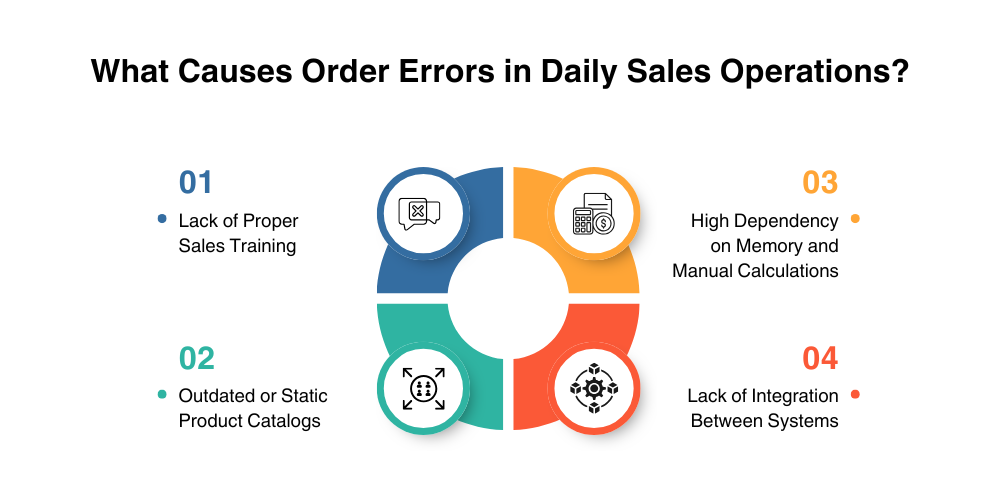
1. Lack of Proper Sales Training
Sales representatives who are not adequately trained on product details, pricing structures, or order processes are more likely to make mistakes. Inconsistent knowledge across teams leads to variation in order accuracy.
2. Outdated or Static Product Catalogs
When product catalogs are not updated in real time, sales reps may select discontinued items, incorrect SKUs, or outdated pricing, leading to frequent order discrepancies.
3. High Dependency on Memory and Manual Calculations
In many cases, sales reps rely on memory for pricing, discounts, or schemes instead of system-driven validation. This increases the chances of human error, especially in complex sales environments.
4. Lack of Integration Between Systems
Disconnected tools for CRM, inventory, and order management create data silos. Without proper integration, information does not sync across systems, resulting in inconsistent and inaccurate orders.
Common Types of Order Errors in Field Sales
Order errors can occur at multiple stages of the sales cycle, and understanding their types is essential for prevention.
One of the most frequent issues is incorrect product selection, where sales reps choose the wrong SKU due to similar product names or lack of clarity. Pricing errors are also common, especially when discounts or promotional offers are not applied correctly due to weak pricing validation.
- Incorrect scheme or offer application
Sales reps often fail to apply the correct promotional scheme or seasonal offer, resulting in billing mismatches and reduced customer trust.
Quantity mismatches, either over-ordering or under-ordering, can disrupt inventory tracking and lead to order fulfillment challenges.
- Customer data entry mistakes
Errors in entering outlet name, billing address, GST details, or contact number can create delivery failures and invoicing issues.
Duplicate orders are another recurring issue, often caused by poor coordination or system limitations.
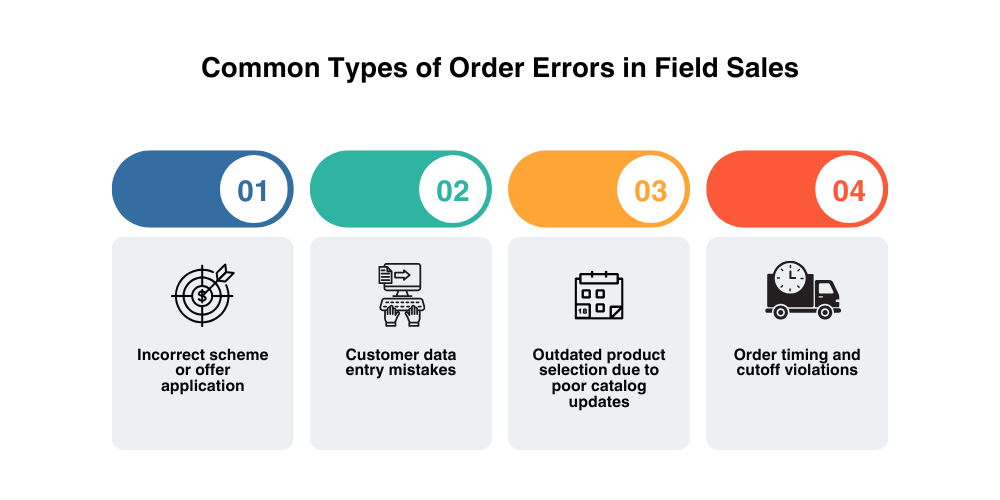
- Outdated product selection due to poor catalog updates
When product catalogs are not updated in real time, sales reps may accidentally select discontinued SKUs or incorrect variants.
Lastly, incomplete orders, where critical customer or delivery details are missing, create delays and require additional follow-ups, reducing overall efficiency in field sales execution.
- Order timing and cutoff violations
Orders placed after cutoff times or outside delivery schedules often lead to delays in processing and disrupt supply chain planning.
Business Impact of Order Errors on Revenue and Customer Experience
The impact of order errors extends far beyond operational inconvenience. At a financial level, incorrect pricing or missed orders can lead to direct revenue leakage. Over time, these losses can significantly affect profitability.
From a customer perspective, frequent order inaccuracies damage trust and satisfaction, negatively affecting customer relationship management. Late deliveries, incorrect products, or repeated errors create a poor experience.
Order errors also disrupt supply chain efficiency. Inaccurate orders lead to stock imbalances, affecting inventory management software and distribution planning. This increases operational costs due to returns, reprocessing, and additional logistics efforts.
Ultimately, these inefficiencies reduce the productivity of sales teams, as they spend more time correcting mistakes than focusing on revenue-generating activities, impacting sales performance tracking.
Business Impacts of Order Errors
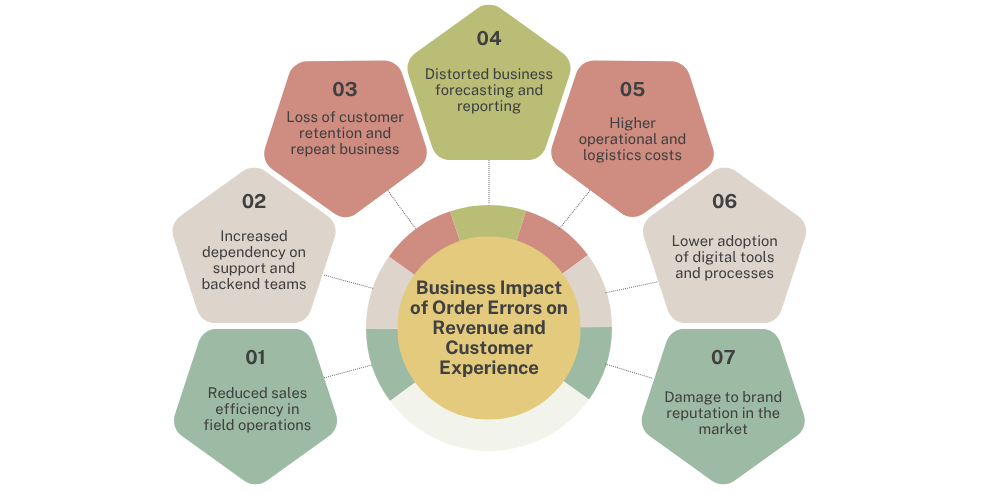
- Reduced sales efficiency in field operations
Frequent corrections and order rework slow down execution in field sales, reducing the number of productive customer visits per day. - Increased dependency on support and backend teams
Sales teams rely heavily on backend coordination to fix errors, which increases workload and reduces overall operational agility. - Loss of customer retention and repeat business
Poor order accuracy directly affects customer loyalty, leading to churn and reduced repeat orders, weakening long-term revenue stability. - Distorted business forecasting and reporting
Inaccurate orders create unreliable data in sales order management systems, affecting demand forecasting and strategic planning. - Higher operational and logistics costs
Frequent corrections increase transportation, warehousing, and reprocessing expenses, reducing overall profit margins. - Lower adoption of digital tools and processes
Repeated errors reduce trust in systems like CRM software and sales workflow automation, slowing down digital transformation efforts. - Damage to brand reputation in the market
Consistent order mistakes negatively impact market perception, making it harder to maintain strong distributor and retailer relationships.
Signs Your Field Sales Process Has Order Accuracy Issues
Order accuracy issues in field sales often do not appear suddenly; they develop gradually due to gaps in processes, systems, and execution discipline. Identifying these early warning signs is essential to prevent revenue leakage, operational inefficiencies, and customer dissatisfaction.
Key Indicators:
- Frequent increase in order returns or cancellations due to incorrect order capture
- Rising number of customer complaints related to delivery errors or billing mismatches
- Delays in order processing and fulfillment due to repeated corrections
- Inconsistent sales data between reported figures and actual deliveries
- High dependency on manual corrections and backend intervention for order fixes
- Repeated order modifications after submission in sales order management systems
- Lack of reliability in sales analytics tools for accurate reporting and insights
When these signs appear consistently, it clearly indicates breakdowns in order processing, validation systems, and overall execution in field sales operations.
With better process control, real-time visibility, and automated validation through modern CRM software and sales workflow automation, businesses can significantly reduce these issues. This leads to improved accuracy, stronger execution discipline, and more reliable sales performance tracking across the entire field force.
How Inefficient Systems Lead to Frequent Order Mistakes
Technology gaps play a major role in increasing order errors. Many organizations still rely on disconnected tools that do not communicate with each other, resulting in fragmented data and limited visibility.
Without integrated systems, sales representatives lack access to accurate and updated information. This leads to incorrect assumptions during order placement, especially in fast-moving environments.
Inefficient systems also fail to provide real-time data access and validation. As a result, errors go unnoticed until later stages, when they become more expensive and time-consuming to fix.
In contrast, modern digital systems enable seamless data flow, real-time updates, and automated validation, significantly improving sales workflow automation.
Key Ways Inefficient Systems Increase Order Errors:
- Fragmented data across multiple platforms
When CRM, inventory, and order management tools are not integrated, sales teams operate on incomplete or outdated information, leading to inaccurate order decisions in field sales. - Lack of centralized visibility for sales teams
Without a unified dashboard, reps cannot see real-time stock availability, pricing updates, or customer history, increasing dependency on guesswork during order processing. - No real-time validation during order entry
In inefficient systems, pricing, quantity, and SKU checks happen after submission, resulting in higher chances of errors in sales order management. - Delayed synchronization between departments
Sales, warehouse, and finance teams often work on different data sets, causing mismatches in order status, billing, and fulfillment. - Increased manual intervention and corrections
Backend teams must frequently fix errors manually, slowing down operations and reducing efficiency in order fulfillment. - Poor scalability of sales operations
As order volume increases, inefficient systems struggle to handle complexity, leading to higher error rates and reduced performance tracking accuracy.
With modern integrated platforms, businesses can eliminate these gaps through real-time data access, automated workflows, and stronger CRM software integration. This ensures smoother execution, fewer errors, and significantly improved efficiency across field sales operations.
Role of Automation in Reducing Order Errors
Automation has emerged as a key solution for improving order accuracy. By eliminating manual intervention, automated systems reduce the likelihood of human error and ensure consistency across processes.
Digital order capture tools, such as mobile sales tool, allow sales representatives to input orders directly into the system, minimizing duplication and transcription mistakes.
Automated validation checks ensure that pricing, quantities, and product selections are accurate before submission, strengthening sales order management.
Real-time synchronization ensures that all stakeholders have access to the same data, improving coordination and reducing miscommunication.
In field sales, automation not only improves accuracy but also enhances speed and efficiency.
Step-by-Step Solutions to Reduce Order Errors in Field Sales
Reducing order errors requires a structured and systematic approach in field sales operations. Each step focuses on improving accuracy, visibility, and control across the order lifecycle, ensuring fewer mistakes and smoother execution.
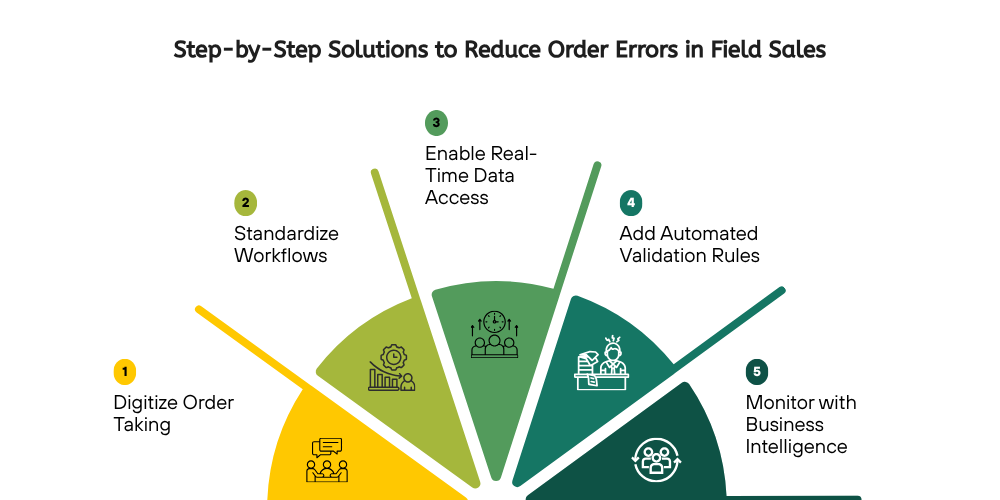
Step 1: Digitize Order Taking
Replace manual methods with CRM software or digital sales tools to improve accuracy and speed in order processing.
Step 2: Standardize Workflows
Define clear steps for order capture, validation, and submission to ensure consistent sales workflow automation across teams.
Step 3: Enable Real-Time Data Access
Provide instant access to inventory, pricing, and customer data to improve accuracy in sales order management.
Step 4: Add Automated Validation Rules
Use system-based checks for pricing, SKU selection, and quantity validation to reduce errors in pricing validation and stock handling.
Step 5: Monitor with Business Intelligence
Use business intelligence insights to track order accuracy, identify patterns, and continuously improve performance in field sales.
Tools and Technologies That Improve Order Accuracy
Modern sales organizations rely on a range of technologies to enhance order accuracy and reduce operational inefficiencies in field sales.
Mobile sales apps enable on-the-go order capture with built-in validation features, reducing manual mistakes and improving speed in order processing. CRM software provides centralized access to customer data, ensuring consistency, better coordination, and improved sales order management across teams.
Inventory tracking tools offer real-time visibility into stock levels, helping sales teams avoid availability-related errors and improving accuracy during order placement. This also strengthens demand planning and reduces fulfillment issues.
Additionally, sales analytics tools and reporting platforms provide deep insights into order patterns, enabling businesses to identify trends, detect anomalies, and reduce recurring issues. These insights support better decision-making and improve overall sales performance tracking.
Supporting Technologies
- Sales workflow automation systems
Automate repetitive tasks such as order approval, validation, and routing to reduce manual errors and improve operational efficiency. - Real-time synchronization platforms
Ensure all systems (CRM, inventory, billing) stay updated simultaneously, reducing data mismatch and improving accuracy in field sales execution. - AI-powered recommendation engines
Suggest correct SKUs, pricing, and order quantities based on past behavior, helping reduce human error during order entry. - Cloud-based sales platforms
Provide scalable and secure access to data from anywhere, ensuring sales teams always work with updated information. - Digital dashboards and BI tools
Offer visual insights into order accuracy, team performance, and system gaps, helping managers continuously improve processes.
Best Practices for Error-Free Order Management
To achieve sustainable improvements, organizations must adopt best practices that reinforce accuracy and consistency in field sales operations.
Standardizing processes across all sales teams ensures uniformity and reduces confusion. Regular training programs help sales representatives stay updated on tools, product catalogs, and evolving workflows, improving overall execution quality in order processing.
Implementing validation checks at multiple stages of the order lifecycle strengthens sales order management and prevents errors from progressing further into fulfillment and billing stages. These checks help catch mistakes early and reduce downstream corrections.
Encouraging accountability and continuous improvement through sales performance tracking helps maintain high standards and motivates teams to follow disciplined processes.
- Maintain a centralized product and pricing database
Ensure all sales teams access a single source of truth to avoid inconsistencies in pricing, SKUs, and promotional schemes. - Enable real-time synchronization across systems
Connect CRM, inventory, and billing systems to ensure accurate and updated information flows across all field sales operations. - Use automated approval workflows
Introduce system-based approvals for discounts, special pricing, and large orders to minimize manual intervention and errors. - Conduct regular audits and error analysis
Continuously review order data to identify recurring issues and improve sales workflow automation efficiency. - Promote feedback loops between sales and backend teams
Encourage communication to quickly resolve issues and improve coordination in sales order management.

Challenges in Eliminating Order Errors
Despite the benefits, implementing error-reduction strategies comes with challenges in field sales environments.
Resistance to change is one of the biggest barriers. Sales teams may hesitate to adopt new tools like mobile sales apps or automated systems due to unfamiliarity and comfort with existing manual processes.
Initial investment in technology and training can also be a concern. Integration complexities with existing systems further add to the challenge, especially when legacy tools are deeply embedded in sales order management workflows.
However, with proper planning and use of business intelligence insights, organizations can overcome these barriers effectively.
- Lack of digital adoption mindset in field teams
Many sales representatives are not fully comfortable with digital tools, leading to underutilization of sales workflow automation systems. - Poor data quality in existing systems
Inaccurate or incomplete customer and product data reduces the effectiveness of CRM systems and increases errors in order processing. - Integration issues between multiple platforms
Disconnected tools for CRM, inventory, and billing create data gaps and reduce accuracy in field sales execution. - Limited real-time connectivity in remote areas
Poor internet or connectivity issues can delay updates, affecting real-time data access and order accuracy. - Insufficient training and onboarding programs
Without proper training, sales teams may misuse tools, leading to errors in pricing validation and order entry. - Scalability challenges during business expansion
As sales volume increases, systems may struggle to maintain accuracy without strong sales analytics tools and infrastructure. - Change management and leadership alignment issues
Without strong leadership support, adoption of new systems remains inconsistent across teams.
Final Thoughts:
Reducing order errors is not just about fixing mistakes, it is about building a robust and scalable system that prevents them from occurring in the first place.
By combining process standardization, real-time data access, and automation, organizations can significantly improve order accuracy and operational efficiency.
For businesses aiming to scale their field sales operations, investing in the right tools and strategies is essential. Accurate order management not only enhances customer satisfaction but also drives long-term growth and competitive advantage.
Book a free demo of Delta Sales App to see how you can streamline order capture, improve accuracy, and empower your field sales teams with real-time visibility and automation.


-1792906895-resized320.png)