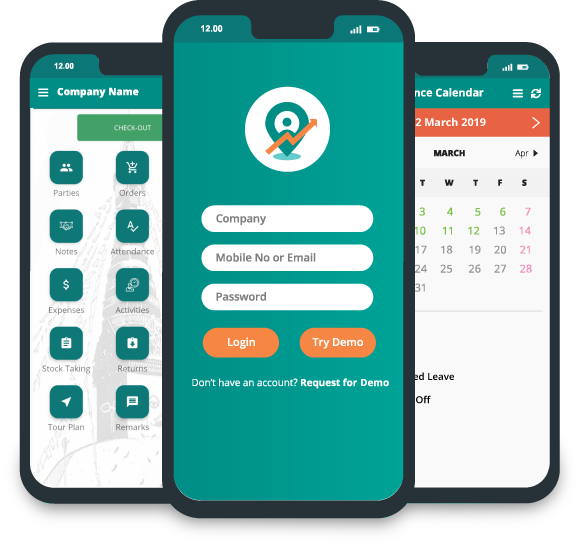

A Quick Guide to Sales Management Process

Sales management is the structured process of planning, executing, monitoring, and optimizing sales activities to achieve revenue goals. It connects strategy with execution and ensures that sales teams operate efficiently across territories, customer segments, and product lines.
In modern organizations, especially FMCG, pharmaceuticals, manufacturing, and distribution sectors, sales management is no longer manual. It is powered by digital systems such as field sales tracking app and automation platforms that provide real-time visibility into field operations.
Without structured sales management, organizations often face inconsistent execution, poor visibility, and missed revenue opportunities. With the right system, businesses can align teams, improve productivity, and scale operations efficiently.
What Is Sales Management?
Sales management is the structured coordination of planning, execution, monitoring, and optimization of sales activities to achieve business revenue goals.
It ensures that sales teams operate efficiently, follow defined processes, and align their efforts with organizational objectives. Modern businesses rely on digital tools to ensure accuracy, transparency, and performance consistency across all sales operations.
Organizations use sales management to:
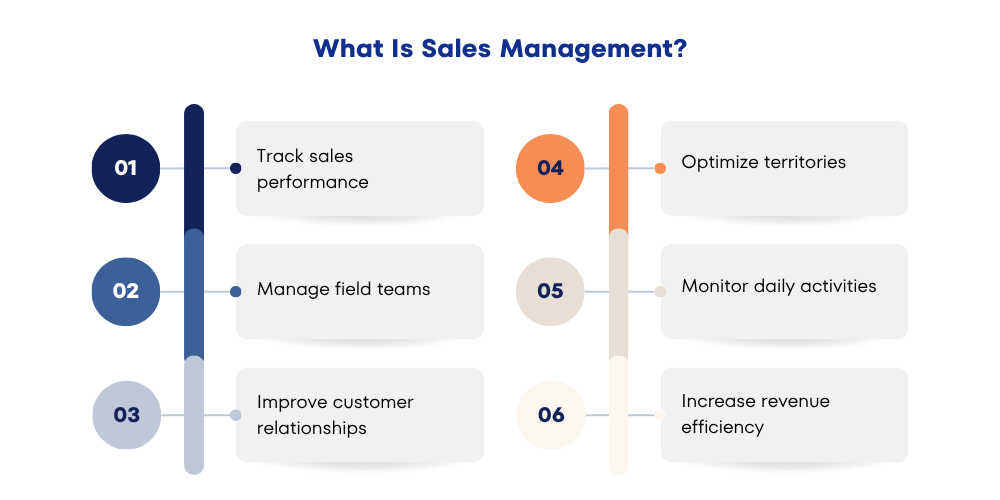
Track sales performance:
Monitor individual and team sales results to evaluate productivity, identify gaps, and improve overall revenue generation and performance accuracy.
Manage field teams:
Coordinate field sales representatives, assign tasks, and ensure smooth execution of daily activities across different regions and customer segments.
Improve customer relationships:
Build stronger customer engagement through timely communication, consistent follow-ups, and personalized interactions that enhance trust and long-term retention.
Optimize territories:
Distribute sales regions strategically to balance workload, maximize coverage, and improve efficiency of field sales operations across markets.
Monitor daily activities:
Track field sales activities such as visits, calls, and orders to ensure accountability and real-time operational visibility for managers.
Increase revenue efficiency:
Streamline sales processes to reduce wastage, improve conversions, and ensure maximum output from available resources and sales efforts.
By centralizing sales operations, businesses gain better control, improved forecasting, and stronger execution capability across all levels.
Why Sales Management Is Essential for Modern Businesses
Sales management plays a direct role in determining business success. Without structured systems, organizations face inefficiencies, poor execution, and missed revenue opportunities. It ensures alignment between strategy, execution, and performance tracking across all sales functions.
Improved Revenue Generation:
Structured sales processes ensure better conversion rates and consistent revenue growth through improved execution, monitoring, and systematic opportunity tracking.
Higher Sales Team Productivity:
Clear workflows reduce confusion and duplication of effort, enabling sales teams to focus more on customer engagement and closing deals effectively.
Better Customer Satisfaction:
Timely follow-ups, structured engagement, and consistent communication improve customer experience, strengthen trust, and increase long-term customer retention rates.
Optimized Territory Coverage:
Balanced distribution of sales teams ensures no region or customer segment is neglected, improving market penetration and sales efficiency overall.
Data-Driven Decision-Making:
Real-time insights help managers make faster, more accurate decisions, improving forecasting, strategy adjustments, and overall business performance outcomes.
Modern organizations increasingly depend on sales force automation software to eliminate manual inefficiencies and improve execution speed.
Key Stages of the Sales Management Process
Sales management follows a structured lifecycle that ensures effective planning, smooth execution, and continuous performance optimization. Each stage plays a critical role in achieving predictable revenue growth and operational efficiency across the sales organization.
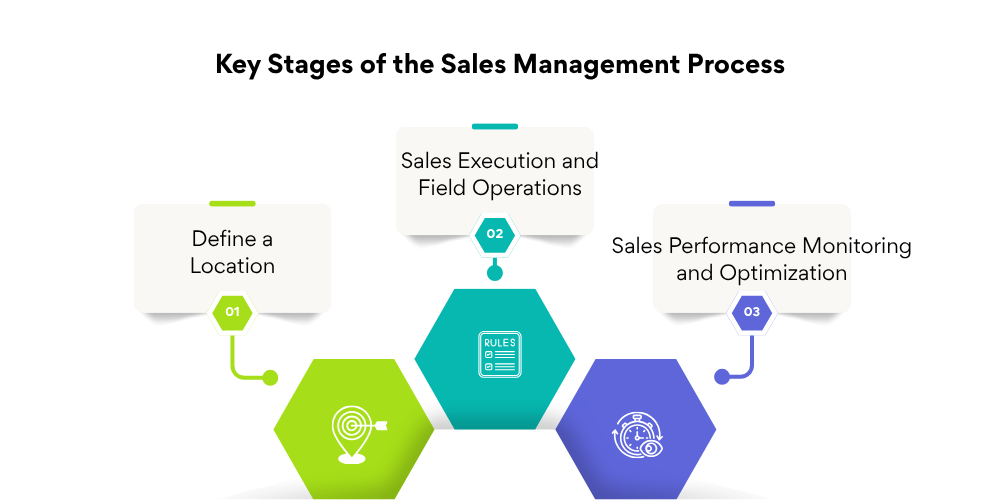
Sales Planning and Strategy Development:
This stage involves setting clear targets, defining market strategies, and allocating territories based on data insights, business goals, and resource availability for maximum efficiency.
Sales Execution and Field Operations:
Sales teams actively engage with customers, generate qualified leads, conduct field visits, and close deals by following predefined strategies and organizational sales guidelines.
Sales Performance Monitoring and Optimization:
Managers continuously track sales performance using dashboards, reports, and analytics to identify gaps, improve productivity, and optimize strategies in real time for better outcomes.
Roles and Responsibilities in Sales Management
Sales management involves multiple roles working in coordination to ensure smooth execution of strategies, consistent performance tracking, and achievement of business objectives across all sales channels.
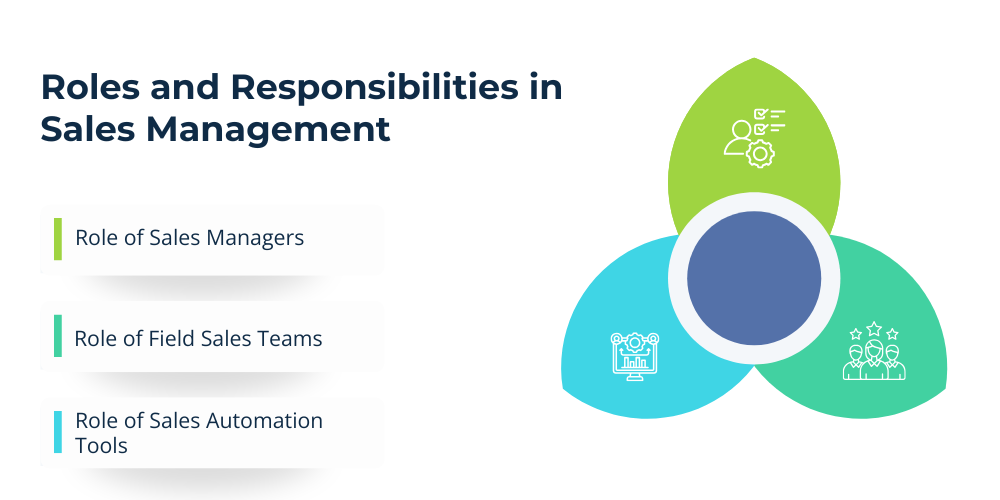
Role of Sales Managers:
Sales managers are responsible for planning strategies, setting achievable targets, monitoring team performance, and ensuring that overall business goals are consistently met through structured guidance.
Role of Field Sales Teams:
Field sales representatives execute sales strategies on the ground by visiting customers, generating orders, building relationships, and ensuring effective market coverage and execution.
Role of Sales Automation Tools:
Sales automation systems reduce manual workload, improve data accuracy, streamline reporting processes, and ensure faster execution of sales activities across the entire organization.
Sales Strategy and Planning
Sales strategy defines how organizations approach markets, customers, and territories to achieve structured growth and sustainable revenue generation. It acts as a roadmap that aligns sales efforts with overall business objectives and ensures consistent execution across teams.
It includes:
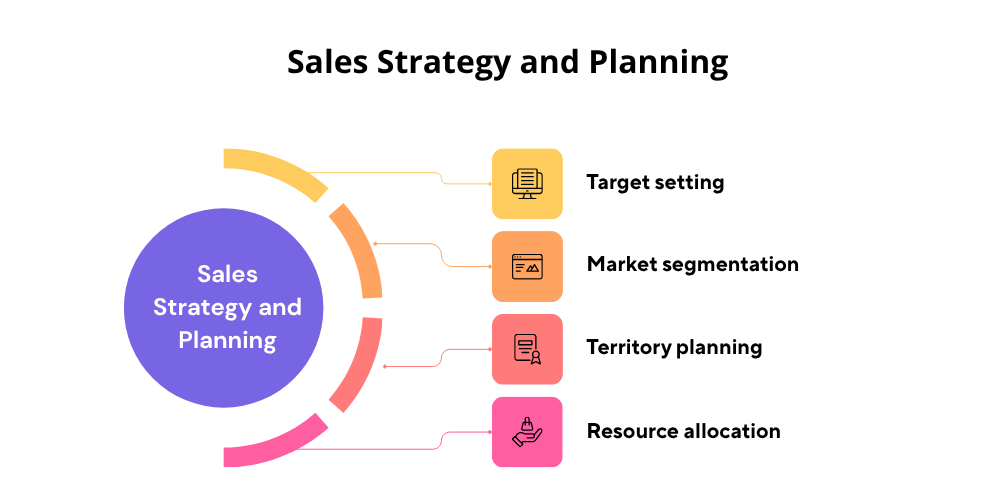
Target setting:
Defining clear and measurable sales goals that guide team performance, track progress, and ensure alignment with organizational revenue objectives.
Market segmentation:
Dividing the market into specific customer groups based on needs, behavior, and potential to improve targeting accuracy and conversion efficiency.
Territory planning:
Allocating geographic regions strategically to sales teams to ensure balanced coverage, reduced overlap, and improved field productivity.
Resource allocation:
Assigning sales personnel, budgets, and tools effectively to maximize output, minimize waste, and improve operational efficiency across teams.
Organizations using field sales management software achieve better planning accuracy, improved coordination, and more consistent execution across all sales operations.
Sales Execution Process
Sales execution is the stage where planned strategies are implemented directly in the field to achieve business objectives and drive revenue growth. It focuses on real-world customer interactions and on-ground performance.
It includes:
Customer visits:
Field sales teams meet customers regularly to build relationships, understand requirements, and strengthen engagement for long-term business growth.
Lead generation:
Sales representatives identify and qualify potential customers to expand the sales pipeline and improve conversion opportunities.
Order collection:
Accurate order capturing ensures smooth processing, reduces errors, and improves efficiency in fulfilling customer demands.
Product demonstrations:
Presenting products effectively helps customers understand value, increasing trust and improving conversion rates during the sales process.
Execution success depends heavily on visibility and coordination, often enabled through field sales automation systems.
Sales Tracking and Monitoring
Sales tracking ensures organizations maintain real-time visibility into field activities, performance, and customer interactions to improve decision-making and accountability.
Businesses now use field sales tracking software to monitor:
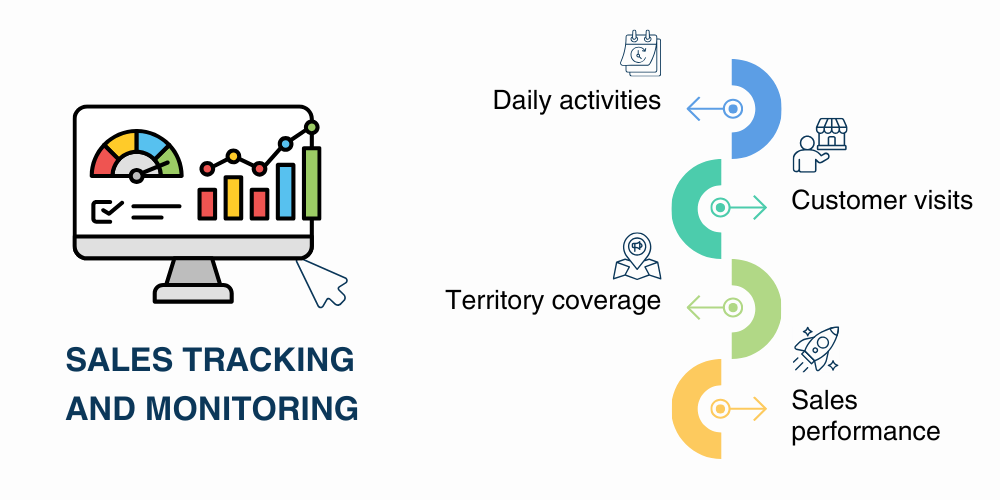
- Daily activities:
Tracking daily field tasks helps managers evaluate productivity and ensure consistent performance across teams. - Customer visits:
Monitoring visits ensures accountability and verifies that field representatives are engaging customers as planned. - Territory coverage:
Ensures all regions are properly covered, reducing gaps and improving market reach and efficiency. - Sales performance:
Helps analyze individual and team performance to identify strengths, weaknesses, and improvement opportunities.
Advanced tracking systems integrate GPS and analytics, as seen in GPS tracking for field sales teams.
Tools and Technology in Sales Management
Modern sales management depends on integrated digital systems that streamline planning, execution, and performance monitoring across the entire sales cycle. These tools improve visibility, accuracy, and coordination between field teams and management.
Key tools include:
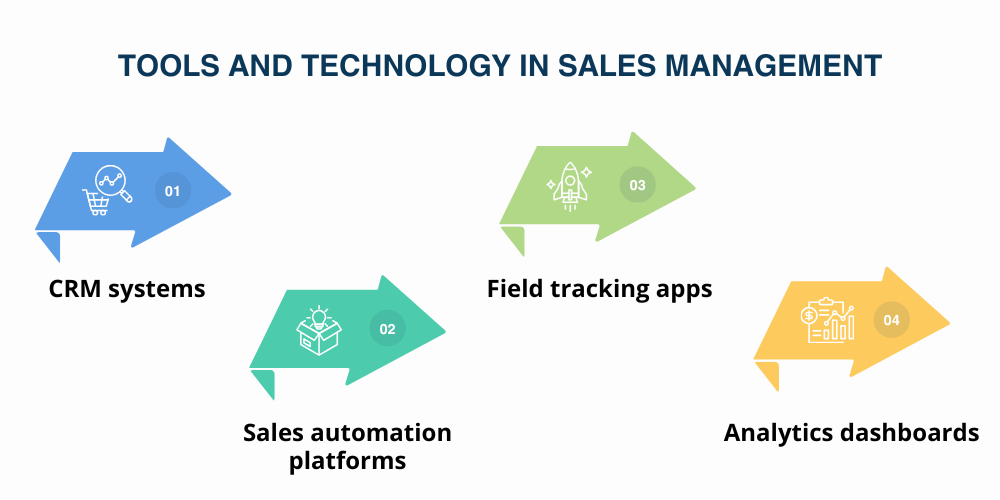
CRM systems:
Customer Relationship Management systems help organizations store customer data, manage interactions, track sales pipelines, and improve relationship-building across different stages of the sales process.
Sales automation platforms:
These platforms automate repetitive sales tasks such as reporting, follow-ups, and order processing, improving efficiency and reducing manual workload for sales teams.
Field tracking apps:
Field tracking applications provide real-time visibility into employee locations, customer visits, and daily activities, ensuring better control over field operations.
Analytics dashboards:
Analytics tools convert sales data into actionable insights, helping managers track performance, identify trends, and make informed business decisions quickly.
A combined ecosystem ensures complete visibility across customer management and field execution, enabling seamless coordination between teams.
Organizations using field sales management software achieve stronger alignment between planning and execution, leading to improved productivity and better sales outcomes.
Role of Field Sales in Sales Management
Field sales teams serve as the execution backbone of the entire sales management process, directly connecting business strategies with real-world customer interactions. They play a crucial role in driving revenue and ensuring market presence.
They are responsible for:
Customer acquisition:
Field representatives identify and convert potential customers through direct engagement, helping businesses expand their customer base and increase revenue opportunities.
Relationship building:
Consistent interaction with customers helps build trust, strengthen loyalty, and ensure long-term business relationships that support sustained growth.
Order generation:
Field teams capture orders accurately from customers, ensuring smooth processing, timely fulfillment, and reduced errors in sales execution.
Market expansion:
Sales representatives explore new territories and customer segments, enabling businesses to grow their market reach and increase brand penetration.
Without strong field visibility, execution becomes inconsistent and difficult to manage. This is why businesses rely on employee tracking systems and insights such as field employee location tracking and trust to ensure accountability and performance transparency.
Sales Performance Optimization
Sales performance optimization ensures consistent growth, improved efficiency, and stronger execution across all sales activities. It focuses on continuously refining processes, team performance, and customer interactions to achieve better business outcomes.
It includes:
Increasing productivity:
Enhancing sales output by reducing idle time, improving task prioritization, and enabling teams to focus more on revenue-generating activities.
Reducing inefficiencies:
Identifying and eliminating delays, redundant tasks, and operational bottlenecks to streamline sales workflows and improve execution speed.
Improving conversion rates:
Optimizing sales approaches and customer interactions to convert more leads into successful deals and increase overall revenue generation.
Enhancing engagement:
Strengthening communication and interaction with customers to build trust, improve satisfaction, and encourage long-term business relationships.
Organizations use structured workflows and productivity tools to improve outcomes significantly, ensuring better alignment between strategy and execution.
Challenges in Sales Management Process
Sales management processes often face visibility issues, manual errors, coordination gaps, and inefficient field execution challenges.
Common challenges include:
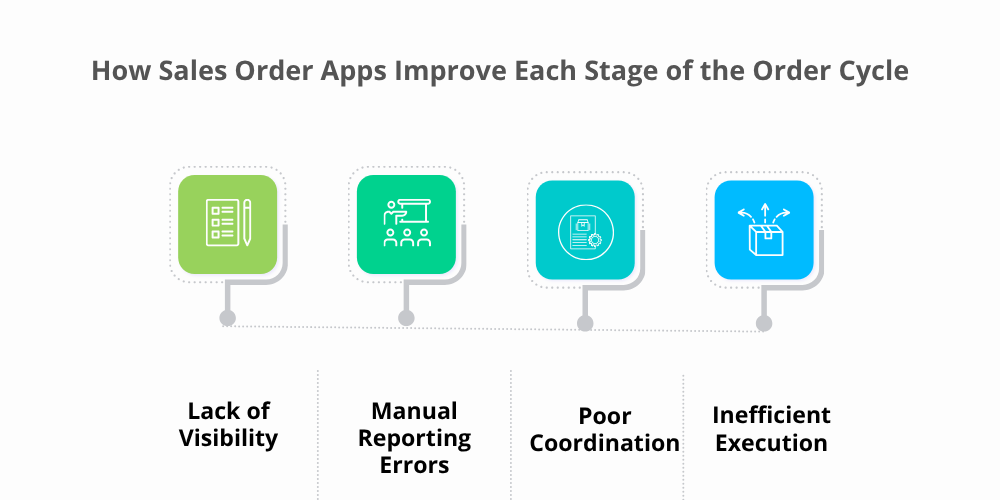
Lack of Visibility
Organizations struggle to monitor real-time field activities, customer visits, and sales execution, leading to reduced control and missed opportunities.
Manual Reporting Errors
Paper-based or spreadsheet reporting often causes inaccuracies, duplication, and delays, impacting decision-making quality and overall sales performance consistency.
Poor Coordination
Lack of communication between field teams and managers results in misaligned goals, missed updates, and inefficient execution of sales strategies.
Inefficient Execution
Without structured systems, sales teams often follow inconsistent processes, leading to delayed tasks, low productivity, and reduced revenue generation.
These challenges are addressed using automation tools and tracking systems such as bridging digital and field sales apps.
How Technology Improves Sales Management Process
Technology plays a transformative role in modern sales management by converting traditional manual processes into a fully digital, data-driven ecosystem. It improves visibility, accuracy, speed, and decision-making across all sales operations.
Organizations using sales force automation software and field sales tracking systems gain better control over field activities and overall performance.
Automation
Automation eliminates repetitive manual tasks such as reporting, attendance marking, and order entry. With sales automation software, businesses streamline workflows, reduce human error, and ensure faster execution of daily sales activities. It also helps standardize processes across teams, improving consistency and operational efficiency.
GPS Tracking
GPS technology enables real-time visibility of field teams through GPS tracking software for field sales teams. Managers can monitor employee movement, verify customer visits, optimize routes, and improve territory coverage. This strengthens accountability and ensures better control over distributed sales operations.
Real-Time Reporting
With an automated report and analytics system, managers receive instant updates on field activities, customer visits, and order status. This eliminates reporting delays and enables faster decision-making. Real-time dashboards improve transparency and help organizations respond quickly to market changes.
AI-Powered Analytics
Modern AI sales analytics tools analyze large volumes of sales data to identify patterns, predict demand, and improve forecasting accuracy. AI helps sales managers optimize territories, improve conversion rates, and make data-backed strategic decisions that enhance overall business growth.
By integrating these technologies, organizations achieve higher productivity, reduced operational delays, improved customer engagement, and stronger revenue outcomes. Digital transformation ensures sales management becomes more efficient, scalable, and performance-oriented.
Best Practices for Effective Sales Management
To achieve consistent growth and operational efficiency, organizations must follow structured sales management practices supported by modern tools like sales force automation systems and field sales tracking software.
Define Clear KPIs
Establish measurable key performance indicators to track sales performance, productivity, and goal achievement accurately.
Train Teams Regularly
Conduct continuous training sessions to improve sales skills, product knowledge, and field execution efficiency.
Use Automation Tools
Implement sales automation tools to reduce manual work, improve accuracy, and streamline daily sales operations.
Monitor Performance Continuously
Track real-time performance metrics to identify gaps, optimize strategies, and improve overall sales effectiveness.
Organizations using sales force automation systems consistently outperform competitors by improving efficiency, visibility, and revenue generation capabilities.
Future of Sales Management Process
The future of sales management is rapidly evolving into a highly intelligent, automated, and data-driven ecosystem. Organizations are moving away from manual processes and adopting advanced technologies such as AI, predictive systems, and real-time analytics.
Modern tools like AI-powered sales management systems and intelligent field sales tracking software will redefine how sales teams operate, execute, and perform.
AI-Powered Insights
Artificial intelligence will analyze large volumes of sales data to generate actionable insights, improve forecasting accuracy, and identify high-value opportunities. AI-driven systems help managers make smarter decisions and optimize sales strategies in real time.
Predictive Analytics
Predictive analytics will enable organizations to forecast demand, customer behavior, and revenue trends more accurately. With sales forecasting tools, businesses can proactively adjust strategies and improve planning efficiency.
Smart Automation
Smart automation will eliminate repetitive tasks such as reporting, follow-ups, and data entry. Sales automation software will streamline workflows, reduce operational delays, and improve overall execution speed across field and inside sales teams.
Real-Time Decision Systems
Real-time decision systems will empower managers with instant access to field data through live sales tracking software and dashboards. This enables faster responses to market changes, improved coordination, and better operational control.
Sales management will become increasingly proactive, intelligent, and data-driven. Organizations adopting these technologies will achieve higher efficiency, stronger forecasting ability, and sustainable revenue growth.

How Delta Sales App Supports Sales Management
Modern organizations need a unified, data-driven platform to manage execution, monitoring, and optimization of sales operations.
Delta Sales App acts as an integrated field sales management software that improves visibility, accuracy, and overall sales performance across teams.
Real-Time Field Tracking
Provides live location updates using GPS tracking for field sales teams, helping managers monitor routes, visits, and territory coverage efficiently.
Attendance & Activity Monitoring
Ensures accurate attendance records and daily activity tracking using field employee attendance management software, improving accountability and workforce transparency across field operations.
Customer Visit Tracking
Tracks every customer interaction with timestamps and location using customer visit tracking system, ensuring structured engagement and improved relationship management.
Sales Automation
Automates reporting, order management, and workflows using sales force automation software, reducing manual effort and improving execution speed across sales teams.
Performance Analytics
Delivers actionable insights using sales team performance analytics tools, helping managers evaluate productivity, identify gaps, and optimize field sales strategies effectively.
By integrating all capabilities into one platform, Delta Sales App helps businesses build a complete sales automation ecosystem, improving decision-making, efficiency, and revenue growth.
Final Thoughts
Sales management is no longer limited to manual coordination, it has transformed into a fully intelligent, data-driven execution system powered by modern technologies. Organizations that adopt advanced digital tools gain significantly better visibility into field operations, improved team efficiency, and stronger, more predictable revenue outcomes.
When a structured sales management process is combined with automation, analytics, and real-time tracking, businesses can scale operations smoothly while maintaining consistency across teams and territories. This shift enables faster decision-making, better customer engagement, and long-term operational stability.
To remain competitive in today’s fast-moving market, businesses must align strategy with execution using integrated sales systems that provide complete control over field activities and performance.
Ready to transform your sales operations?
Book a free demo of Delta Sales App today and experience how a powerful field sales management software can improve productivity, visibility, and revenue growth across your entire sales team.