
Sales Rep Idle Time Analysis: Identifying Hidden Productivity Losses in Field Operations

In field sales, productivity is often evaluated through visible outputs such as visits completed, orders booked, and revenue generated. However, one of the most overlooked performance drainers is idle time, the unproductive hours spent between planned sales activities.
A structured sales rep idle time analysis reveals that even high-performing teams lose a significant portion of their working hours due to inefficiencies that are not immediately visible in standard reports. These hidden gaps directly reduce customer coverage, weaken conversion potential, and distort true field sales performance.
Understanding and optimizing idle time is no longer optional. It is essential for building a predictable and scalable sales execution system.
What Is Sales Rep Idle Time?
Idle time refers to any period during working hours when a sales representative is not engaged in productive activities such as customer visits, order generation, or follow-ups.
It includes travel delays, waiting time, unplanned gaps between meetings, and poor scheduling.
- Inefficient route planning that increases unnecessary travel time
- Gaps between appointments due to unstructured beat plans
- Time spent waiting at customer locations without productive engagement
Most organizations focus only on completed visits, ignoring the time lost between activities, which distorts real field sales team performance.
Without proper field activity tracking, idle time remains invisible and gradually reduces overall sales productivity, even when reported activity levels appear normal.
Why Idle Time Is a Critical Performance Metric
Idle time directly impacts core sales outcomes such as revenue generation, territory coverage, and customer engagement. When not monitored, it leads to inconsistent sales execution and weak forecasting accuracy across the organization.
Key reasons why idle time matters:
- Reduces effective working hours per day - Cutting productive selling time and limiting daily field output significantly.
- Impacts sales rep productivity across territories - Uneven utilization reduces efficiency and weakens overall performance consistency across regions.
- Creates imbalance in field sales operations - Some territories get over-served while others remain under-covered frequently.
- Lowers overall conversion efficiency - Fewer quality interactions result in reduced order closures and missed opportunities.
- Distorts performance evaluation metrics - Inaccurate data makes it difficult to assess true sales effectiveness and productivity.
- Increases dependency on assumptions instead of real field activity tracking - Decisions rely on guesswork rather than verified on-ground data insights.
- Weakens visibility into actual sales performance data - Managers lose clarity on real-time execution and rep movement patterns.
- Leads to inefficient utilization of field resources and effort - Time and energy are wasted on non-productive activities daily.
Common Causes of Hidden Productivity Losses
Idle time does not occur randomly. It is usually the result of structural inefficiencies in field operations that slowly accumulate and reduce overall sales productivity and field sales performance.
1. Poor Route Planning
Inefficient routing increases travel time and reduces the number of possible customer visits per day.
Poor sequencing of outlets forces reps to backtrack frequently, wasting valuable productive selling hours.
2. Unstructured Beat Plans
Without proper beat planning, reps often visit outlets in an unorganized sequence, leading to unnecessary movement.
Lack of structured scheduling reduces visit efficiency and creates confusion in daily field execution priorities.
3. Long Travel Gaps Between Visits
Poor territory clustering results in excessive travel between customers, increasing non-productive time.
Geographically scattered visits significantly reduce effective working hours and limit total customer coverage capacity.
4. Lack of Real-Time Monitoring
Without real-time sales tracking, managers cannot identify delays or idle gaps during field execution.
This visibility gap prevents timely intervention, allowing inefficiencies to continue throughout the working day unnoticed.
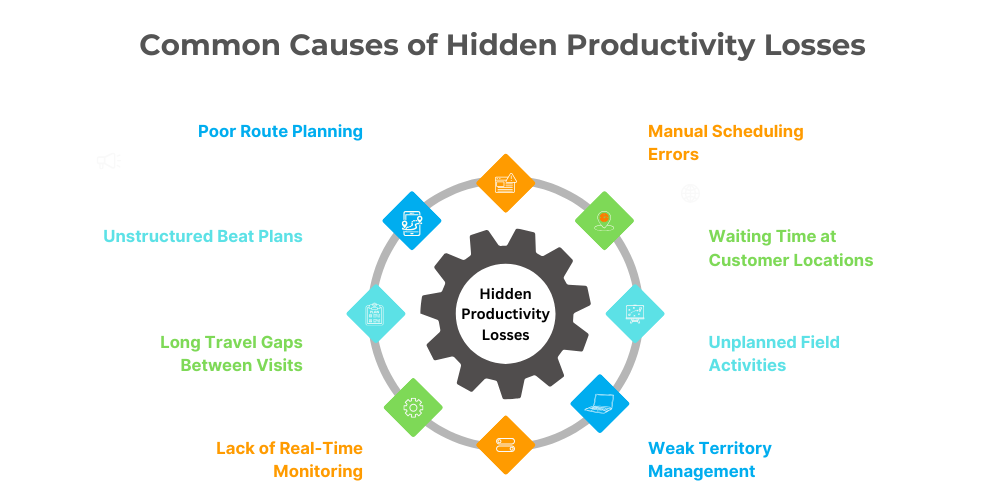
5. Manual Scheduling Errors
Dependence on manual planning tools often leads to inefficient daily scheduling and lost time slots.
Human errors in planning create overlapping appointments, idle gaps, and poor utilization of field workforce capacity.
6. Waiting Time at Customer Locations
Delays in customer availability or improper appointment planning increase idle intervals.
Sales reps often spend unproductive time waiting, reducing the number of effective customer interactions per day.
7. Unplanned Field Activities
Absence of structured workflows leads to random decision-making in the field.
Reps deviate from planned routes, causing inconsistent execution and reducing overall sales efficiency significantly.
8. Weak Territory Management
Improper sales territory optimization causes uneven workload distribution and inefficiency.
Some areas become over-served while others remain under-covered, creating imbalance in overall sales performance outcomes.
How Idle Time Impacts Sales Performance
Idle time creates a ripple effect across the entire sales ecosystem, directly weakening field sales performance and reducing overall execution efficiency across teams.
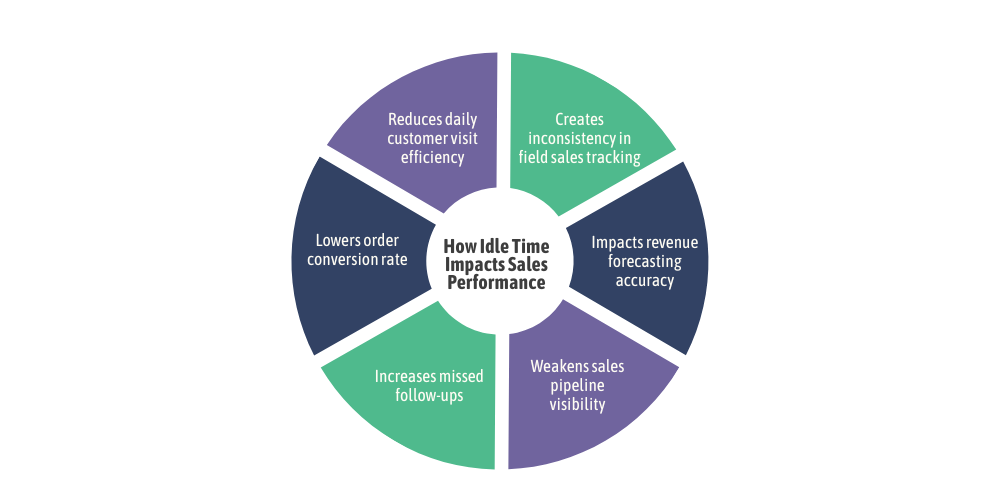
- Reduces daily customer visit efficiency - Fewer productive visits per day limit customer reach and overall sales opportunities.
- Lowers order conversion rate - Reduced meaningful interactions lead to fewer conversions and weaker revenue generation outcomes.
- Increases missed follow-ups - Delayed or skipped follow-ups result in lost prospects and weakened customer relationships over time.
- Weakens sales pipeline visibility - Incomplete activity tracking creates gaps in understanding deal progress and future revenue potential.
- Impacts revenue forecasting accuracy - Unreliable field data leads to incorrect projections and poor strategic planning decisions.
- Creates inconsistency in field sales tracking - Uneven reporting makes it difficult to compare performance across reps and territories fairly.
Over time, organizations begin to see performance gaps between top performers and average reps, not because of skill differences but due to operational inefficiencies, lack of structured workflows, and poor sales execution systems.
Identifying Idle Time in Field Operations
Detecting idle time requires more than end-of-day reporting. Traditional methods fail to capture real behavior in the field, making it difficult to understand true sales execution efficiency and hidden productivity losses.
Key challenges include:
- Lack of GPS-based verification - Field presence cannot be confirmed accurately without real-time GPS tracking, geo-tagging, and location validation systems in place.
- Delayed reporting systems - End-of-day updates prevent managers from identifying, analyzing, and correcting idle gaps during active field sales execution.
- Inaccurate manual entries - Human errors in reporting create misleading sales data, reducing visibility and distorting actual field performance measurement significantly.
- No visibility into sales rep movement tracking - Managers cannot analyze travel routes, movement efficiency, or identify unproductive travel time between visits.
- Missing timestamps for field activities - Without precise time data, measuring productive working hours versus idle time becomes completely inaccurate and unreliable.
Without proper sales force automation, idle time remains hidden and unaddressed, leading to reduced field sales productivity, poor decision-making, and weak operational control across teams.

Key Metrics to Measure Idle Time Effectively
To manage idle time, organizations must track the right performance indicators that reflect real field execution quality and sales productivity rather than just reported activity.
- Active vs idle time ratio - Measures proportion of productive selling hours versus non-productive gaps during field operations, helping identify efficiency levels and execution discipline accurately.
- Visit-to-productive-hour conversion - Evaluates how effectively total working hours are converted into meaningful customer visits, highlighting productivity efficiency and overall field execution effectiveness clearly.
- Travel time efficiency - Tracks how optimally sales representatives move between customer locations, reducing unnecessary travel delays and maximizing productive selling time across assigned territories daily.
- Daily visit completion rate - Compares planned customer visits against actual completed visits, helping identify execution gaps, discipline issues, and field productivity inconsistencies across teams.
- Customer engagement time per visit - Measures quality and duration of interaction time spent with customers, indicating sales effectiveness, relationship building strength, and conversion potential per visit.
- Territory-wise productivity comparison - Analyzes performance differences across regions, helping identify high-performing and underperforming territories for better resource allocation and improved field sales performance optimization decisions.
- Time spent per order closure - Evaluates how long sales reps take to convert prospects into confirmed orders, reflecting efficiency of selling process and negotiation effectiveness levels.
- First-to-last visit gap - Measures total time span between first and last daily visits, helping assess scheduling efficiency, route planning quality, and overall time utilization patterns.
- Idle travel intervals - Identifies non-productive time spent moving between customer locations, highlighting route inefficiencies, poor planning, and opportunities for sales force automation improvement.
These metrics help in improving sales performance standardization, enabling better field sales tracking, improved decision-making, and stronger operational control across teams.
How to Reduce Idle Time in Field Sales Teams
Reducing idle time requires a combination of process improvement, structured planning, and modern sales automation tools that improve visibility and execution efficiency across field operations.
1. Smart Route Optimization
Route optimization reduces unnecessary travel, improves visit sequencing, and ensures maximum customer coverage within limited working hours, significantly enhancing overall field productivity and efficiency levels.
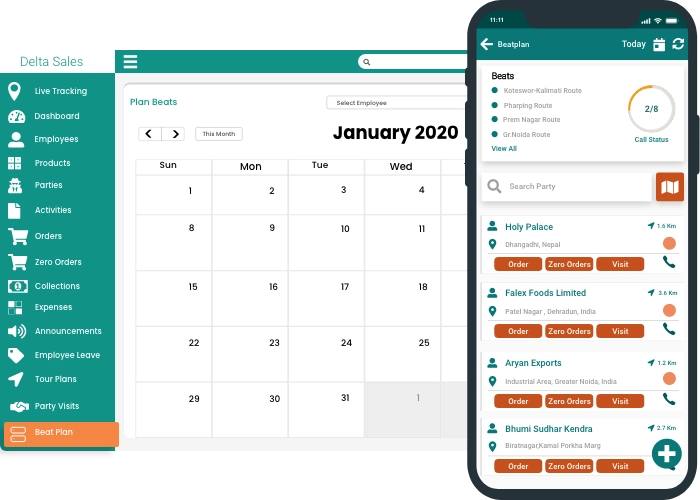
2. Structured Beat Planning
A fixed beat plan strategy ensures systematic outlet coverage, minimizes random movement, reduces idle gaps, and improves daily field sales productivity with predictable execution patterns.
3. Real-Time Activity Tracking
Live monitoring improves transparency in field sales execution, helping managers identify delays, inefficiencies, and idle gaps instantly while ensuring continuous performance visibility across field teams.
4. GPS-Based Verification
Location validation ensures accurate reporting of visits, eliminates fake check-ins, improves accountability, and strengthens trust in sales force automation systems across all field operations consistently.
5. Task-Based Scheduling
Clear daily objectives improve time utilization, reduce unplanned activities, and help sales reps focus on high-priority customer engagements while maintaining structured execution throughout the day.
6. Mobile Sales Automation
A mobile sales app streamlines reporting, reduces manual effort, improves data accuracy, and enhances sales activity tracking, ensuring faster and more reliable field execution processes.
7. Performance Dashboards
Analytics dashboards help identify inefficiencies in real time, enabling data-driven decisions, improving sales performance management, and supporting continuous optimization of field productivity and execution quality.
8. Customer Prioritization Models
High-value customers are prioritized to maximize revenue per visit, improve conversion rates, reduce wasted effort, and strengthen long-term customer engagement strategy for sustainable business growth.
Role of Sales Force Automation in Reducing Idle Time
A sales force automation (SFA) system plays a critical role in eliminating hidden productivity losses by improving transparency, structure, and control across field operations.
It helps by:
- Enabling real-time field visibility - Provides instant insights into sales rep movements, activities, and productivity status across all territories continuously.
- Automating sales activity tracking - Removes manual reporting dependency by capturing visits, orders, and interactions automatically with high accuracy and consistency levels.
- Reducing manual reporting errors - Eliminates human mistakes in data entry, ensuring reliable sales execution data for better performance evaluation and planning decisions.
- Improving sales rep accountability - Creates transparent tracking systems that ensure reps are responsible for every visit, activity, and customer engagement outcome daily.
- Enhancing field productivity analytics - Offers detailed insights into working hours, idle time, and efficiency patterns to improve overall field sales performance continuously.
- Supporting data-driven decision-making - Enables managers to rely on accurate real-time data instead of assumptions, improving forecasting and strategic sales planning effectiveness significantly.
With automation, organizations move from reactive management to proactive optimization of field performance, ensuring consistent execution, reduced idle time, and improved revenue outcomes.
Common Mistakes That Increase Idle Time
Many organizations unintentionally increase idle time due to poor systems, lack of visibility, and outdated field execution practices that reduce overall sales productivity.
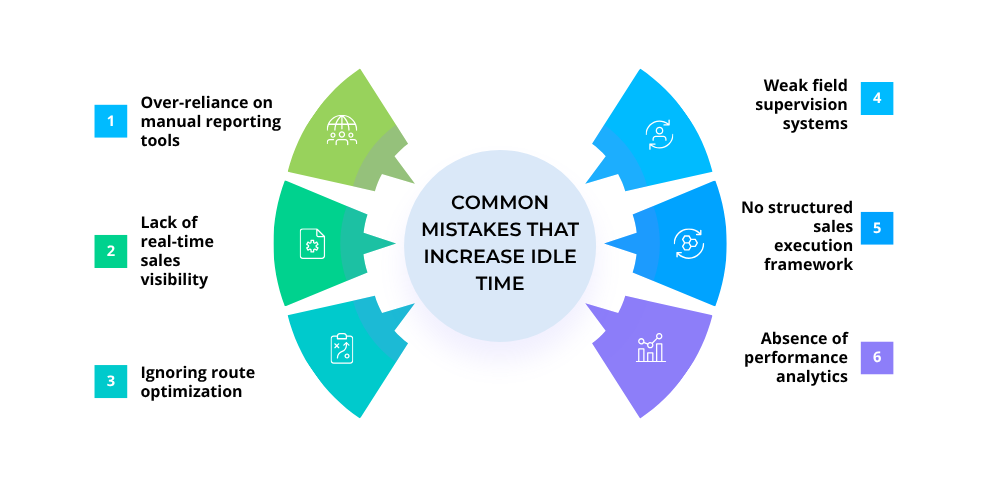
- Over-reliance on manual reporting tools - Manual systems create delays, errors, and inaccurate field data, increasing unproductive time significantly across daily operations.
- Lack of real-time sales visibility - Without live tracking, managers cannot identify inefficiencies or idle gaps during ongoing field sales execution activities effectively.
- Ignoring route optimization - Poorly planned travel routes increase unnecessary movement, reduce customer coverage, and waste valuable productive selling hours daily.
- Weak field supervision systems - Limited monitoring allows inconsistent execution, reducing accountability and increasing hidden idle time across sales representatives.
- No structured sales execution framework - Absence of standardized processes leads to unpredictable workflows, inconsistent performance, and reduced operational efficiency across teams.
- Absence of performance analytics - Without data insights, organizations cannot identify productivity gaps or optimize sales performance management strategies effectively over time.
These mistakes lead to long-term productivity leakage, reduced revenue potential, and weaker field sales tracking accuracy across the organization.
Building a Data-Driven Field Sales System
To eliminate idle time permanently, businesses must shift toward a data-driven model that ensures every activity is measurable and optimized for efficiency.
This includes:
- Real-time dashboards for field tracking - Provides live visibility into rep activities, helping managers monitor performance and reduce idle gaps instantly.
- Automated report and analytics systems - Eliminates manual reporting errors and ensures accurate, consistent sales execution data across all field operations daily.
- Predictive performance analytics - Uses historical data to forecast productivity trends, identify risks, and improve decision-making in advance effectively.
- AI-based route planning tools - Optimizes travel paths intelligently, reducing unnecessary movement and increasing customer coverage across territories significantly.
- Integrated CRM and field operations - Connects customer data with field activities, improving coordination, visibility, and overall sales force automation efficiency.
Such systems ensure that every working hour contributes directly to measurable output, improving field sales productivity, accountability, and long-term business growth.
Final Thoughts
Idle time is one of the most underestimated challenges in field sales operations. A proper sales rep idle time analysis reveals that hidden inefficiencies often account for a significant loss in productivity and revenue potential.
By combining structured processes with modern sales automation tools, organizations can eliminate unproductive gaps, improve field sales efficiency, and build a highly predictable sales engine.
Ultimately, reducing idle time is not just about working harder, it is about working smarter with visibility, structure, and control over every field activity.
To take full control of your field execution and eliminate idle time effectively, book a demo of Delta Sales App and transform how your sales team operates in real time.

-1792906895-resized320.png)