
What Happens to Sales Team Morale When There Is No Visibility or Accountability

Your best salesperson and your worst salesperson both turn in the same end-of-day report. Both say they checked every retailer on their run. Both say they meet their daily targets. Both provide updates by phone calls or spreadsheets. Without real-time visibility, how do you know who really delivered?
The truth is you don't.
That is one of the challenges in field sales. When managers cannot see what is happening in the market accountability suffers. This affects more than how much work gets done in a day. It changes how the whole team feels about their job. Top performers start to wonder why they should put in effort if no one is paying attention. Average performers get confused when expectations are unclear. To help their teams improve, managers spend hours trying to track down phone calls and messages. As transparency fades, trust, motivation, and team spirit disappear too.
The morale of a sales team is not about rewards or pay. Employees feel more involved when they know their hard work is noticed and their performance is judged fairly. Everyone is held to the same standards. When a workplace acknowledges achievements and makes accountability clear, engagement and performance naturally improve. This is the reason why many growing FMCG companies, distributors, and manufacturing businesses are moving away from manual reporting to a Sales Force Automation (SFA) solution. A field sales tracking system, automated daily reports, and automated performance dashboards allow managers to see the whole picture of what goes on in the field so that employees stay focused and accountable.
In this blog, we’ll explore how a lack of visibility and accountability impacts sales team morale, the warning signs businesses should look out for, and how the right technology can build a more transparent, motivated, and high-performing sales organization.
Why Visibility Matters in Field Sales
Field sales reps are not office employees. They are out in the field most of the day visiting retailers, visiting distributors, collecting orders, and building customer relationships at multiple locations. “Managers are not there when these things happen so they have to rely on their teams to tell them what is going on in the field.”
When information gets to managers late or it is not complete or it is just plain wrong managers cannot make good decisions. They cannot figure out how well people are working or find the problems that need to be fixed. They also cannot give their team the help they need when they need it. Managers spend most of their time fixing problems that have already happened of stopping them before they cause trouble and cost the company sales.
Clarity for sales representatives is very important. It gives them visibility. Sales representatives know what they are supposed to do, how their work will be measured, and how the things they do every day help the company reach its goals.
Without proper visibility, businesses often struggle with issues such as:
- Missed retailer visits go unnoticed
- Customer follow-up delay
- Manual reporting errors
- Spotty area coverage
- Employee Performance Hard to Measure
- Managers spend more time gathering updates than coaching
These challenges are amplified when a business grows into several cities, territories, or regions. As visibility increases, managers spend less time asking “What happened today?” and more time helping their teams improve tomorrow. That transition also creates a transparent work culture characterized by accountability, recognition of accomplishments, and increasing morale among the sales team.
How Poor Visibility Damages Sales Team Morale
A sales team can have a bad day or miss a target and still keep their spirits high. It slowly declines when employees feel their efforts are not recognized, performance is not consistently measured, or everyone is treated the same regardless of results.
In field sales, where employees operate independently in separate territories, uncertainty for both managers and sales representatives arises from a lack of visibility. Without the right data managers cannot identify wins, react to poor performance, or intervene early. So trust starts to erode, motivation starts to drop, and the team's overall performance suffers. Here are some of the most common ways poor visibility impacts sales team morale:
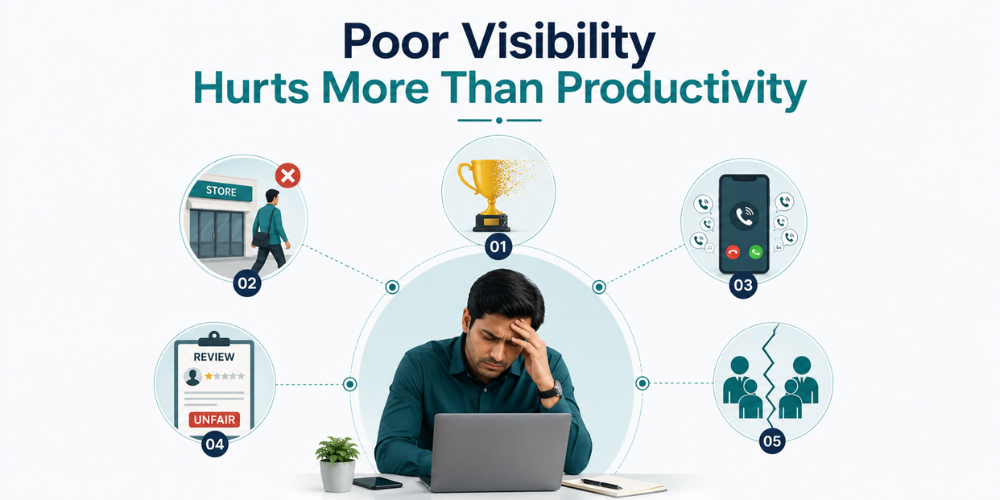
1. High Performers Feel Their Efforts Go Unrecognized
Your sales team has employees who always go the extra mile. They see more retailers, develop better relationships with their customers, achieve higher sales targets, and solve problems before they become serious. But all of this extra effort often goes unnoticed when managers receive manual reports or verbal updates. If both turn in similar reports, a rep who visits 35 retailers may not look any different than one who visits only 20.
Over time, high performers tend to ask themselves:
-
If no one notices, why should I work harder?
-
Will my extra effort be acknowledged?
-
Are we really measuring performance fairly?
When recognition disappears, motivation disappears. Employees who have exceeded expectations in the past may eventually slacken off because they no longer feel that their performance is being recognized or rewarded. Managers can measure productivity on actual field activities, not assumptions, and make sure the top performers get the recognition they deserve with daily work reports.
2. Poor Performers Continue Without Accountability
Visibility is lacking not just among the top performers. And it also lets underperformance go unnoticed.
Some employees may not be able to verify field activities when managers:
-
Skip planned visits to retailers
-
Postpone customer follow-ups
-
Not following assigned routes
-
file false reports
-
Overstate their daily life
Without reliable data, it’s difficult to recognize these issues or to offer corrective coaching. This results in an unfair work environment whereby the more productive employees feel they are doing more than their fair share of work. Field sales tracking and live location tracking allow managers to verify visits, monitor route completion, and provide support with accurate information rather than manual updates.
3. Managers Spend More Time Following Up Than Coaching
Sales managers’ greatest contribution is coaching their teams, meeting market challenges and helping reps improve their performance. Unfortunately many managers have to spend their day asking questions like "Poor visibility means that
-
Which stores did you go to today? Which stores did you go to today?
-
Where are you right now? Where are you right now?
-
How many orders did you pick up? How many orders did you pick up?
-
Why was this customer not visited? Why was this customer not visited?
Instead of thinking about strategy and development, they spend valuable time collecting information that should be readily available. The endless follow-up frustrates both sales reps and managers. Employees believe they are constantly explaining what they do, and managers still don’t trust the information they’re provided with. With Automated Daily Work Reports and Live Location Tracking, this back and forth disappears, and managers can focus on coaching instead of chasing updates.
4. Performance Reviews Feel Unfair
Promotions, incentives, and recognition based on measurable performance make employees more motivated. But with no visibility, performance appraisals are often based on incomplete reports, personal observations, or assumptions. This can lead to the appearance of bias, even when managers are trying to be fair. When employees don’t trust the evaluation process, engagement starts to drop. They may wonder if more effort will really make a difference. Sales force automation software provides objective performance data, allowing for more accurate, consistent, and fair reviews for each member of the team through transparent reporting.
5. Team Trust and Collaboration Begin to Decline
Poor visibility doesn’t just impact individual performance. It impacts the entire team. When information isn't communicated well, employees can unknowingly visit the same retailers, miss important follow-ups with customers, or not know what's happening with sales efforts. Miscommunication grows, coordination becomes more difficult, and frustration mounts. With centralized sales force automation software, every team member has the same up-to-date information, which improves collaboration and reduces unnecessary confusion.
Why Accountability Improves Sales Performance
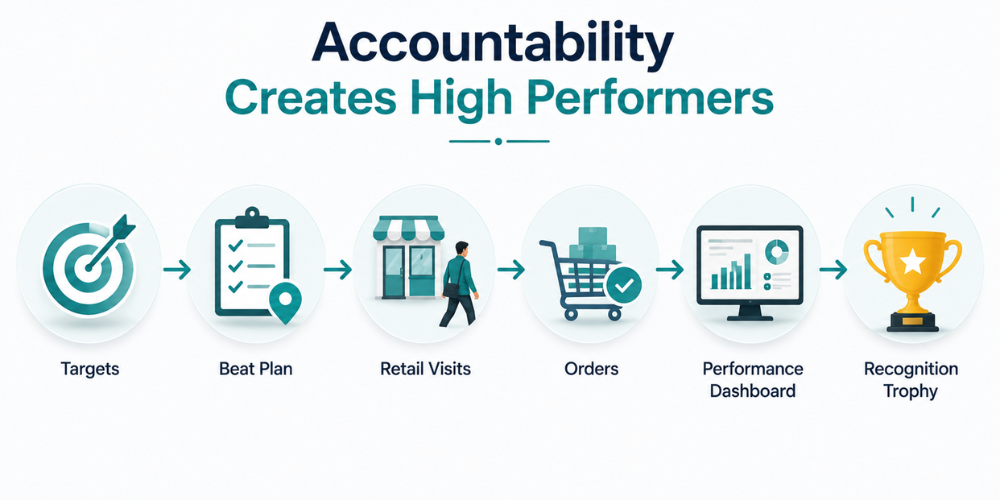
Accountability is often confused with constant supervision or micromanagement. In reality it’s about establishing clarity, consistency, and accountability. When every sales rep knows what is expected of them and managers have accurate data to measure progress, the whole team operates with greater confidence and purpose. In field sales, accountability ensures that day-to-day activities are aligned with business goals. Representatives know which retailers they have to visit, the orders they are to collect, and the targets they have to achieve. In turn, managers are able to identify challenges early, provide timely support, and recognize good performance based on facts, not assumptions.
This creates an atmosphere of work in which employees are motivated because they know their work is visible, measurable, and appreciated.
-
Accountability Creates Clear Expectations
Employees perform better when the expectations are clear. Salespeople who know their daily visit targets, assigned territories, customer priorities, and reporting requirements can plan their work more effectively. Without clear expectations, employees may not know what activities to pursue or may not understand how their performance is measured. Management can give structured routes and daily schedules using tools such as beat planning so each representative knows where they need to be and what they need to do.
-
It Encourages Ownership
Tracking sales activities and making performance transparent naturally makes employees more accountable for their results. Representatives own, instead of waiting for managers to remind them:
-
Planned retailer visits completed
-
Following up with customers on time
-
Taking orders correctly
-
Follow up with customers in time
-
Keeping up with what they’re up to
That sense of ownership drives discipline and creates a stronger performance culture across your sales team.
-
Managers Can Coach Instead of Guess
Accountability also provides managers with accurate performance data that makes coaching much more effective. If a rep is consistently absent on retailer visits or not closing orders, managers can easily pinpoint the problem and offer targeted guidance. Without visibility, these issues can be buried until they impact sales results. With daily work reports and field sales tracking, managers can have meaningful performance discussions based on real activities, not assumptions.
-
Recognition Becomes Fair and Transparent
Fair recognition is one of the greatest drivers of employee motivation. When accountability is built into the sales process, rewards, incentives, and promotions can be based on measurable performance, not opinions. The system is trusted by employees, as everyone is measured by the same set of standards. This transparency breeds a healthy competitive environment, motivates the top performers, and pushes others to improve.
-
Better Accountability Leads to Better Business Results
When accountability is woven into the fabric of daily operations, businesses reap benefits that go far beyond employee morale. They often witness:
- Sales productivity growth
- Improved retailer coverage
- Better customer follow-up
- More precise sales reporting
- More orders collected
- Improved team discipline
- Quicker decision-making
- Improved overall sales results
With the help of sales force automation software, accountability becomes an inherent part of the process, not an extra managerial task. Real-time analytics, automated reporting, and performance tracking help managers lead their teams more effectively while giving sales reps the clarity they need to succeed.
How Better Visibility Increases Sales Team Morale
When employees know that their work is visible, measured fairly, and appreciated, they become more engaged in their role. Visibility takes out uncertainty in the sales process and replaces it with transparency. Instead of worrying if their efforts are being noticed, sales reps can spend their time building customer relationships, hitting targets, and improving performance.
For managers, that means less time chasing updates and more time supporting their teams. This is a healthier work environment where employees feel guided, not monitored.
Here are some of the biggest ways better visibility improves sales team morale.
-
Fair Recognition Builds Motivation
Recognizing good performance on a regular basis helps employees stay motivated. Managers gain real-time insights into retailer visits, order collection, and daily activities to identify top performers based on actual results, not assumptions. That means recognition, incentives, and promotions are tied to measurable performance. Companies can build a transparent performance management process that motivates employees to perform at high standards all the time by using daily work reports and sales force automation software.

-
Employees Receive Timely Support
Visibility not only shows success; it shows you challenges before they become a bigger problem. If a sales rep is not covering their territory, missing customer visits or falling behind on targets, managers can spot the problem early and offer coaching or additional resources. Employees are more engaged when they believe managers are there to help them succeed, as opposed to only stepping in when targets are missed.
-
Stronger Trust Between Managers and Teams
Trust is built when decisions are based on facts, not assumptions. Employees have more confidence in performance reviews and incentive programs when they know that attendance, retailer visits and sales activities are being tracked objectively. Managers also gain confidence as they no longer have to rely on partial updates or manual reports. Another plus for both employees and management is transparency through features like Live Location Tracking and Field Sales Tracking.
-
Better Collaboration Across the Team
Visibility means everyone is working with the same information. Sales reps can view their assigned territories, completed tasks and customer updates, so there’s less chance of duplicate visits and missed follow-ups. Managers can coordinate teams better and employees experience less misunderstanding and smoother workflows. This common visibility builds a greater sense of teamwork and helps everyone move in the same direction toward common goals.
-
Employees Feel More Accountable and Confident
Good visibility helps employees to understand their performance better. Instead of asking themselves if they are on track, they can measure their progress and find out what needs to improve. This creates ownership, builds confidence, and motivates employees to better themselves daily. Tools such as beat planning, field sales tracking, and daily work reports give sales reps a clear plan of what to do daily and managers the information needed to provide meaningful guidance.
How Delta Sales App Helps Build a Transparent Sales Culture
“Accurate information is the foundation of a transparent sales culture. Trust comes naturally when managers have real-time visibility of field operations and employees know their work is being measured fairly. Instead of having to make assumptions or update information manually, everyone is working off the same data. That creates a culture of accountability and recognition of accomplishments.
Delta Sales App helps businesses do this by digitizing field sales operations and providing a single platform for managers and sales teams.
-1784260590.png)
Get Complete Visibility Into Every Field Activity
Managers can now see how their team is performing without needing to resort to phone calls, spreadsheets, or end-of-day reports with the Delta Sales App. They have a live view of critical field activities, including sales visits, employee attendance, live location, beat adherence, order management, including sales interactions, daily activity reports, team productivity, and territory performance. This level of complete visibility allows managers to identify gaps quickly, monitor execution, and make informed decisions and provide sales reps with a clear view of how they are being measured.
-
Turn Data Into Better Decisions
Real-time insights are only useful if they lead to action. The Delta Sales App does more than track activity to help manager. They can spot underperforming territories, identify top-performing reps, troubleshoot field issues faster, and deploy resources where they matter most. Some of the features that provide accurate field data to back up every decision rather than guesswork include field sales tracking, beat planning, and daily work reports.
-
Create Fair Accountability
Employees are more motivated when they believe in the evaluation process. Performance reviews are based on measurable outcomes not subjective opinions, as every visit, order and activity are automatically recorded. This ensures that recognition, incentives and promotions are based on real contributions, creating a workplace where employees feel valued for their efforts.

-
Spend Less Time Monitoring and More Time Coaching
Managers can focus on what really improves performance, coaching their teams instead of chasing updates throughout the day. With Live Location Tracking, Attendance and Leave Management, and automated reporting, managers are always aware of how the team is progressing. This enables them to offer timely counsel, address challenges early on and support employees before small issues escalate into big problems.
-
Build a High-Performance Sales Culture
Accountability happens when transparency is built into day to day operations. Employees know what they need to do, managers can make faster decisions, and the whole team is confidently working towards common goals. Delta Sales App combines real-time visibility, automated reporting, and field sales team performance monitoring into one platform to help businesses develop a sales culture that is stronger in trust, higher in morale and where every team member is empowered to perform at their best.
Conclusion
When there is no visibility, it is not only harder to manage a sales team but also directly impacts morale, accountability, and business performance. If managers are reliant on manual updates or incomplete data, then high performers are not recognised, underperformance is difficult to address and valuable time is spent chasing reports instead of coaching teams.
In contrast, when field activities are transparent and performance is measured using real-time data, employees feel trusted, recognized, and motivated to perform at their best. Managers can make decisions more quickly, give meaningful support, and create a culture where accountability drives growth rather than pressure.
Enough spreadsheets and all the follow-up calls. Give your managers the visibility they need. Give your sales team the tools they need to be successful.
Get a free demo of Delta Sales App today and learn how real-time visibility and accountability can boost sales team morale, increase productivity, and drive sustainable business growth.

-1792906895-resized320.png)