15 Best Distributor Management Software (DMS) Tools for 2026

Distribution gets harder as a company grows. A new territory, a bigger retailer network, or a larger sales team means more distributor orders to process, more stock to follow, and more field activity to check. It’s a daily problem for FMCG and consumer goods companies. When that information sits in spreadsheets and separate systems, records drift apart, managers can’t tell which products are actually selling, and problems in the market show up late. Distributor management software brings orders, stock movement, secondary sales, and field activity into one system, so companies can control their distribution workflows and see sales performance more clearly and sooner.
Choosing the platform is not just about picking software that has the most features. Some tools are built around billing, accounting, and inventory tracking. Others focus on distributor order processing, retail execution, sales force automation, and real-time field reporting. The best option depends on your business model, how your distribution network works, the size of your team, and what systems need to connect. How much visibility you want over both primary and secondary sales.
In this blog, we look at the 15 distributor management software options for 2026. We talk about what each system provides. We also explain where each one works best. We share what features companies should check before choosing a solution. If you run a business that is growing or if you are in charge of an FMCG sales network, this list will help you find tools that match your needs. This list will also help you plan for the future and grow your business.
Distributor Management Tools Worth Considering
The right software can simplify distributor operations, improve sales visibility, and help teams manage orders and inventory more efficiently. Here are 15 platforms to consider, each with different strengths and capabilities for distribution businesses.
1. Delta Sales App
Best for: FMCG companies, manufacturers, wholesalers, and distributors that need distributor visibility alongside field sales management.
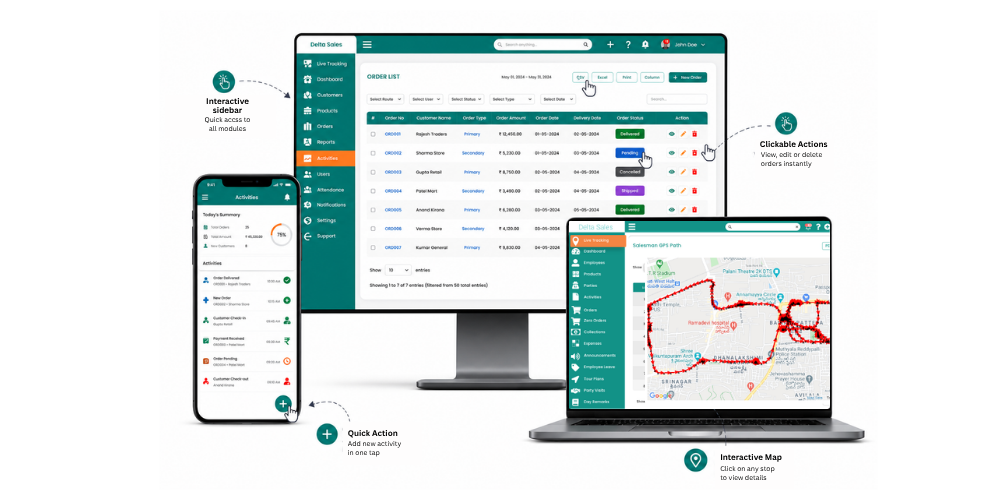
Delta Sales App brings together distributor management and field sales automation. It helps companies link office reports with what sales representatives do in the market. Instead of depending only on phone updates, spreadsheets, and reports, at the end of the day, managers can use a single system to track orders, visits, money collected, and how the team is doing.
It has a distributor management system that handles order management, distribution tracking, stock-related tasks, and payments. The field sales app includes GPS-based tracking of employees, monitoring of customer visits, planning of sales routes, attendance records, expense reports, and sales data analysis.
This combination is useful when a company needs to understand not just how much stock it has supplied to distributors but also how effectively its field team is serving retailers and customers.
Key capabilities
-
Distributor and customer management
-
Primary and direct customer order workflows
-
GPS-based location and visit tracking
-
Beat planning and route monitoring
-
Payment collection and field expense reporting
-
Mobile access with offline functionality and automatic synchronization when connectivity returns
-
Automated sales reports and performance dashboards
What to consider: Businesses with complex enterprise requirements should confirm the depth of scheme management, distributor billing, accounting integrations, and multi-level approval workflows during the demo.
Delta Sales App is worth evaluating when distribution operations and field sales execution need to work together rather than operate as disconnected systems.
2. Bizom
Best for: FMCG brands prioritizing retail execution and distribution visibility.
Bizom focuses on intelligence and route‑to‑market execution. Bizom helps consumer goods companies link field sales actions with distributor and retailer information. Bizom is especially useful for brands that run general‑trade networks. Companies that want insight into outlet coverage, sales results, and distribution work should look at Bizom. By connecting market execution with business reporting, Bizom lets sales managers find territories and see how well their teams serve retailers.
What to check: Verify secondary sales reporting, distributor inventory visibility, trade scheme management, and ERP integration against your specific requirements.
3. PepUpSales
Best for: Emerging to mid-sized consumer goods manufacturers that want simple integration with their accounting systems.
PepUpSales covers primary and secondary sales reporting, distributor ledger sync and targets against achievement. It lists ERP integration with Tally and SAP, which helps companies that want sales data and accounting records to match. It suits smaller manufacturers that need distributor reporting without a heavy setup.
What to check: Published descriptions differ on whether it’s a distributor tool or a lead and pipeline tool. Confirm which modules your plan includes, and ask to see the distributor ledger sync with your own accounting data.
4. FieldAssist
Best for: Consumer goods businesses managing extensive field sales teams and distributor networks.
FieldAssist offers tools for sales force automation and distribution-related tasks. It helps businesses manage field representatives, retailers, and channel partners. The features are useful for companies that want to turn sales activities into digital processes. It also helps them see how well their sales are performing in the market. For sales managers, being able to look at visits to stores, order reporting, and how the team is doing can show where there are problems with coverage. It also helps make reports more consistent. Whether it is a fit depends on the modules chosen and how the company handles its distribution.
What to check: Confirm the available DMS modules, offline functionality, distributor reporting, scheme management, and implementation requirements before making a decision.
5. BeatRoute
Best for: Businesses connecting field sales execution with distribution performance.
BeatRoute provides tools for sales execution and distribution that help businesses manage sales goals, fieldwork, and channel processes. It's worth looking at for companies that want to link how sales representatives perform with distribution goals. For instance, sales managers might need to find out if missed targets are because of poor store coverage, irregular order taking, or problems at the distributor level. A sales execution platform that is connected can help bring details into the decisions that are made.
What to check: Review distributor inventory visibility, scheme handling, reporting flexibility, integration requirements, and the workflows included in the proposed package.
6. Botree Software
Best for: Large FMCG organizations with complex distribution networks and enterprise reporting requirements.
Botree Software provides sales and distribution technology for consumer goods businesses. It is worth assessing when an organization manages multiple distribution layers, large product portfolios, and operations spread across several regions. For these businesses, distributor management often involves coordinating sales information, channel workflows, and reporting across different teams. An enterprise-oriented platform can help standardize processes while supporting the company's broader technology environment.
What to check: Ask about distributor onboarding, data migration, ERP integration, rollout timelines, customization requirements, and ongoing support. Confirm which capabilities are included in the proposed solution.
7. Ivy Mobility
Best for: Consumer goods companies seeking connected sales, distribution, and supply chain processes.
Ivy Mobility offers tools for consumer goods sales and distribution operations that can help companies connect fieldwork and distribution with operational systems. I believe Ivy Mobility is a fit for businesses that want to link sales, distributors, and supply chain functions across many regions. For manufacturers working in areas of coordination between sales teams, distributors, and supply chain people, it is essential to keep products available and to see how the whole operation runs. A connected platform from Ivy Mobility can shrink the gaps in information between these groups. Make everything run smoother.
What to check: Establish which modules are included, how distributor workflows are handled, what integrations are supported, and whether implementation requirements match your organization's scale.

8. Marg ERP
Best for: Distributors and wholesalers prioritizing billing, inventory management, and accounting workflows.
Marg ERP is useful for distribution businesses that must keep track of sales invoices, purchases, stock records, customer accounts, and daily transactions. These features are especially helpful for wholesalers who deal with products and frequent sales. Accurate billing and inventory records allow distributors to track stock movement, handle returns, and check balances. Still, businesses must separate the task of running a distributor’s operations from giving manufacturers insight into secondary sales throughout the larger distribution network. Marg ERP can also streamline these processes, making daily work easier for distribution businesses.
What to check: Confirm whether the selected edition supports field sales tracking, mobile order capture, secondary sales visibility, and manufacturer-level reporting. Verify the integration options available for your existing systems.
9. SalesDiary
Best for: Businesses looking to digitize mobile sales activities, customer visits, and order reporting.
SalesDiary is worth evaluating for organizations that want to move field sales processes away from manual records and disconnected reporting tools. Digital workflows for customer visits, order capture, and sales activity reporting can help managers maintain more consistent visibility into daily market execution. For businesses with distributed field teams, centralized reporting can make it easier to review representative activity, monitor customer coverage, and identify gaps in daily sales reporting.
What to check: Verify distributor inventory management, secondary sales reporting, offline access, GPS-based tracking, and the capabilities included in the proposed package. If a complete DMS is required, confirm that distributor-level workflows are supported.
10. FieldMax
Best for: Businesses evaluating mobile field sales management and representative activity tracking.
Organizations that want to move their field sales processes into form, like tracking customer visits, capturing orders, and generating sales reports, can look at FieldMax. This kind of solution works well for companies that rely on sales reps to manage areas and stay in touch with clients on a regular basis. When choosing a field sales platform, businesses should think about how it helps with day-to-day tasks and whether the data it collects can be used to track performance and plan future sales efforts.
What to check: Confirm the current product offering, official vendor details, GPS capabilities, offline support, distributor management features, and integration options. Determine whether it meets your complete DMS requirements or is better suited to field sales automation.
11. SalesPort by Sort String
Best for: Distribution businesses evaluating connected order processing and field operations.
SalesPort by Sort String is another tool to look at if a business wants to organize distribution tasks and sales work. SalesPort by Sort String should be checked to see if it matches the company's needs for order processing, inventory visibility, and communication between field and back-office teams. For distributors and manufacturers, the main question is whether SalesPort, by Sort String, gives operational data and backs the steps needed to manage orders, watch stock, and review sales performance.
What to check: Request a demonstration of order processing, inventory management, distributor reporting, field sales tracking, and system integrations. Confirm which features are available in the current product and whether additional configuration is required.
12. SAP
Best for: Large enterprises already running SAP that want distributor and channel management inside their ERP.
SAP’s cloud ERP for distribution covers distributor and channel management, order processing, inventory, and supply chain management, all connected to the wider ERP. It makes the most sense when finance, supply chain, and sales already run on SAP, and the company wants one system of record.
What to check: Ask what’s standard and what needs custom work, especially secondary sales visibility across distributors. Confirm the implementation scope, timeline, and cost, since this is usually a larger project than a dedicated DMS.
13. Cin7 Core
Best for: Distributors and wholesale brands that sell through e-commerce, retail and B2B channels together.
Cin7 Core keeps inventory in sync across sales channels, automates warehouse picking and packing, and includes a B2B portal where customers can order themselves. That helps a distributor that takes orders from several places and wants one stock count behind all of them.
What to check: Its strength is inventory and ordering, so ask how it reports secondary sales and whether a field sales app is part of the package.
14. SimplyDepo
Best for: Consumer goods companies that want field sales, route optimization and retail execution together.
SimplyDepo is a unified mobile and web system for managing field reps, secondary sales and store-level execution. It suits brands whose main need is seeing what happens at the outlet and linking it to sales data.
What to check: Confirm how deep its distributor billing and stock features go if you need a full DMS rather than field sales and secondary sales tracking.
15. Nural DMS
Best for: Distributors that want a standalone system for orders, billing and van sales with a quick rollout.
Nural DMS covers order management, billing, mobile van sales, and payment reconciliation. It suits a distributor that needs to run its own daily operations without a large implementation.
What to check: Ask about ERP and accounting integration and whether it gives manufacturers reporting across their whole distributor network.
How to Choose the Right Distributor Management Software
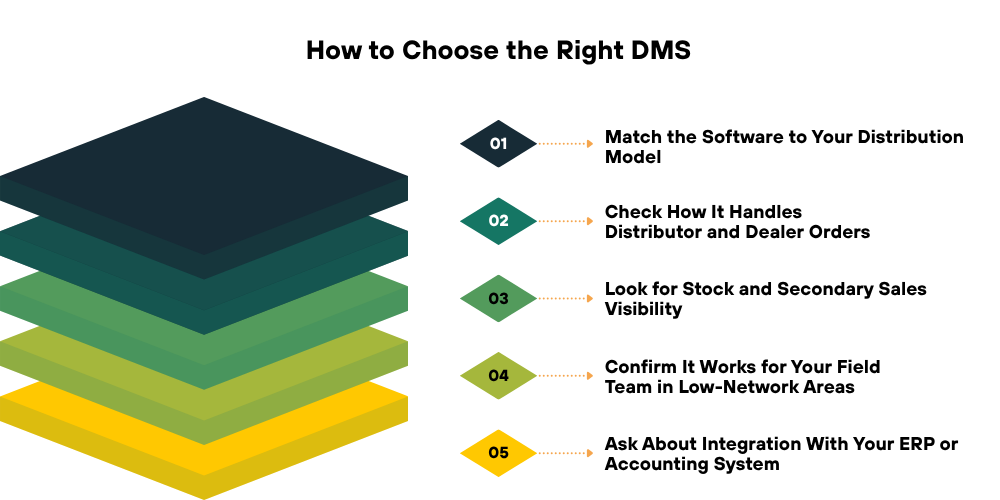
A feature list alone will not tell you whether a DMS fits your business. The right platform should match your distribution model, work with the systems you already use, and provide reliable information to the people making daily sales decisions.
For a detailed feature checklist, see Delta Sales App's guide to the top 10 features of the distributor management system. Use the following criteria to evaluate shortlisted vendors.
-
Match the software to your distribution model
First map how your products reach your customers. Are your products sold directly to distributors or do you work through super‑stockists or manage layers of dealers and retailers? Are your representatives taking orders in the market? Are distributors placing replenishment orders independently? These differences shape the structure of the system you need. If your FMCG brand has a general‑trade network, you may prioritize secondary sales and retailer coverage. If you are a manufacturer, you may need dealer account management, quotations, and order approvals. If you are a wholesaler, you may emphasize stock, billing, and receivables. List your workflows before you compare vendors. This approach helps you avoid paying for modules that your team will not use while missing essential operational requirements.
-
Check how it handles distributor and dealer orders
Order management needs to handle the process, not just the first step of placing an order. Make sure the software has product lists and price lists. Check if it allows order approvals, gives discounts, shows order status, handles cancellations, and manages returns. Keep payment records. If your company has rules for different distributors, find out how those rules are used and how they are shown in reports. Ask the vendors to show an order starting from when it is created all the way to when it's fulfilled. If your team works with both orders and orders, at the retailer level test both of those processes. Make sure you know who is allowed to change an order and how those changes appear in reports.
-
Look for stock and secondary sales visibility
Primary sales tell you what your company supplies to distributors. Secondary sales show what distributors sell onward to retailers. Both matter, but they answer different questions. A distributor may place a large order at the beginning of a month while several fast-moving SKUs run out at retail outlets a week later. Without reliable secondary sales and stock information, managers may mistake distributor loading for genuine market demand. Look for distributor-wise and SKU-wise stock visibility, sales trends, stock movement, returns, and retailer-level reporting. The system should help managers identify slow-moving products, recurring stockouts, and gaps in territory coverage. Also establish how the software collects distributor data and how frequently it updates. A dashboard is only useful when the underlying records are complete and timely.
-
Confirm it works for your field team in low-network areas
Field sales representatives often work in places where mobile signals are weak. If the app stops working when the network fails, employees may delay updates. Use paper records instead. Test the workflow with real field tasks. Can representatives open their assigned outlets, log visits, and take orders when the connection is down? What happens when the network comes back? How are duplicate entries and sync errors fixed? GPS tracking, visit checks, beat plans, and route watching can help managers see if the planned work matches what actually happened in the market. Check the permissions, how often reports must be sent, and how much battery GPS tracking uses before launching the feature.
-
Ask about integration with your ERP or accounting system
A DMS should complement your existing systems rather than create another isolated source of data. Discuss integration with your ERP, accounting software, product masters, customer records, pricing rules, and tax‑related workflows. If distributors use accounting tools such as Tally, ask whether data can be exchanged reliably and which system remains the source of truth for each record. Before signing, document the integration scope, data fields, synchronization frequency, error handling, ownership of customizations, and any additional fees. A successful demo does not automatically mean that a production integration is included in the quoted price. Finally, evaluate implementation support and adoption. The vendor should explain how distributors and sales representatives will be trained, how existing data will be migrated, and how issues will be handled after launch.
Final Thoughts
Choosing the right distributor management software is about more than digitizing orders and inventory. Businesses need a solution that connects distributor operations with field sales activities, improves visibility into secondary sales, and helps managers make informed decisions using reliable data. Before making a decision, evaluate each platform based on your distribution model, integration requirements, reporting needs, and plans for future growth.
For FMCG and distribution businesses, the right system can reduce manual work, improve distributor coordination, strengthen retail execution, and give sales managers a clearer picture of market activities. Take the time to compare essential features, implementation support, and scalability before committing to a platform.
Delta Sales App helps businesses connect distributor operations with field sales activities through capabilities such as order management, field team tracking, outlet visit monitoring, and sales performance reporting. It can help managers improve visibility across their sales operations and make decisions based on real-time field data.
Ready to improve your distribution and field sales operations?
Get a personalized product demo to explore how Delta Sales App can support your business requirements and help your sales team work more efficiently.