
Why Van Sales Automation is Essential for FMCG Brands

In the fast-moving consumer goods (FMCG) industry, speed, accuracy, and availability are critical determinants of market success. Brands operate in highly competitive environments where margins are thin, distribution networks are vast, and customer expectations are continuously rising. Among the many sales models FMCG companies rely on, van sales plays a particularly vital role in ensuring product availability, especially in traditional trade, semi-urban, and rural markets.
However, as distribution complexity increases and market dynamics evolve, manual and semi-digital van sales processes are no longer sufficient. Paper-based order taking, delayed reporting, inventory mismatches, and limited visibility into field operations restrict growth and create operational inefficiencies. This is where van sales automation becomes not just a technological upgrade, but a strategic necessity for FMCG brands seeking scalability, control, and sustained competitive advantage.
What Is Van Sales Automation
Sales automation refers to the use of digital tools and software platforms that fully digitize and streamline the end-to-end van sales process. It integrates mobile applications for field sales representatives with centralized backend systems, enabling real-time data capture, processing, and analysis.
An automated van sales system typically includes features such as mobile order booking, real-time inventory tracking, automated invoicing, route and beat tracking, digital payments, scheme management, and instant data synchronization with ERP or distribution systems. By replacing manual workflows with intelligent automation, FMCG brands gain visibility, control, and consistency across all van sales activities.
The Modern FMCG Distribution Challenge
Today’s FMCG landscape demands precision in distribution. Whether you’re serving premium outlets in business districts or neighborhood stores in residential areas, the fundamentals remain the same: consistent availability, timely delivery, and reliable service.
Consider the complexity: every market has unique consumption patterns, diverse retail formats, and varying service expectations. A convenience store in a metro area expects different service levels than a traditional kirana shop, but both require dependable supply chains.
-1766553964.png)
This diversity creates challenges:
Varied outlet requirements: Different store formats need different service approaches
Complex route planning: Maximizing coverage while minimizing costs across diverse geographies
Inventory management: Ensuring right products reach right outlets at right times
Relationship building: Maintaining strong connections with retailers across all market segments
Van sales operations directly address these challenges by providing flexible, responsive distribution that adapts to local market needs.
Importance of Van Sales in the FMCG Industry
-
Role of Van Sales in FMCG Distribution: Van sales is a direct-to-retail distribution model where sales representatives carry stock, take orders, deliver products instantly, and collect payments during store visits.
-
Subtopic: Business Value of Van Sales: This model ensures faster order fulfillment, improved shelf availability, and stronger retailer relationships.
-
High-frequency replenishment: Van sales enables frequent store visits, ensuring shelves are consistently stocked and reducing lost sales caused by product unavailability in fast-moving retail environments.
-
Faster product availability: Direct delivery from vans shortens fulfillment cycles, helping FMCG brands respond quickly to daily demand fluctuations without relying solely on warehouse dispatches.
-
Rural and semi-urban reach: Van sales bridges infrastructure gaps, allowing brands to efficiently serve remote and fragmented markets where traditional distribution models are less effective.
-
Last-mile distribution strength: This model improves execution at the final point of sale, ensuring products reach retailers quickly and in sellable condition.
-
Local demand responsiveness: Sales teams can adjust quantities and assortments on the spot, aligning supply with real-time market demand.
Challenges in Traditional Van Sales Operations
-
Manual and Paper-Based Processes: Traditional van sales relies heavily on handwritten orders, invoices, and stock registers. These processes increase administrative workload, slow down sales execution, and limit operational transparency.
-
Inventory and Reporting Inefficiencies: Without automation, FMCG brands face frequent inventory mismatches, delayed sales reporting, and limited visibility into field activities, making it difficult to control losses or optimize distribution.
-
Manual documentation errors: Paper-based order taking and invoicing increase human errors, causing incorrect billing, inventory mismatches, and unreliable sales records that negatively affect revenue control and operational efficiency.
-
Delayed data visibility: Sales and inventory information is available only after day-end consolidation, limiting real-time monitoring and preventing managers from taking timely corrective or preventive actions.
-
Execution tracking gaps: Without digital tracking, managers cannot confirm route adherence, outlet coverage, or target achievement, leading to poor execution control and inconsistent field performance.
-
Revenue leakage risk: Manual pricing and discount application often results in unauthorized concessions, incorrect scheme execution, and margin loss across van sales operations.
-
Low accountability: Lack of automated tracking makes it difficult to measure individual salesperson performance, reducing accountability and weakening performance management across the field sales team.
Improved Sales Execution and Field Productivity
-
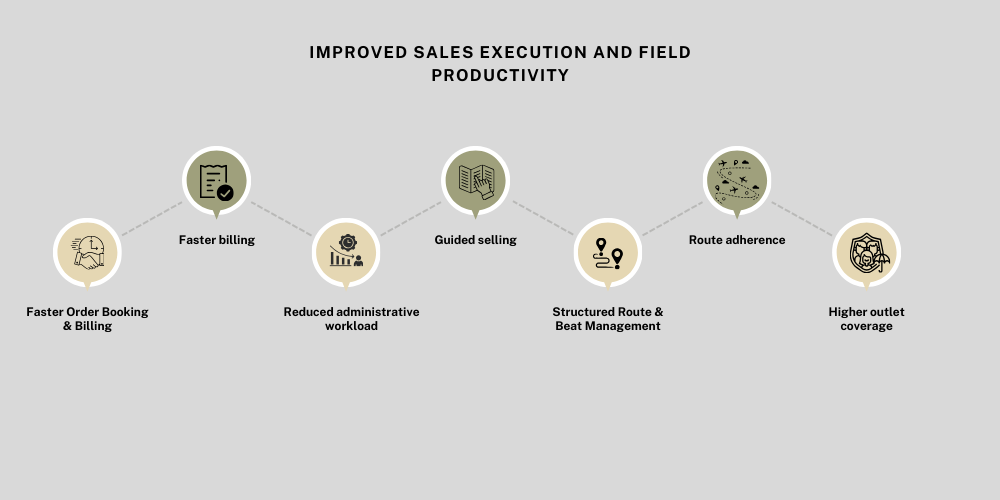
Faster Order Booking and Billing: Automation simplifies order capture and invoice generation, reducing time spent on paperwork and allowing sales representatives to focus on selling and customer engagement.
-
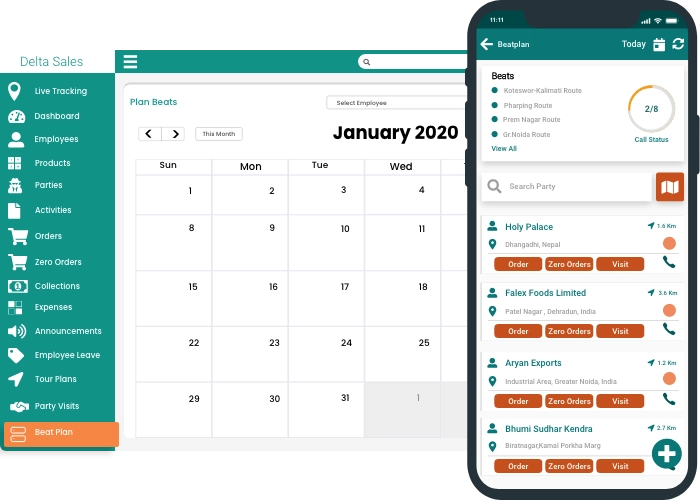
Structured Route and Beat Management: Predefined routes and outlet lists ensure disciplined coverage, optimal time utilization, and consistent execution across all sales territories.
-
Reduced administrative workload: Automation eliminates manual paperwork, allowing sales representatives to focus more on selling activities, retailer engagement, and improving service quality during market visits.
-
Higher outlet coverage: Streamlined order booking and billing processes reduce time per outlet, enabling sales representatives to visit more stores and increase overall daily sales productivity.
-
Route adherence: Digital route planning ensures disciplined execution by guiding representatives through planned outlets, improving territory coverage, visit consistency, and route efficiency.
-
Faster billing: Instant invoice generation reduces checkout time at outlets, enhances transaction accuracy, and creates a smoother, more professional buying experience for retailers.
-
Guided selling: System-driven product recommendations help representatives suggest optimal SKUs and quantities, increasing average order value and improving sales effectiveness.
Real-Time Inventory Visibility and Control
-
Accurate Van-Level Stock Tracking: It provides real-time visibility into stock movement from warehouse dispatch to final sale, reducing pilferage and stock discrepancies.
-
Better Demand and Replenishment Planning: With accurate inventory data, FMCG brands can identify fast- and slow-moving SKUs and adjust replenishment strategies to minimize stock-outs and returns.
-
Accurate stock tracking: Digital recording of every stock movement ensures precise inventory visibility, reduces discrepancies, prevents pilferage, and improves overall control across van-level and warehouse-level operations.
-
Optimized van loading: Demand-based loading ensures vans carry the right product mix and quantities, reducing stock-outs, excess inventory, and unnecessary returns during daily sales routes.
-
Reduced expiries and damage: Real-time visibility highlights slow-moving or aging stock early, enabling timely redistribution or promotions to minimize product expiry and damage-related losses.
-
Warehouse coordination: Live inventory and sales data improves coordination between warehouse teams and field sales, ensuring timely replenishment and accurate dispatch planning.
-
SKU-level insights: Detailed SKU-wise analytics help brands evaluate product performance by route and market, supporting better assortment planning and targeted sales strategies.
Accurate Pricing, Schemes, and Discounts
-
Centralized Pricing Control: Automated systems ensure that correct prices and discounts are applied based on predefined rules, eliminating manual errors and revenue leakage.
-
Consistent Scheme Execution: Promotional schemes are automatically enforced across all vans and regions, ensuring uniform execution and transparency for retailers.
-
Error-free billing: Automated pricing calculations remove human error during order processing, ensuring correct invoices, improved compliance, and accurate revenue reporting across van sales operations.
-
Uniform pricing: Centralized price control ensures consistent pricing across all regions and routes, reducing channel conflicts and maintaining fair trade practices.
-
Automatic scheme application: System-driven scheme application ensures promotions are applied correctly every time, eliminating dependency on salesperson judgment or manual interpretation.
-
Margin protection: Built-in controls restrict unauthorized discounts, safeguarding profit margins and preventing revenue leakage across field sales operations.
-
Retailer transparency: Clear, accurate invoices improve retailer confidence, reduce disputes, and strengthen long-term business relationships.
Faster Billing, Collections, and Cash Reconciliation
-
Instant Invoicing and Payment Capture: Automation enables real-time invoice generation and supports multiple payment modes, improving transaction accuracy and speed.
-
Improved Financial Accuracy: Automated reconciliation links sales, collections, and returns, reducing financial risk and simplifying end-of-day closure for sales and finance teams.
-
Instant invoicing: Immediate invoice generation accelerates sales closure, reduces outlet waiting time, and improves overall transaction efficiency.
-
Multiple payment modes: Support for digital payments minimizes cash handling risks, improves payment convenience, and accelerates collections from retailers.
-
Quick reconciliation: Automated matching of sales and payments simplifies end-of-day reconciliation and reduces manual effort for field and finance teams.
-
Accurate outstanding tracking: Real-time tracking of receivables helps manage credit exposure and reduces overdue payments.
-
Improved cash flow visibility: Finance teams gain real-time visibility into collections, enabling better cash flow planning and control.
Enhanced Managerial Visibility and Decision-Making
-
Real-Time Sales and Route Monitoring: Managers gain instant access to dashboards showing sales performance, route efficiency, and outlet coverage, enabling proactive interventions.
-
Data-Driven Strategic Decisions: Reliable, real-time data supports better forecasting, performance evaluation, and resource allocation at both operational and leadership levels.
-
Live performance dashboards: Real-time dashboards provide instant visibility into sales, coverage, and productivity, enabling proactive management of field operations.
-
Representative-level analysis: Detailed performance comparisons help identify skill gaps, training needs, and high-performing sales representatives.
-
Early issue detection: Real-time monitoring highlights underperformance early, allowing managers to take corrective actions before issues escalate.
-
Faster supervision: Supervisors can monitor and intervene during sales activities rather than relying on delayed reports.
-
Better forecasting: Accurate, real-time data improves demand forecasting and sales planning accuracy.
-1766553915.png)
Scalability and Market Expansion Enablement
-
Standardized Processes Across Regions: It creates a repeatable operational framework that supports rapid expansion without losing control or consistency.
-
Faster Sales Team Onboarding: Digital workflows and guided processes reduce training time and help new sales representatives become productive quickly.
-
Easy territory expansion: Digital van sales systems enable quick addition of new routes and markets without disrupting existing operations or increasing manual workload and operational complexity.
-
Process consistency: Standardized digital workflows ensure uniform execution, policy compliance, and service quality across all regions, teams, and distribution networks.
-
Reduced dependency: Automation captures operational knowledge within systems, reducing reliance on individual sales representatives and ensuring continuity despite staff changes.
-
SKU expansion support: Automated systems efficiently manage growing product assortments, enabling smooth SKU expansion without impacting sales execution or operational efficiency.
-
Centralized oversight: Central dashboards provide management with real-time visibility and control across all markets, even as van sales operations scale rapidly.
Strengthening Retailer Relationships
-
Reliable service: Accurate deliveries and error-free invoicing ensure dependable service, reduce disputes, and increase retailer confidence in the brand’s operational reliability.
-
Clear scheme communication: Consistent, system-driven scheme application ensures retailers clearly understand and receive all promotional benefits without confusion or misinterpretation.
-
Faster issue resolution: Access to accurate, real-time transaction data enables quick resolution of billing, delivery, or scheme-related issues, strengthening retailer trust.
-
Trust building: Transparent pricing, invoicing, and promotion execution foster long-term trust and stable partnerships between FMCG brands and retailers.
-
Professional engagement: Digitized sales processes improve service efficiency, enhance interaction quality, and position the brand as professional and technologically advanced.
Competitive Advantage in FMCG Markets
-
Faster Market Response: Automated systems allow FMCG brands to launch promotions, adjust routes, and respond to market changes quickly.
-
Sustainable Growth Enablement: By reducing costs, improving execution, and enhancing visibility, automation becomes a long-term growth driver rather than just an operational tool.
-
Rapid market response: Real-time sales and inventory insights enable FMCG brands to respond quickly to changing demand patterns, competitive actions, and market opportunities.
-
Faster promotions: Digitized systems allow instant rollout of new schemes and product launches across all routes, ensuring timely and consistent market execution.
-
Lower operational costs: Automation minimizes manual work, reduces errors, and lowers administrative and operational expenses across van sales operations.
-
Stronger retail presence: Improved sales execution ensures better product availability, shelf placement, and visibility at retail outlets.
-
Future readiness: Digital platforms equip FMCG brands to adapt quickly to evolving market conditions, customer expectations, and technological advancements.

Conclusion
Van sales automation transforms van sales from a manual, error-prone activity into a strategic, data-driven operation. For FMCG brands aiming to scale efficiently, improve execution quality, and maintain competitive advantage, van sales automation is no longer optional, it is essential.
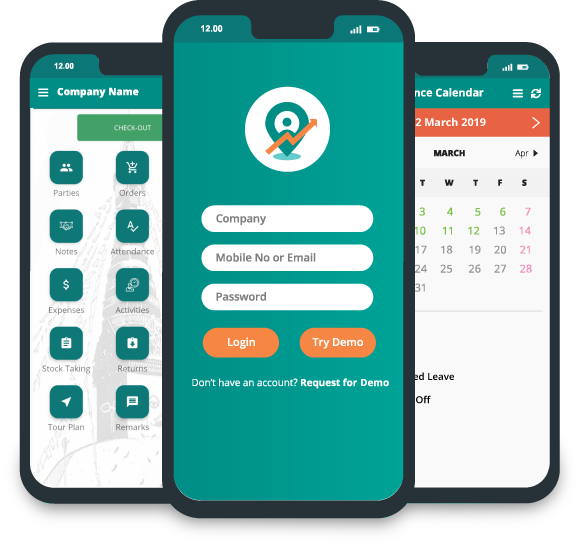
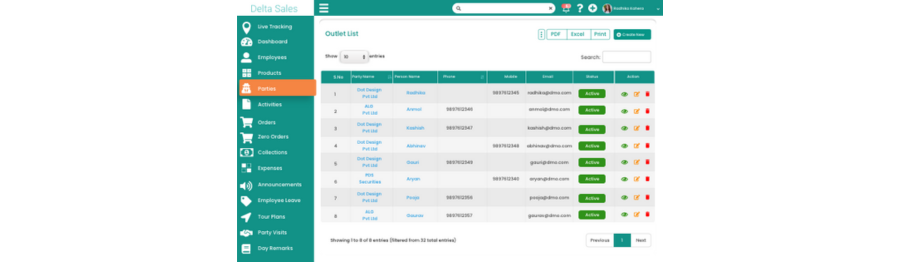
With the Delta Sales app, FMCG companies can digitize their entire van sales process from route planning and order booking to inventory control, billing, and collections while gaining real-time visibility and control over field operations. Delta Sales empowers sales teams to execute faster, managers to make informed decisions, and leadership to drive consistent growth across markets.
Take the next step toward smarter, more efficient van sales. Explore the Delta Sales app today and transform your field sales operations into a scalable growth engine.