
What Is Inventory Turnover and Why Does It Matter for FMCG?
For an FMCG business, having products in stock is only part of the job. Those products also need to move at the right speed.
A distributor carrying too much stock may have money tied up in unsold products. A retailer with slow-moving SKUs may eventually face expiry or reduced shelf space. On the other hand, inventory that moves too quickly can create stockouts and lost sales.
This is where inventory turnover becomes useful.
Inventory turnover shows how often a business sells and replaces its average inventory during a specific period. For FMCG companies, it can provide a practical view of how efficiently products are moving through the supply chain.
A company with healthy FMCG inventory management software is generally better positioned to keep products moving, manage working capital, reduce unnecessary stock, and respond to changes in customer demand.
But a higher turnover ratio is not automatically better. The right level depends on the product category, shelf life, demand pattern, distribution model, and sales cycle.
What Is Inventory Turnover in FMCG?
Inventory turnover measures how frequently a company sells and replaces its inventory over a given period, usually a month, quarter, or year.
In simple terms, it answers a basic question:
How quickly are our products moving?
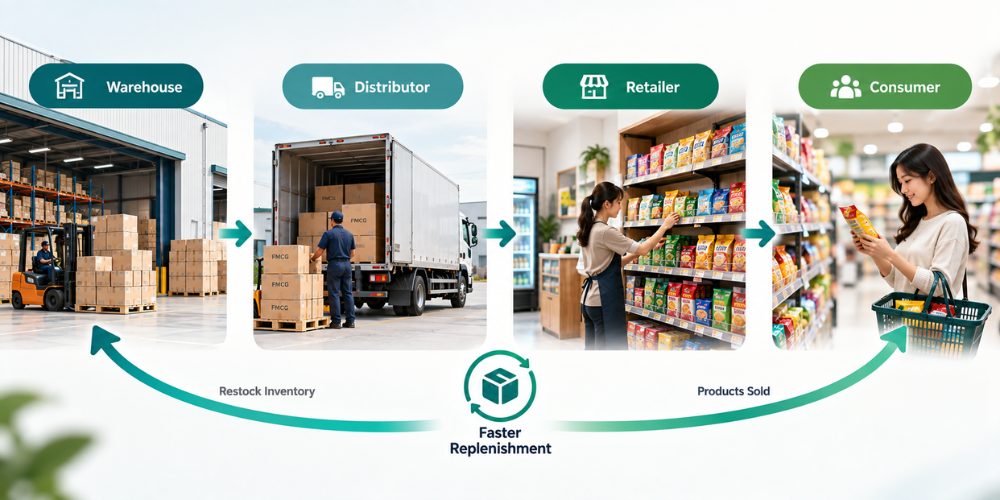
For an FMCG company, this could mean looking at how quickly products move from a warehouse to distributors, from distributors to retailers, and eventually from retailers to consumers.
For example, imagine an FMCG distributor keeps an average inventory worth ₹10 lakh during a year and sells goods worth ₹60 lakh at cost during that period. The business has turned over its inventory several times during the year.
A higher inventory turnover ratio generally indicates that stock is moving faster. A lower ratio can point toward excess inventory, weak demand, poor distribution, or other operational issues.
However, managers should always look at the reason behind the number rather than judging the number alone.
A low turnover ratio for a seasonal product may be perfectly normal during an off-season period. Similarly, an unusually high ratio may look positive but could indicate that inventory levels are too low and stockouts are becoming more likely.
How Do You Calculate Inventory Turnover?
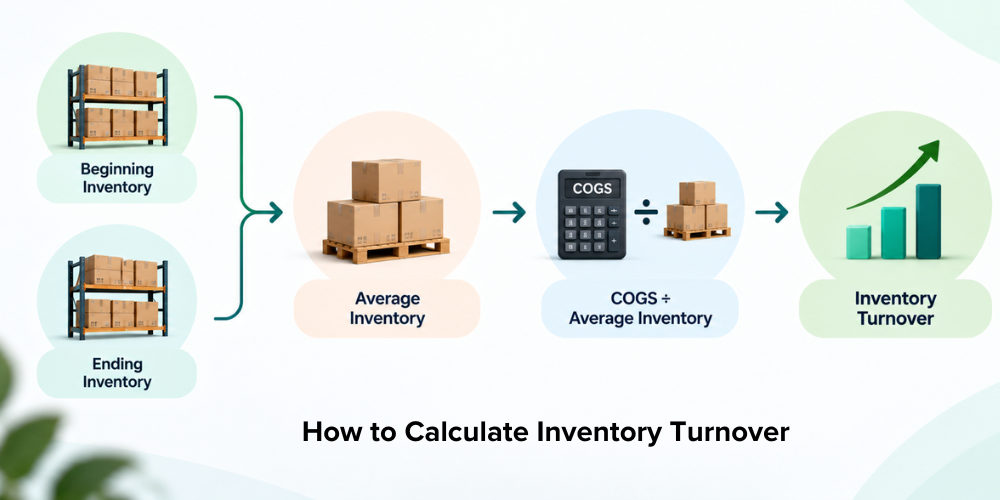
The standard inventory turnover formula is:
Inventory Turnover = Cost of Goods Sold ÷ Average Inventory
Average inventory is usually calculated as:
Average Inventory = (Beginning Inventory + Ending Inventory) ÷ 2
Using the cost of goods sold rather than sales revenue makes the comparison more meaningful because both figures are based on inventory cost.
A Simple FMCG Example
Suppose an FMCG distributor has:
-
Beginning inventory: ₹8 lakh
-
Ending inventory: ₹12 lakh
-
Cost of goods sold during the year: ₹50 lakh
First, calculate average inventory:
(₹8 lakh + ₹12 lakh) ÷ 2 = ₹10 lakh
Then:
₹50 lakh ÷ ₹10 lakh = 5
So the distributor's inventory turnover ratio is 5 times per year.
That means the business effectively sold and replaced its average inventory five times during the year.
The figure becomes more useful when compared with previous periods, similar products, territories, or industry expectations.
For example, if a distributor's turnover drops from 7 to 5, managers should investigate what changed. Perhaps demand has weakened, inventory purchases increased, some SKUs are moving slowly, or sales coverage has declined.
What Does a High or Low Inventory Turnover Ratio Mean?
The meaning of an inventory turnover ratio depends on the business and product category.
When Inventory Turnover Is Too Low
Low inventory turnover usually means products are sitting in storage or at retail locations for longer than expected.
This can happen when businesses purchase more stock than the market can absorb. It can also result from inaccurate demand forecasting, weak sales execution, declining demand, or poor distribution coverage.
For FMCG companies, prolonged low turnover can be particularly concerning because many products have limited shelf lives.
Slow-moving stock can tie up cash and occupy warehouse space while increasing the risk of expiry, damage, or discounting.
When Inventory Turnover Is Too High
A high turnover ratio generally means products are moving quickly. That sounds positive, but extremely high turnover can create another problem: insufficient stock.
If demand is strong but replenishment cannot keep pace, retailers may face stockouts. When the preferred product is unavailable, customers can easily switch to another brand.
For this reason, businesses should not simply aim for the highest possible turnover.
Finding the Right Balance
The goal is to maintain enough inventory to meet demand without keeping unnecessary stock.
The right balance can vary based on:
-
Product shelf life
-
Demand consistency
-
Seasonality
-
Order frequency
-
Lead times
-
Distribution model
-
Promotional activity
-
Product category
This is why FMCG managers should examine inventory turnover alongside other inventory and sales indicators.
Why Does Inventory Turnover Matter for FMCG Companies?
FMCG businesses deal with large product volumes, frequent orders, multiple SKUs, and a wide network of distributors and retailers. Small inventory problems can therefore become expensive when repeated across hundreds or thousands of outlets.
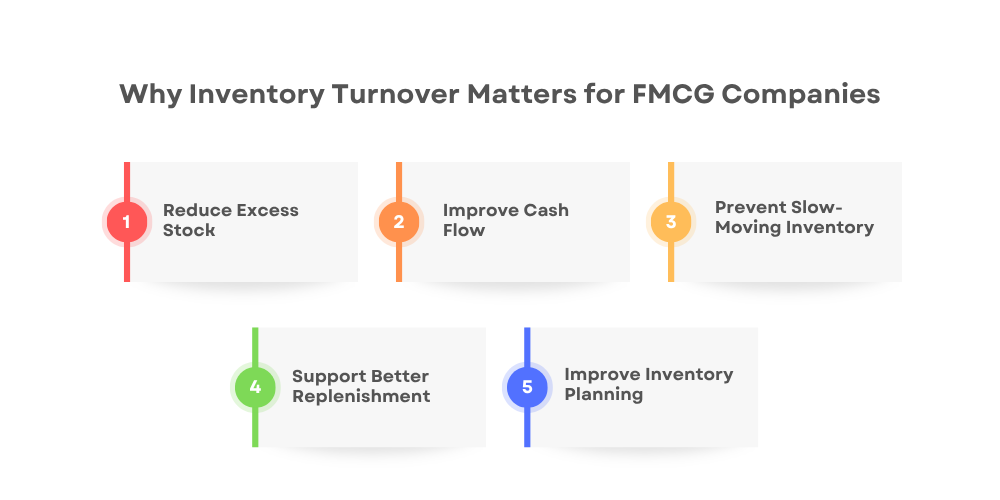
Helps Reduce Slow-Moving Stock
Slow-moving inventory takes longer to sell and can gradually become a financial burden.
Monitoring turnover helps managers identify products that are not moving at the expected rate. Once these products are identified, the company can investigate whether the issue is pricing, demand, distribution, visibility, or sales execution.
This is more useful than discovering the problem only after warehouses are already full.
Reduces the Risk of Product Expiry
Expiry is a major concern for many FMCG categories, particularly food, beverages, personal care, and other products with limited shelf lives.
Better inventory management in FMCG helps businesses understand which products are moving slowly and where those products are sitting.
This gives sales and distribution teams more time to take corrective action before products become unsellable.
Improves Working Capital Efficiency
Inventory represents money invested in products that have not yet been sold.
When too much stock sits idle, more working capital remains tied up in inventory.
Improving inventory efficiency allows businesses to use available cash more effectively instead of continuously purchasing products that are already sitting in warehouses or distribution points.
Supports Better Inventory Planning
Turnover data can help managers make more informed purchasing and replenishment decisions.
Instead of relying entirely on assumptions, managers can examine historical stock movement, product demand, and sales performance to determine where inventory needs to increase or decrease.
Reveals Product Demand and Sales Performance
Turnover can also highlight differences between products and territories.
One SKU may sell quickly in one market but remain slow in another. A particular distributor may have strong movement while another carries excess stock.
This makes inventory turnover analysis useful for understanding where inventory is moving efficiently and where sales teams may need to investigate further.
What Causes Low Inventory Turnover in FMCG?
A falling turnover ratio rarely happens for just one reason. Several operational issues can contribute to the problem.
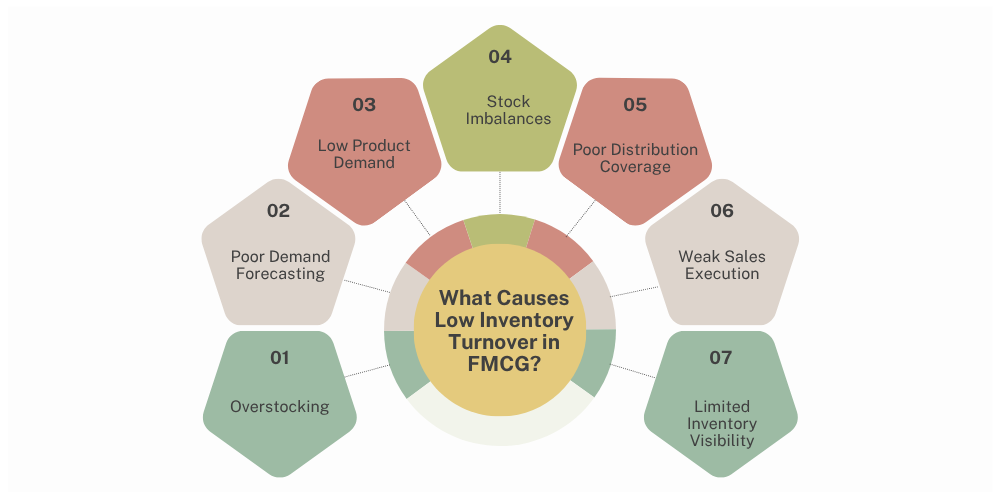
Overstocking of Products
Businesses sometimes purchase large quantities to secure better pricing, prepare for promotions, or avoid future shortages.
If actual demand is lower than expected, the extra stock can remain unsold for months.
Inaccurate Demand Forecasting
Forecasts based on outdated sales figures or assumptions may not reflect current market demand.
Changes in customer preferences, competition, seasonality, or local market conditions can quickly make a forecast less reliable.
Uneven Retailer Demand
Not every outlet sells the same products at the same speed.
A product that performs well in high-footfall stores may move slowly in smaller outlets. Treating every retailer the same can therefore create uneven stock levels.
Understanding retailer inventory and outlet-level demand can help companies distribute products more intelligently.
Poor Distribution Coverage
A product cannot sell if it is not reaching the right outlets.
Weak FMCG distribution coverage can leave products concentrated in a few locations while other areas have potential demand but limited availability.
Weak Sales Execution
Field representatives influence how frequently retailers are visited, which products are discussed, and how orders are captured.
If sales teams skip outlets, visit them inconsistently, or fail to identify replenishment opportunities, product movement can suffer.
Limited Visibility Into Market-Level Stock Movement
Managers may know how much stock exists in a warehouse but have limited visibility into what is happening at retailer level.
Without reliable market-level stock visibility, it becomes difficult to understand whether poor turnover is caused by excess supply, weak demand, or gaps in distribution.
How Can FMCG Companies Improve Inventory Turnover?
Improving inventory turnover is not simply about reducing inventory. The objective is to improve the movement of the right products through the right channels.

Match Inventory With Actual Market Demand
Use historical sales, current order patterns, seasonality, and territory-level performance to make purchasing decisions.
Avoid treating every market as identical. Demand can differ significantly between cities, territories, distributors, and outlet types.
Identify and Act on Slow-Moving SKUs
Regularly review slow-moving stock by SKU, distributor, territory, and outlet.
Once a slow-moving product is identified, determine why it is not moving.
Possible actions may include changing the distribution focus, improving retailer coverage, adjusting order quantities, running suitable promotions, or moving stock toward markets where demand is stronger.
Improve Retailer and Distributor Replenishment
Replenishment should be based on actual movement rather than simply following a fixed schedule.
If a retailer consistently sells a product every week, the sales team should be able to recognize that pattern and support timely replenishment.
Better distributor stock management also helps prevent situations where stock is available in one location while another market is experiencing shortages.
Strengthen Sales and Outlet Coverage
Consistent outlet visits can have a direct impact on product movement.
Sales representatives can check product availability, identify retailer requirements, take orders, and report market conditions during their visits.
Better sales coverage means fewer outlets are left unattended and fewer replenishment opportunities are missed.
Monitor Stock Movement by Product and Territory
A company-wide turnover figure can hide important differences.
Managers should compare SKU performance, territories, distributors, and outlet groups.
For example, if a particular product has healthy turnover nationally but poor movement in one territory, the issue may be local distribution or demand rather than the product itself.
Use Field Sales Data to Make Faster Inventory Decisions
Sales teams collect valuable information from the market every day. Retailer orders, outlet visits, product availability, and sales activity can help managers understand what is happening closer to the point of sale.
Combining this information with inventory data can make inventory planning more responsive to actual market conditions.
Which Inventory Metrics Should FMCG Managers Track?
Inventory turnover is useful, but it should not be viewed in isolation.
Inventory Turnover Ratio
The inventory turnover ratio shows how frequently inventory is sold and replaced during a specific period.
Days Inventory Outstanding
Days Inventory Outstanding, or DIO, estimates how many days inventory remains with the business before being sold.
It provides another way to understand inventory movement and is particularly useful when comparing periods.
Stock Cover
Stock cover estimates how long current inventory can support expected demand.
For example, if current stock is expected to last 20 days based on current sales, the business has approximately 20 days of stock cover.
Sell-Through Rate
The sell-through rate measures how much of the available inventory has been sold during a particular period.
It can help managers understand product movement at different stages of distribution and retail.
Stockout Rate
The stockout rate shows how frequently products are unavailable when customers or retailers need them.
This is important because improving inventory turnover by keeping inventory extremely low can create stock availability problems.
How Can Field Sales Data Help FMCG Companies Improve Inventory Turnover?
Field sales teams operate close to retailers, which gives them access to information that may not appear in warehouse reports.
-1790055753.png)
Track Retailer Order Patterns
Regular order data can reveal which products retailers purchase frequently and which products are rarely reordered.
This helps managers identify changes in demand before they become larger inventory problems.
Understand Product Movement by Outlet
Different outlets can have very different sales patterns.
Tracking outlet-level orders and visits helps businesses understand where products are moving and where additional sales attention may be needed.
Identify Slow-Moving Products and Territories
If order activity remains low for a particular SKU or territory, managers can investigate the reason instead of waiting for month-end inventory reports.
Improve Distributor Replenishment Decisions
Reliable market orders can help distributors replenish products based on actual retailer requirements.
This reduces the chance of both excessive inventory and unnecessary stock shortages.
Connect Market Activity With Inventory Movement
This is where field sales data becomes particularly useful.
Managers can compare sales visits, retailer orders, outlet coverage, and product movement to understand whether inventory problems are related to demand or sales execution.
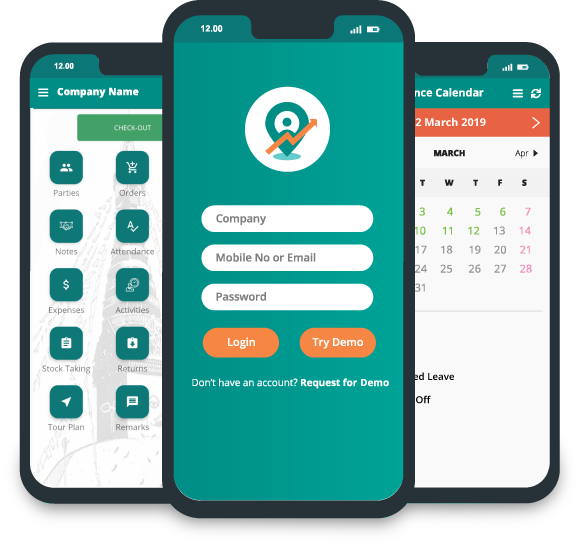
A field sales management platform such as Delta Sales App can help companies capture market orders, monitor outlet visits, track sales activity, and maintain better visibility into what field teams are doing across territories.
Final Takeaway
Inventory turnover helps FMCG businesses understand how efficiently products are moving and whether stock levels match market demand. Low turnover can indicate excess or slow-moving products, while unusually high turnover may increase the risk of stockouts.
Better inventory management in FMCG requires visibility beyond the warehouse. Retailer demand, distributor movement, outlet coverage, orders, and field sales activity can help managers make better replenishment decisions and keep products moving.
Get Better Visibility From the Market
Delta Sales App helps businesses track sales visits, capture market orders, monitor outlet coverage, and view daily field sales activity.
Book a Demo of Delta Sales App and get ready to improve field sales visibility.