
What Is Retailer Retention and How Can FMCG Brands Improve It?
An FMCG brand can have a strong product, competitive pricing, and a wide distribution network, yet still struggle to grow if retailers do not keep ordering from it.
A retailer may start with a few products, place regular orders for several months, and then slowly reduce purchases. Sometimes the reason is obvious, such as poor availability or delayed delivery. In other cases, the problem is less visible. Sales visits become irregular, the retailer stops receiving attention from the sales team, or a competing brand offers better support.
This is where retailer retention becomes important.
For FMCG companies, retaining retailers is not simply about keeping a list of outlets active. It means creating a reliable buying experience that gives retailers a reason to continue stocking and ordering the brand's products.
The good news is that many of the factors behind retailer retention are connected to everyday field-sales activities. By improving outlet coverage, order handling, product availability, sales visits, and follow-ups, FMCG brands can build stronger and more consistent customer relationships.
What Is Retailer Retention in FMCG?
Retailer retention refers to an FMCG brand's ability to keep retailers actively purchasing and selling its products over time.
A retained retailer continues to place orders, maintains the brand's products on the shelf, responds to sales representatives, and remains part of the company's active distribution network.
-1790501983.png)
For example, suppose an FMCG distributor serves 1,000 retailers. If 850 of those retailers continue ordering regularly while the remaining 150 gradually stop buying, the company has a retention problem even if its total sales still look healthy.
Retention is therefore closely connected to repeat orders, retailer loyalty, outlet coverage, and order frequency.
It is also important to understand that a retailer does not always leave suddenly. A retailer may first reduce the size of orders, stop buying certain products, skip sales visits, or purchase from competitors more frequently. These small changes can be early signs that the relationship is weakening.
FMCG managers who notice these changes early have a better chance of bringing the retailer back to regular ordering.
Why Is Retailer Retention Important for FMCG Brands?
Retailers are a critical link between FMCG brands and consumers. When retailers consistently stock a product, consumers are more likely to find it when they need it.
A strong retailer base also makes distribution more predictable. Sales teams know which outlets are active, distributors can plan inventory more effectively, and managers can identify areas where market coverage needs attention.
There is another practical benefit: retaining an existing retailer is generally more efficient than constantly trying to replace inactive outlets.
A retailer who already knows the brand, understands the products, and has an established buying relationship requires less effort than an entirely new outlet.
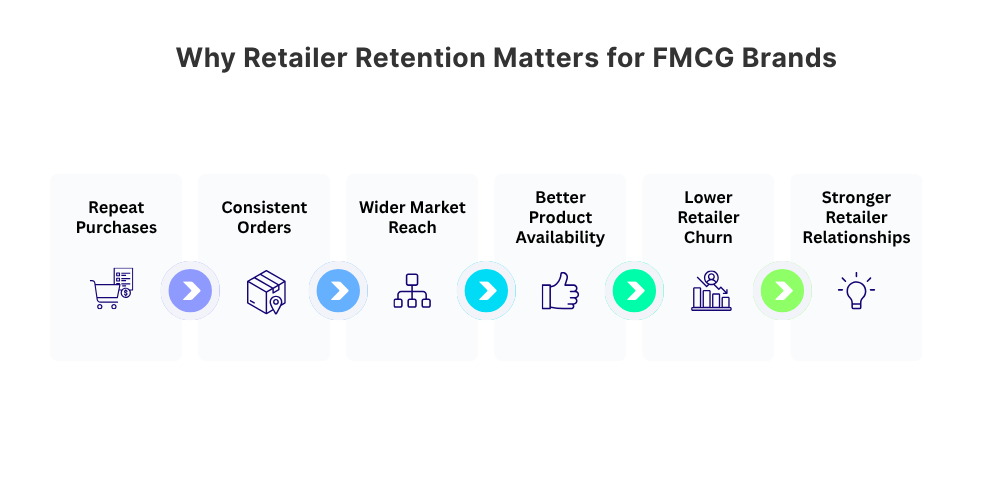
Good retention can also lead to:
-
More consistent repeat purchases
-
Better distribution reach
-
Stronger relationships between retailers and sales representatives
-
More predictable demand
-
Better shelf presence
-
Lower retailer churn
-
Greater opportunities for cross-selling and upselling
For FMCG brands operating across thousands of outlets, even a small improvement in retention can make a meaningful difference to the health of the distribution network.
Why Do FMCG Brands Lose Retailers?
Retailers rarely stop buying because of one single reason. Their decision is usually influenced by several issues that build up over time.
Inconsistent Product Availability
Retailers cannot sell products they cannot get. If popular SKUs are frequently unavailable, retailers may replace them with competing products. Once customers start asking for another brand and the retailer becomes comfortable stocking it, winning that space back becomes harder.
Stock availability therefore plays a major role in maintaining retailer relationships.
Irregular Sales Visits
A retailer may expect a sales representative to visit regularly, take orders, check stock, discuss new products, and resolve basic issues.
When visits become inconsistent, the retailer may feel neglected. More importantly, the sales team may miss changes in demand, competitor activity, or product requirements.
Consistent sales representative visits help FMCG brands stay connected with the market.
Poor Order Handling
An incorrect quantity, missed SKU, duplicate order, or delayed order confirmation can create unnecessary frustration.
For retailers, ordering should be straightforward. If they repeatedly have to call different people to check an order or correct mistakes, they may become more willing to shift purchases elsewhere.
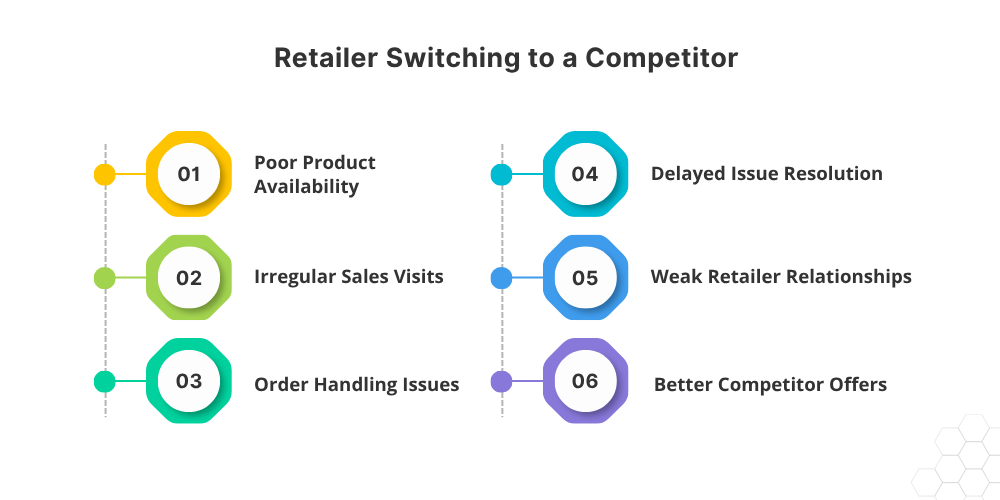
Delayed Issue Resolution
Retailers will occasionally have problems involving damaged products, pricing, availability, credit, delivery, or order discrepancies. The issue itself may not damage the relationship. The bigger problem is when nobody follows up.
Quick and clear retailer support shows that the brand values the outlet beyond simply taking orders.
Weak Retailer Relationships
Technology and distribution processes matter, but relationships still have a major role in FMCG sales. A sales representative who understands a retailer's business, remembers product preferences, communicates clearly, and visits consistently can build trust over time.
That relationship becomes particularly valuable when competitors enter the same market.
Competitive Offers From Other Brands
Retailers constantly compare brands based on pricing, margins, schemes, product demand, service, availability, and payment terms.
FMCG brands cannot always offer the highest margin. However, they can compete by making the overall buying and selling experience reliable.
What Makes Retailers Stay With an FMCG Brand?
Retailers generally want products that sell, margins that make sense, and suppliers who make their work easier. Several factors influence whether they continue ordering from a brand.
Reliable Product Availability
Fast-moving products should be available when retailers need them. Frequent stockouts can push retailers toward competing products.
Sales and distribution teams should pay particular attention to high-demand SKUs and outlets where availability problems occur repeatedly.
Consistent Sales Support
A regular sales visit gives the retailer an opportunity to place orders, discuss products, raise concerns, and receive updates.
The objective should not be to maximize the number of visits alone. The focus should be on making each retailer visit useful.
Easy and Accurate Ordering
The fewer mistakes involved in ordering, the easier it is for retailers to continue doing business.
Field representatives should have accurate product information, retailer details, previous order information, and a simple way to record new orders.
Timely Order Fulfillment
A retailer who places an order expects it to arrive within a reasonable timeframe. When orders are consistently delayed or incomplete, the retailer may keep less stock or turn to another supplier.
Strong Sales Representative Relationships
The sales representative is often the face of the FMCG brand in the market. A representative who visits on schedule, understands the outlet, checks product availability, and follows up on previous concerns can contribute significantly to long-term retailer relationships.
How Can FMCG Brands Improve Retailer Retention?
Improving retention does not require one large initiative. It usually comes from making several everyday sales and distribution activities more reliable.
Maintain Consistent Retailer Coverage
Every active outlet should have an appropriate visit frequency based on its importance, order potential, location, and business requirements.
Managers should know which outlets were visited, which were missed, and which retailers have not been contacted recently.
Reliable outlet coverage helps prevent valuable retailers from quietly becoming inactive.
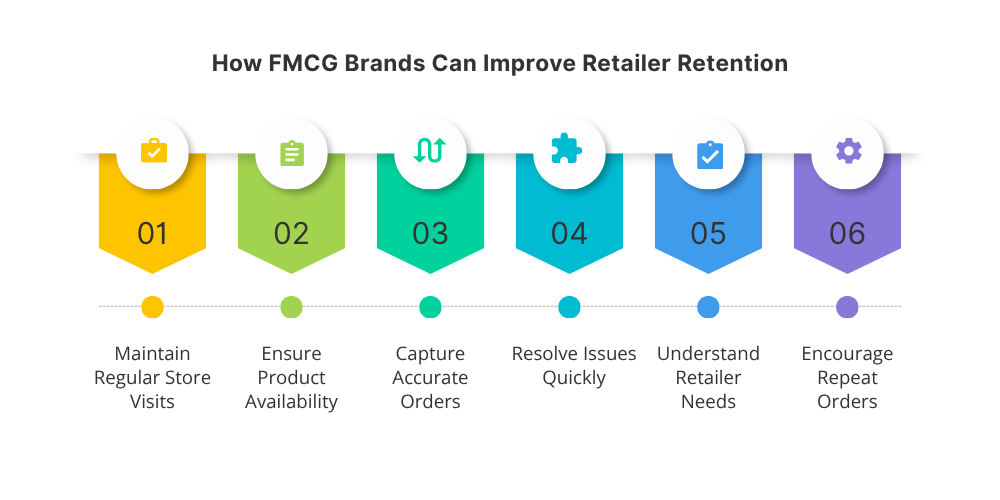
Make Order Booking Faster and More Accurate
Manual order-taking can create problems when sales representatives write orders on paper, enter them later, or depend on messages to communicate order details.
A structured mobile order booking process allows representatives to record product quantities directly during the visit.
This reduces the chance of losing order information between the retailer, sales representative, and distributor.
Reduce Stockouts of Fast-Moving Products
Retailer retention becomes difficult when the products customers regularly ask for are unavailable. FMCG managers should look for repeated stockout patterns across products, distributors, territories, and outlets.
When sales teams can report market-level availability issues quickly, distributors and managers can take action before retailers start replacing products with competitors.
Improve the Quality of Sales Visits
A sales visit should involve more than asking, “Do you need anything?” Representatives can check stock, review previous purchases, identify products that need replenishment, discuss new SKUs, collect orders, and understand retailer concerns.
This turns the visit into a useful business interaction instead of a routine check-in.
Follow Up With Declining or Inactive Retailers
Not every inactive retailer has permanently left the brand. Some may have experienced temporary cash-flow problems. Others may have excess stock, changed their product mix, or simply stopped receiving regular visits.
The sales team should identify inactive retailers and declining outlets and follow up based on the reason behind the change.
A retailer who has not ordered for 30 days may require a different approach from one whose order value has declined gradually over six months.
Use Retailer Purchase History to Plan Visits
Past orders can tell sales teams a lot about retailer behavior. If an outlet usually orders a particular product every two weeks but has not ordered it for a month, the next visit should address that change.
Similarly, if an outlet regularly buys five product categories but has recently reduced its range to two, the representative can investigate what changed.
Using retailer purchase history makes sales visits more informed and relevant.
Resolve Retailer Issues at the Field Level
Small issues can become large relationship problems when they remain unresolved. Sales representatives should have a clear process for reporting issues involving product availability, incorrect orders, pricing, delivery, or other retailer concerns.
Managers can then track whether the issue was actually addressed rather than assuming that passing the information along was enough.
Strengthen Communication With Retailers
Retailers appreciate clear communication about new products, schemes, order status, availability, and changes that affect their business.
Sales teams should collect retailer feedback and share recurring market concerns with managers. This gives FMCG companies a better understanding of what is happening beyond internal sales numbers.
How Can FMCG Brands Identify Retailers at Risk of Churn?
The most useful time to address a retention problem is before the retailer completely stops ordering.
There are several warning signs managers can monitor.
A retailer may be at risk when:
-
Order frequency starts falling
-
Average order value declines
-
Fewer products are being purchased
-
Sales visits are repeatedly missed
-
The outlet has become inactive
-
Competitor products are taking more shelf space
-
Product availability issues occur frequently
-
Retailer complaints remain unresolved
-
The gap between two orders becomes unusually long
These signs become more useful when viewed together.
For example, a single missed order may not mean much. But if a retailer has missed two scheduled visits, reduced its order value, and has not purchased its usual fast-moving products, the situation deserves attention.
This is where sales activity data can help managers move from assumptions to evidence.
Which Retailer Retention Metrics Should FMCG Managers Track?
FMCG managers do not need dozens of metrics. A small group of practical measures can provide a clear picture of retailer health.
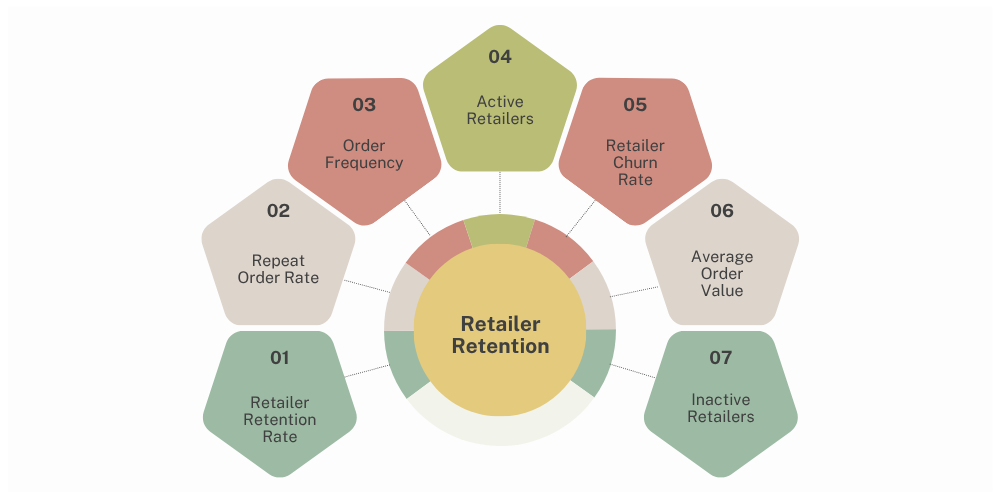
Repeat Order Rate
This shows how many retailers continue placing orders after their initial purchase. A declining repeat order rate can indicate problems with availability, service, product demand, or retailer engagement.
Order Frequency
Track how often active retailers place orders. If the normal ordering cycle changes significantly, the sales team should investigate why.
Active Retailer Rate
This measures the proportion of outlets that are currently ordering or actively purchasing. It helps managers distinguish between a large retailer database and a genuinely active distribution network.
Retailer Churn Rate
Retailer churn rate indicates the proportion of retailers that become inactive during a defined period. Tracking churn over time can help managers determine whether retention is improving or getting worse.
Average Order Value
A retailer may still be ordering while gradually reducing its purchase value. Monitoring average order value alongside order frequency can reveal changes that an active/inactive report may miss.
Outlet Visit Frequency
Regular visits help maintain relationships and create opportunities to identify issues. Comparing planned visits with completed visits can highlight coverage gaps that may eventually affect retailer activity.
How Can Field Sales Data Help Improve Retailer Retention?
Field sales data connects what happens inside the market with what managers see from the office.
Instead of waiting for monthly sales numbers, managers can review daily activity such as retailer visits, orders booked, missed outlets, and changes in outlet activity.
For example, imagine a territory where 20 retailers have not placed an order recently. A manager can look at visit data and discover that several of those outlets have also missed their planned sales visits.
Instead of assuming the retailers are no longer interested, the manager can ask the sales representative to revisit them and understand what is happening.
This is one of the most practical uses of field sales reporting. It helps managers identify gaps in market execution that may otherwise remain hidden.
With the right system, managers can also compare sales visits, orders, outlet coverage, and retailer activity across territories and representatives.
The goal is not simply to collect more data. The goal is to use it to decide where a sales team needs to act.
How Can Technology Help FMCG Brands Build Stronger Retailer Relationships?
Technology can make retention efforts easier when it supports the actual work sales teams perform in the market.
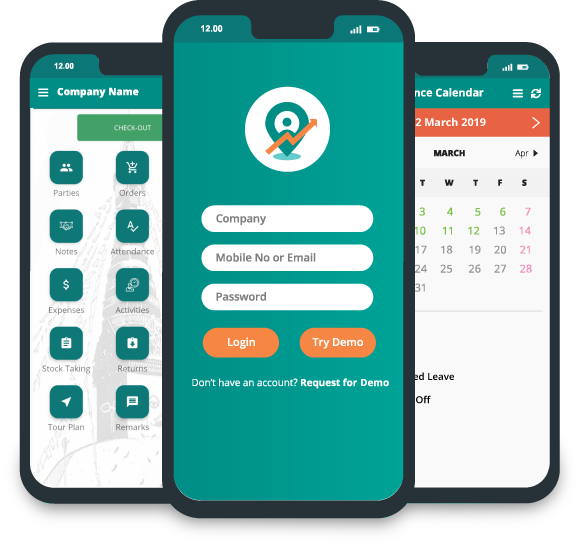
A field sales management app can help companies maintain an organized retailer database, track visits, capture orders, monitor outlet coverage, and review daily sales activity.
For FMCG managers, this creates better visibility into what is happening at the outlet level.
A sales representative can visit a retailer, record the order from the market, update relevant information, and move to the next outlet. Managers can then review activity without depending entirely on end-of-day messages, spreadsheets, or manually prepared reports.

GPS tracking can also help managers understand whether planned outlets are being covered consistently.
For companies managing large field teams, this visibility can make it easier to identify missed visits, inactive outlets, order gaps, and territories that need attention.
Delta Sales App is designed for this type of field-sales operation. It helps businesses track salesman visits with GPS, capture orders from the market, manage outlet information, monitor coverage, and review sales-team activity.
The technology itself does not retain a retailer. The value comes from helping sales teams visit consistently, capture orders accurately, spot problems earlier, and act on what is happening in the market.
Final Thoughts
Keeping retailers active is not about making one big change. It comes down to getting the everyday details right, regular sales visits, reliable product availability, accurate order booking, timely follow-ups, and quick support when a retailer has a problem.
FMCG managers should also look beyond overall sales numbers. A retailer who is ordering less often, reducing order value, or missing regular sales visits may be showing early signs of disengagement. Finding these changes early gives the sales team an opportunity to step in before the outlet becomes inactive.
Better retailer engagement, consistent outlet coverage, and accurate field-sales information can help FMCG brands understand what is happening across their market and take action where it matters most.
If your sales team still depends on manual reports to track market visits, retailer orders, and outlet coverage, it may be difficult to spot these issues in time. Delta Sales App gives managers better visibility into field activity with GPS visit tracking, mobile order capture, outlet management, and daily sales reports.
Want better visibility into what your sales team is doing in the market?
Book a demo of Delta Sales App and see how it can help your team manage field sales more effectively.