
What Is Sales Coverage and How Can Companies Measure It?
Having a large sales team does not automatically mean a company has strong market coverage. A business may have dozens or even hundreds of sales representatives, yet still leave important retailers, customers, or territories unattended. This is where sales coverage becomes important.
Sales coverage refers to how effectively a sales team reaches and serves its target customers, outlets, territories, or markets. It helps businesses understand whether their sales representatives are visiting the right customers, covering planned territories, and maintaining the required visit frequency.
For companies that depend on field sales, measuring coverage is especially important. Sales representatives spend their working days visiting retailers, distributors, dealers, and other customers. Without proper monitoring, managers may not know whether planned visits are actually happening or whether some areas are being overlooked.
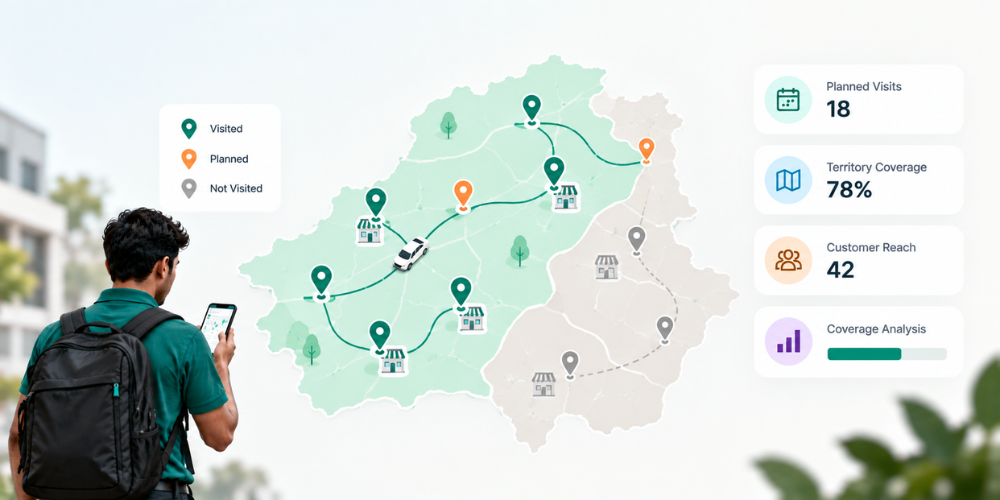
By tracking field sales coverage, businesses can identify coverage gaps, improve sales routes, prioritize important customers, and make better use of their sales resources.
What Is Sales Coverage?
Sales coverage is the measurement of how effectively a company's sales force reaches its target customers or market opportunities within a defined territory and period.
In simple terms, answers a basic question:
Are your sales representatives reaching the customers and outlets they are expected to cover?
For example, suppose a company has 1,000 retail outlets in a particular territory and its sales representatives visit only 700 of them during a month. The company has achieved 70% outlet coverage for that period.
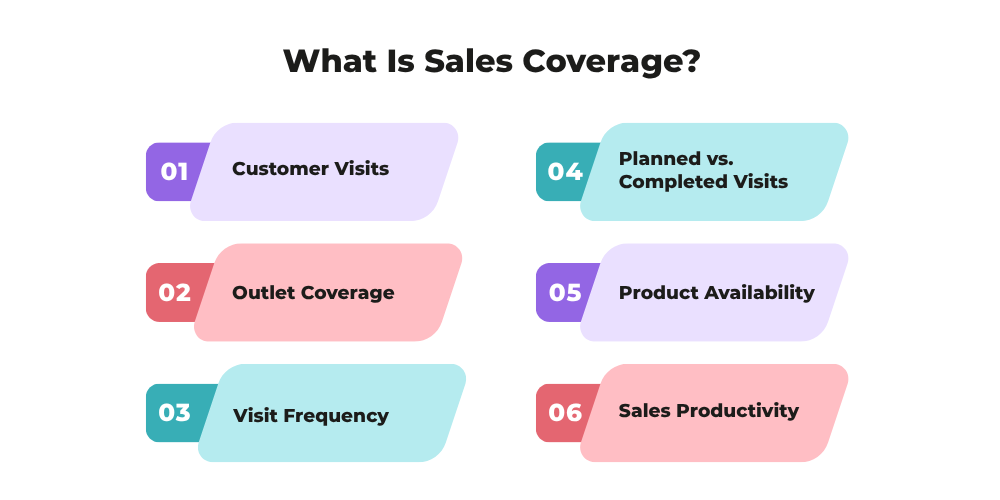
Sales coverage can be measured across several dimensions, including:
-
Number of customers visited
-
Number of retail outlets covered
-
Territory coverage
-
Visit frequency
-
Planned versus completed visits
-
Product availability across outlets
-
Sales representative productivity
For businesses operating through distributors and retailers, outlet coverage is often one of the most useful measures because it shows how extensively the sales team is reaching the market.
Sales coverage is not simply about visiting as many customers as possible. Quality and consistency also matter. A sales representative who visits 30 low-priority outlets may not create as much value as one who effectively serves 15 high-potential customers.
Therefore, companies should measure coverage alongside customer value, visit frequency, sales performance, and territory priorities.
Why Is Sales Coverage Important for Businesses?
Strong sales coverage helps businesses maintain a consistent presence in the market. When customers receive regular visits and support, companies have more opportunities to take orders, identify demand changes, resolve issues, and strengthen relationships. For field-based organizations, effective territory management also helps distribute sales resources more efficiently. Managers can identify territories that are over-served, under-served, or receiving inconsistent attention.
Sales coverage can help businesses:
-
Identify missed customers and outlets
-
Improve market reach
-
Increase sales opportunities
-
Reduce unnecessary travel
-
Improve sales representative productivity
-
Maintain consistent customer visits
-
Strengthen retailer relationships
-
Improve territory planning
-
Identify underserved markets
-
Support better resource allocation
Consider a distributor with sales representatives covering five different territories. If one representative consistently visits 90% of assigned outlets while another reaches only 55%, management needs to understand why. The problem could be poor route planning, excessive travel time, an unrealistic workload, territory imbalance, or weak execution. Without coverage data, these issues can remain hidden. With the right sales performance tracking, managers can compare coverage across representatives and territories and take corrective action based on actual field activity.
What Are the Different Types of Sales Coverage?
Sales coverage can mean different things depending on the company's business model. For field sales organizations, four common types are particularly useful.
Geographic Sales Coverage
Geographic sales coverage measures how effectively sales representatives cover assigned geographic areas. A territory may include a city, district, region, route, or group of locations. Managers need to ensure that each assigned area receives adequate sales attention. For example, a company may divide a city into four territories and assign one representative to each. Geographic coverage helps management determine whether representatives are consistently visiting customers within their assigned areas. This becomes particularly important when companies expand into new markets or redistribute sales territories.
Customer or Outlet Coverage
Customer coverage measures how many target customers or outlets are being visited within a specific period.
For example:
-
500 assigned outlets
-
425 outlets visited
-
85% customer coverage
This metric provides a straightforward view of market reach. For FMCG, consumer goods, pharmaceutical distribution, and other retail-driven businesses, tracking retail execution alongside outlet coverage can provide even more useful information. A visit should ideally result in meaningful execution, such as order collection, product availability checks, merchandising, or retailer interaction.
Product Coverage
Product coverage focuses on the availability and presence of products across target outlets. A company may have excellent customer coverage but poor product coverage if important SKUs are missing from stores. For example, a sales representative may visit an outlet every week, but if several important products are consistently unavailable, the company may still be losing sales opportunities. Tracking product coverage helps businesses identify distribution gaps, stock issues, and opportunities to improve product availability.
Sales Representative Coverage
Sales representative coverage measures how effectively individual salespeople complete their assigned visits and territories.
Managers can compare:
-
Planned visits
-
Completed visits
-
Missed visits
-
Visit frequency
-
Productive visits
-
Orders generated
-
Customer coverage
This gives managers a clearer understanding of individual and team execution.
How to Measure Sales Coverage
Measuring sales coverage starts with defining the customers, outlets, territories, and visit frequencies that the sales team is expected to manage. Once these targets are established, companies can compare planned coverage with actual field activity.
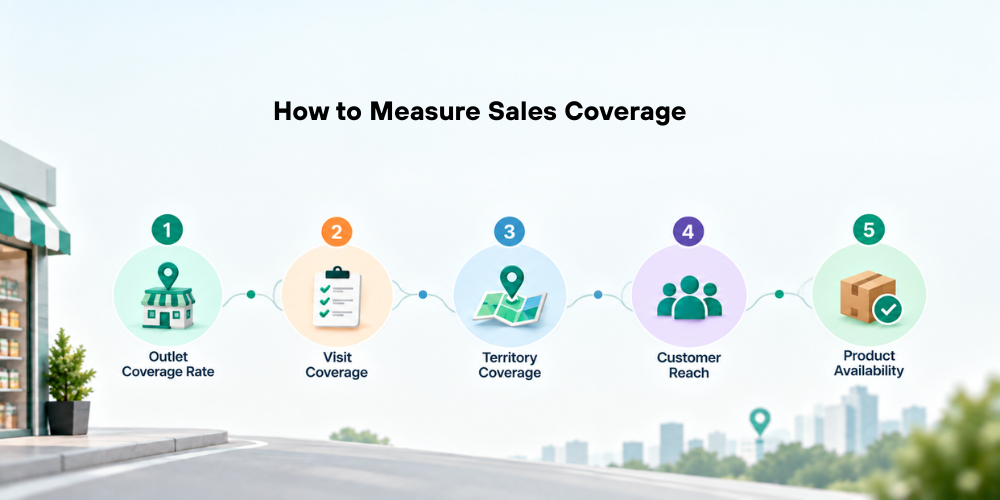
Outlet Coverage Rate
One of the simplest ways to measure coverage is the outlet coverage rate.
Formula:
Outlet Coverage Rate = Number of Outlets Visited ÷ Total Assigned Outlets × 100
For example:
- Total assigned outlets = 1,000
- Outlets visited = 800
Coverage Rate = 800 ÷ 1,000 × 100 = 80%
An 80% coverage rate means the sales team reached 80% of its assigned outlets during the measurement period. However, managers should avoid assuming that a higher percentage is always better. Coverage targets should reflect outlet importance, territory size, visit frequency, and sales objectives.
Visit Coverage
Visit coverage measures whether sales representatives are completing the visits planned for a particular period.
Formula:
Visit Coverage = Completed Visits ÷ Planned Visits × 100
For example:
- Planned visits = 400
- Completed visits = 360
Visit Coverage = 360 ÷ 400 × 100 = 90%
This metric helps managers identify execution gaps. If a representative consistently completes only 60-70% of planned visits, management can investigate the reason rather than simply assuming poor performance.
Territory Coverage
Territory coverage shows how effectively assigned geographic areas are being served.
Businesses can compare coverage across:
-
Cities
-
Districts
-
Sales territories
-
Routes
-
Distributor areas
-
Sales representatives
This can reveal areas where customers are not receiving adequate sales attention.
Customer Reach
Customer reach measures how many unique customers a sales team interacts with during a specific period. This is useful when companies have large customer databases and need to understand whether salespeople are reaching enough of their target market. Customer reach can also be segmented by customer type, location, sales potential, or purchase frequency.
Product Availability
For distribution-driven businesses, product availability is another important indicator of effective market coverage. A sales team may visit an outlet regularly, but the business should also determine whether the required products are actually available.
Tracking product availability can reveal:
-
Stockouts
-
Distribution gaps
-
Slow replenishment
-
Missing SKUs
-
Regional demand differences
Combining coverage information with sales territory planning helps companies understand not only where sales representatives are working but also whether their coverage is supporting product availability and sales objectives.
What Is a Good Sales Coverage Rate?
There is no universal sales coverage rate that is considered good for every business. The right benchmark depends on how many customers a sales representative manages, how frequently they need to be visited, and how widely the business operates.
The right target depends on factors such as:
-
Number of customers or outlets
-
Territory size and geographic spread
-
Customer value and priority
-
Required visit frequency
-
Number of sales representatives
-
Industry and sales model
-
Travel time between locations
-
Product category and demand
For example, a business selling fast-moving consumer products may require frequent visits to a large number of retail outlets. A B2B company with fewer high-value customers may need fewer visits but deeper customer engagement. Instead of setting an arbitrary target, businesses should establish coverage benchmarks based on historical performance and commercial objectives. The important point is to create measurable targets and review them regularly.
Common Sales Coverage Challenges
Many businesses struggle to maintain consistent sales coverage because field teams operate across large territories and changing market conditions.
Poor Route Planning
Inefficient routes make sales representatives spend excessive time traveling between customers, reducing productive selling hours and limiting the number of outlets they can cover.
Uneven Territory Allocation
When territories are not distributed properly, some representatives manage too many outlets while others have lighter workloads, creating uneven coverage and productivity.
Missed Customer Visits
Planned visits may be skipped or postponed because of workload, travel issues, or poor scheduling, leaving important customers and outlets without regular attention.
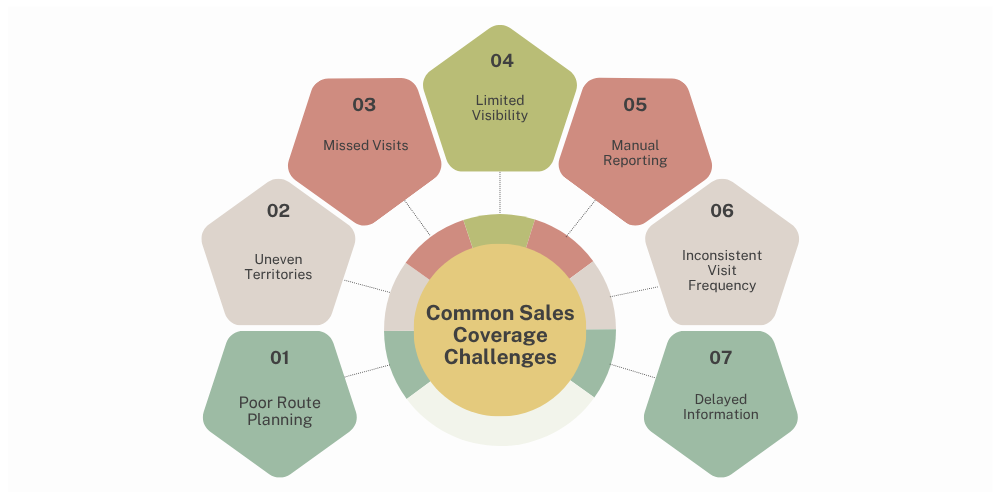
Limited Field Visibility
Managers may struggle to know where representatives are working, which customers they have visited, and whether planned field activities are being completed as expected.
Manual Reporting
Paper reports, spreadsheets, and messaging apps can scatter sales visit information across multiple sources, making it difficult to consolidate, compare, and analyze coverage data.
Inconsistent Visit Frequency
Without clear visit schedules, some high-value customers may receive frequent attention while other important outlets are visited less often, creating uneven market coverage.
Lack of Real-Time Information
Delayed field reports prevent managers from identifying coverage gaps quickly, making it harder to adjust routes, reassign visits, or take timely corrective action.
How to Improve Sales Coverage
Improving coverage does not necessarily mean asking sales representatives to complete more visits. The goal should be to make existing field resources more productive.
Prioritize High-Value Customers
Not every customer requires the same level of attention. Businesses can classify customers according to:
-
Sales volume
-
Purchase frequency
-
Growth potential
-
Strategic importance
-
Location
-
Product requirements
High-value customers can receive more frequent visits, while lower-priority accounts can follow a different visit schedule.
Create Efficient Sales Routes
Good route planning can reduce unnecessary travel and help representatives complete more productive visits within their working hours. Businesses should consider customer locations, traffic conditions, visit priorities, and required visit frequency when designing routes.
Set Clear Visit Objectives
Every customer visit should have a purpose. Depending on the business, the objective could be:
-
Taking an order
-
Checking stock
-
Collecting payment
-
Reviewing merchandising
-
Introducing a new product
-
Resolving a customer issue
Clear objectives make field visits more productive.
Monitor Planned vs. Actual Visits
Managers should regularly compare planned visits with actual visits.
This helps identify:
-
Missed visits
-
Delayed visits
-
Over-served customers
-
Under-served territories
-
Productivity issues
Review Coverage Regularly
Coverage should not be measured only at the end of the month. Weekly or daily monitoring allows managers to identify problems earlier and adjust plans before they become significant.
How Technology Helps Track Sales Coverage
Manual sales coverage tracking becomes increasingly difficult as the number of customers, outlets, territories, and sales representatives grows. Modern sales tracking software can give businesses a centralized way to monitor field activity and customer coverage. Instead of relying on handwritten reports or spreadsheets, sales representatives can record visits directly from their mobile devices.
Technology can help businesses:
-
Create digital customer and outlet lists
-
Assign territories to sales representatives
-
Plan customer visits
-
Track GPS-based field activity
-
Record completed visits
-
Capture orders
-
Submit visit reports
-
Monitor outlet coverage
-
Analyze territory performance
GPS-Based Route Optimization
GPS technology can help sales managers understand travel patterns and improve route planning. Representatives can receive optimized routes based on their assigned customers, helping reduce unnecessary travel and improve daily productivity.
Real-Time Visit Tracking
Real-time tracking provides managers with greater visibility into field activity. Managers can see which visits have been completed and identify potential coverage gaps before the end of the working day.
Sales Reports and Analytics
A centralized dashboard can bring coverage data together across representatives and territories.
Managers can compare:
-
Planned versus actual visits
-
Outlet coverage
-
Visit frequency
-
Sales activity
-
Territory performance
-
Representative productivity
This makes it easier to move from manual reporting to sales analytics and data-driven decision-making.
How Delta Sales App Helps Businesses Improve Sales Coverage
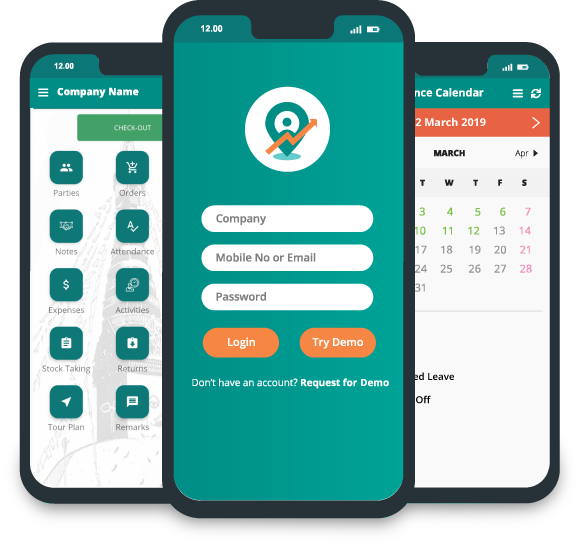
For businesses with sales representatives visiting retailers, distributors, dealers, and customers in the market, maintaining consistent coverage can be challenging. Delta Sales App helps businesses manage and monitor field sales activities from a centralized platform.

Sales managers can use the platform to improve visibility into:
-
Customer and outlet visits
-
Sales representative locations
-
Planned and completed visits
-
Sales activity
-
Orders captured from the field
-
Route and territory performance
-
Daily field reports
With GPS-based tracking, managers can gain better visibility into where sales representatives are working and which outlets they are visiting. The platform also supports route and beat planning, helping businesses organize customer visits more effectively and improve market coverage. Sales representatives can capture orders directly from the field, while managers can review sales activity and reports without waiting for manually prepared updates.
This creates a more connected workflow:
Plan Visits → Visit Outlets → Capture Orders → Track Activity → Analyze Coverage → Improve Execution
For growing distribution and field-sales teams, this approach can make sales coverage easier to measure and manage while giving managers better visibility into day-to-day market operations.
Conclusion
Sales coverage gives businesses a clearer picture of how effectively their sales teams are reaching the market. By measuring outlet coverage, customer visits, territory coverage, visit frequency, and product availability, companies can identify gaps and improve field execution. The key is not simply to increase the number of visits. Businesses need to ensure that sales representatives are reaching the right customers, at the right frequency, with clear objectives. Digital tools can make this process much easier by providing centralized visibility into visits, routes, outlets, orders, and sales activity.
Want to improve visibility across your field sales team?
Book a free demo of Delta Sales App and see how it can help your business track visits, manage outlet coverage, and monitor sales activity.