
Why Are Sales Reps Visiting Outlets but Not Generating Orders?

The outlet was visited. The retailer was there. The conversation happened. So where did the order go? That question turns out to be surprisingly hard for sales managers to answer when field activity gets tracked mainly through visit counts, not through what actually happened once the rep walked in.
A rep can spend hours traveling between stores, meeting retailers, presenting products, checking requirements, and completing every visit on the schedule, and the order count at the end of the day tells a completely different story. When that keeps happening, sending reps to visit even more outlets isn't going to fix it by itself.
The real cause could be sitting anywhere in the sales process. Reps might be visiting outlets with no clear objective, following an inefficient route, working off stale stock information, losing too much time to manual reporting, or just not following up on orders that were sitting right there. Sometimes it's not the rep at all; it's that managers simply don't have the data to see what's actually happening in the field.
A productive outlet visit should do more than add one more tick to a daily activity report. It should surface real demand, understand what the retailer actually needs, recommend the right products, and create an actual path toward an order.
So why are reps visiting outlets without generating orders? This blog looks at the key reasons behind unproductive visits, how that visit-to-order gap hits revenue, forecasting, and field sales ROI, and what businesses can do to close it.
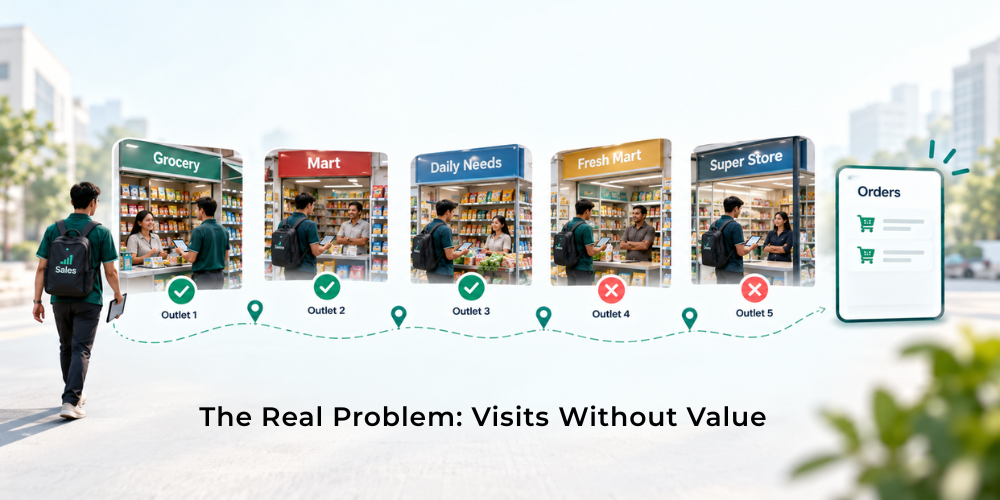
The Real Problem: Visits Without Value
A high visit count can look impressive on a daily report. But if those visits rarely result in orders, collections, new product placements, or meaningful retailer engagement, the number alone tells managers very little. This is where businesses need to look beyond activity volume and understand the quality of field execution.
What "Unproductive Visits" Actually Means
An unproductive visit isn't necessarily one where no order got placed. Sometimes a retailer genuinely doesn't need stock that day. Other times the outlet's sitting on excess inventory, demand's just weak right now, or there's some temporary business issue going on. The real concern is when zero-order visits turn into a repeated pattern with no clear reason and no follow-up action attached to it. If a rep keeps visiting the same outlet without generating an order, managers should be able to figure out:
-
Did the outlet have enough stock on hand?
-
Were the appropriate products showcased?
-
Was the retailer present and engaged?
-
Did the representative adhere to the planned route?
-
Was there a meaningful sales dialogue?
-
Was a follow-up conversation arranged?
-
Are comparable outlets achieving better results?
Without this context, a visit report merely indicates that someone visited.
The Visit-to-Order Ratio Every Sales Manager Should Track
The visit-to-order ratio helps managers understand how effectively outlet visits are converting into orders. A simple calculation is
Visit-to-Order Ratio = Number of Visits Resulting in Orders ÷ Total Productive Visits × 100
For example, if a representative makes 40 eligible outlet visits and receives orders from 18 outlets, the conversion rate is 45%. This metric isn't a one-size-fits-all standard, as conversion rates differ across various industries, product types, regions, store formats, and how often customers visit. Instead, managers should look at the ratio in relation to:
-
Individual sales representatives
-
Different territories
-
Types of outlets
-
Categories of products
-
Various time frames
Noticing a sudden decline can highlight an issue that merely counting visits might overlook.
Common Reasons Sales Reps Aren't Converting Visits Into Orders
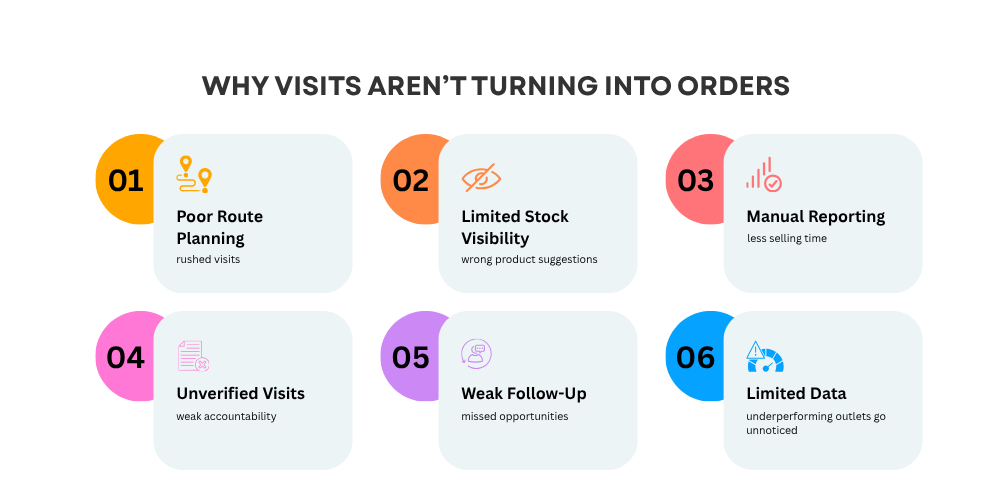
Visiting an outlet is only one part of the sales process. What happens before, during, and after that visit is what determines whether it actually turns into anything. Inefficient routes, limited stock visibility, weak follow-ups, and too much time lost to paperwork- any of these operational issues can stop a genuine sales opportunity from ever becoming an order.
No Structured Beat Plan or Route
When reps decide where to go based on habit, convenience, or whatever instruction came in last minute, real selling time slips away. Structured beat planning assigns outlets by territory, priority, visit frequency, and business potential instead. Skip that and reps end up burning too much time in transit while high-value customers get inconsistent coverage. Poor route planning also causes rushed visits. A rep who's running late or has too many stops left on the list starts focusing on just checking off the visit instead of actually creating a sales opportunity. What you end up with is activity without enough real selling time behind it.
Lack of Real-Time Stock and Order Visibility
Picture a sales representative visiting a store and suggesting a product that the retailer already has too much of or, even worse, recommending something that isn’t in stock at all. Without up-to-the-minute visibility into inventory, these reps might engage in conversations without a clear understanding of what can actually be ordered. This situation can result in:
-
Misguided product suggestions
-
Lost chances for restocking
-
Delays in order fulfillment
-
Objections related to stock issues
-
Erosion of retailer trust
By providing representatives with access to the latest product and order details, their discussions with retailers can become much more meaningful and impactful.
Reps Spending Time on Manual Reporting Instead of Selling
Every minute spent filling out spreadsheets, writing up handwritten reports, calling in updates, or entering the same information twice is time stolen straight from selling. Manual processes also mean delayed information, and by the time a manager finally sees the report, the chance to act on a missed order has usually already passed. Automated reporting cuts out that repetitive admin work and gets managers faster access to what's actually happening in the field. The goal is simple: reps spend more time with retailers and less time writing up what they already did.

No Accountability or Visit Verification
A visit recorded on paper doesn't tell a manager much about whether the rep actually reached the outlet, how long they were there, or what actually happened during that time. That's where outlet visit tracking earns its place. With location and time data, managers can line up planned visits against what actually happened and catch missed outlets, suspiciously short visits, outlets with repeated zero-order visits, and gaps between the planned route and the real one. The point was never just watching employees. It's understanding whether field activity is producing the outcome it's supposed to.
Poor Retailer Relationship or Follow-Up
Not every order lands on the first conversation. A retailer might ask for time to check existing stock, weigh the pricing, evaluate a new SKU, or just wait for a particular selling cycle to come around. If the rep never follows up, that opportunity quietly evaporates. Real retailer relationship management means knowing purchase patterns, previous orders, product preferences, outstanding issues, and what follow-up is actually owed. When a rep can see all of that, every visit builds on the last conversation instead of starting from zero every single time.
Absence of Data to Identify Underperforming Outlets
Certain outlets consistently thrive with strong sales, while others hold great promise yet remain dormant. Some may not be ideal for regular visits. Without detailed outlet-level insights, recognizing these variations becomes a challenge. Managers need to understand:
-
Which outlets are actively placing orders
-
Which outlets have ceased ordering
-
Which outlets are visited but yield no orders
-
Which products excel in each region
-
Which representatives achieve higher conversion rates
-
Which customers require follow-up
This knowledge empowers managers to direct their field efforts where they can make the most impact.
How This Impacts Business Growth
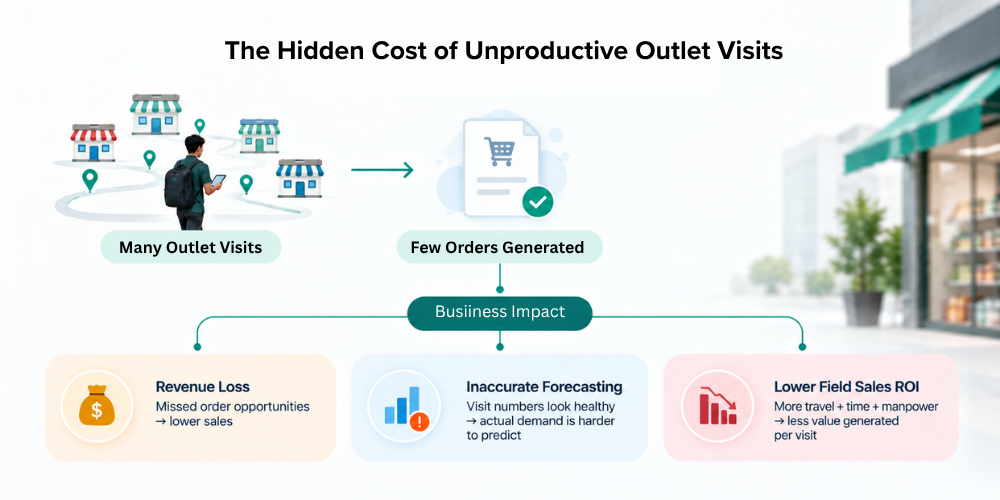
Outlet visits that consistently fail to generate orders are more than a field-team performance issue. When productive opportunities are missed repeatedly, the impact can spread across revenue, sales forecasting, and the overall return on field sales investment. Over time, a gap between field activity and actual sales can make it harder for managers to understand where growth is being lost and what needs to change.
Revenue Loss From Missed Order Opportunities
Not every unsuccessful visit is lost revenue, exactly. But when the same pattern keeps showing up without anyone investigating it, real opportunities go missed that could've been converted. A retailer might get visited over and over and never once get a relevant product recommendation, a timely replenishment suggestion, or a real follow-up. Across hundreds or thousands of outlets, those small missed opportunities pile up into a genuinely significant sales gap.
Distorted Sales Forecasting
Sales forecasts rely heavily on trustworthy insights from the field. When managers observe a high volume of visits but struggle to differentiate between effective and ineffective interactions, they risk misjudging market demand or downplaying potential sales challenges. This misunderstanding can have significant implications:
-
Planning inventory effectively
-
Meeting distributor needs
-
Making informed production choices
-
Setting realistic territory goals
-
Accurately forecasting sales
-
Allocating resources wisely
By gaining a clearer picture of field activities, businesses can transform their sales data into a more powerful tool for decision-making.
Low ROI on Field Sales Investment
Field teams involve salaries, travel costs, incentives, communication expenses, management time, and other operational investments. If representatives spend a large portion of their working day travelling, reporting, or making low-value visits, the business may not be getting enough return from that investment. The goal is therefore not simply to increase the number of outlet visits. It is to increase the business value generated by each relevant visit.
How to Fix the Visit-to-Order Gap
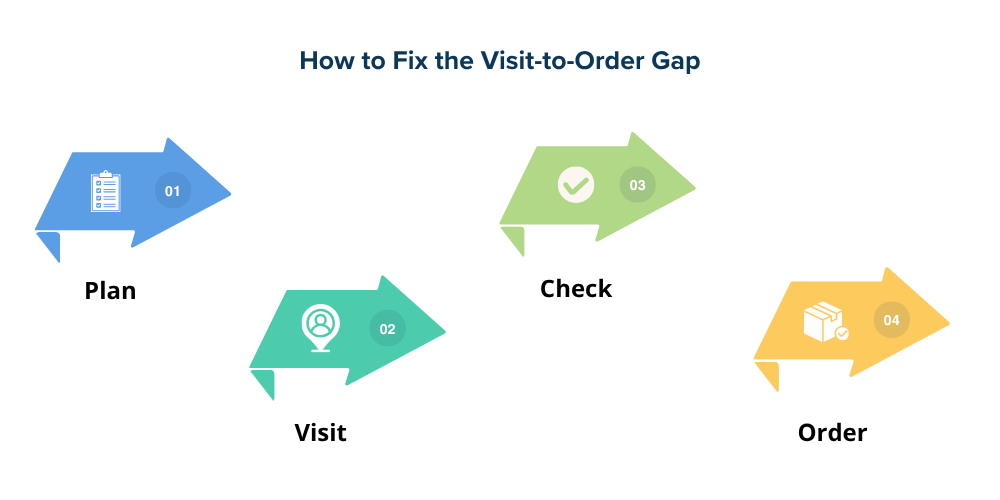
Closing the visit-to-order gap starts with understanding that more visits do not automatically mean more sales. Sales teams need the right information, clear objectives, and simple processes to make each outlet interaction more productive. By improving how visits are planned, verified, managed, and converted into orders, businesses can help sales reps spend less time on administrative work and more time creating actual sales opportunities.
Track Visits with GPS and Time-Stamped Check-ins
A reliable GPS-based tracking system lets managers actually verify where reps are working and when they reach an assigned outlet. Time-stamped check-ins add real context around field activity, letting managers compare planned routes against actual movement and spot the unusual gaps. That builds a genuinely reliable record of market coverage, and it's what surfaces the operational problems quietly dragging productivity down.
Automate Order Booking During the Visit Itself
Capturing an order at the moment of the sales conversation is often the most effective approach, rather than waiting for hours afterward. With digital order booking, sales representatives can easily choose products, quantities, and important customer details right during their visit to the outlet. This streamlined process helps to minimize:
-
Redundant data entry
-
Delayed order processing
-
Errors from manual input
-
Miscommunication
-
Missing order information
Additionally, it provides managers with quicker insights into incoming sales, enhancing overall efficiency.
Use Real-Time Dashboards to Monitor Rep Performance
Managers shouldn't have to wait until the end of the day to find out a territory keeps generating zero-order visits. A sales performance dashboard brings visits, orders, sales value, outlet coverage, and rep activity together in one place, so patterns show up early enough to actually correct.
If one rep has high visit numbers but noticeably lower order conversion than everyone else, a manager can dig into the actual reason instead of just telling that rep to visit more.
Set Clear KPIs Beyond Just "Number of Visits"
Visit volume is useful, but it shouldn't be the only measure of field productivity a business tracks. Worth watching alongside it: visit-to-order conversion, sales value per visit, productive outlet percentage, average order value, outlet coverage, new outlet orders, repeat orders, follow-up completion, and how often zero-order visits show up. Together, those give a far clearer picture of whether field activity is actually contributing to revenue.
How Delta Sales App Solves This Problem
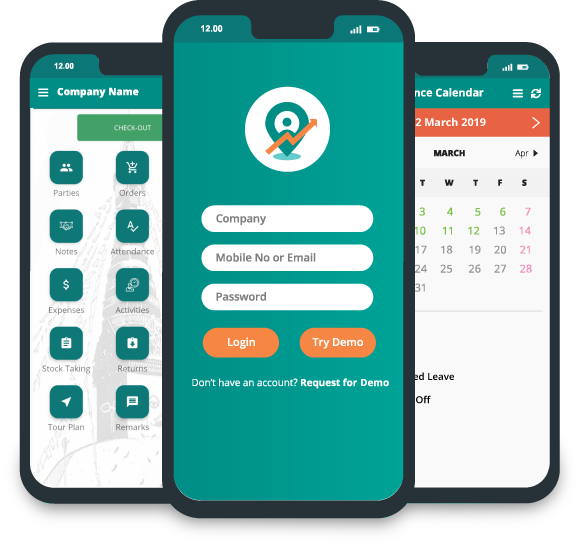
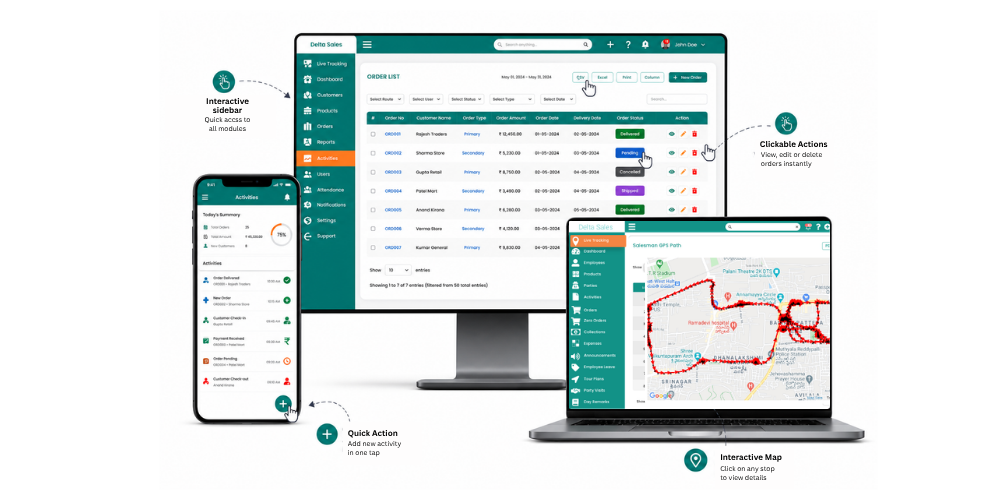
When the gap between visits and orders gets too hard to manage by hand, a connected field sales system pulls the important pieces together. Delta Sales App combines field activity, customer information, order management, route planning, and performance visibility, so managers can see not just where reps are going, but what's actually happening once they get there.
-
Real-Time Order Booking at the Outlet
Reps can capture customer orders straight from the field instead of relying on paper notes or entry that happens hours later. Order collection becomes part of the outlet visit itself, which shrinks the gap between the sales conversation and the order actually getting processed.
-
GPS-Verified Visit Tracking
Delta Sales App uses GPS-based tracking so managers can monitor field movement and verify visits actually happened. That gives real visibility into outlet coverage and lets managers compare the planned route against what actually happened out in the market.
-
Automated Reports Replacing Manual Paperwork
Instead of relying entirely on manually prepared updates, field information gets captured digitally through the app. That cuts down repetitive reporting work and gives managers faster access to visits, orders, attendance, and everything else happening in the field.
-
Performance Dashboards for Sales Managers
Managers need more than a list of completed visits. They need to actually understand sales activity and see where performance is shifting. Delta Sales App provides reporting and analytics around field activity, orders, sales team performance, and customer activity, so managers can spot the gaps and make decisions based on something real.
Conclusion
A full day in the market doesn't automatically mean a productive one. If reps are visiting outlets and orders still aren't moving, telling them to "visit more customers" is rarely the actual answer. Managers need to know which outlets are being visited, what's happening during those visits, why orders are getting missed, and which reps or territories actually need attention.
The real shift is from measuring activity to measuring outcomes. With structured routes, verified visits, accessible customer and stock information, faster order capture, and clear performance metrics, field visits start turning into real sales opportunities instead of just entries on a list. If your team's working hard in the field and the orders still aren't showing it, that's worth a closer look at the visit-to-order gap specifically.
Book a free demo of Delta Sales App and see how your team can turn more outlet visits into measurable sales opportunities.